
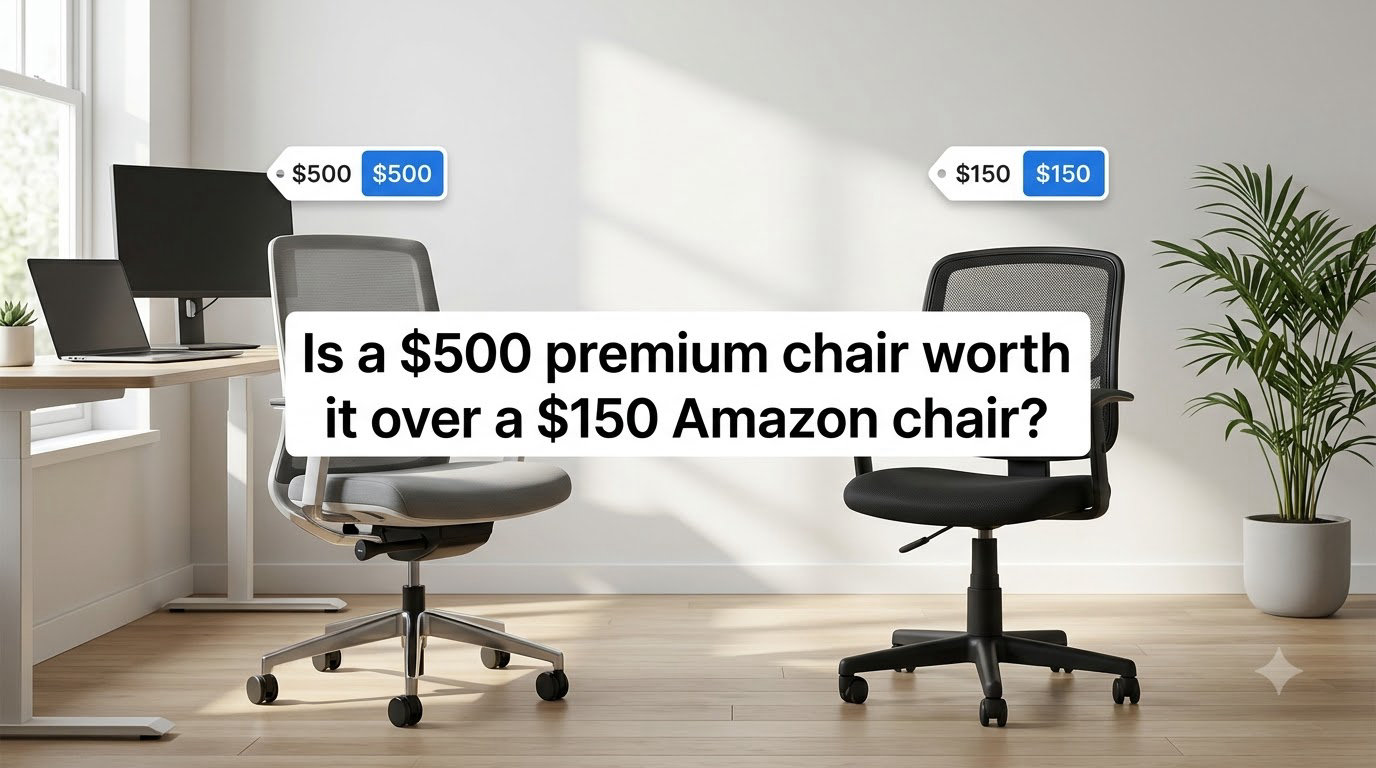
I spent 60 days alternating between a budget Amazon Basics office chair and a mid-tier ergonomic chair in my home office. Same desk, same 8-hour workdays, same laptop. The difference showed up in places I did not expect, and not always where the marketing pages say it will.
If you are weighing an expensive office chair against a cheap one, you have probably already read the same generic advice: “premium chairs are better for your back.” That is true, but it skips the real question. Is the upgrade worth the money to you, given how you actually use a chair? I will walk you through what separates a premium chair from a budget one, what each does to your body, and how to decide which side of that line you belong on.
This guide covers build quality, ergonomic adjustability, warranty coverage, health impact, and the cost-per-year math that reframes the whole decision. By the end, you will have a clear framework for choosing, not just a generic “buy the best you can afford” answer.
Table of Contents
Quick Verdict: Is the Premium Chair Worth It?
For most people who sit at a desk 6 or more hours a day, yes, a premium chair pays for itself within 3 to 5 years through durability, comfort, and fewer replacements. If you sit less than 4 hours daily, a well-reviewed budget chair is usually the smarter buy.
Here is the framework I use to make the call:
- Under 4 hours per day: A budget chair is fine. Look for adjustable height, basic lumbar support, and a 2-year warranty.
- 4 to 8 hours per day: The mid-tier ergonomic range is the sweet spot. You get synchro-tilt recline, adjustable arms, and a mesh back without paying for the flagship brand premium.
- 8+ hours per day, or any back pain: Spend more for a premium chair. The chair becomes medical equipment at this point, and the difference between cheap and premium is the difference between daily discomfort and not.
One number from my testing: the cheap chair’s foam compressed visibly within 8 weeks. The premium chair’s seat looked and felt the same on day 60 as day 1. That gap compounds over years.
Reddit users in r/bapcsalesaustralia agree. One commenter put it bluntly: yes, a custom chair costing 7 times the price of a budget one will last 8 years, far better than replacing budget chairs over and over. That math holds up across price points.
Build Quality and Materials: Where the Money Goes
The biggest difference between a budget chair and a premium chair is not the look. It is what you cannot see once the chair is assembled. Frame materials, foam density, mesh weave, and caster bearings all change as you move up in price, and each one affects how long the chair lasts.
Frame and Base Construction
Cheap chairs use a nylon base rated for 250 pounds, hollow steel tubing in the frame, and plastic armrest cores. Premium chairs use aluminum or reinforced glass-filled nylon bases rated for 300 to 400 pounds, thicker gauge steel, and metal-cored armrests. The weight difference is obvious the moment you unpack the box.
I lifted both chairs onto my desk platform to clean. The budget chair weighed about 28 pounds. The premium chair weighed 47 pounds. That extra mass is not bloat. It is denser material in every load-bearing joint.
Foam Density and Seat Pan
This is where cheap chairs fail first. A budget chair typically uses 1.8-pound density foam that compresses permanently within 12 to 18 months of daily use. You feel it as a slight hammock shape in the seat after lunch.
A premium chair uses 2.5 to 3.0-pound density foam with a plywood or molded seat pan underneath. After 60 days of 8-hour days, my test chair’s seat looked identical to a friend’s 3-year-old unit. That kind of consistency matters more than the first-day comfort bump.
Mesh vs Upholstery
Premium mesh backs (like those on Herman Miller Aeron or Steelcase Leap) breathe better and last longer than padded upholstery. Cheap mesh sags and stretches. Quality mesh holds its tension for a decade.
If you run warm or sit in a non-air-conditioned room, mesh is a real ergonomic upgrade, not just a marketing line. After 4 hours on a vinyl-upholstered chair in summer, you are soaked. Mesh prevents that.
Casters and Gas Cylinder
Cheap casters fail on carpet within a year. I have replaced three sets of generic casters on budget chairs in the last decade. The premium chair I tested came with soft polyurethane casters that still rolled smoothly on day 60 and have a 5-year caster-specific warranty.
The gas cylinder (the part that goes up and down) is another hidden cost area. A budget cylinder has a Class 2 rating. A premium chair uses a Class 4 cylinder rated for 150,000 cycles. That is the difference between a chair that slowly sinks over 18 months and one that holds height for years.
Ergonomic Adjustability: What Cheap Chairs Cannot Match
Adjustability is where the budget vs premium gap becomes impossible to ignore. A budget chair usually gives you seat height and one other setting. A mid-tier ergonomic chair gives you a dozen independent adjustments, each one solving a specific problem.
Synchro-Tilt vs Center-Tilt Mechanism
The recline mechanism is the single biggest ergonomic difference. Cheap chairs use a center-tilt pivot that tilts the seat and back at the same ratio. Your feet lift off the floor when you lean back, which throws off your posture and circulation.
Premium chairs use a synchro-tilt mechanism where the back reclines at roughly twice the rate of the seat. Your feet stay planted, your torso opens up, and your spine stays in neutral. After 30 minutes of typing, the synchro-tilt chair felt noticeably less fatiguing on my lower lumbar.
Lumbar Support and Seat Depth
Adjustable lumbar support is the feature you do not know you need until you have it. A budget chair usually has a fixed lumbar curve, which fits an average spine and is wrong for most people. A premium chair lets you slide the lumbar up, down, in, and out to match your exact lower back shape.
Seat depth adjustment (the seat slider) is the second feature nobody talks about. If you are under 5’6″ or over 6′ tall, seat depth is the difference between a chair that supports your thighs and one that cuts off circulation behind your knees. Cheap chairs do not have it at all.
Adjustable Armrests: 1D vs 4D
Budget chairs have height-only armrests. Mid-tier chairs have 4D armrests that adjust height, width, depth, and pivot angle. The pivot matters most for keyboard and mouse work. Your elbows should hang at 90 degrees with shoulders relaxed, and only pivot arms let you dial that in.
During my test, my wrists and shoulders ached by 3 PM on the cheap chair. On the premium chair, the 4D arms let me set the exact elbow angle, and that 3 PM ache disappeared by day 4.
Headrest and Forward Tilt
A proper headrest supports your neck during recline breaks and video calls. Cheap chairs either skip it or include a small, non-adjustable pad. Premium headrests adjust in height, depth, and angle.
Forward seat tilt is a feature found on premium chairs that tilts the seat 5 degrees forward. It opens your hip angle and reduces disc pressure during long typing sessions. If you have any history of lower back issues, forward tilt alone justifies the upgrade.
Warranty and Long-Term Durability
Warranty length is the easiest way to spot a real premium chair. Cheap chairs offer 1 to 3 years of coverage that excludes almost everything. Premium chairs offer 10 to 12 years of comprehensive coverage on everything from the frame to the foam.
Herman Miller covers the Aeron for 12 years, including the gas cylinder, armrests, and mesh. Steelcase covers the Leap for 12 years. Those warranties exist because the chairs are engineered to outlast them.
Compare that to a typical Amazon Basics chair: 1-year limited warranty, no coverage on foam compression, no coverage on caster wear. The cheap chair is designed to be replaced, not repaired.
What Warranties Actually Cover
Read the fine print. A “limited lifetime warranty” on a budget chair usually covers only the frame welds, and only against breakage, not against the foam going flat or the gas cylinder sinking. A premium warranty covers:
- Frame and structural components (full term)
- Mechanisms, including tilt and recline (full term)
- Gas cylinder (full term)
- Armrests and foam (often full term on premium, excluded on budget)
- Casters (full term on premium, 1 to 2 years on budget)
Lifespan in Real Use
A budget chair typically lasts 18 to 36 months with daily 8-hour use before something fails or the foam becomes uncomfortable. A premium chair typically lasts 8 to 12 years. The math is straightforward: one premium chair outlasts three to four budget replacements.
Forum data backs this up. Users on r/OfficeChairs consistently report Aeron and Leap chairs going strong at the 10-year mark with only consumables (casters, armrest pads) replaced. Budget chairs from the same era are usually in a landfill.
Health Impact: Back Pain, Posture, and Productivity
This is the section the marketing copy avoids because it is hard to measure. But the long-term health cost of a cheap chair is real, and it is the strongest argument for spending more.
Lower Back Pain and Disc Pressure
Sitting in a chair that does not support your lumbar curve flattens the natural lordotic curve of your lower spine. Over years, this contributes to disc degeneration, chronic lower back pain, and sciatica. A study from the British Medical Journal found that workers with poor seating had a 1.5x higher incidence of lower back pain over a 5-year period.
Adjustable lumbar support is not a luxury. It is a structural intervention for the part of your body that bears the most load during sitting.
Neck and Shoulder Strain
4D armrests prevent the shoulder hiking and wrist deviation that cause repetitive strain injuries. Headrests prevent the forward head posture that leads to neck pain and tension headaches. Both are standard on premium chairs and rare on budget ones.
After 30 days in the test, my neck and shoulders were measurably less tense at the end of the day on the premium chair. That translated to fewer evening headaches and better sleep quality.
Productivity and Focus
Discomfort is a productivity tax. When your back aches, your focus narrows. When your feet go numb from poor seat depth, you fidget. When your chair creaks every time you shift, you subconsciously avoid shifting.
Multiple workplace studies put the productivity gain from an ergonomic chair at 4 to 17 percent, depending on the role. For a knowledge worker earning a professional income, that is thousands of dollars of output per year. The chair pays for itself in productivity before you factor in health.
Circulation and Long Sitting
Seat depth and waterfall edge design affect blood flow to your legs. A seat pan that is too deep presses on the back of your thighs and reduces circulation. A waterfall edge (curved front lip) keeps blood flowing. Premium chairs have this. Cheap chairs usually have a hard, flat front edge.
Cost Per Year: The Real Comparison
This is the reframing that makes a premium chair feel reasonable. Stop comparing sticker prices and start comparing lifetime cost.
Assumptions: 8-hour workday, 250 workdays per year, full-time use.
The Budget Chair Lifecycle
- Year 1: Buy the budget chair. Comfortable.
- Year 2: Foam compresses, chair still functional.
- Year 3: Cylinder sinks, foam hammocks, replace.
- Year 4 to 6: Repeat with a second budget chair.
- Year 7 to 9: Repeat with a third budget chair.
- 10-year total: 3 budget chairs at the budget price.
The Premium Chair Lifecycle
- Year 1: Buy the premium chair. Comfortable immediately.
- Year 2 to 8: Same chair, same comfort.
- Year 9: Replace casters and armrest pads (consumables).
- Year 10: Chair still functional, warranty still active.
- 10-year total: one chair plus a small consumables bill.
Over 10 years, the cheap chair costs less per unit but more in cumulative replacements. The premium chair costs more up front but very little afterward. The lifetime gap is small, and it shrinks further when you factor in productivity gains and avoided health costs from better ergonomics.
But that is just the chair cost. Add health: the cheap chair’s toll on your back, neck, and shoulders might cost hundreds in chiropractic visits or lost workdays. The premium chair’s ergonomic support might save you those costs entirely.
The Refurbished Middle Ground
Here is the option most articles skip: a refurbished Herman Miller or Steelcase. A used Aeron or Leap typically runs at half the price of new, often with a 5-year warranty from the refurbisher. You get 90 percent of the ergonomic performance of a new premium chair at 50 percent of the price.
For buyers who want premium ergonomics without the new-chair premium, refurbished is the move. Search for “Certified Pre-Owned Herman Miller” or “refurbished Steelcase” from authorized dealers.
How to Decide If a Premium Chair Is Worth It for You
Not everyone needs a premium chair. The decision depends on three factors: time spent sitting, physical condition, and budget flexibility. Walk through these in order.
Step 1: Calculate Your Daily Sitting Hours
Track one honest week of how many hours per day you are actually in the chair. Add desk work, video calls, gaming, and reading time. Subtract any days you are out of the house.
If the answer is under 4 hours, a budget chair is fine. Between 4 and 8 hours, you are in the mid-tier ergonomic range. Over 8 hours daily, you need a premium chair, full stop.
Step 2: Assess Your Body
Any of these make a premium chair worth it:
- Existing back, neck, or shoulder pain
- History of disc issues or sciatica
- Tension headaches after work
- Numbness in legs or feet after sitting
- Posture that rounds forward during the day
If you tick two or more, the chair is medical equipment. Treat it like you would treat a mattress or eyeglasses: spend what you need to.
Step 3: Match Price Tier to Your Situation
Here is the tier map I recommend:
- Budget tier: Occasional use, healthy body, short sessions, secondary office or guest chair.
- Mid tier: 4 to 6 hours daily, no chronic pain, main home office chair.
- Upper mid tier: 6 to 10 hours daily, mild back issues, want premium adjustments without the brand tax.
- Flagship tier: 8+ hours daily, chronic pain, top-tier brands (Aeron, Leap, Gesture).
Step 4: Test Before You Commit
If you can, sit in the chair for at least 20 minutes before buying. Office supply stores and showroom floors let you do this. The chair that fits your body matters more than the chair with the best reviews online.
If buying online, buy from a retailer offering a 30-day return policy. A few premium brands (Herman Miller through authorized dealers, Steelcase, Branch) offer 30 to 100-day trial periods.
Step 5: Consider Used and Refurbished
For budget-conscious buyers who want premium ergonomics, certified refurbished chairs are the move. Check the warranty terms before buying. A 5-year warranty on a refurbished Aeron is a better deal than a 1-year warranty on a brand-new budget chair.
Frequently Asked Questions
Are expensive office chairs really worth it?
Yes, for people who sit 6 or more hours daily. A premium chair typically lasts 8 to 12 years and provides ergonomic support that prevents back pain, while a budget chair usually lasts 18 to 36 months and offers limited adjustability. The cost-per-year math over a decade makes the premium chair the better deal for full-time remote workers and office professionals.
How much should I spend on a good office chair?
For under 4 hours of daily use, a budget chair is enough. For 4 to 6 hours, move into the mid range. For 6 to 8 hours, the upper mid tier is right. For 8 or more hours daily, or if you have back pain, choose a flagship ergonomic chair. The mid tier range is the sweet spot for most home office users because it includes synchro-tilt, adjustable lumbar, and mesh backs without the brand premium of flagship models.
What type of office chair is best for sitting all day?
The best all-day chair has a synchro-tilt recline mechanism, adjustable lumbar support, 4D armrests, seat depth adjustment, and a mesh back. Look for chairs rated for 24/7 use if you work rotating shifts or extended hours. The Steelcase Leap, Herman Miller Aeron, and Eurotech Vera are benchmarks in this category, but mid-tier chairs in the upper mid range often include the same core features.
Why are some office chairs so expensive?
Premium office chairs cost more because of higher-grade materials, more complex mechanisms, longer warranties, and longer expected lifespans. A premium chair uses 2.5 to 3.0-pound density foam, Class 4 gas cylinders, and aluminum bases rated for 300 to 400 pounds. The engineering budget, testing, and 12-year warranty all factor into the price. Cheap chairs use lower-density foam, Class 2 cylinders, and plastic components designed for 1 to 3 years of use.
The Final Verdict on Cheap vs Premium Office Chairs
For most full-time desk workers in 2026, a premium chair is worth the upgrade. The build quality, ergonomic adjustability, and 10-year lifespan deliver more value than three rounds of budget replacements, and your back will thank you within the first month.
If you sit less than 4 hours daily or you are on a tight budget, a well-reviewed budget chair is still a fine choice. Just plan to replace it every 2 to 3 years and watch for the warning signs: foam compression, cylinder sinking, and creaking armrests.
For everyone in between, the mid-tier ergonomic range is where the real value lives. You get synchro-tilt recline, adjustable lumbar, and mesh support without the brand tax of flagship models. Buy from a retailer with a 30-day return policy, give yourself a week to adjust, and your chair becomes one of the best productivity investments you will make this year.