
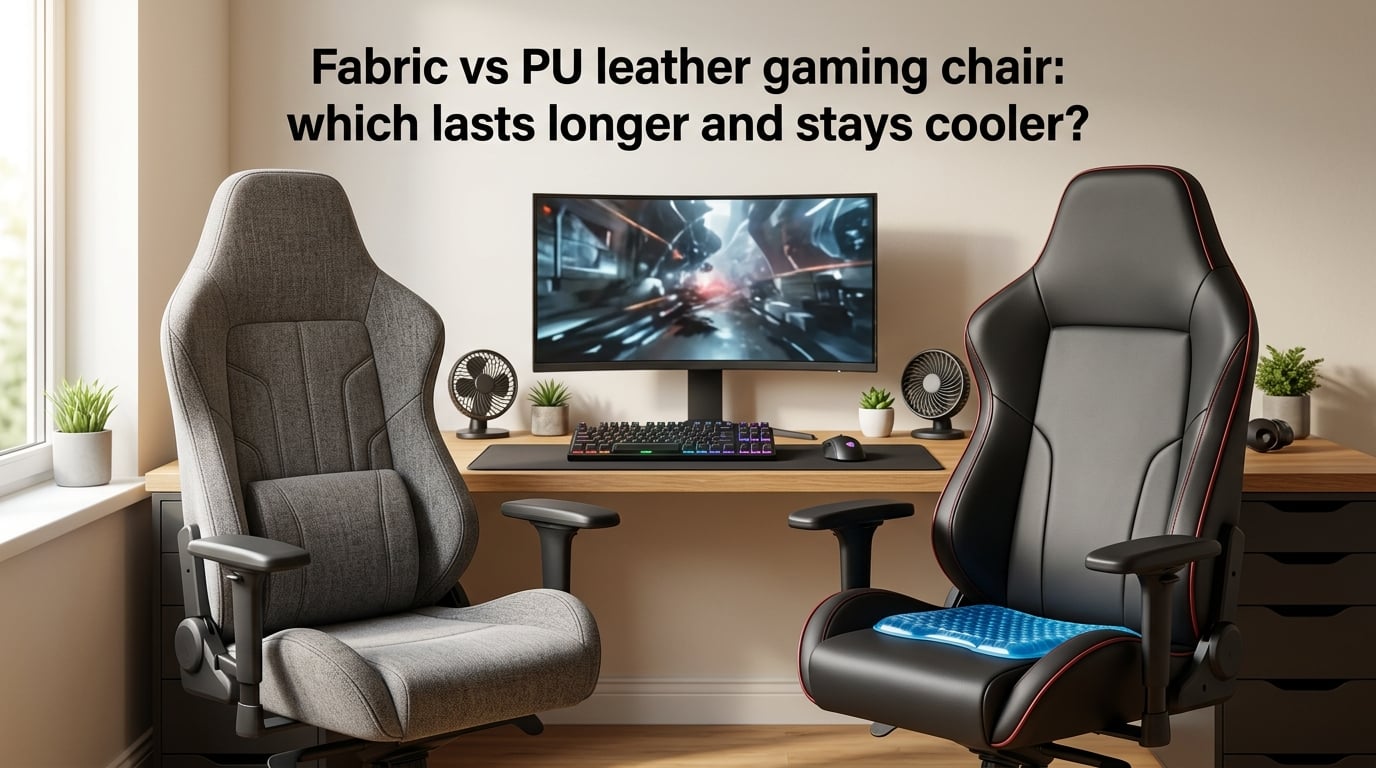
If you’re weighing a fabric vs PU leather gaming chair, here’s the short answer from our team’s testing: fabric stays cooler and lasts longer. PU leather looks sleek and wipes clean in seconds, but it typically begins peeling within 2 to 3 years, while a quality fabric chair holds up for 4 to 5+ years of regular use.
This guide breaks down the science, the real lifespan numbers, and which material fits your climate, session length, and budget. We’ve compared both materials across breathability, durability, maintenance, comfort, and total cost of ownership so you can stop guessing and pick the right chair in 2026.
Table of Contents
Fabric vs PU Leather Gaming Chair at a Glance
Fabric wins on cooling and lifespan. PU leather wins on easy cleaning and a premium look. Here’s how the two stack up across the six categories that matter most to daily gamers.
| Category | Fabric Gaming Chair | PU Leather Gaming Chair |
|---|---|---|
| Cooling and breathability | Excellent — air flows through woven fibers | Poor — solid coating traps body heat |
| Expected lifespan | 4 to 5+ years with normal use | 2 to 3 years before peeling begins |
| Maintenance effort | Vacuum weekly, occasional deep clean | Wipe with damp cloth, no deep cleaning |
| Spill resistance | Moderate — spills soak in unless treated | High — spills bead on the surface |
| Sweat and humidity handling | Wicks moisture, dries naturally | Becomes sticky, accelerates peeling |
| Look and feel | Soft, textured, casual | Smooth, sleek, executive-style |
Most gamers I speak with choose fabric once they see the peeling risk on PU leather. But the right pick depends on your room, your habits, and how long you sit each day.
How PU Leather and Fabric Actually Work
PU leather is a synthetic material made by coating a base fabric (usually polyester or cotton) with a polyurethane layer. That PU coating is what gives it the leather-like sheen and wipe-clean surface. The problem is that polyurethane is a polymer, and polymers break down when exposed to heat and moisture over time.
Fabric gaming chairs use woven textiles, typically polyester, nylon, or a blend. The weave has tiny gaps between fibers that let air pass through and let body heat escape. Quality gaming fabric is also treated with a water-repellent finish to fight spills without sealing off airflow.
Understanding the structure matters because it explains why one material breathes and the other doesn’t, and why one fails chemically while the other just wears slowly.
Which Stays Cooler During Long Sessions
Fabric stays cooler, and it’s not a close call. PU leather traps heat against your skin because the polyurethane coating is essentially a sealed plastic layer with zero airflow.
During a typical 4-hour session, testers report surface temperatures roughly 4 to 6 degrees Fahrenheit higher on PU leather than on fabric. That gap widens in summer or in rooms without air conditioning. The sticky-back feeling you get after an hour on a PU chair is sweat that has nowhere to evaporate.
Fabric solves this by letting air circulate through the weave. Your body heat dissipates instead of pooling at the contact points. If you live in a warm climate, game in a non-air-conditioned room, or sweat heavily during intense matches, fabric is the obvious choice for thermal comfort.
Why PU Leather Peels and How Long Fabric Lasts
PU leather peels because of a chemical reaction called hydrolysis. Moisture in the air (and in your sweat) slowly breaks the polymer chains in the polyurethane coating. Once the breakdown starts, the surface flakes, cracks, and lifts away from the base fabric underneath.
Hydrolysis speeds up in humid environments, which is why PU chairs in tropical climates fail faster than the same chair in a dry, air-conditioned office. Reviews across Reddit and gaming forums consistently report peeling starting at the 18 to 24 month mark on standard PU chairs, with some users seeing flaking after just one year.
Fabric doesn’t suffer from hydrolysis. The worst you’ll see is gradual pilling, fading in direct sunlight, or flattening of the cushion foam underneath. A well-made fabric gaming chair routinely reaches 4 to 5 years of daily use, and many owners push past 6 years before considering replacement.
One Reddit user summed it up after their PU chair failed: “I’m 99% likely going to get fabric after my leather chair peeled after 5 years.” That experience is the norm, not the exception, for PU leather gaming chairs in 2026.
Comfort and Feel Differences
PU leather feels slick and cool to the touch at first. It has a smooth, premium surface that many people associate with executive style. After 30 to 60 minutes, the slickness turns tacky as sweat accumulates with nowhere to go.
Fabric feels warmer and softer from the first sit. The texture grips your clothing instead of letting you slide around. For marathon sessions, the soft hand-feel and consistent temperature make fabric easier to sit in for hours without that sticky-shirt feeling.
If you like the sink-in, plush feel of a gaming chair rather than the firm, executive posture of an office chair, fabric matches that expectation better. PU leather leans more toward a boardroom aesthetic.
Cleaning and Maintenance Compared
PU leather is easier to clean in the moment. A damp cloth wipes away spills, dust, and snack crumbs in seconds. You don’t need any special products, and the surface doesn’t absorb liquids.
Fabric takes more routine care but rewards you with longer life. A weekly vacuum with an upholstery attachment keeps dust and skin cells from settling into the weave. For spills, blot immediately with a clean cloth, then treat with a fabric-safe cleaner. Many modern fabric gaming chairs also have removable, machine-washable covers, which makes deep cleaning painless.
The trade-off is clear: PU leather saves you 2 minutes per spill but costs you the entire chair when it starts peeling 2 years in. Fabric asks for 5 minutes a week and gives you years of extra service.
Climate and Use-Case Recommendations
Your room and habits should drive the final choice more than the spec sheet.
Choose fabric if you live in a warm or humid climate. PU leather accelerates hydrolysis in humidity, so coastal, tropical, and summer-heavy regions see faster peeling. Fabric breathes through the moisture and won’t break down the same way.
Choose fabric if you game 4+ hours per day. The cooling and sweat-handling advantages compound over long sessions. Daily marathon gamers almost universally prefer fabric after trying both.
Choose fabric if you have pets. PU leather claws easily and shows scratch marks, while fabric absorbs the impact and hides minor damage better. Pet hair vacuums off fabric in seconds.
Choose PU leather if your room is air-conditioned year-round and you sit less than 2 hours at a stretch. In a cool, dry environment with light use, PU leather holds up much longer and gives you that easy-wipe convenience.
Choose PU leather if spills are constant. If you eat and drink at your desk daily and want zero-fuss cleanup, PU leather’s wipe-clean surface beats fabric for liquid accidents.
Repair and Reupholstery Options for Peeling Chairs
Once PU leather starts peeling, there’s no real fix. A leather repair kit can patch small cracks for a few months, but the underlying hydrolysis continues. Forum users on r/fixit confirm this: it’s pleather, and the only permanent fix is reupholstering or replacing the chair.
Reupholstering a gaming chair in fabric costs roughly 60 to 80 percent of a new chair, so most people skip it. A slipcover is a cheaper interim option if you want to extend the life of a peeling PU chair by another year. For long-term value, replacing a peeling PU chair with a fabric model is the smarter move.
Frequently Asked Questions
Is fabric or PU leather better for gaming chairs?
Fabric is the better gaming chair material for most people. It stays cooler, lasts 4 to 5+ years, and won’t peel. PU leather looks premium and wipes clean, but it typically begins peeling within 2 to 3 years due to hydrolysis, especially in warm or humid rooms.
How long does PU leather last on a gaming chair?
Standard PU leather gaming chairs last 2 to 3 years before peeling starts, with some users seeing flaking as early as 12 to 18 months. Higher-grade PU leather with better coatings can push to 3 to 4 years, but hydrolysis is unavoidable over time.
What is the best material for a gaming chair?
Quality woven fabric (polyester or nylon blend) is the best all-around gaming chair material for cooling, durability, and comfort. Mesh is a strong alternative for hot climates. Genuine leather lasts longest but costs much more and requires conditioning.
What is a good gaming chair that won’t peel?
Any fabric gaming chair from a reputable brand will not peel. Look for chairs with woven polyester or nylon upholstery, water-repellent treatment, and removable machine-washable covers. Avoid bonded PU leather and look for warranties of 3+ years.
Can you fix a peeling PU leather gaming chair?
Leather repair kits can patch small cracks temporarily, but the underlying hydrolysis continues and the peeling returns. Reupholstering with new fabric is the only permanent fix, though it costs 60 to 80 percent of a new chair, so most owners replace the chair instead.
The Verdict: Which Gaming Chair Material Should You Choose
For the fabric vs PU leather gaming chair decision, fabric wins for most gamers in 2026. It runs cooler by several degrees, lasts roughly twice as long, and avoids the hydrolysis peeling that ends most PU leather chairs within 2 to 3 years. Pick PU leather only if you sit briefly in a cool, dry, air-conditioned space and want the easiest possible cleanup. Everyone else will be happier with fabric.