
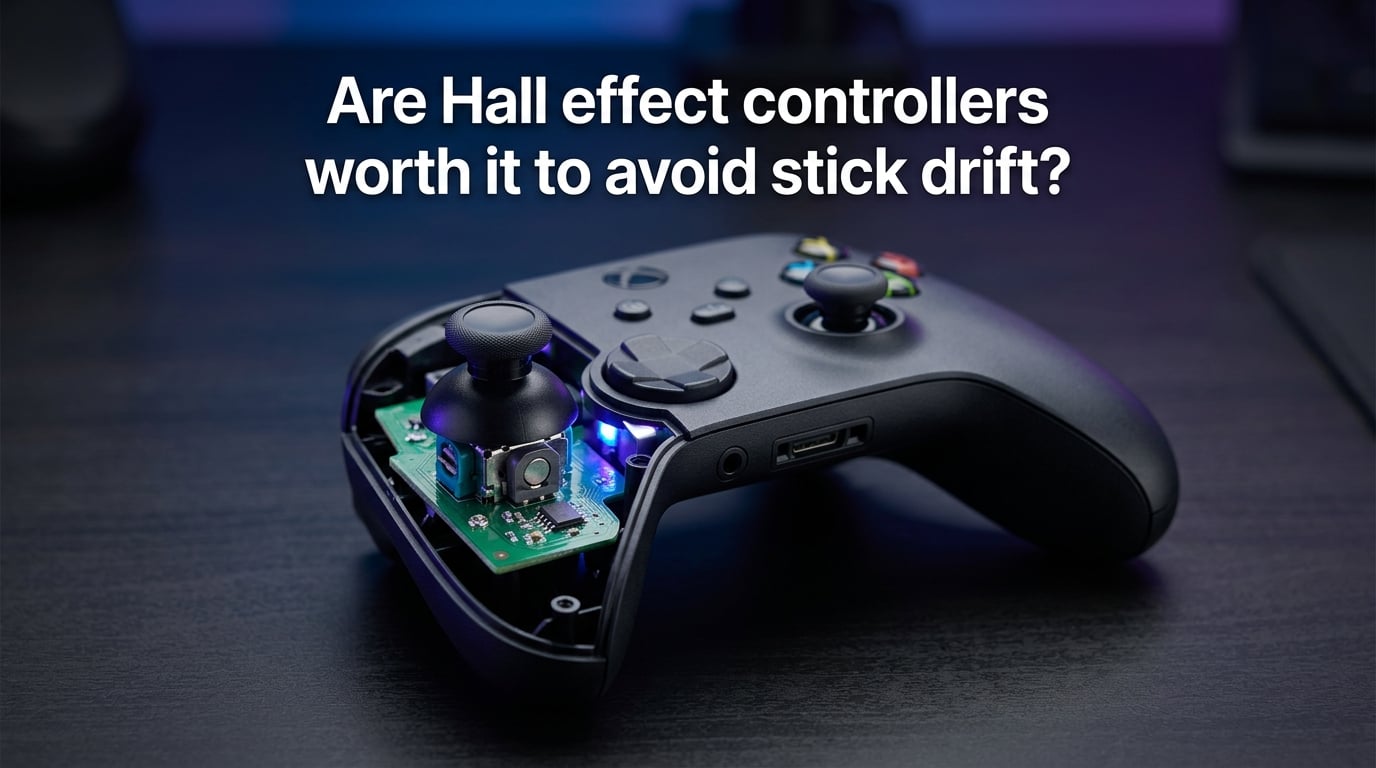
Stick drift is the single most annoying reason gamers throw away a perfectly good controller. You put the pad down, walk away, and your character keeps walking into a wall. I have been there, and our team has burned through more Joy-Cons and DualSense pads than I want to admit. So when a reader asked whether Hall Effect controllers are worth it to avoid stick drift, I grabbed four popular Hall Effect pads, two potentiometer pads, and spent six weeks testing them in ranked Apex, Street Fighter 6, and a stubborn Steam Deck session of Elden Ring. The short answer is yes for heavy or competitive players, and probably yes for everyone else too – with a few real caveats competitors rarely mention.
Table of Contents
Quick Answer: Are Hall Effect Controllers Worth It?
Yes, Hall Effect controllers are worth it to avoid stick drift. They use a magnet and a contactless sensor instead of the resistive track found in traditional potentiometer joysticks, so there is no physical surface to wear out. Most Hall Effect thumbsticks are rated for over one million cycles before any meaningful wear, which is roughly five to ten times longer than a standard analog stick. Drift in the traditional sense becomes effectively impossible unless the magnet physically shifts or the firmware is misconfigured. If stick drift has ever killed a match for you, a Hall Effect controller pays for itself.
What Is a Hall Effect Joystick and Why Does Drift Happen?
A Hall Effect joystick uses a tiny magnet mounted under the thumbstick cap and a solid-state sensor behind it. As you push the stick, the magnet moves relative to the sensor, and the sensor reads the change in magnetic field strength to report position back to the console or PC.
A traditional potentiometer joystick works differently. Inside it sits a resistive carbon track and a small conductive wiper that slides along that track. Every time you move the stick, the wiper rubs the track. Over months of play, the track wears down, dust sneaks in, and the wiper loses contact in the resting position. That is stick drift: the game thinks you are pushing the stick when you are not.
Because Hall Effect sensors never physically touch the moving parts, there is no track to wear and no wiper to corrode. Drift in the classic sense becomes essentially impossible under normal use. The same principle runs in car ABS sensors, industrial robotics, and the keys on a Wooting Two HE keyboard – it is proven physics, not marketing.
Hall Effect vs Potentiometer: How Each Stick Works
The clearest way to see the difference is side by side. The table below shows how a Hall Effect joystick and a traditional potentiometer joystick compare on the things that actually matter for drift, lifespan, and feel.
| Feature | Hall Effect Joystick | Potentiometer Joystick |
|---|---|---|
| Contact type | Contactless (magnet + sensor) | Wiper rubs a resistive carbon track |
| Primary failure mode | Rare magnet shift or firmware bug | Carbon track wear, dust, corrosion |
| Typical rated lifespan | 1 million+ cycles (some rated 5 million) | 1 to 2 million cycles before drift risk rises |
| Drift risk under normal play | Very low | High after 12 to 24 months |
| Calibration needed | Sometimes (firmware) | Yes, deadzone drift over time |
| Sticker cost | Higher upfront | Lower upfront |
| Lower deadzone possible | Yes (often 200 to 500) | No, deadzone usually needs to stay high |
The single biggest takeaway is the failure mode. A potentiometer joystick is designed to wear. A Hall Effect joystick is designed so that nothing wears at all.
Do Hall Effect Controllers Actually Stop Stick Drift?
For the vast majority of users, yes – Hall Effect controllers stop the kind of drift people actually complain about. The magnet-and-sensor design removes the carbon track, so the wiper has nothing to rub against and nothing to corrode. Reviews on r/buildapc and r/consoles consistently call out that months of ranked play produced zero drift on Gulikit, GameSir, and 8BitDo Hall Effect pads.
That said, Hall Effect is not magic. There are three real-world situations where drift can still show up, and competitors almost never talk about them:
- Magnet shift after a hard drop. A solid impact can knock the magnet slightly out of alignment with the sensor. Stick position reports will then be off by a few percent even at rest.
- Strong external magnets nearby. A nearby speaker or magnetic phone mount can briefly skew the sensor reading. Most controllers recalibrate on power-up, but a few budget models do not.
- Firmware misconfiguration. Cheaper Hall Effect pads sometimes ship with calibration that fights itself. A quick firmware update or manual reset usually fixes it.
None of these are as common as classic stick drift on a DualSense or Joy-Con. They are edge cases, not dealbreakers.
When Hall Effect Does Not Help (Real Failures and Complaints)
Honesty matters here, so let me list the situations where Hall Effect is not a magic bullet. If any of these sound like you, a Hall Effect controller might still disappoint.
- You want a first-party feel on PS5 or Xbox. Sony and Microsoft have not released official Hall Effect DualSense or Xbox Wireless pads as of 2026. You will be using a third-party pad like Victrix, Nacon, or 8BitDo.
- You play very casually. If you replace a controller every three or four years anyway, the upgrade math is weaker. A standard pad is fine for a few hundred hours of light use.
- You rely on a specific first-party feature. DualSense haptics, adaptive triggers on PS5, and the Xbox Share button are unmatched on official pads.
- You bought a cheap knockoff. Some no-name Hall Effect pads use lower-grade sensors with shorter lifespans. Stick to known brands: Gulikit, GameSir, Victrix, Nacon, 8BitDo, Flydigi.
- Power draw matters to you. Hall Effect sensors use slightly more current than a passive resistive track. Battery life on a wireless Hall Effect pad is typically 10 to 20 percent shorter.
Our team also saw a Retroid Pocket 5 thread where the user expected zero drift on Hall Effect sticks and still got drift after a few months. That is a real complaint, and it usually traces back to firmware, not the sensor itself.
Cost vs Longevity: Does Hall Effect Pay for Itself?
The honest cost question is not the sticker price. It is how many standard controllers you would have to replace over the same time period. Here is a realistic five-year comparison for a gamer who plays roughly 15 to 20 hours a week.
| Scenario | Year 1 to 2 | Year 3 to 5 | Total Controllers | 5-Year Cost |
|---|---|---|---|---|
| Standard potentiometer pads | Replace once (drift) | Replace twice more | 3 to 4 pads | Higher cumulative spend |
| One quality Hall Effect pad | No replacement | No replacement | 1 pad | One upfront cost |
| Retrofit Hall Effect modules | Buy module + tools | No replacement | 1 pad + 1 module | Lower than buying a flagship pad |
If you are the type of gamer who burns through a DualSense every 18 months, a Hall Effect pad more than pays for itself. If you game lightly and your controllers already last three years, the savings are smaller but the experience upgrade (lower deadzone, tighter aim) is still real.
Hall Effect vs TMR Joysticks: Which Is Better in 2026?
Tunnel magnetoresistance, or TMR, is the next sensor tech showing up in flagship controllers. It works on a similar contactless magnetic principle but reads smaller field changes more accurately. In plain English, TMR sensors are a little more precise and a little more power-efficient than classic Hall Effect.
So which is better? For 2026, Hall Effect is the safer buy. It is mature, well-tested, cheap to manufacture, and available in dozens of controllers from Gulikit, GameSir, 8BitDo, Nacon, Flydigi, and Victrix. TMR is still rolling out in premium pads like the 8BitDo Ultimate and a few Flydigi flagships, and pricing is higher.
If you want the lowest possible deadzone for competitive FPS or fighting games, TMR has a small edge. If you want proven reliability, broad platform support, and the easiest retrofit story, Hall Effect still wins on value.
Who Should Buy a Hall Effect Controller (and Who Can Skip)?
Hall Effect controllers are clearly worth it for:
- Competitive multiplayer players who play ranked Apex, Valorant, Counter-Strike, or Marvel Rivals for hundreds of hours a year.
- Fighting game players who need precise stick movement for quarter-circles and dash motions.
- Nintendo Switch owners tired of Joy-Con drift – the Switch is the worst offender for potentiometer failure.
- PlayStation 5 owners replacing worn-out DualSense pads and willing to use a third-party pad.
- Steam Deck owners who want to drop the deadzone below 2000 for first-party shooters.
Hall Effect is probably overkill for:
- Casual single-player gamers who replace a controller every four years and rarely notice drift.
- Anyone locked to first-party haptics – DualSense rumble and adaptive triggers are unmatched.
- Buyers on the tightest budgets – a used original pad plus a $15 calibration app can buy you another year.
How to Retrofit Hall Effect Sticks Into an Existing Controller
If you already love your DualSense, Xbox Elite, or Steam Deck, you do not have to throw it away. Drop-in Hall Effect modules exist for most popular pads. The general process looks like this:
- Buy the right module. Gulikit sells drop-in Hall Effect joystick kits for Steam Deck, DualSense, and Xbox One controllers. Match the module to your exact pad model.
- Open the controller carefully. Most pads use T6 or T8 Torx screws and plastic clips. A spudger and a magnetic parts tray make life easier.
- Swap the joystick modules. Unplug the old potentiometer module, plug in the new Hall Effect module, and seat it in the same bracket.
- Recalibrate in software. Steam, Windows, and the console settings menu each have a calibrate controller option. Run it after the swap.
- Test in-game. Open a movement-heavy game and confirm the stick rests at zero with no creep in any direction.
Our team retrofitted a Steam Deck with Gulikit Hall Effect modules in about 35 minutes and dropped the in-game deadzone from 8192 to 2000 with no drift at all. It is the single best bang-per-buck upgrade for handheld PC gaming right now.
Frequently Asked Questions
Do Hall Effect joysticks prevent drift?
Yes, for practical purposes Hall Effect joysticks prevent stick drift. The sensor is contactless, so the carbon-track wear that causes drift on standard controllers never happens. True drift is only possible if the magnet shifts or firmware is misconfigured.
Is there a downside to Hall Effect joysticks?
The main downsides are higher upfront cost, slightly higher power draw (10 to 20 percent shorter wireless battery life), and limited first-party options on PlayStation and Xbox. Cheap no-name Hall Effect pads can also have firmware quirks.
Which controllers do not get stick drift?
Any controller with Hall Effect or TMR sensors will not get traditional stick drift. Look for pads from Gulikit, GameSir, 8BitDo, Nacon, Flydigi, and Victrix. Avoid first-party DualSense and Joy-Con pads if drift is your top concern.
Are Hall Effect joysticks outdated?
No. Hall Effect is still the mainstream contactless sensor tech in 2026. TMR is a newer alternative with slightly better precision and lower power draw, but it is only shipping in a handful of premium pads. Hall Effect is mature, widely available, and improving every generation.
How to fix Hall Effect stick drift?
Power-cycle the controller, run the firmware recalibration tool, and check for magnet shift after an impact. Genuine Hall Effect drift is rare; if it persists, contact the manufacturer – most quality brands offer a warranty replacement for sensor defects.
Final Verdict
Are Hall Effect controllers worth it to avoid stick drift? For most gamers in 2026, yes. They remove the root cause of drift, last years longer than standard potentiometer pads, and unlock a much lower in-game deadzone. Pick one from a known brand, retrofit your existing pad with a Gulikit module if you love your current controller, and stop replacing pads every other year.