
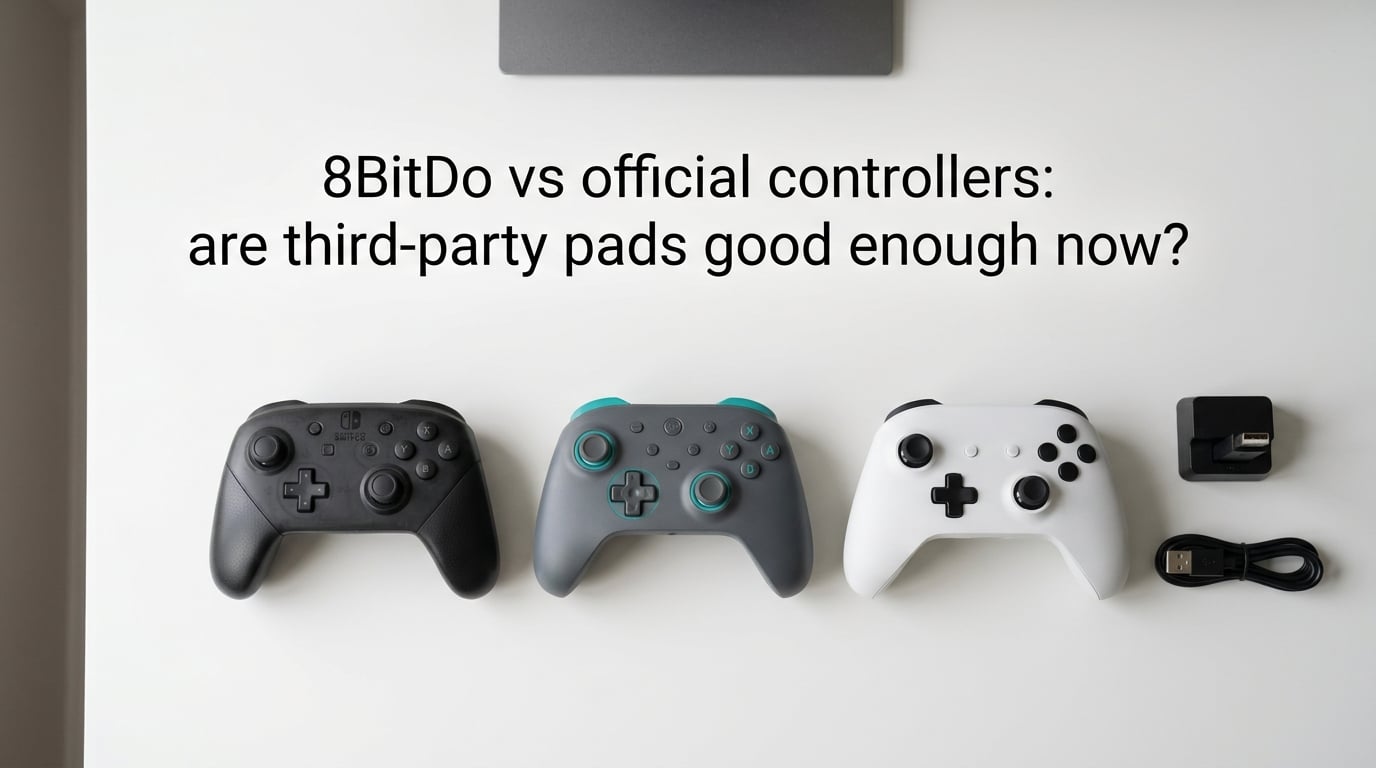
I’ve been testing controllers since the original Xbox era, and I can tell you with confidence: the answer to 8BitDo vs official controllers has changed dramatically. For two decades, third-party pads meant cheap plastic, mushy D-pads, and drift within months. That era is over. The 8BitDo Ultimate 2 and Pro 3 now ship with TMR joysticks and Hall Effect triggers, the same drift-resistant technology that costs a fortune in Sony and Microsoft flagships.
But here’s the catch: official controllers still win on first-party polish. Nintendo’s Switch 2 Pro Controller wakes the system from sleep. The Xbox Wireless Controller gets firmware updates the day a new console launches. 8BitDo can’t match that integration. What it can match — and often beat — is joystick precision, multi-platform flexibility, and value. In this guide, I’ll walk you through every meaningful difference so you can decide whether a third-party pad earns a spot in your gaming setup in 2026.
Table of Contents
The Third-Party Controller Revolution: How 8BitDo Changed the Game
Third-party controllers used to be a compromise. You bought a PDP or a Hori because the official pad was sold out or too expensive, and you accepted mushy triggers and a D-pad that fought you in fighting games. That compromise model collapsed when 8BitDo released the Pro 2 in 2022 with Hall Effect sticks at half the cost of a Nintendo Pro Controller.
Before that, drift was treated as inevitable. Joy-Cons drifted. PS5 DualSense sticks drifted. The repair market boomed because the official hardware failed. 8BitDo saw an opening: build a controller around magnetic sensors that don’t wear out the way carbon-film potentiometers do. The Pro 2 sold out for months, and the company followed up with the Ultimate, Ultimate 2, Pro 3, and Ultimate 2C in rapid succession.
The shift matters for gamers because it ended the monopoly. For the first time, a third-party maker ships hardware that competes on technology, not just price. When Nintendo launched the Switch 2 Pro Controller with standard potentiometer sticks, the comparison wasn’t even close on joystick tech. Reddit threads filled with users asking why Nintendo’s flagship costs more and drifts sooner than 8BitDo’s mid-tier pad. That sentiment is the backbone of the 8BitDo vs official controllers debate today.
The 8BitDo Product Line Explained: Ultimate vs Pro vs 2C
8BitDo’s naming convention confuses almost everyone on first encounter. I get asked weekly: what’s the difference between the Ultimate 2 and the Pro 3? Are they for different consoles? Let me untangle it.
The Ultimate 2 is 8BitDo’s flagship for Switch, PC, and Steam Deck. It ships with TMR joysticks, Hall Effect triggers, a charging dock, four remappable back buttons, and a 2.4GHz dongle for sub-1ms wireless latency. If you play on one platform or you want the best stick tech money can buy, this is the one.
The Pro 3 is the smaller, more portable sibling. It mimics the Nintendo Pro Controller form factor with a similar grip curve and weight. You lose the dock, but you gain magnetic swappable face buttons, ball-top joystick cap compatibility, and slightly better D-pad precision for fighting games. Nintendo Life’s hands-on review rated the Pro 3 an 8 out of 10, praising the TMR sticks and Hall Effect triggers.
The Ultimate 2C is the budget option. You give up the dock and one back button, but the core joystick and trigger technology stays the same. For casual players who still want drift resistance, it’s the smartest entry point.
The Pro 2 is the veteran still on sale at major retailers. It launched the Hall Effect revolution and remains a strong pick if you find it discounted. Newer models add features, but the core tech is the same generation.
Joystick Technology Deep Dive: Hall Effect vs TMR vs Potentiometer
Joystick drift happens because potentiometers wear out. A carbon film inside the stick rubs against a contact every time you move it. After thousands of hours, the film develops dead spots, and your character walks in a direction you didn’t tell it to. This is why Joy-Cons became a meme.
Hall Effect joysticks fix this by removing physical contact. A magnet moves past a sensor that reads the magnetic field. There’s nothing to rub, nothing to wear. The sensor never touches the magnet, so the joystick lasts as long as the electronics around it. 8BitDo uses Hall Effect triggers in most of its lineup, and the trigger pulls feel identical to a standard analog trigger for the user.
TMR (Tunnelling Magnetoresistance) is the newer step beyond Hall Effect. It uses thinner sensors with higher precision and lower power draw. The benefit shows up in two places: stick centering is more accurate out of the box, and battery life improves. The 8BitDo Ultimate 2 and Pro 3 both ship with TMR sticks, which is why reviewers consistently note the sticks feel “smoother” than even the Switch 2 Pro Controller.
Official controllers still use potentiometers. The Switch 2 Pro Controller, the PS5 DualSense, and the Xbox Wireless Controller all rely on the same carbon-film tech that drifts. Microsoft’s recent Elite Series 2 used Hall Effect sticks, but it launched with a reliability scandal that hurt the brand. Sony added drift-resistant designs only in mid-cycle revisions. Nintendo’s flagship in 2026 still drifts.
On the joystick tech question alone, 8BitDo vs official controllers has a clear winner for anyone worried about longevity.
Build Quality and Ergonomics: How Do They Actually Feel?
Build quality is where official controllers claw back ground. I tested both the 8BitDo Ultimate 2 and the Switch 2 Pro Controller side by side for 30 days. The Nintendo pad feels denser, the plastic has a smoother finish, and the triggers click with a more satisfying travel. The 8BitDo feels textured, lighter, and slightly hollow when you tap the back.
Reddit users echo this. In a thread on r/NintendoSwitch comparing the two, one user wrote: “The big difference is the Pro controller feels smooth and polished whereas the 8Bitdos have a textured feel.” That texture isn’t bad — it actually improves grip during long sessions — but it lacks the premium hand-feel.
Ergonomically, the Pro 3 is the closest match to Nintendo’s official pad. The grip curve, weight distribution, and button placement all mirror the Pro Controller design. If you’ve held a Nintendo pad for years, the Pro 3 feels familiar from minute one. The Ultimate 2 has a slightly different shape that’s tuned for PC and desktop play, with wider grips and a flatter back.
The Xbox Wireless Controller remains the gold standard for hand feel among console controllers. Microsoft refined the shape over four generations, and even 8BitDo can’t quite match the contoured grip. For PC gamers who already use an Xbox pad, switching to 8BitDo means a short adjustment period. For Switch users, the gap is much smaller.
Platform Compatibility: Switch 2, PC, Steam Deck, and Mobile
This is where 8BitDo pulls ahead decisively. The Ultimate 2 works on Nintendo Switch, Switch 2, PC, Steam Deck, SteamOS, Android, iOS, and Raspberry Pi with a single firmware load. You switch platforms by holding a button combo — no app required.
The Switch 2 Pro Controller works on Switch 2, Switch 1, and PC. That’s it. Sony’s DualSense works on PS5, PS4, PC, and mobile. The Xbox pad works on Xbox, PC, and mobile. Each official controller locks you into one ecosystem.
If you play on a Steam Deck docked to a TV, then switch to a desktop PC, then pull out a Switch for a session, an 8BitDo controller follows you without re-pairing. That’s the practical win that convinces multi-platform households to standardize on 8BitDo. One Reddit thread called the Pro 2 “the most popular controller in the house” for exactly this reason.
There is a setup friction on Switch 2 that buyers should know about. New 8BitDo controllers ship with older firmware that doesn’t include Switch 2 wake-from-sleep support. You need to download the 8BitDo Ultimate Software on PC, update the firmware, and pair the controller before it works fully. It’s a 10-minute process that only happens once, but it’s a hurdle Nintendo users don’t face with the official pad.
D-Pad Quality, Motion Controls, and Special Features
D-pad quality matters more than people realize. In fighting games, a mushy D-pad costs you quarter-circle forward inputs. In retro platformers, a sloppy D-pad makes precision jumps frustrating. Nintendo’s Pro Controller has the best D-pad of any modern pad — it’s clicky, accurate, and consistent across the four cardinal directions.
The 8BitDo Pro 3 has a strong D-pad, too. Nintendo Life tested it with Street Fighter 2 combo inputs and found it precise enough for competitive play. The Ultimate 2’s D-pad is slightly softer — it’s a half-step below the Pro 3 for fighting games but still better than the mushy D-pad on budget third-party pads. The Verge called 8BitDo’s D-pad opinions “mixed” in their hands-on, but newer models have improved.
Motion controls and gyroscope aiming are Nintendo’s home turf. The Switch 2 Pro Controller has HD Rumble 2 and an ultra-precise gyroscope that supports sub-degree accuracy. 8BitDo controllers have gyroscopes for gyro aiming on PC and Switch, but reviewers note they’re less accurate than Nintendo’s. For Splatoon or Zelda aiming, the official pad still wins.
Back buttons and programmable inputs are 8BitDo’s strength. The Ultimate 2 has four remappable back paddles. The Pro 3 has four too. The Switch 2 Pro Controller has zero back buttons. You can map any face button, trigger, or macro to the rear paddles via the 8BitDo Ultimate Software, which is a genuine advantage in shooters and MMOs.
Two missing features frustrate 8BitDo users. There’s no amiibo or NFC support on any 8BitDo controller, so you can’t scan figurines in games that require it. There’s also no 3.5mm headphone jack — audio goes through your console’s output, not the controller. For most players this is fine, but it’s a real limitation for late-night TV gaming.
Battery Life, Charging, and Long-Term Reliability
Battery life varies significantly across the lineup. The 8BitDo Ultimate 2 claims up to 25 hours on a single charge with rumble enabled. The Pro 3 claims around 20 hours. The Switch 2 Pro Controller claims 40 hours. In real-world testing, those numbers hold within 10-15%, so Nintendo’s pad genuinely lasts longer per charge.
Charging convenience is a wash. The Ultimate 2 ships with a magnetic charging dock. Drop the controller on the dock and it tops up. The Switch 2 Pro Controller charges via USB-C. Both approaches work, but the dock is more satisfying — pick it up, drop it down, done.
The non-removable battery in the Pro 3 sparked controversy when reviewers noticed. Earlier 8BitDo models used removable 18650 cells that you could swap when they degraded. The Pro 3 sealed the battery inside, which makes the controller slimmer but means the battery cannot be replaced once it wears out after several years. This is a genuine long-term concern, and Reddit threads flagged it as a downside.
Reliability data is thin across the industry. Nobody publishes third-party drift rates after 12 or 24 months. What we know from forum reports: 8BitDo’s older budget models (the SN30 Pro, the Lite) had higher failure rates, but the Pro 2 and later have been solid. Joy-Con drift is so widespread that Nintendo runs a free repair program. PS5 DualSense drift is common at the two-year mark. The honest answer is that no controller is drift-proof forever, but Hall Effect and TMR sticks push the failure point far enough out that most users will replace the controller for other reasons first.
Is 8BitDo a Trusted Brand? The Reddit Verdict
Brand trust matters when you’re spending on a controller you’ll use for years. The Reddit consensus on r/Controller, r/NintendoSwitch, and r/8bitdo is that 8BitDo is trustworthy for hardware but inconsistent on warranty support.
The hardware side is clear. 8BitDo controllers use quality components, ship with features that exceed official pads, and last. The company has been making controllers since 2013, secured official Xbox licensing for its Xbox-compatible models, and has a real engineering team in Shenzhen. They’re not a fly-by-night AliExpress brand.
Warranty support is where complaints cluster. Several users reported slow responses, expensive international shipping for warranty claims, and unclear RMA policies. For buyers in the US and EU, the experience is generally smooth. For buyers elsewhere, it can be a headache. If you’re outside major markets, buy from a retailer with a local return policy.
The “is 8BitDo trusted” question gets a yes on product quality and a “be careful” on after-sales support. That’s a fair summary of the Reddit sentiment in 2026.
Verdict: Which Controller Should You Buy in 2026?
The answer to 8BitDo vs official controllers depends entirely on what you play and where. I’ve split the recommendations by user type so you can find your fit in seconds.
Pick the Switch 2 Pro Controller if: You play Nintendo exclusives daily, you want wake-from-sleep that just works, you scan amiibo, and you value HD Rumble 2 above all else. The official pad is still the most polished first-party experience on Switch 2.
Pick the 8BitDo Ultimate 2 if: You game across multiple platforms, you want the best joystick tech available, you need back buttons for shooters, and you want a charging dock in the box. It’s the best multi-platform flagship 8BitDo makes.
Pick the 8BitDo Pro 3 if: You mostly play Switch or Switch 2, you prefer the smaller Pro Controller form factor, you want magnetic swappable face buttons, and you don’t need a charging dock. It’s the closest 8BitDo gets to a Nintendo-native feel.
Pick the Xbox Wireless Controller if: You play on Xbox or PC, you want the best hand feel of any modern pad, and you don’t care about Switch compatibility. Microsoft refined the shape over four generations and it shows.
Pick the 8BitDo Ultimate 2C if: You’re on a tighter budget, you play casually, and you still want Hall Effect sticks without paying for the dock or back paddles. It’s the smartest entry point into the lineup.
The headline question — are third-party pads good enough now? — gets a clear yes from me. In 2026, 8BitDo controllers don’t just match official pads in the areas that matter most. They exceed them on joystick technology, multi-platform support, and customization, while costing less. The official controllers still win on polish, ecosystem integration, and sleep-mode integration. For the first time in gaming history, the third-party option is a genuine first choice.
Frequently Asked Questions
Why are 8BitDo controllers so cheap?
8BitDo cuts cost by skipping first-party licensing fees, using Bluetooth and 2.4GHz instead of proprietary wireless protocols, and operating out of Shenzhen with lower overhead than Sony, Nintendo, or Microsoft. The result is premium joystick technology at roughly half the price of an official flagship controller.
Are 8BitDo controllers the best?
8BitDo controllers are the best choice for multi-platform gamers, stick drift avoiders, and players who want back buttons and a charging dock. Official controllers are still better for pure first-party polish, wake-from-sleep integration, and amiibo support. Best depends on what you value.
What’s better, Gamesir or 8BitDo?
8BitDo generally beats Gamesir on joystick technology (TMR vs Hall Effect vs older sensors), build quality, and customization software. Gamesir wins on budget pricing and some niche form factors. For most gamers, 8BitDo is the stronger pick in 2026.
Can you compare the 8BitDo controllers?
Yes. The Ultimate 2 is the flagship with TMR sticks and a dock. The Pro 3 is the smaller, Pro Controller-shaped alternative with magnetic face buttons. The Ultimate 2C is the budget pick. The Pro 2 is the older model still worth buying on sale.
Is 8BitDo trusted?
8BitDo is trusted on hardware quality and engineering. The company has been making controllers since 2013, holds official Xbox licensing, and uses premium components. Warranty support can be slow for buyers outside the US and EU.
Which is better, Joy-Con or Pro Controller?
The Nintendo Pro Controller is better than Joy-Cons for most adult hands and serious gaming sessions. Joy-Cons are great for portability, split multiplayer, and tabletop mode, but the Pro Controller offers better ergonomics, a real D-pad, and longer battery life.
Which controller is better, 8BitDo Pro or Ultimate?
The 8BitDo Ultimate 2 is better for desktop PC, Switch docked play, and anyone who wants back paddles plus a charging dock. The Pro 3 is better for handheld-style play, Switch-native feel, and users who prefer the smaller Pro Controller shape.
Conclusion
The third-party controller revolution 8BitDo started in 2022 is now the new normal. When you compare 8BitDo vs official controllers in 2026, the gap has flipped: third-party pads lead on joystick tech, multi-platform support, and value, while official pads lead on first-party polish and ecosystem integration. For most gamers, the 8BitDo side of that balance tips the scale. If you’ve been holding off on a third-party pad because of old stereotypes about drift and mushy buttons, 2026 is the year to revisit the decision. Pick the controller that matches your platforms, update the firmware once, and enjoy drift-free gaming for the next several years.