
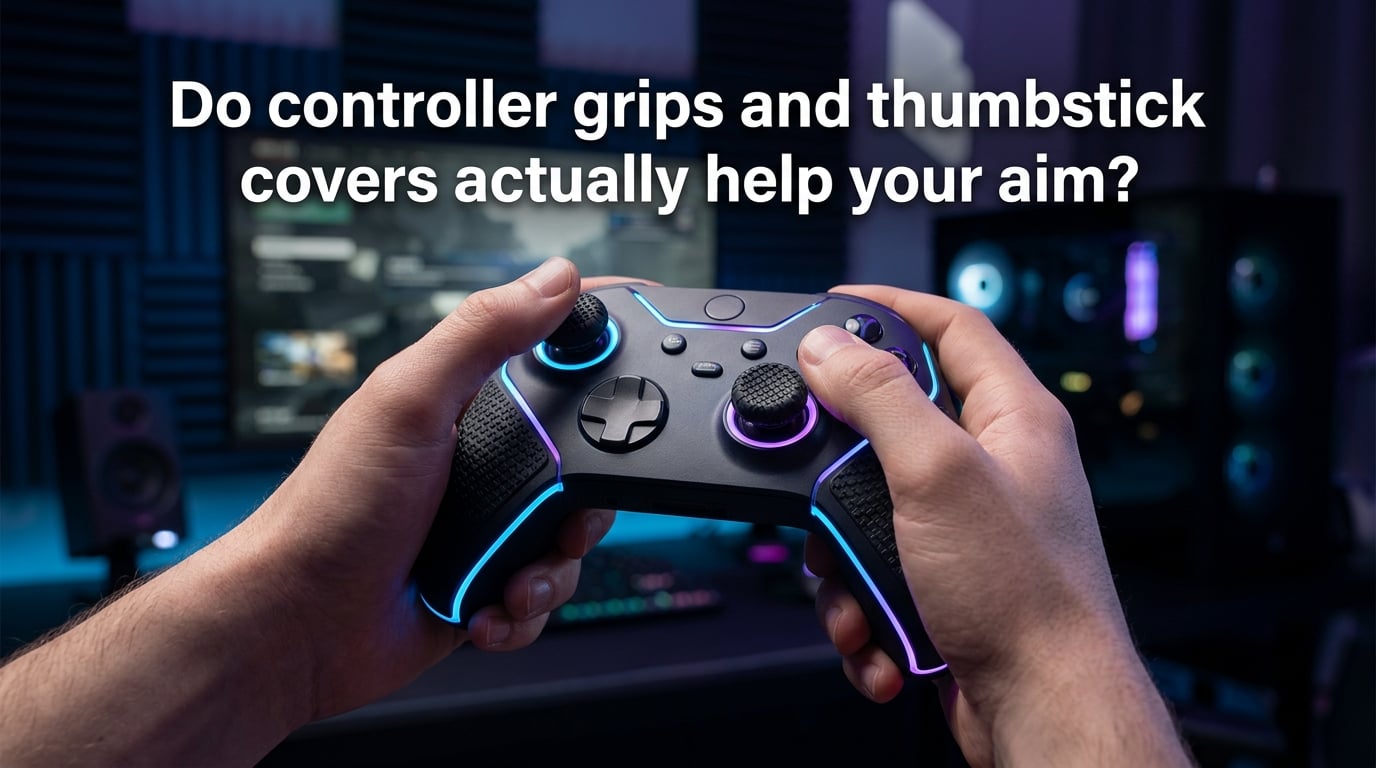
Yes, controller grips and thumbstick covers can genuinely improve your aim—but only under specific conditions. They work by increasing the physical distance your thumb travels, giving you more room for precise micro-adjustments. If you play FPS games, struggle with sweaty thumbs, or want to push your sensitivity higher, grips are worth trying. If your aim issues come from bad settings or lack of practice, no accessory will fix that.
I’ve tested multiple grip types across different controllers over several months of competitive play. This guide breaks down exactly when and why they help, when they don’t, and how to figure out if they’re right for your setup.
Table of Contents
How Controller Grips and Thumbstick Covers Work
Most gamers slap on thumb grips thinking they’ll instantly become better. The reality involves physics, and understanding it saves you from wasting money on the wrong accessory.
The Leverage Principle
Your thumbstick pivots from a fixed point at the base. When you add a taller cap, you’re extending the lever arm. That means your thumb moves through a wider arc to achieve the same in-game movement.
Think of it like a door handle. A longer handle requires less force to push. A taller thumbstick requires less precise muscle input for the same fine movement. You get more granular control because each millimeter of thumb movement translates to a smaller in-game change.
How Texture Prevents Slippage
The second benefit has nothing to do with height. Rubber and silicone grips add friction between your thumb and the stick surface. During intense gunfights, sweaty thumbs sliding off stock sticks is a real problem. Grips fix that immediately.
This matters more than most people realize. When your thumb slips even slightly, your brain has to compensate, which adds hesitation to your reactions. A textured surface keeps your thumb locked in place so your muscle memory stays consistent.
Deadzone and Range of Motion
With stock sticks, your deadzone (the center area where stick movement doesn’t register input) takes up a percentage of your total range. Taller grips effectively expand the physical range that maps to the useful portion of stick travel. Smaller deadzones become more viable because you have more physical distance to work with for tiny corrections.
Types of Thumbstick Covers and Grips
Not all grips are the same. The shape, height, and material all change how they feel and perform.
Concave Caps
These dip inward like a bowl, cradling the tip of your thumb. They’re the most common type and work well for players who rest their thumb flat on the stick. Concave caps help with comfort and prevent slipping but don’t add much height. Good starting point if you’ve never used grips before.
Convex Caps
Convex caps dome upward, pushing your thumb to a single contact point. Some players prefer this for precise directional input because it naturally centers your thumb. They’re popular among fighting game players who need clean directional inputs rather than analog precision.
High-Rise / Precision Thumbsticks
These are the taller options that add 6-12mm of height. Brands like KontrolFreek popularized this category. The extra height dramatically increases range of motion, which benefits long-range aiming and scoped shooting. The tradeoff: more thumb travel means slower reactions in close-range panic situations until you adjust.
Height Comparison
Low-rise (2-4mm): Minimal change to stick feel. Best for comfort and grip only. Works for all game genres. No sensitivity adjustment needed.
Mid-rise (5-8mm): Noticeable improvement in fine aim control. Good balance between precision and reaction speed. Works well for most FPS players. May need minor sensitivity tweaks.
High-rise (9-12mm): Maximum precision for long-range engagements. Significant adjustment period. Best for dedicated FPS players willing to retrain muscle memory. Requires sensitivity changes.
Which Games Benefit Most from Thumb Grips
Not every genre benefits equally from grip modifications. Here’s where you’ll actually notice a difference.
FPS Shooters (Biggest Impact)
Games like Apex Legends, Call of Duty, Rainbow Six Siege, and Valorant on console benefit the most. These games demand precise tracking, recoil control, and quick target switching. The added range of motion from taller grips directly translates to better control in all three areas.
Long-range sniping and AR sprays at distance see the most dramatic improvement. When you need to make tiny adjustments to stay on a target 200 meters away, that extra stick travel gives you the control room you need.
Battle Royales
Similar benefits to FPS games but with added emphasis on target switching. In games like Warzone or Fortnite, you’re constantly flicking between targets at varying distances. Grips help with both the precision of those flicks and the control when tracking a moving target.
Fighting Games (Minimal Impact)
Fighting games rely on clean directional inputs rather than analog precision. Convex caps can help with consistent inputs, but tall grips offer little benefit. If fighting games are your main genre, basic rubber caps for comfort are enough.
Sports and Racing Games (Negligible Impact)
FIFA, Madden, racing sims—these games don’t require the fine aim adjustments that make grips worthwhile. Standard sticks handle these inputs perfectly well. Save your money if these are your primary games.
When Controller Grips Actually Improve Your Aim
Grips help in specific situations. If you match any of these scenarios, there’s a good chance they’ll make a noticeable difference.
You Have Sweaty Hands
This is the most immediate, obvious benefit. If your thumbs slip during heated moments, textured grips solve the problem completely. No amount of sensitivity tweaking fixes slippage—only better friction does. Multiple players on Reddit report this alone makes grips worth buying.
You Want to Increase Sensitivity
Higher sensitivity means faster turning and target acquisition. But it also means less room for error on fine adjustments. Taller grips solve this paradox by expanding your physical range of motion. You can crank up sensitivity for fast flicks while still having enough stick travel for precision work.
As one Reddit user in r/apexuniversity put it: “With a longer stick and a smaller deadzone, you can improve your small quick aim adjustments and recoil control while also giving more range of motion.”
You Struggle with Recoil Control
Pulling down steadily to compensate for recoil requires smooth, consistent thumb movement. Grips add stability and control to that downward pull. This is especially helpful in games with aggressive recoil patterns like Rainbow Six Siege or Apex Legends.
You Play Long Sessions
Stock sticks can cause thumb fatigue over extended play. Rubber grips add cushioning that reduces pressure on your thumb joint. If you game for 3+ hours at a time, the comfort improvement alone can keep your aim consistent late in sessions.
You Have Larger Hands
Players with bigger hands often find stock sticks too short, causing their thumbs to cramp or feel cramped. Taller grips bring the stick height to a more natural position for larger hands. This is a comfort improvement that indirectly helps aim by reducing tension.
When Grips Won’t Help (and What to Do Instead)
Honest truth: grips aren’t magic. If your aim is bad for other reasons, adding rubber caps won’t fix it.
Your Settings Are Wrong
Before spending money on grips, make sure your deadzone, response curve, and sensitivity are properly configured. Bad settings make aim inconsistent regardless of what’s on your sticks. Fix your foundation first—adjust deadzone to as low as possible without drift, and find a sensitivity that lets you track targets smoothly.
You Haven’t Built Muscle Memory Yet
If you’re new to controller FPS, your aim problems are likely practice-related, not hardware-related. Grips add a variable that can actually slow down the muscle memory building process. Get comfortable with standard sticks first, then experiment with grips once your fundamentals are solid.
You Have Stick Drift
Grips don’t fix hardware failure. If your stick is drifting (moving on its own), the sensor inside is worn. No cap or cover addresses that. You need a controller with Hall Effect sensors or a replacement. Stick drift requires a hardware fix, not an accessory.
You Experience Pain or Numbness
Taller grips change your hand position, which can worsen existing discomfort. If you feel pain, tingling, or numbness while gaming, grips may make it worse by increasing the range of thumb movement. Address ergonomic issues first—take breaks, adjust your grip, or consult a doctor for persistent problems.
How to Test If Thumb Grips Help Your Aim
Don’t just slap on grips and hope for the best. Use this testing method to get objective results.
Step 1: Baseline Your Current Aim
Spend 30 minutes in your game’s practice range or aim trainer. Record your accuracy percentage, average reaction time, and consistency scores if available. Note how your thumbs feel during the session—any slipping, fatigue, or cramping.
Step 2: Install Grips and Play Immediately
Don’t change any sensitivity settings yet. Spend 30 minutes with the grips using your current settings. Notice what feels different—is aiming easier, harder, or about the same? Record the same metrics from Step 1.
Step 3: Adjust Sensitivity If Needed
If you’re using taller grips, try increasing your sensitivity by 5-10%. Taller sticks give you more physical range, so you can afford higher sensitivity without losing precision. Test for another 30 minutes at the new sensitivity.
Step 4: Give It a Full Week
Initial impressions can be misleading. Your muscle memory needs time to adapt to the changed stick feel. Most players report 3-7 days before they feel fully comfortable. If grips feel awkward on day one, that’s normal. If they still feel wrong after a week, they might not be right for your playstyle.
Step 5: Compare Results
After a full week, run the same practice range tests from Step 1. Compare accuracy, consistency, and how your hands feel. If your numbers improved and your hands feel better, grips are working for you. If numbers are the same or worse, you may not need them—or you may need a different height/type.
Sensitivity Adjustments After Adding Grips
This is where most players get confused. The internet is split on whether to increase or decrease sensitivity with grips. Here’s the actual answer.
Why You Should Increase Sensitivity (Usually)
Taller grips expand your physical range of motion. If you keep the same sensitivity, you’ll have to move your thumb further for the same in-game rotation, which can feel sluggish. Increasing sensitivity compensates for the added height while keeping your effective turn speed similar.
Start by increasing your sensitivity by 5-10% from your baseline. Play for a few hours, then adjust from there. Most competitive FPS players who use high-rise grips run sensitivity 10-15% higher than they would with stock sticks.
When to Decrease Sensitivity
If you were already running very high sensitivity and struggling with precision, grips give you the physical range to lower it. You’ll get more control per degree of sensitivity. This is rare but works for players who forced high sensitivity for fast turns but couldn’t track smoothly.
The Right Approach
There’s no universal setting. The goal is to match your effective turn speed and precision to what feels natural. Use the testing method above to find your sweet spot. Change one variable at a time—either sensitivity or grip height, never both at once.
Frequently Asked Questions
Are thumbstick caps worth it?
Thumbstick caps are worth it for FPS players who want better grip, more precise aim control, or experience sweaty thumbs. They’re an inexpensive upgrade that provides immediate improvement in comfort and can improve aim over time with proper adjustment. For non-FPS gamers, the benefit is minimal.
Do thumbsticks improve aim?
Taller thumbsticks improve aim by increasing the physical range of motion, which gives you more room for fine micro-adjustments. This is most noticeable in FPS games for long-range tracking, recoil control, and scoped aiming. The improvement requires an adjustment period of 3-7 days and may need sensitivity tweaks.
What are the best thumbsticks for aiming?
The best thumbsticks for aiming depend on your game type and hand size. High-rise sticks (8-12mm) work best for FPS precision, mid-rise (5-8mm) offer a balance of speed and control, and low-rise (2-4mm) are best for comfort only. Popular options include KontrolFreek for high-rise and Skull and Co for budget-friendly alternatives.
Should I increase sensitivity with thumb grips?
Yes, most players should increase sensitivity by 5-10% after adding taller grips. The extra height expands your physical range of motion, so keeping the same sensitivity can feel sluggish. Adjust incrementally and test each change for at least one full gaming session before tweaking further.
How long does it take to adjust to thumb grips?
Most players need 3-7 days of regular play to fully adjust to thumb grips. The first day often feels awkward because your muscle memory is calibrated to the original stick height. Give yourself at least a week before deciding grips don’t work for you.
Conclusion
So, do controller grips and thumbstick covers actually help your aim? For most FPS players, the answer is yes—especially if you deal with sweaty thumbs, want more precision at range, or plan to experiment with higher sensitivity. They’re one of the cheapest controller upgrades you can make, and the worst-case scenario is you don’t notice enough difference to keep using them. Test them properly with the methodology above, give yourself a week to adjust, and let the results speak for themselves.