
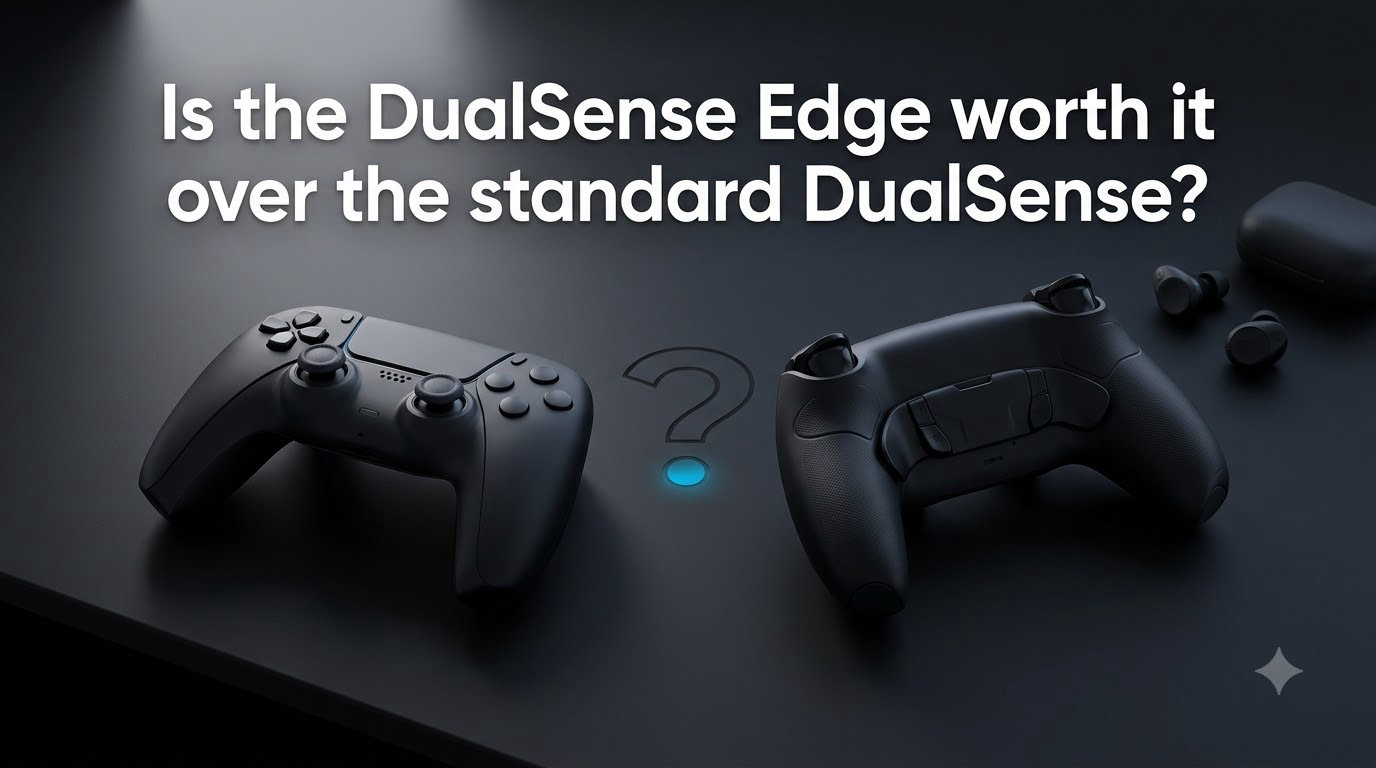
If you’re a competitive gamer who plays FPS titles or values custom controls, the DualSense Edge is worth the upgrade over the standard DualSense. If you’re a casual player who mostly enjoys single-player adventures, the standard DualSense delivers nearly identical core performance at roughly a third of the investment. This guide breaks down every difference to help you decide.
Sony’s DualSense Edge launched as the first-party “pro controller” for PS5, packing back paddles, swappable thumbstick modules, trigger stops, and deep customization into a premium package. But at roughly three times the cost of the standard DualSense, the value question dominates every forum thread and review comment section.
After analyzing feedback from competitive gamers, casual players, and long-term owners across Reddit, GameFAQs, and dedicated PS5 communities, we’ve put together a comprehensive comparison. Here’s everything you need to know about the DualSense Edge versus the standard DualSense in 2026.
Table of Contents
Quick Comparison: DualSense Edge vs Standard DualSense
The fastest way to understand the gap between these two controllers is a direct spec comparison. The table below covers the key differences at a glance.
| Feature | DualSense Edge | Standard DualSense |
|---|---|---|
| Back Paddles | 2 rear Function buttons | None |
| Swappable Thumbsticks | Yes, modular design | No, fixed sticks |
| Trigger Stops | Adjustable lock sliders | None |
| Button Profiles | Multiple saved profiles | Single default |
| Dead Zone Customization | Yes, per-stick | No |
| Battery Life | 5–7 hours | 6–7 hours |
| Weight | ~15% heavier | Standard weight |
| Carrying Case | Included | Not included |
| Connection | USB-C, Bluetooth | USB-C, Bluetooth |
| Haptic Feedback | Yes | Yes |
| Adaptive Triggers | Yes | Yes |
Both controllers share the same core DualSense technology—haptic feedback, adaptive triggers, built-in microphone, and motion sensors. The Edge doesn’t change how games feel on a fundamental level. What it changes is how you interact with them through customization and hardware-level adjustments.
Price and Value: Is the DualSense Edge Worth the Premium?
The standard DualSense carries a mainstream price point, while the DualSense Edge commands a premium roughly three times higher. That gap is the single biggest factor in most buying decisions.
The price gap is steep, but context matters. The Edge ships with a braided USB-C cable, a carrying case, a connector housing, and multiple thumbstick caps—accessories that would cost separate money otherwise. The carrying case alone is a well-designed clamshell unit that protects the controller during travel.
Does the DualSense Edge ever go on sale? Historically, the Edge sees modest discounts during major sales events like Black Friday and Days of Play, occasionally dropping by a modest percentage. The standard DualSense, by contrast, regularly sees steeper percentage discounts during the same events. If you’re price-sensitive, waiting for a sale on the Edge narrows the gap somewhat, but the standard DualSense remains the better deal for budget-conscious buyers.
For casual gamers who play a few hours a week, the standard DualSense offers exceptional value. You get the same haptic feedback, adaptive triggers, and overall build quality that makes the PS5 controller generation feel special. The money saved could go toward a new game or an extra standard controller for multiplayer.
Design and Build Quality Differences
Pick up both controllers and you’ll notice the Edge immediately. It’s about 15% heavier, which competitive players often prefer for stability during extended sessions. The extra weight comes from the metal back paddle mechanisms and the modular thumbstick system.
The grip texture on the Edge feels more premium out of the box, with a slightly different surface treatment than the standard model. However, some long-term owners have reported grip discoloration or yellowing over time, particularly with heavy use. This is worth knowing if you tend to keep controllers for years.
The standard DualSense is no slouch in build quality. It’s the same base design that won widespread praise at the PS5’s launch for its comfortable ergonomics and solid feel. The difference is that the Edge adds modular components and a metal-reinforced rear section.
The included carrying case is a standout feature. It holds the controller, USB cable, extra thumbstick caps, and the connector housing in a compact clamshell design. For anyone who travels with their PS5 or attends gaming events, this case alone adds practical value that the standard controller doesn’t offer.
Key Features That Set the Edge Apart
The DualSense Edge’s feature set is where the price premium starts to make sense—specifically for certain types of players. Here’s what the Edge adds that the standard DualSense simply cannot do.
Back Paddles and Function Buttons
The Edge includes two metallic rear Function buttons mapped to any face button. In competitive FPS games, this means you can jump, slide, or reload without taking your thumbs off the analog sticks. Forum feedback consistently ranks these back paddles as the single most valuable Edge feature. Competitive players report noticeable improvement in reaction time and movement fluidity.
The metal construction feels significantly better than third-party plastic paddle attachments. They’re responsive, tactile, and positioned naturally where your middle fingers rest during play.
Trigger Stop Locks
Physical trigger lock sliders let you shorten the trigger pull distance for L2 and R2. In shooters, this means faster firing because the trigger registers input sooner in the pull arc. You can set different depths for each trigger, which is useful for games where you aim with one trigger and fire with another.
Swappable Thumbstick Modules
The Edge uses a modular thumbstick system that lets you pop out and replace the entire analog stick assembly. This directly addresses the stick drift problem that has plagued DualSense controllers since launch. When drift eventually appears, you replace the module rather than the entire controller.
Replacement modules are available separately, and the swap takes seconds without tools. This repairability gives the Edge a potential longevity advantage over the standard DualSense, which requires either DIY soldering skills or a full replacement when drift hits.
Customization Profiles
The on-controller Function buttons give you access to saved button remapping profiles. You can create different profiles for different games—tight trigger stops and aggressive sensitivity curves for Call of Duty, then switch to a racing-friendly layout for Gran Turismo with a button press. The standard DualSense has no hardware-level profile switching.
Performance and Battery Life
Battery life is the Edge’s most commonly cited weakness. The standard DualSense manages 6–7 hours of play, while the Edge typically lasts 5–7 hours depending on feature usage. The extra battery drain comes from the additional electronics powering the customization system.
In real-world use, some owners report needing to charge the Edge more frequently. One reviewer at Tom’s Guide mentioned buying two Edge controllers specifically to rotate them during long sessions. If you play marathon sessions of 4+ hours regularly, this is a genuine consideration.
Performance-wise, both controllers deliver identical gaming experiences in terms of input latency, haptic feedback quality, and adaptive trigger feel. The Edge doesn’t make games perform better—it gives you more control over how you interact with them.
The stick drift story is nuanced. The Edge’s swappable modules mean you can replace drifting sticks easily, but the modules themselves can still develop drift over time. The advantage isn’t that the Edge avoids drift—it’s that fixing drift costs far less than replacing the entire controller.
PC Gaming Compatibility
Both the DualSense and DualSense Edge work on PC via USB-C or Bluetooth, with growing Steam integration. The Edge’s Function buttons and button profiles carry over to PC, making it a strong option for PC gamers who prefer PlayStation ergonomics.
Steam recognizes the DualSense Edge as a distinct device and supports its additional features, including back paddle mapping and profile switching. For PC gamers who play across PS5 and PC, the Edge offers a consistent experience across both platforms with saved profiles.
The standard DualSense also works well on PC and has become a popular choice thanks to Steam’s native support for haptic feedback and adaptive triggers in compatible titles. If PC gaming is your primary use case, the Edge’s advantages narrow to the back paddles and trigger stops—valuable for competitive play but less critical for single-player PC games.
Who Should Buy the DualSense Edge?
The right controller depends entirely on how you play. Here’s a straightforward decision framework based on real user experiences and community feedback.
The DualSense Edge Is Worth It If You:
- Play competitive FPS games regularly (Call of Duty, Apex Legends, Valorant on console)
- Want back paddles for movement and aiming without lifting your thumbs
- Value hardware-level trigger stops for faster response times
- Prefer a repairable controller with swappable stick modules
- Use multiple game profiles and switch between genres frequently
- Travel with your controller and want the included carrying case
The Standard DualSense Is the Better Choice If You:
- Play casually, a few hours per week
- Primarily enjoy single-player adventure, RPG, or story-driven games
- Don’t need back paddles or trigger adjustments
- Want the best value for money
- Prefer a lighter controller for extended comfortable play
- Already own a working DualSense and don’t have a specific need for Edge features
Community consensus on Reddit and gaming forums is clear: casual gamers almost universally recommend the standard DualSense, while competitive FPS players consider the Edge a worthwhile investment. The split comes down to whether the back paddles and customization features translate into actual gameplay improvement for your specific use case.
DualSense Edge vs Xbox Elite Series 2
For gamers considering both ecosystems, the Xbox Elite Series 2 is the Edge’s direct competitor. The Elite offers four back paddles versus the Edge’s two, and its battery life stretches to roughly 40 hours—dramatically outlasting both DualSense models.
However, the Edge includes haptic feedback and adaptive triggers that the Xbox controller lacks entirely. For PS5-exclusive titles that leverage these features, the Edge has no Xbox equivalent. The Elite’s build quality has also faced criticism for bumper and stick drift issues of its own, so neither premium controller is immune to durability concerns.
If you game primarily on PS5, the Edge is the clear choice. If you split time between PS5 and Xbox, or primarily game on PC with an Xbox preference, the Elite Series 2 offers more back paddles and vastly superior battery life.
Final Verdict: Should You Upgrade?
For most PS5 owners, the standard DualSense remains the best overall controller. It delivers the full DualSense experience at a reasonable price and handles everything casual to moderate gaming demands.
The DualSense Edge earns its premium specifically for competitive players and customization enthusiasts. If back paddles, trigger stops, and swappable modules address real pain points in your gaming sessions, the investment makes sense. The repairability angle also tips the long-term value equation in the Edge’s favor if you tend to wear through controllers.
Is the DualSense Edge worth it over the standard DualSense? If you play competitively, absolutely. If you play casually, save your money and stick with the standard model—the core gaming experience is identical.
Frequently Asked Questions
Is the DualSense Edge worth it over the regular DualSense?
The DualSense Edge is worth it for competitive gamers who play FPS titles and value back paddles, trigger stops, and customization profiles. For casual players, the standard DualSense offers the same core experience at a much lower investment.
Which DualSense version is the best?
The DualSense Edge is the most feature-rich version with back paddles, swappable thumbstick modules, and trigger locks. The standard DualSense is the best value, delivering the same haptic feedback and adaptive triggers at a fraction of the cost.
Does DualSense Edge have stick drift issues?
The DualSense Edge can develop stick drift like any controller, but its swappable thumbstick modules make repair simple and affordable. You replace the drifting module for a fraction of the cost of a new controller, rather than needing a full replacement.
Is the DualSense Edge worth the price?
The DualSense Edge is worth the investment if you regularly play competitive games where back paddles and trigger stops provide a gameplay advantage. For casual gaming, the standard DualSense delivers the same fundamental experience at a fraction of the cost.
Does the DualSense Edge ever go on sale?
The DualSense Edge does go on sale during major events like Black Friday and Days of Play, typically with modest percentage discounts off the standard retail price. The standard DualSense sees steeper percentage discounts during the same sales events.
Is the DualSense Edge better than the original?
The DualSense Edge adds back paddles, swappable thumbstick modules, trigger stops, customizable profiles, and a carrying case. It uses the same haptic feedback and adaptive triggers as the original but is heavier, has slightly shorter battery life, and commands a significantly higher investment.
How long will a DualSense Edge last?
The DualSense Edge’s swappable thumbstick modules give it a longevity advantage over the standard DualSense. When stick drift develops, you replace the module rather than the entire controller. Battery lifespan depends on usage patterns but matches typical lithium-ion controller longevity.
Can you use DualSense Edge on PC?
Yes, the DualSense Edge works on PC via USB-C or Bluetooth with Steam integration. Its back paddles, trigger stops, and button profiles carry over to PC gaming, making it a strong option for cross-platform players.