
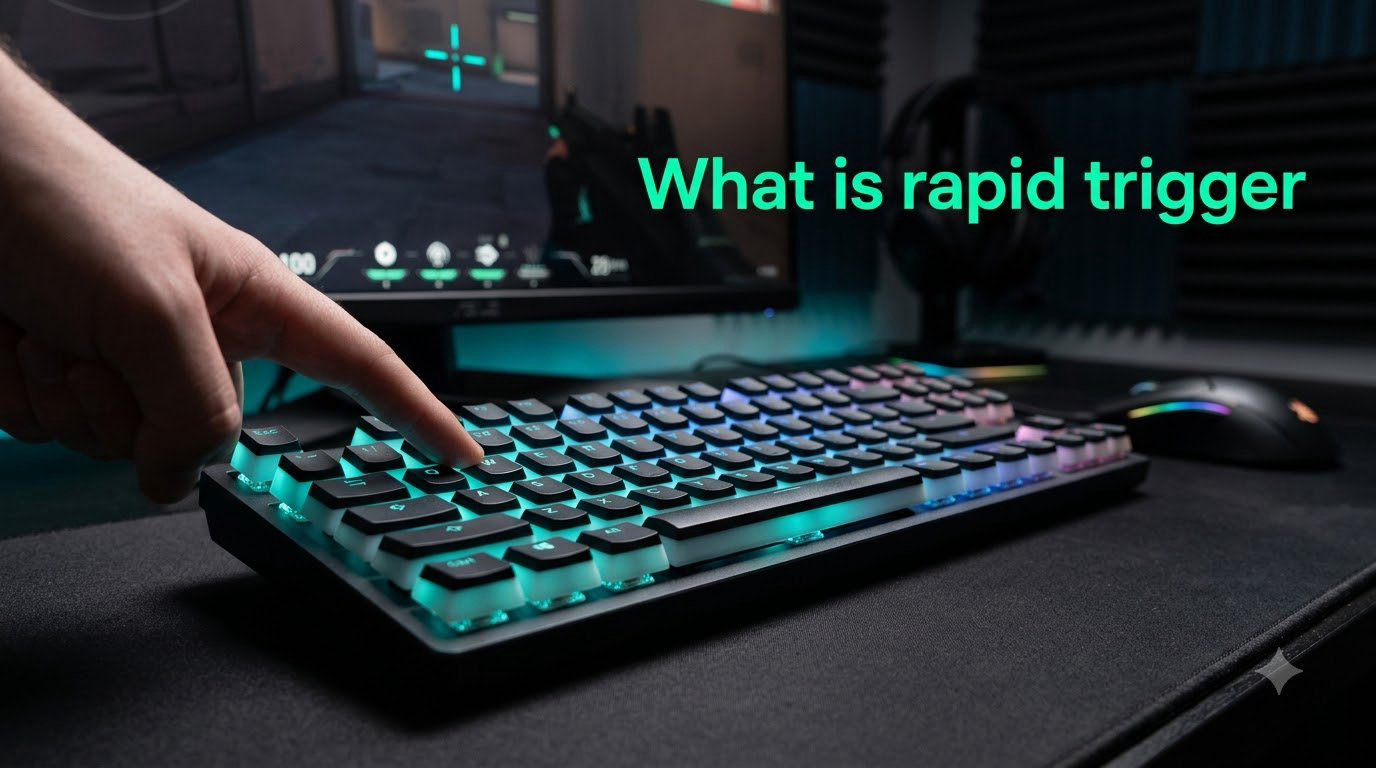
Rapid Trigger is a keyboard feature that dynamically adjusts the actuation and reset points of each key based on how far you press it, eliminating the fixed travel distance of traditional mechanical switches. In this guide, I’ll explain exactly how it works, why Valorant players care so much, and whether you actually need it to compete.
Table of Contents
What Is Rapid Trigger on a Keyboard?
Rapid Trigger is a hardware-level feature built into magnetic (Hall Effect) keyboards that lets each key activate the instant you press it and deactivate the moment you release it. Unlike traditional mechanical switches, which have fixed actuation and reset points, Rapid Trigger dynamically adjusts based on the physical position of the key at all times.
The feature was introduced by Wooting in 2019 with their original 60HE keyboard. Since then, every major keyboard manufacturer — Razer, SteelSeries, Akko, Keychron, and others — has adopted some version of it. It has become a standard feature in competitive gaming keyboards.
The key technology behind Rapid Trigger is the Hall Effect sensor. Instead of physical metal contacts like mechanical switches, these sensors use magnets to detect exactly how far a key has traveled. This allows the keyboard to register inputs with sub-millimeter precision, often as fine as 0.1mm, and to change those thresholds on the fly without any physical modification.
How Does Rapid Trigger Work?
Traditional mechanical switches operate on two fixed points. The actuation point is the distance you must press a key before it registers a press — typically 2mm on a Cherry Red switch. The reset point is how far the key must return upward before it can register another press — usually the same 2mm. You physically cannot act faster than these fixed thresholds allow.
Rapid Trigger throws those fixed points away. Using Hall Effect sensors, the keyboard measures the exact position of each key in real time, often with 0.01mm accuracy. When you press down, the key activates the moment it crosses your custom threshold — which you can set as low as 0.1mm. When you release, the key resets the instant it starts moving upward, with no minimum return distance required.
The latency difference is significant. Magnetic switches respond in approximately 0.125ms, while traditional mechanical switches take 5-10ms to debounce. That may sound small, but in a game where a single round can be decided by who counter-strafes first, those milliseconds matter.
Most rapid trigger keyboards let you set sensitivity per-key through companion software like Wootility, Razer Synapse, or SteelSeries Engine. You can configure WASD to ultra-low 0.1mm actuation for movement while keeping your ability keys at 2mm to prevent accidental presses.
Rapid Trigger vs Traditional Mechanical Switches
The differences between rapid trigger keyboards and traditional mechanical switches come down to five key areas:
Actuation Point: Mechanical switches have a fixed actuation point — usually 1.5mm to 2mm. Rapid trigger keyboards let you set this as low as 0.1mm, meaning far less physical movement is needed to register a keypress.
Reset Point: On mechanical switches, you must let the key return to the fixed reset point before pressing again. With Rapid Trigger, the key resets the moment it begins moving upward. This is the single biggest difference for competitive gaming.
Latency: Magnetic Hall Effect switches respond in about 0.125ms. Mechanical switches require 5-10ms of debounce time to prevent double-registering from contact bounce. Over hundreds of inputs per match, that adds up.
Lifespan: Magnetic switches have no physical metal contacts, which means no wear from friction. Most are rated for over 100 million keystrokes, roughly double the 50 million lifespan of quality mechanical switches.
Customization: With mechanical switches, you’re locked into whatever the switch designer chose. Rapid trigger keyboards give you software control over actuation, reset, and sensitivity per key — adjustable from 0.1mm to 4mm.
Why Gamers Care: Counter-Strafing in Valorant
Counter-strafing is the technique of tapping the opposite movement key to stop your character instantly so your shots become accurate. In Valorant, your first bullet accuracy drops significantly while moving, so mastering counter-strafing is fundamental to winning gunfights.
Here’s why Rapid Trigger matters specifically for Valorant: Valorant agents have higher movement acceleration penalties than characters in CS2. This means your character takes longer to stop moving, making the timing window for an accurate shot tighter. Rapid Trigger compresses that window by eliminating the reset delay on your movement keys.
With a traditional mechanical keyboard, you press A to strafe left, release A, and wait for the key to physically return to the reset point before D (strafe right) registers. With Rapid Trigger, the A key resets the instant your finger lifts, and D activates the instant you press it. The transition between strafes becomes nearly instantaneous.
Pro players noticed. TenZ, Aspas, and many VCT competitors now use Wooting 60HE or similar rapid trigger keyboards in official tournaments. This adoption is validated by Riot Games — these keyboards are fully legal in VCT events and have been used on broadcast without incident.
As one r/VALORANT commenter put it: “It will improve your rank. It won’t make you mechanically great. What it does is make you think less about counter-strafing and deadzoning.” That’s the honest assessment — Rapid Trigger automates a mechanical skill so you can focus on crosshair placement and game sense.
Other Games That Benefit from Rapid Trigger
Counter-Strike 2 (CS2): CS2 has smaller movement acceleration penalties than Valorant, so the improvement from Rapid Trigger is less dramatic. Still, faster counter-strafing and peek timing give a measurable edge. Donk and s1mple have competed on mechanical keyboards, which tells you skill matters more than hardware in CS.
Apex Legends: Movement is central to Apex. Rapid Trigger helps with tap-strafing, super glides, and the fast directional changes that define high-level Apex play. The instant reset is particularly useful for the quick inputs these advanced techniques require.
osu!: The osu! community was actually the first to adopt Rapid Trigger. Fast streams and deathstreams require repeated tapping at extreme speeds, and the instant reset reduces finger fatigue during long sessions. This is where Wooting first saw demand for the feature.
Fortnite: Building and editing at high speeds benefits from the rapid key re-registration. Double-tapping edits and piece control inputs become more reliable with instant actuation and reset.
Fighting Games: Frame-accurate inputs for parries, reversals, and combos benefit from the precision of Hall Effect switches, though this is a smaller use case compared to FPS and rhythm games.
Snap Tap vs Rapid Trigger: What’s the Difference?
Snap Tap and Rapid Trigger are completely different features, and the confusion between them is one of the most common misconceptions in the gaming keyboard space.
Snap Tap is a Razer software feature introduced in 2024 that prioritizes the most recently pressed key when two opposing keys (like A and D) are held simultaneously. It eliminates the need to physically release one key before pressing the other. The feature was controversial because some players argued it functioned like a macro, and there were initial questions about its anti-cheat compatibility.
Rapid Trigger is a hardware-level feature powered by Hall Effect sensors. It works at the switch level — the keyboard physically measures key position and adjusts actuation dynamically. No software scripts, no macros, no priority overrides. This is why Rapid Trigger is universally accepted by anti-cheat systems including Riot Vanguard.
The key distinction: Snap Tap modifies input priority logic. Rapid Trigger changes how the physical key is detected. They solve related problems (faster directional changes) through fundamentally different mechanisms.
Is Rapid Trigger Bannable in Valorant?
No, Rapid Trigger is not bannable in Valorant. It is a hardware-level feature that operates within the switch itself — there are no macros, scripts, or software modifications involved. Riot Vanguard, Valorant’s anti-cheat, cannot and does not flag hardware-level actuation adjustments.
Every major keyboard brand offering Rapid Trigger — Wooting, Razer, SteelSeries, Akko, Keychron, Corsair — has products used in official VCT (Valorant Champions Tour) broadcasts. Riot Games has never issued a statement against the feature, and no player has been banned for using a rapid trigger keyboard.
The distinction matters: a macro that automates inputs is bannable. A keyboard that measures key position more accurately is not. Rapid Trigger falls firmly in the second category.
Do You Actually Need Rapid Trigger for Valorant?
The honest answer depends on where you are in your Valorant journey. Rapid Trigger is a hardware multiplier, not a skill replacement. It enhances the inputs you already make — it does not teach you crosshair placement, game sense, or ability usage.
You’ll notice the most benefit if: You’re in Platinum or above, you already understand counter-strafing but find the mechanical execution inconsistent, and you’ve hit a movement-related plateau where your kills feel like they should connect but don’t.
You probably don’t need it if: You’re below Gold, your aim and positioning still need fundamental improvement, or you primarily play agents where movement accuracy is less critical. Spending time in aim trainers will give you far more improvement than any keyboard upgrade.
That said, the barrier to entry has dropped significantly. Budget rapid trigger keyboards are now available from brands like Redragon, Attack Shark, and Royal Kludge. Multiple Reddit threads confirm these budget boards deliver a genuine rapid trigger experience. You do not need to spend premium money on a Wooting 60HE to feel the difference.
Expect to spend one to two weeks adjusting. Players coming from mechanical keyboards often experience accidental key presses at first because the ultra-low 0.1mm actuation is far more sensitive than they’re used to. Most people adapt within a week of regular play.
If you’re serious about improving in Valorant and you’ve already developed solid fundamentals, Rapid Trigger is one of the few hardware upgrades that can provide a genuine, measurable advantage. Just remember: it helps you execute what you already know. It doesn’t teach you anything new.
Frequently Asked Questions
What is a rapid trigger on a keyboard?
Rapid Trigger is a keyboard feature that dynamically adjusts the actuation and reset points of each key based on its physical position, eliminating the fixed travel distance of traditional mechanical switches. It uses Hall Effect sensors to detect key movement with sub-millimeter precision.
Can you get banned for using rapid trigger?
No. Rapid Trigger is a hardware-level feature that operates within the keyboard switches themselves. It does not use macros or software scripts, and is fully compatible with all major anti-cheat systems including Riot Vanguard. No player has ever been banned for using a rapid trigger keyboard.
Is rapid trigger worth it for Valorant?
For players in Platinum and above who understand counter-strafing but find execution inconsistent, yes. Rapid Trigger is a hardware multiplier that enhances existing skills. Players below Gold will benefit more from improving fundamentals first.
Should I enable rapid trigger on my keyboard?
If your keyboard supports it, yes — especially for FPS games like Valorant and CS2. Start with a moderate actuation setting (around 0.5mm) and lower it as you adjust. You can always disable it for typing or general use.
What is the difference between Snap Tap and Rapid Trigger?
Snap Tap is a Razer software feature that prioritizes the most recently pressed key when opposing keys are held simultaneously. Rapid Trigger is a hardware feature using Hall Effect sensors that dynamically adjusts key actuation and reset points. They solve related problems through different mechanisms.
Which keyboards have rapid trigger?
Major brands offering rapid trigger keyboards include Wooting (60HE, 80HE), Razer (Huntsman series), SteelSeries (Apex Pro), Akko (HE series), Keychron (HE series), DrunkDeer, and budget options from Redragon and Royal Kludge. The feature requires Hall Effect magnetic switches.
Is 60% keyboard bad for gaming?
A 60% keyboard is not bad for gaming — most professional Valorant players use 60% or 65% layouts. The smaller size gives more mouse space and is preferred in competitive FPS. You lose dedicated arrow keys and function row, but these are rarely needed during gameplay.
How do I set up rapid trigger on my keyboard?
Download your keyboard’s companion software (Wootility for Wooting, Razer Synapse for Razer, SteelSeries Engine for SteelSeries). Navigate to the actuation settings, enable Rapid Trigger mode, and set your preferred sensitivity. Start with 0.5mm and lower it gradually as you adjust to the sensitivity.
Final Thoughts
Rapid Trigger is a genuine innovation in keyboard technology — not marketing hype. It uses Hall Effect sensors to give your movement keys instant activation and instant reset, which directly translates to faster counter-strafing in Valorant. The technology is legitimate, tournament-legal, and now available at nearly every price point.
But knowing what rapid trigger is and actually needing it are two different things. If you’re still building your fundamentals, your time is better spent in aim trainers and VOD reviews. If you’ve plateaued and your movement is the bottleneck, a rapid trigger keyboard is one of the few hardware upgrades that can provide a measurable edge. The skill-versa-hardware equation is simple: hardware multiplies skill. It does not replace it.