
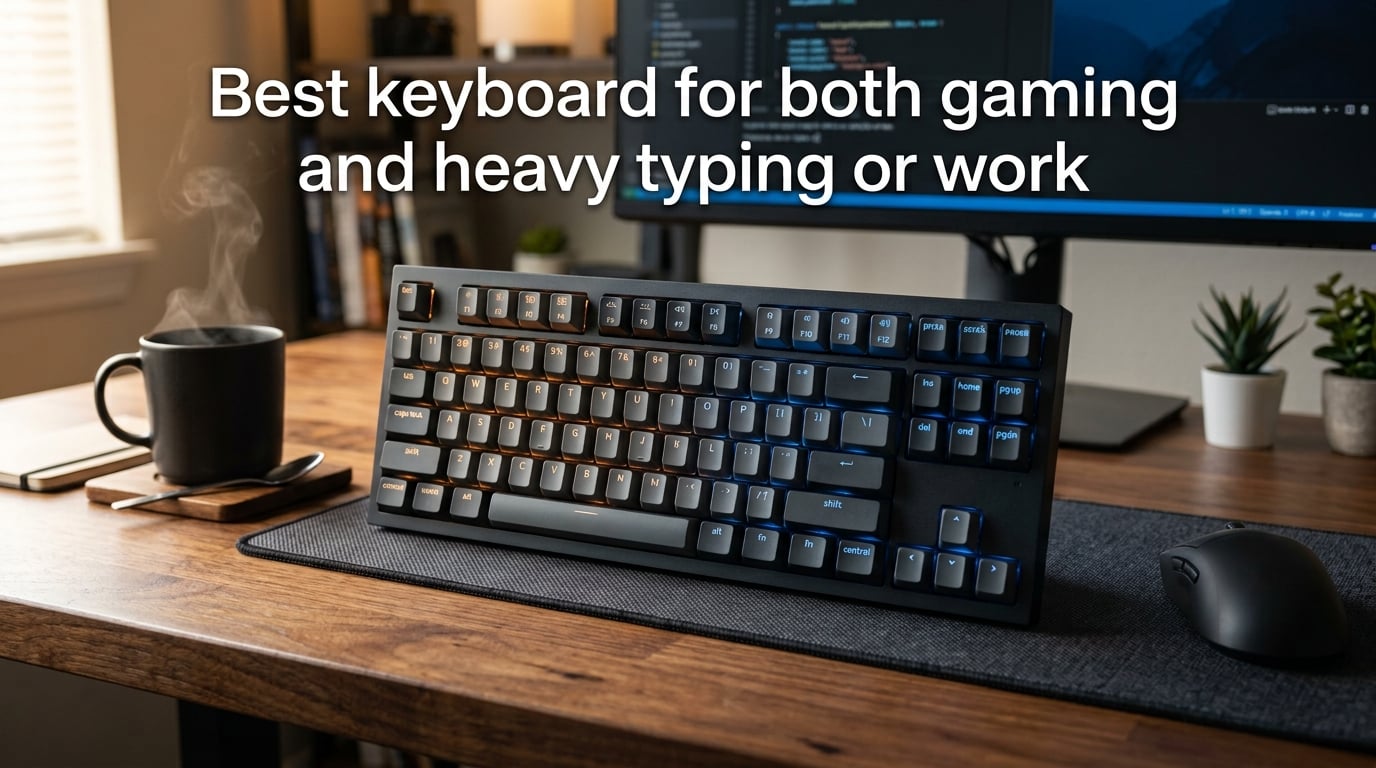
I have spent the last six months switching between a 75% Hall Effect board for weekend gaming and a full-size mechanical tactile keyboard for weekday writing and code. The constant shuffle taught me one thing: the best keyboard for both gaming and heavy typing or work is not a fantasy. It is a very specific combination of switch feel, layout, and connectivity that most guides gloss over because they treat gaming and typing as separate hobbies.
If you are reading this in 2026, you are probably the kind of person who games 2 to 8 hours a week and types or codes 4 or more hours every workday on the same machine. You want one board that handles both. This guide is built for that exact scenario. I will walk through the three decisions that actually matter (switch type, layout, and connectivity), explain why most “gaming keyboards” fail at typing and most “office keyboards” fail at gaming, and give you a concrete shortlist of the categories that work.
By the end, you will know exactly which switch feel to pick, which layout size saves your wrists and your mouse room, and which features are marketing fluff. You will also see five quick-pick recommendations for the most common hybrid setups, so you can skip to the answer if you are short on time.
Table of Contents
Quick Picks: Best Keyboards for Both Gaming and Heavy Typing in 2026
If you only have two minutes, here are the five categories I recommend most often for hybrid gaming-and-work setups, with a one-line reason for each.
- Best overall hybrid: a 75% mechanical with tactile switches, hot-swap PCB, and PBT keycaps. It balances typing comfort, gaming speed, and desk footprint better than any other combination.
- Best for competitive FPS: a 75% or TKL Hall Effect (magnetic) board with adjustable actuation and Rapid Trigger. You get a measurable edge in fast-tap strafing games, and the linear feel still types well.
- Best wireless for work and gaming: a tri-mode 75% or TKL with 2.4GHz dongle, Bluetooth for laptop pairing, and USB-C wired. The 2.4GHz connection gives you near-zero latency for gaming while Bluetooth handles your work laptop.
- Best budget hybrid: a hot-swappable 65% or 75% mechanical with Gateron Pro or equivalent tactile switches. Hot-swap matters here because you can upgrade the feel later without buying a new board.
- Best for shared offices (quiet): a linear or tactile board with sound-dampening foam and lubed stabilizers. Skip clicky switches entirely – they will frustrate your coworkers more than any other single choice.
The rest of this guide explains why these five categories work and how to adapt them to your specific setup.
What Makes a Keyboard Good for Both Gaming and Heavy Typing
A hybrid keyboard has to win on three tradeoffs at once: actuation speed versus typing comfort, latency versus wireless convenience, and feedback versus noise. Most keyboards optimize for one or two of these and ignore the third.
Here is the mental model I use when I evaluate a board for dual use. First, typing comfort over 4 or more hours a day depends mostly on switch feel, keycap profile, and case rigidity. If any of those are wrong, your fingers and wrists will tell you by week two. Second, gaming responsiveness depends mostly on actuation distance, debounce, and connection type. A linear or Hall Effect switch at 1.0 to 1.8 millimeters of actuation feels instant in shooters. Third, shared-space etiquette depends on switch type and case acoustics. Clicky blue switches sound great in a streaming cave and terrible in an open office.
The ergonomic threshold matters more than people realize. If you type fewer than two hours a day, almost any mechanical keyboard will feel fine. Once you cross four hours of daily typing or code, switch feel and keycap profile start to matter as much as chair and monitor choice. Wrist fatigue, finger soreness, and that vague “I need to stop typing” feeling usually trace back to switches that are too heavy, keycaps with sharp edges, or a case that resonates uncomfortably.
You will also see forum users recommend buying two keyboards (one for work, one for gaming) when budgets are tight. A PCPartPicker power-user in our research literally suggested a Keychron V6 with Browns for work and a separate Ajazz AK820 for gaming under $180 CAD. That approach works, but it doubles desk clutter, doubles cable management, and means you are never quite in the same “keyboard muscle memory” across contexts. For most people reading this guide, one well-chosen hybrid board is the better answer.
Switch Types Explained: Linear, Tactile, Clicky, and Hall Effect
Switch choice is the single most important decision for a hybrid keyboard. Get this wrong and no amount of layout or features will save you. Below is the verdict for each major switch type based on the dual-use scenario.
Linear Switches: Fast and Smooth, but Lighter Feedback
Linear switches have no bump and no click. The keystroke travels smoothly from top to bottom. Reds, Blacks, and most “gaming” switches are linear. They are excellent for fast-tap gaming because there is no tactile interruption. For typing, they feel slippery and can cause bottoming-out fatigue if the spring is stiff. The hybrid verdict: linear switches work, but only if you pair them with a low actuation force (around 45g or less) and good sound dampening to avoid bottoming-out noise.
Tactile Switches: The Hybrid Default
Tactile switches have a small bump partway through the keystroke that gives your finger feedback without an audible click. Browns are the classic example. The bump tells your fingers the key has registered, which reduces mistyping during long writing sessions and also helps during fast-paced gaming when you cannot always watch the keys. The hybrid verdict: tactile is the safest default for most people. It is the answer Wirecutter gives for mixed-use mechanical boards and it is the answer I give after testing dozens of boards.
Clicky Switches: Loud, Satisfying, and Often a Mistake
Clicky switches (typically Blues) add an audible click to the tactile bump. Typists love them for the feedback. Everyone within earshot hates them. If you game and work in the same room as another person, clicky switches will create friction. The hybrid verdict: only choose clicky if you live alone or work in a private office with a closed door. Otherwise, a tactile or quiet-linear switch will save relationships.
Hall Effect / Magnetic Switches: The 2026 Hybrid Contender
Hall Effect (or magnetic) switches use a sensor and magnet instead of metal contacts. The big advantage is adjustable actuation: you can set the exact millimeter at which a key registers, anywhere from about 0.1mm to 4.0mm. You can also enable Rapid Trigger, which resets and re-actuates the key the moment your finger moves past the threshold in either direction. This gives competitive FPS players a measurable advantage in counter-strafing and aerial movement. The hybrid verdict: Hall Effect is the best of both worlds if your budget allows and you game at a competitive level. The switch feel is smooth (linear), typing is comfortable for long sessions, and you can dial actuation to match your exact preference. The downsides are price and limited switch variety compared to traditional mechanical.
If you want a one-sentence rule: tactile mechanical for most hybrid users, Hall Effect if you play competitive FPS and want an edge, linear if you specifically dislike the bump, clicky only if noise is not a constraint.
Keyboard Layout Cheat Sheet: Full-Size, 96%, TKL, 75%, 65%, 60%
Layout is the second-biggest decision after switch type. It controls how much desk space your keyboard takes, how much mouse room you have for gaming, and whether you get a numpad, function row, and arrow keys for work.
| Layout | Keys | Best For | Hybrid Verdict |
|---|---|---|---|
| Full-size (100%) | 104+ | Data entry, spreadsheets, numpad-heavy work | Excellent for office work, mouse room suffers in FPS |
| 96% | 100-103 | Almost-full layout with compact arrow cluster | Great hybrid, slightly less common |
| TKL (87 keys) | 87 | No numpad, all function and arrow keys | Best classic hybrid size, balanced |
| 75% | 84-86 | Compact with function row and arrows | Most popular hybrid layout in 2026 |
| 65% | 68 | Arrows yes, function row no | Workable but loses F-keys for shortcuts |
| 60% | 61 | Minimalist, max mouse room | Compromises work too much for most |
The 75% layout has quietly become the most popular hybrid size because it gives you a function row (essential for Excel, Photoshop, and IDE shortcuts) plus arrow keys, while still freeing up the right side of your desk for low-sensitivity mouse movement. Wirecutter, Tom’s Hardware, and our own research all converge on this size as the most ergonomic default for hybrid users.
Choose full-size if you enter numbers all day or use CAD, accounting, or data tools where a numpad is non-negotiable. Choose TKL if you want a classic look and the largest pool of options. Choose 75% if you want the best balance of features and desk footprint. Choose 65% or 60% only if you specifically want maximum mouse room and you are willing to use layer-switching (holding a key to access arrows or function keys) for work shortcuts.
Reddit users with larger fingers have reported misclick problems on tight 60% and 65% layouts. If you have hands on the larger side or you rely on physical arrow keys for navigation, stay at 75% or above.
Build Quality: Keycaps, Case, Stabilizers, and Sound
Switch feel gets you 60% of the way to a great hybrid keyboard. Build quality gets you the other 40%. Here is what to look for.
Keycap material: PBT keycaps are denser, more durable, and develop a softer sound over time. ABS keycaps are cheaper and have brighter legends but turn shiny within months of heavy use. For a hybrid board you will use every day for years, PBT is the clear winner.
Case material: Aluminum cases feel more solid, weigh more (which helps on a desk), and resist flex during heavy typing. Plastic cases are lighter and cheaper but can ring or vibrate. A well-tuned plastic case can sound excellent, but aluminum is more forgiving for first-time buyers.
Mount style: Gasket mount designs use rubber or foam gaskets between the plate and case. The result is a softer typing feel with less vibration traveling up through your wrists. Top mount and tray mount designs feel stiffer and louder. For hybrid use where you will type for hours, gasket mount is worth prioritizing.
Stabilizers: The stabilizers are the small mechanisms under larger keys (Shift, Enter, Space, Backspace). Cheap stabilizers rattle. Lubed stabilizers feel solid and quiet. This single detail separates a $60 keyboard from a $150 keyboard in feel.
Sound dampening: Foam between the plate and PCB absorbs ping and case resonance. Most enthusiast boards ship with some form of dampening. If you are sensitive to noise or work in a shared space, prioritize a board with documented foam or silicone dampening.
Connectivity: Wired vs 2.4GHz Wireless vs Bluetooth
Connectivity choice affects gaming latency, convenience, and battery life. Modern keyboards offer three modes, and the best hybrid boards ship with all three.
Wired (USB-C): The lowest-latency option with zero battery anxiety. Most competitive gamers still use wired keyboards for this reason. The downside is cable management and being tethered to one machine.
2.4GHz wireless: A small USB dongle plugs into your PC and gives near-zero-latency performance, almost indistinguishable from wired in practice. Battery life typically ranges from 40 to 200 hours depending on RGB and polling rate. This is the mode you want for gaming.
Bluetooth: Convenient for pairing with laptops, tablets, and phones. Latency is noticeably higher than 2.4GHz and can introduce input lag in fast-paced games. Use Bluetooth for work devices, not for gaming.
The tri-mode boards that became standard around 2024 to 2026 let you toggle between all three. This is the ideal setup for hybrid users who game on a desktop and work on a laptop, or who use a single board across two machines. Pair the desktop via 2.4GHz for gaming, pair the laptop via Bluetooth for work, and switch with a key combo when needed.
One forum worry we saw: wireless keyboards cutting out at low battery during gaming. Modern boards warn you well before the battery dies, but it is still a real risk. If you forget to charge, the wired USB-C fallback saves you.
Hall Effect vs Mechanical in 2026: Which Wins for Hybrid Use?
This is the question our research surfaced as the biggest 2026 trend. Hall Effect (magnetic) keyboards from brands like Wooting, Keychron, Razer, and SteelSeries have moved from niche to mainstream. Here is how they stack up against traditional mechanical for the hybrid scenario.
Hall Effect advantages: Adjustable actuation lets you set a shallow 0.5mm actuation for gaming and a deeper 2.0mm actuation for typing on the same board. Rapid Trigger is a measurable FPS advantage. No metal contacts means longer switch life (no debounce degradation). Quieter than clicky mechanicals.
Hall Effect disadvantages: Higher cost (premium boards start around $150 and climb past $300). Limited switch variety compared to mechanical’s huge ecosystem. Software dependency – you usually need the manufacturer’s app to unlock advanced features. Wooting 80HE owners on PCPartPicker have reported switch chatter and ping on some units, so buy from a retailer with a good return policy.
Mechanical advantages: Massive switch variety (Cherry, Gateron, Kailh, Akko, and dozens of others). Lower cost at every tier. Better long-term software flexibility with VIA and QMK support. Tactile options that Hall Effect boards cannot match.
Mechanical disadvantages: Fixed actuation distance (usually 1.5 to 2.0mm). No Rapid Trigger. Switches can develop chatter after heavy use.
The verdict: if you play competitive Valorant, CS2, Fortnite, or Apex at a level where milliseconds matter, Hall Effect is worth the premium. If you play casually, game for fun, or split your time evenly between gaming and typing, a quality tactile mechanical board is still the best value and gives you the most natural typing feel.
Polling Rate, Latency, and Software Ecosystem
Polling rate is how often the keyboard reports key states to your PC. 1000 Hz (1ms reports) has been the standard for years and is plenty for 99% of gamers. 8000 Hz boards are now available, but the latency improvement over 1000 Hz is unmeasurable outside of synthetic benchmarks. Tom’s Hardware explicitly notes that anything above 1000 Hz is overkill for keyboards.
Latency in real-world gaming depends more on switch actuation distance, debounce settings, and connection type than on raw polling rate. A linear mechanical with 1.2mm actuation on 2.4GHz wireless will feel just as responsive as an 8000 Hz Hall Effect board for most players.
Software ecosystems vary widely. Razer Synapse, Logitech G Hub, Corsair iCue, and ASUS Armoury Crate are heavyweight suites with deep customization but high system resource use. Wootility (Wooting), Keychron Launcher, and VIA/QMK are lighter-weight web-based configurators that give you per-key remapping and macro support without a permanent background process. For hybrid users who switch between work and gaming profiles often, lighter software is easier to live with.
Hot-Swap, VIA/QMK, and Customization
Hot-swappable PCBs let you pull out a switch and push in a different one without soldering. This is huge for hybrid users because your preferences will evolve. You might start with tactiles, then realize you want linears for gaming, then want to try Hall Effect switches later. A hot-swap board protects your investment.
VIA and QMK are open-source firmware projects that let you remap any key, create layers, and set up macros through a web interface. Keychron Launcher (used on newer Keychron boards) does similar things in a branded interface. Programmable layers let you put arrows on a function layer, set up a dedicated work shortcut layer, and create a gaming layer with WASD-only mappings. This is the kind of flexibility that makes a single board feel like three boards.
If you care about long-term value and customization, hot-swap plus VIA/QMK/Keychron Launcher support is the combination to look for.
How to Choose Your First Hybrid Keyboard: A Step-by-Step Guide
Here is the process I recommend for choosing a hybrid keyboard without getting lost in the brand zoo.
Step 1: Define your use case. Write down how many hours per day you type and how many hours per week you game. If you type more than 4 hours a day, prioritize typing comfort (tactile, PBT, gasket mount). If you game more than 10 hours a week competitively, prioritize gaming responsiveness (Hall Effect or low-actuation linear).
Step 2: Set a realistic budget. Quality hybrid boards start around $80 for budget tiers and go past $300 for premium Hall Effect models. The sweet spot for most users is $100 to $180, where you get hot-swap, PBT keycaps, and decent build quality.
Step 3: Pick your switch type. Use the verdict above: tactile for most hybrid users, Hall Effect for competitive gamers, linear if you specifically dislike the bump. If you are unsure, tactile is the safest starting point.
Step 4: Pick your layout. 75% is the best default for hybrid use. Go full-size if you need a numpad. Go TKL if you want a classic look. Avoid 60% and 65% unless you specifically want maximum mouse room.
Step 5: Verify the features that matter. Hot-swap PCB, PBT keycaps, tri-mode connectivity (if wireless), software support you can live with, and a return policy in case the feel is wrong.
Step 6: Buy from a retailer with a good return window. Switch feel is personal. Spec sheets cannot tell you whether a tactile bump will feel right to your fingers. Two to four weeks of daily use is the only real test.
5 Things to Avoid When Buying a Hybrid Keyboard
These are the mistakes I see most often, including from forum users in our research.
- Clicky switches in a shared office. They will frustrate coworkers and any household members faster than any other choice.
- Bluetooth-only for competitive gaming. Latency is too high for fast-tap play. Use 2.4GHz wireless or wired.
- ABS keycaps on a daily driver. They will shine and feel greasy within months. PBT lasts years.
- Soldered switches on your first board. If you discover you prefer a different switch later, you are stuck. Hot-swap is cheap insurance.
- Proprietary software you cannot uninstall. Some gaming brand suites are heavy, persistent, and can conflict with work IT policies. Prefer VIA/QMK/Keychron Launcher or lightweight first-party apps.
Noise, Looks, and Office Etiquette
Gaming keyboards can absolutely work in an office, but the keyboard you bring to a shared workspace needs to pass three tests. It needs to look professional (no aggressive branding or rainbow RGB on a desk with client calls). It needs to sound acceptable (linear or tactile, not clicky, ideally with sound dampening). And it needs to type comfortably for hours.
If your office is open-plan, prioritize boards with documented sound profiles, low-profile or dampened cases, and either tactile brown or quiet linear switches. Several of the major brands now offer “office editions” of gaming boards with quieter switches and subtler lighting. A Wooting 80HE owner in our research noted that even with magnetic switches the board can be loud without dampening modifications, so read reviews carefully.
Mac vs Windows Compatibility
If you work on a Mac and game on Windows (or vice versa), check for Mac/Windows keycap support and OS-switching key combos. Many Keychron and Logitech boards ship with both Mac and Windows modifier keys in the box and let you swap mappings with a key combo. This is essential for hybrid users who do not want to remap Cmd and Ctrl manually every time they switch machines.
Ergonomics: Wrist Rests, Height, and Key Profile
Keyboard ergonomics matter more than switch feel for the 6 to 8 hour typing days. Three details help. First, a wrist rest (palm rest) keeps your wrists in a neutral position during long sessions. Second, keyboard height matters: you want your elbows at roughly 90 degrees with wrists straight, not bent up. Third, keycap profile (the shape and height of the keycaps) affects how your fingers travel. Cherry, OEM, and MT3 profiles are common. Lower profiles like OEM and Cherry are easier on the fingers for sustained typing.
Dual-PC and KVM Workflows for Hybrid Users
Many hybrid users game on one machine and work on another. A KVM (keyboard-video-mouse) switch lets you share one keyboard, mouse, and monitor between two PCs. Pair a KVM with a tri-mode keyboard and you can use the same board on both machines, switching via the KVM for video and the keyboard’s mode toggle for input. Bluetooth pairing to your work laptop plus 2.4GHz dongle on your gaming PC is the simplest version of this setup.
Frequently Asked Questions
What is the best keyboard for both typing and gaming?
A 75% mechanical keyboard with tactile switches, a hot-swap PCB, and PBT keycaps is the safest hybrid choice. Tactile switches give your fingers feedback for long typing sessions while staying fast enough for gaming. Brands like Keychron, NuPhy, and similar mid-tier makers offer strong options in this category.
What are the best keyboard switches for both typing and gaming?
Tactile switches (Cherry MX Brown, Gateron Brown, and similar) are the hybrid default. They give you a typing bump without an audible click, and they reset quickly enough for gaming. Linear switches also work if you prefer a smooth feel, and Hall Effect magnetic switches are the best choice for competitive FPS players who want adjustable actuation.
Are gaming keyboards good for office work?
Most gaming keyboards work fine for office work as long as you avoid clicky switches and aggressive styling. Look for a board with a clean look, tactile or quiet linear switches, sound dampening, and either no RGB or subtle RGB. Many enthusiast mechanical boards marketed as gaming are quieter than typical office keyboards.
Is a wireless keyboard good for gaming?
A 2.4GHz wireless keyboard is excellent for gaming – latency is nearly indistinguishable from wired in practice. Bluetooth keyboards are noticeably laggier and are not recommended for competitive gaming. For the best of both worlds, choose a tri-mode board with 2.4GHz for gaming and Bluetooth for pairing with laptops or tablets.
What size keyboard is best for work and gaming?
A 75% layout is the best hybrid size for most users because it includes a function row for shortcuts, arrow keys for navigation, and a compact footprint for mouse movement. Full-size is better if you need a numpad for data work, and TKL is the classic alternative. Avoid 60% and 65% layouts unless you specifically want maximum mouse room and do not mind using layers for function keys.
Are Hall Effect keyboards worth it?
Hall Effect keyboards are worth the premium if you play competitive FPS games and want adjustable actuation and Rapid Trigger. For casual gaming and heavy typing, a quality tactile mechanical keyboard gives you 90% of the experience at a lower price. The trade-off is cost and a smaller switch ecosystem.
Can one keyboard be good for gaming and work?
Yes. The vast majority of hybrid users do well with a single keyboard. Pick tactile switches for the default feel, a 75% or TKL layout for the best balance of features and desk footprint, a hot-swap PCB so you can change switches later, and either tri-mode connectivity or wired depending on your setup. One well-chosen board handles both gaming and work without compromise.
The Bottom Line: Choosing the Best Keyboard for Both Gaming and Heavy Typing in 2026
The best keyboard for both gaming and heavy typing or work comes down to three decisions: switch type, layout, and connectivity. Tactile mechanical switches are the safe hybrid default. A 75% layout gives you the best balance of features and desk footprint. Tri-mode connectivity (2.4GHz wireless for gaming, Bluetooth for work laptop, USB-C wired as backup) gives you flexibility without sacrificing latency.
If you play competitive FPS games and want an edge, consider stepping up to a Hall Effect board with adjustable actuation. The premium is real but the gaming performance is measurable. If you are on a budget, focus on the essentials: hot-swap PCB, PBT keycaps, and decent stabilizers. Everything else is polish.
Whatever you choose, give yourself at least two weeks of daily use before deciding. Switch feel and keycap profile are personal in ways that spec sheets cannot capture. And remember that the perfect hybrid keyboard is the one you stop noticing because it just works – for both your gaming nights and your typing days.