
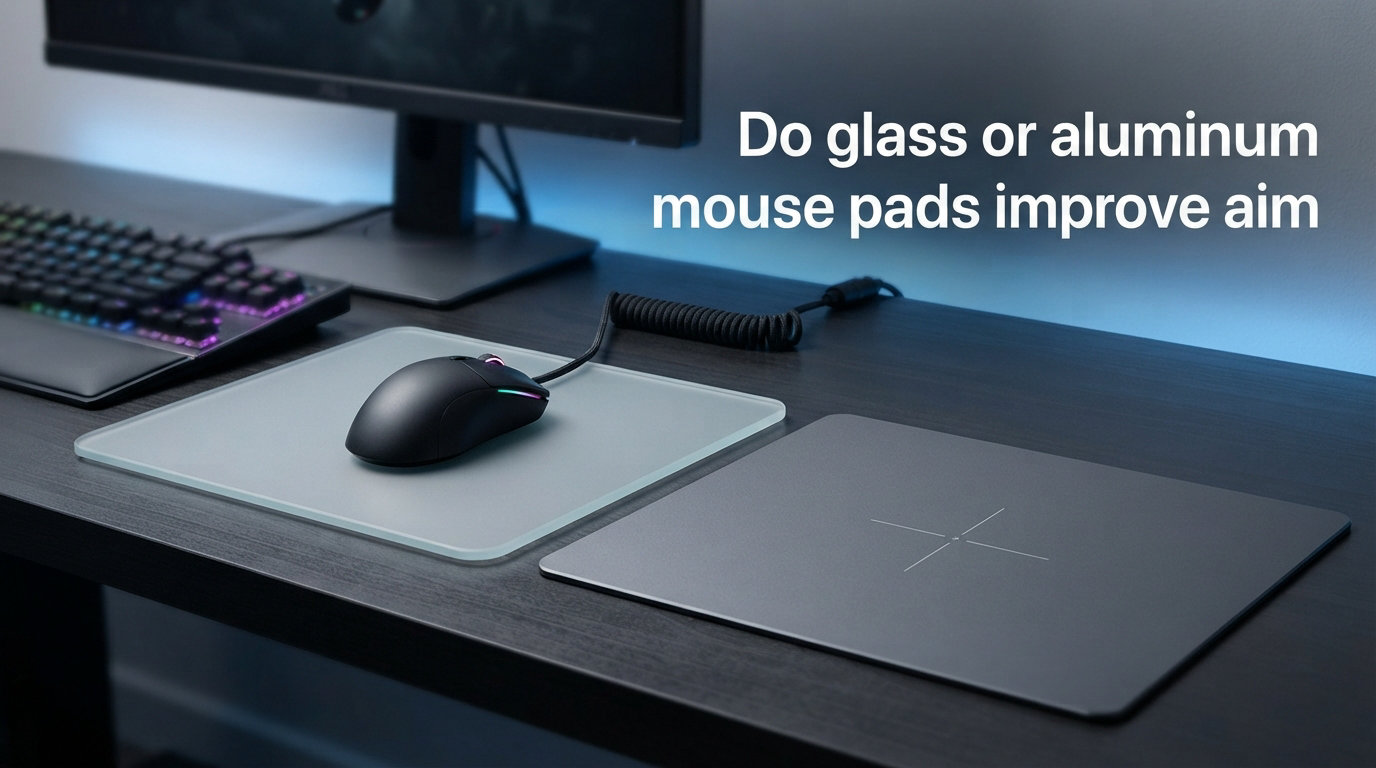
Glass and aluminum mouse pads can improve aim consistency, but they won’t magically make you a better aimer. What they do is eliminate the variable friction and texture inconsistencies found in cloth pads, giving you a more predictable glide. This helps players achieve smoother tracking and cleaner micro-adjustments over time, though the improvement comes with an adjustment period that varies by player.
Most FPS gamers grow up using cloth mouse pads, so hard surfaces like glass and aluminum feel foreign at first. The mouse moves faster, stopping feels different, and your muscle memory needs time to recalibrate. But for players willing to put in the practice, these materials offer something cloth cannot: a surface that performs identically whether it’s brand new or two years old.
In this guide, I’ll break down exactly how glass and aluminum mouse pads affect aim, compare the two materials head to head, and help you decide which surface fits your playstyle. I’ve spent time researching forum discussions, pro player feedback, and technical friction data to give you the complete picture.
Table of Contents
How Mouse Pad Surface Material Affects Your Aim
Your mouse pad is the surface your sensor reads thousands of times per second. The material underneath determines three critical properties: initial friction (how much force starts movement), dynamic friction (how much resistance exists during movement), and stopping power (how quickly the mouse halts).
On cloth pads, these values shift over time. Humidity, sweat, wear patterns, and fabric compression all change the friction profile. A cloth pad you bought six months ago doesn’t feel the same as it did on day one. This inconsistency is what drives many competitive players toward hard surfaces.
Glass and aluminum solve the consistency problem differently. Glass offers near-zero initial friction with very uniform glide across the entire surface. Aluminum provides more textured feedback with controlled friction, giving players a tactile sense of where the mouse is. Neither approach is universally better. It depends on what your aim style needs.
The key insight is this: mouse pad material affects the feel of your aim, not your raw mechanical skill. A player with shaky fundamentals will still overshoot on glass. But a player with solid mechanics who feels held back by inconsistent cloth glide may find hard surfaces unlock more reliable performance, especially in high-pressure situations.
Glass Mouse Pads: Speed and Consistency
Glass mouse pads use tempered glass with a micro-etched surface that creates a near-frictionless glide. The etching gives optical sensors consistent tracking data while keeping the surface smooth enough for effortless mouse movement. Brands like SkyPAD, Pulsar, and Wallhack have popularized this category in recent years.
The standout benefit for aim is consistency. Every square centimeter of a glass pad feels identical, which means your tracking stays uniform whether you’re moving from center to edge or making tiny circular corrections. Players who switched to glass frequently report immediate improvements in tracking scenarios in aim trainers like Kovaak’s, even before fully adjusting to the new surface.
One Reddit user described getting high scores in Kovaak’s without deliberate practice after switching to glass, suggesting the material itself improved tracking consistency. Multiple forum users echo this: glass helps with smooth tracking movements more than flick shots, at least initially.
However, glass pads come with trade-offs. Micro-adjustments feel very difficult at first because the low friction means tiny wrist movements produce larger cursor shifts than expected. Overshooting becomes a real problem during the first week or two. The surface also makes worn mouse skates feel rough and loud, so you’ll need PTFE skates in good condition.
Temperature is another factor. Glass feels cold in winter and can get uncomfortably warm with extended use. Many players end up wearing an arm sleeve, which itself requires an adjustment. One user noted that wearing an arm sleeve “feels like a goof” but is necessary for consistent glass pad use.
For cleaning, glass is the easiest material to maintain. A quick wipe with a microfiber cloth removes oils, dust, and sweat instantly. Unlike cloth, there’s no fiber compression, no staining, and no need for deep cleaning. The surface performs the same whether you cleaned it yesterday or last week.
Aluminum Mouse Pads: Control and Durability
Aluminum mouse pads feature an anodized or brushed metal surface that offers more texture than glass. This texture creates natural stopping resistance, giving players tactile feedback about mouse speed and position. While glass pads are all about smooth glide, aluminum pads balance glide with control.
The surface on aluminum pads is typically micro-textured through brushing or anodization, which creates tiny grooves that interact with mouse skates. This produces a feel that’s faster than cloth but more controlled than glass. Players who want speed without losing their sense of where the mouse is often prefer aluminum.
Durability is where aluminum really shines. A quality aluminum pad won’t scratch, warp, or degrade from sweat exposure. Anodized surfaces resist corrosion and maintain their texture for years. Unlike glass, aluminum won’t crack if dropped, making it a safer choice for LAN events or frequent transport.
The tactile feedback from aluminum helps with flick shots in particular. You can feel the surface texture through your skates, which provides sensory information about mouse speed that glass cannot. For tactical FPS players in games like Valorant or CS2, this feedback loop can improve crosshair placement confidence.
Cleaning aluminum is straightforward. Wipe it down with a damp cloth and it’s ready to go. The material doesn’t absorb oils the way cloth does, though it can show fingerprints and smudges more readily than glass. Some users prefer the slightly textured grip that develops on aluminum over time.
One notable difference: aluminum pads tend to be thinner and lighter than glass equivalents, making them slightly more portable. They also stay closer to room temperature, avoiding the cold shock of glass in winter.
Glass vs Aluminum Mouse Pads: Head-to-Head Comparison
Both materials outperform cloth in consistency and durability, but they serve different aim philosophies. Here’s how they stack up across the factors that matter most for gaming performance.
Glide speed: Glass is faster. The near-zero friction means less effort to start and maintain mouse movement. Aluminum is moderately fast, sitting between glass and cloth in friction profile. If you want maximum speed, glass wins. If you want fast but controllable, aluminum is the better choice.
Stopping power: Aluminum provides more natural stopping resistance due to its textured surface. Glass requires you to learn active stopping techniques since the surface won’t slow your mouse for you. Players who rely on the pad to help stop their mouse will adapt to aluminum faster.
Tracking consistency: Both materials beat cloth handily. Glass edges out aluminum slightly because its surface is perfectly uniform, while aluminum’s micro-texture can introduce very subtle variations. The difference is small enough that most players won’t notice it outside aim training software.
Flick shots: Aluminum offers better sensory feedback during flicks, letting you “feel” the speed through your skates. Glass flicks feel smoother but less controlled initially. Over time, players develop stopping techniques for glass that match aluminum’s natural feedback.
Durability: Aluminum is more durable in practical terms. It won’t crack if dropped and resists scratches well. Glass is highly scratch-resistant but vulnerable to impact damage. Both materials last years under normal use, far outlasting cloth pads.
Cleaning: Glass is easier. A single wipe restores it completely. Aluminum requires slightly more effort to clean textured grooves but is still much easier than cloth. Neither material absorbs sweat or develops odor.
Comfort: Aluminum maintains a neutral temperature and doesn’t require arm sleeves for most users. Glass can feel cold initially and often necessitates arm sleeves due to skin friction. For long gaming sessions, aluminum tends to be more comfortable out of the box.
Price: Glass mouse pads typically cost more than aluminum equivalents. Premium glass pads from brands like SkyPAD or Wallhack sit at the high end, while quality aluminum pads offer similar performance benefits at a lower investment.
Which Surface Improves Which Type of Aim?
Different aim types benefit from different surface properties. Understanding this can save you from buying the wrong material for your playstyle.
Tracking aim (following moving targets in Apex Legends, Overwatch, or Fortnite) benefits most from glass. The uniform, low-friction glide lets you maintain smooth crosshair movement without stutter or resistance. Players who primarily track should strongly consider glass mouse pads.
Flick aim (snapping to targets in Valorant, CS2, or Rainbow Six Siege) works well on both surfaces but may feel more natural on aluminum initially. The textured surface gives sensory feedback that helps you gauge how far and fast you’re moving. Experienced players can flick effectively on glass too, but the learning curve is steeper.
Micro-adjustments (tiny corrections while holding angles or pre-aiming) are the hardest skill to maintain on hard surfaces. Glass makes micro-adjustments feel overly sensitive at first. Aluminum’s slight texture resistance makes these small movements easier to control, especially for lower-sensitivity players.
Low-sensitivity players (large arm movements, 20+ cm/360) benefit from both materials but should consider pad size carefully. Glass pads are often smaller due to manufacturing constraints, which can be limiting for low-sens players. Aluminum pads come in a wider range of sizes.
High-sensitivity players (wrist-dominant, under 20 cm/360) may find glass too fast initially since small wrist movements translate to large cursor shifts. Aluminum provides a better speed floor for high-sens players who want consistency without uncontrollable glide.
Tactical FPS players (Valorant, CS2, Siege) who hold angles and rely on crosshair placement may prefer aluminum’s control characteristics. The slight stopping resistance helps with the deliberate, precise movements these games demand.
Tracking-heavy FPS players (Apex Legends, Overwatch 2, The Finals) who need smooth, continuous aim will likely get more from glass. The frictionless glide rewards players who can maintain smooth tracking patterns.
Switching From Cloth: What to Expect
Switching from cloth to a hard surface is a significant adjustment, regardless of whether you choose glass or aluminum. Here’s what the first few weeks look like based on feedback from hundreds of players who’ve made the switch.
Days 1-3: Everything feels too fast. You’ll overshoot targets constantly and your aim will feel chaotic. This is normal. Your muscle memory is calibrated for cloth friction, and both glass and aluminum have much lower resistance. Don’t make sensitivity changes yet.
Days 4-10: Your brain starts adapting. Overshooting decreases, but micro-adjustments still feel imprecise. This is the most frustrating period. Many players switch back to cloth during this window, missing the adaptation by days.
Days 10-21: The new surface starts feeling normal. Your tracking will likely show measurable improvement in aim trainers. Flick shots become more confident. You may notice your grip style shifting slightly, moving toward more fingertip contact.
Mouse skates matter: Worn PTFE skates feel terrible on hard surfaces. Fresh skates make a dramatic difference in glide quality and noise level. Budget for new skates when you buy a hard pad.
Arm sleeve recommendation: Glass pad users almost universally recommend arm sleeves to prevent skin friction and sweat from affecting glide. Aluminum users can often skip this, though sleeves still help with consistency. It feels unusual at first but quickly becomes normal.
Sensitivity adjustment: Resist changing your sensitivity for at least two weeks. Your aim is adjusting to the surface, and changing sensitivity simultaneously creates too many variables. If you still feel uncomfortable after two weeks, consider a small sensitivity increase of 5-10% to compensate for the faster glide.
Frequently Asked Questions
Do glass mouse pads actually improve aim?
Glass mouse pads improve aim consistency rather than raw aim skill. They eliminate friction variations found in worn cloth pads, which helps with tracking smoothness and micro-adjustment reliability. Players with solid fundamentals typically see measurable improvement within 2-3 weeks of adjustment.
Are aluminum mouse pads good for FPS gaming?
Aluminum mouse pads are excellent for FPS gaming, especially tactical shooters like Valorant and CS2. They offer faster glide than cloth with more natural stopping power than glass, making them a balanced choice. The textured surface provides tactile feedback that helps with flick shots and crosshair placement.
Which is better for aim, glass or aluminum?
Neither is universally better. Glass excels at tracking aim and consistency, while aluminum offers better control and stopping power for flick-based aim. Tracking-heavy game players (Apex Legends, Overwatch) tend to prefer glass. Tactical FPS players (Valorant, CS2) often prefer aluminum. Your playstyle determines the best choice.
Why do most pro gamers not use glass mouse pads?
Most pros stick with cloth pads because they’ve trained on cloth for years and switching would disrupt their muscle memory during competition. Some pros do use glass pads, but the adjustment period makes switching risky for players whose income depends on consistent performance. For developing players, the switch can be worthwhile.
How long does it take to adjust to a glass mouse pad?
Most players need 10-21 days of regular use to fully adjust to a glass mouse pad. The first week feels chaotic with frequent overshooting. By the second week, tracking begins to feel natural. Micro-adjustments typically take the longest to recalibrate, sometimes up to a month for precision-dependent players.
Do I need an arm sleeve for a glass mouse pad?
Yes, an arm sleeve is strongly recommended for glass mouse pads. Bare skin creates friction against the glass surface, causing inconsistent glide and uncomfortable pulling. Arm sleeves eliminate this friction completely. Most experienced glass pad users consider sleeves essential equipment rather than optional accessories.
Can I use any mouse skates on a glass pad?
PTFE (Teflon) skates work best on glass mouse pads. Avoid worn skates entirely, as degraded PTFE creates rough, loud glide on glass. Hard or ceramic skates can scratch glass surfaces. Fresh, quality PTFE skates from brands like Corepads or Tiger Ice provide the smoothest experience on both glass and aluminum.
Is a hard mouse pad better for low sensitivity?
Hard mouse pads can work well for low sensitivity, but pad size matters more than material. Both glass and aluminum pads offer the consistent glide that low-sens players need for large arm movements. However, glass pads are often smaller than cloth alternatives, so measure your required play area before purchasing.
Final Verdict
So, do glass or aluminum mouse pads improve aim? The honest answer is: they improve consistency, which indirectly improves aim over time. Neither material will turn a bad aimer into a good one, but both can help a good aimer become more reliable.
Glass mouse pads are the better choice if you prioritize tracking consistency, play tracking-heavy games, and are willing to invest time in adjustment plus an arm sleeve. Aluminum mouse pads are the better choice if you want a faster surface with natural stopping power, play tactical FPS games, or prefer a material that works immediately without accessories.
For players still using worn cloth pads with inconsistent glide, either material will feel like a significant upgrade. The key is committing to the adjustment period and resisting the urge to switch back during the frustrating first week. Your aim will thank you for the patience.