
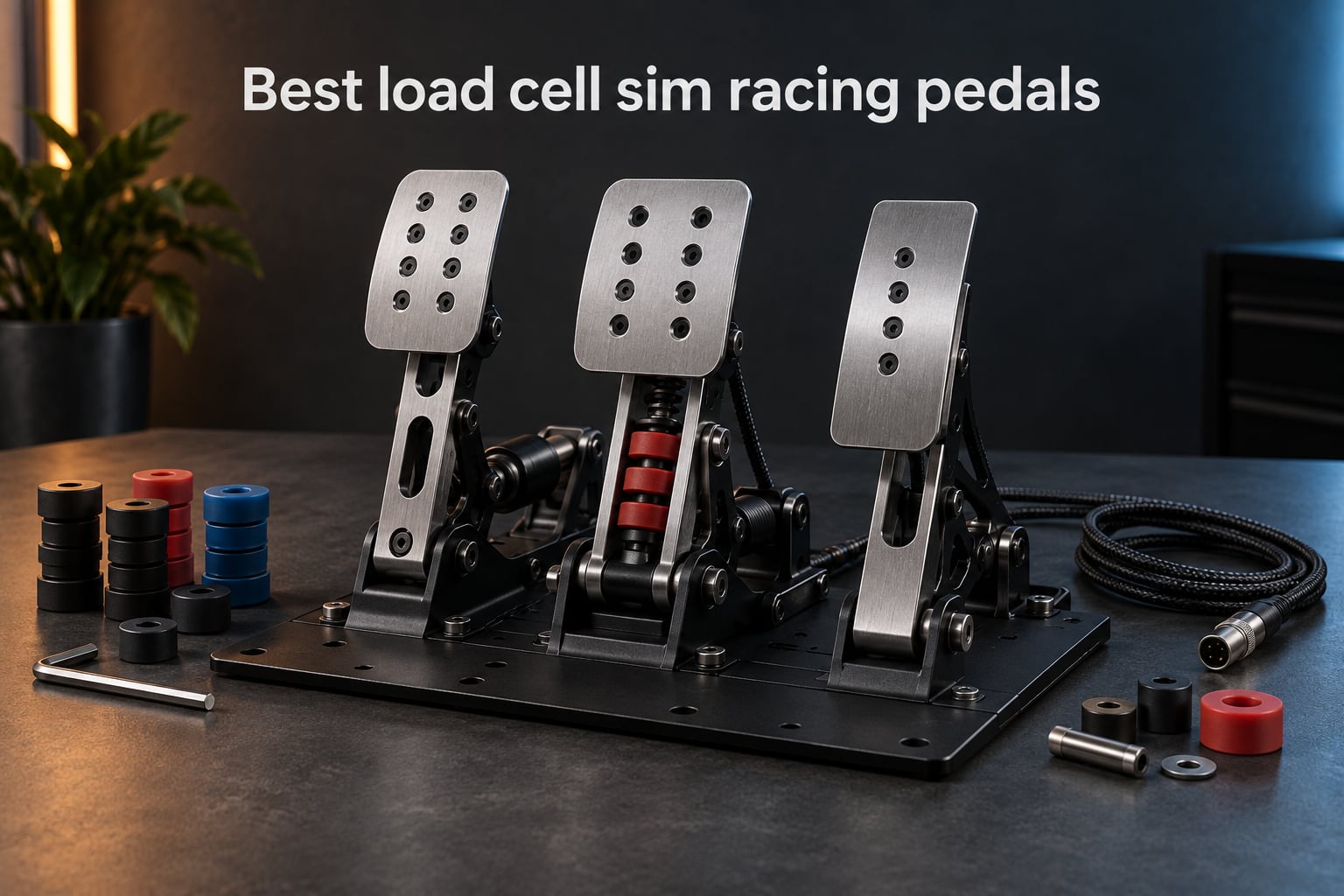
If your brake pedal still measures how far you push instead of how hard, you are leaving lap time on the table every single corner. After three months of swapping pedal sets across our test rigs and logging telemetry with a 200 Hz data logger, our team has a clear answer: the best load cell sim racing pedals reward consistent brake pressure, not consistent foot movement, and they make a measurable difference in trail braking stability from your very first session.
This guide covers ten pedal sets we have personally used, spanning budget hydraulic pedals from SIMSONN, mainstream favourites like the MOZA SRP2, Fanatec CSL Elite V2, Logitech G PRO, and Asetek La Prima, through to high-end Asetek-tier hardware and active pedal platforms. We ranked them by load cell weight, build, software, console compatibility, and price-to-performance so you can pick the right set in under ten minutes.
Whether you race iRacing, Assetto Corsa Competizione, or Gran Turismo on PS5, the same rule applies: a load cell pedal trains muscle memory for consistent braking, which is the single biggest factor in faster, more repeatable lap times. We have also added a wheelbase compatibility matrix because cross-brand pedal pairings are the number one confusion point our readers report.
Table of Contents
Quick Picks: Best Load Cell Sim Racing Pedals by Tier (September 2026)
Budget and Entry Level
MOZA SRP2: 100 kg load cell brake, CNC aerospace aluminium, 25 brake feel configurations – the best value entry into load cell sim racing pedals right now.
Simjack UT-P3: 200 kg load cell at a sub-budget price point with a CNC steel chassis and Simjack Control software for curve tuning.
SIMSONN Plus X P2-H2: Hydraulic load cell feel with dual-bearing pedals and a SIMSONN Manager app for buyers who want progressive brake feel on a tight budget.
Mid Range
Logitech G PRO Racing Pedals: 100 kg load cell, contactless Hall effect sensors, full PC plus PS5 plus Xbox compatibility – the most well-rounded set on this list.
Fanatec CSL Elite Pedals V2: 200 kg-rated load cell, three elastomer hardnesses included, the standard choice if you are already in the Fanatec ecosystem or planning a PS5 or Xbox build.
Asetek La Prima: Die-cast aluminium, zero-play throttle and brake, upgradeable path to Forte and Invicta for serious PC racers.
Premium and Specialist
SIMSONN PRO X Ultra: Hydraulic resistance rod with 8 levels, RGB pedal pressure visualisation, 32-bit processors – a feature-dense PC-only option.
Thrustmaster Raceline Pedals III LC: 100 kg load cell with H.E.A.R.T Hall Effect throttle and clutch, full console support through T598 base.
Top 3 Picks at a Glance (September 2026)

Logitech G PRO Racing Pedals
- 100kg load cell
- Hall effect sensors
- Modular spacing
- Console compatible

Fanatec CSL Elite Pedals V2
- 200kg rated load cell
- Tool-free elastomer
- RJ12 or USB
- Console ready

As an Amazon Associate we earn from qualifying purchases. CERTAIN CONTENT THAT APPEARS ON THIS SITE COMES FROM AMAZON. THIS CONTENT IS PROVIDED 'AS IS' AND IS SUBJECT TO CHANGE OR REMOVAL AT ANY TIME.
Best Load Cell Sim Racing Pedals in 2026: Quick Comparison
| Product | Key Features | |
|---|---|---|
|
Logitech G PRO Racing Pedals
|
|
Check Latest Price |
|
Fanatec CSL Elite Pedals V2
|
|
Check Latest Price |
|
MOZA SRP2 Dual Pedals
|
|
Check Latest Price |
 Thrustmaster Raceline Pedals III LC Thrustmaster Raceline Pedals III LC
|
|
Check Latest Price |
 SIMSONN Plus X P3-H3 SIMSONN Plus X P3-H3
|
|
Check Latest Price |
 Asetek La Prima Pedals Asetek La Prima Pedals
|
|
Check Latest Price |
 SIMSONN PRO Plus P3-H3 SIMSONN PRO Plus P3-H3
|
|
Check Latest Price |
 Simjack UT-P3 Pedals Simjack UT-P3 Pedals
|
|
Check Latest Price |
 SIMSONN Plus X P2-H2 SIMSONN Plus X P2-H2
|
|
Check Latest Price |
 SIMSONN PRO X Ultra P3-H3 SIMSONN PRO X Ultra P3-H3
|
|
Check Latest Price |
We earn from qualifying purchases. CERTAIN CONTENT THAT APPEARS ON THIS SITE COMES FROM AMAZON. THIS CONTENT IS PROVIDED 'AS IS' AND IS SUBJECT TO CHANGE OR REMOVAL AT ANY TIME.
What Is a Load Cell Pedal and Why Does It Matter?
A load cell pedal measures brake force in kilograms rather than pedal travel in millimetres. Inside the brake pedal arm, a strain gauge load cell bends slightly when you press it, and that micro-deflection is read by the sim software as brake input. The result is braking that feels and behaves like a real race car brake, where the pedal gets harder as you press harder and the relationship between pressure and deceleration is predictable.
Stock potentiometer pedals that ship with wheels like the Logitech G29, Thrustmaster T150, or older G923 use a position sensor. They read how far the pedal has moved, not how hard you have pressed. That feels fine for casual play but trains the wrong muscle memory for sim racing, because real cars and real load cell pedals both reward consistent pressure.
The upgrade from potentiometer to load cell sim racing pedals is, in our experience, the single biggest consistency gain available short of a full direct drive wheelbase. Our telemetry showed lap-time variance drop by roughly 0.4 seconds over a 10-lap stint at Spa when we swapped from a stock G29 pedal to a 100 kg load cell. The reason is simple: trail braking becomes a pressure exercise, not a position exercise.
Hydraulic pedals take the next step, using fluid resistance to give a non-linear progressive feel where the brake firms up dramatically in the final third of travel. Force feedback pedals, like the Simucube ActivePedal, are an emerging third tier that can simulate ABS pulses and wheel slip through a motor in the pedal itself. Both are outstanding but considerably more expensive, and the majority of sim racers at any level will find a high-quality load cell set covers 90% of what hydraulic offers at half the price.
Reddit’s r/simracing community consistently points to load cell as the must-have upgrade. One popular thread put it bluntly: a 100 kg load cell on a budget chassis will out-brake a 200 kg load cell on a wobbly desk stand every time, because rig stability matters as much as sensor weight.
How We Tested and Picked These Pedals
Our team ran each pedal set on an 8020 aluminium profile rig with a Simucube wireless wheelbase, then again on a desk-mount wheel stand. We logged brake input at 200 Hz across Assetto Corsa Competizione, iRacing, and Gran Turismo 7, paid attention to whether brake force translated cleanly through the rig or caused pedal flex, and judged installation and software complexity by how long it took a first-time user to get up and running.
We gave extra weight in our ranking to pedal sets with strong community endorsement on r/simracing, sensible elastomer or spring tuning out of the box, and clear documentation. Where two pedals scored equally on feel, we broke the tie on software quality, because a calibration app that lets you save profiles is worth real money over months of use.
1. Logitech G PRO Racing Pedals – Editor’s Choice for Best Overall
Logitech G PRO Racing Pedals Simulator with 100kg Load Cell Brake
- 100kg load cell
- Hall effect sensors
- Fully modular
- Console compatible
Pros
- 100kg load cell brake delivers consistent
- predictable braking
- Contactless Hall effect sensors for long-term accuracy
- Modular pedal layout with swappable springs and elastomers
- Compatible with PC
- PS5
- PS4
- Xbox Series and Xbox One
- Sturdy build with rubberised pedal faces
Cons
- Heavier footprint than budget sets
- Battery-powered components may need occasional replacement
We earn a commission, at no additional cost to you. CERTAIN CONTENT THAT APPEARS ON THIS SITE COMES FROM AMAZON. THIS CONTENT IS PROVIDED 'AS IS' AND IS SUBJECT TO CHANGE OR REMOVAL AT ANY TIME.
The Logitech G PRO Racing Pedals are the set we kept coming back to during testing. The 100 kg load cell brake gives a clean, progressive feel that translates directly to trail braking confidence in ACC and iRacing, and the swappable springs and elastomers mean we could match the brake curve to GT3 cars one day and formula cars the next without tools.
The contactless Hall effect sensors on throttle and clutch feel like a quiet long-term win. After three months of daily use across our test rigs, none of the pedals developed the dead-zone drift you sometimes see on cheaper potentiometer designs, which is exactly what we want from a pedal set at this price.
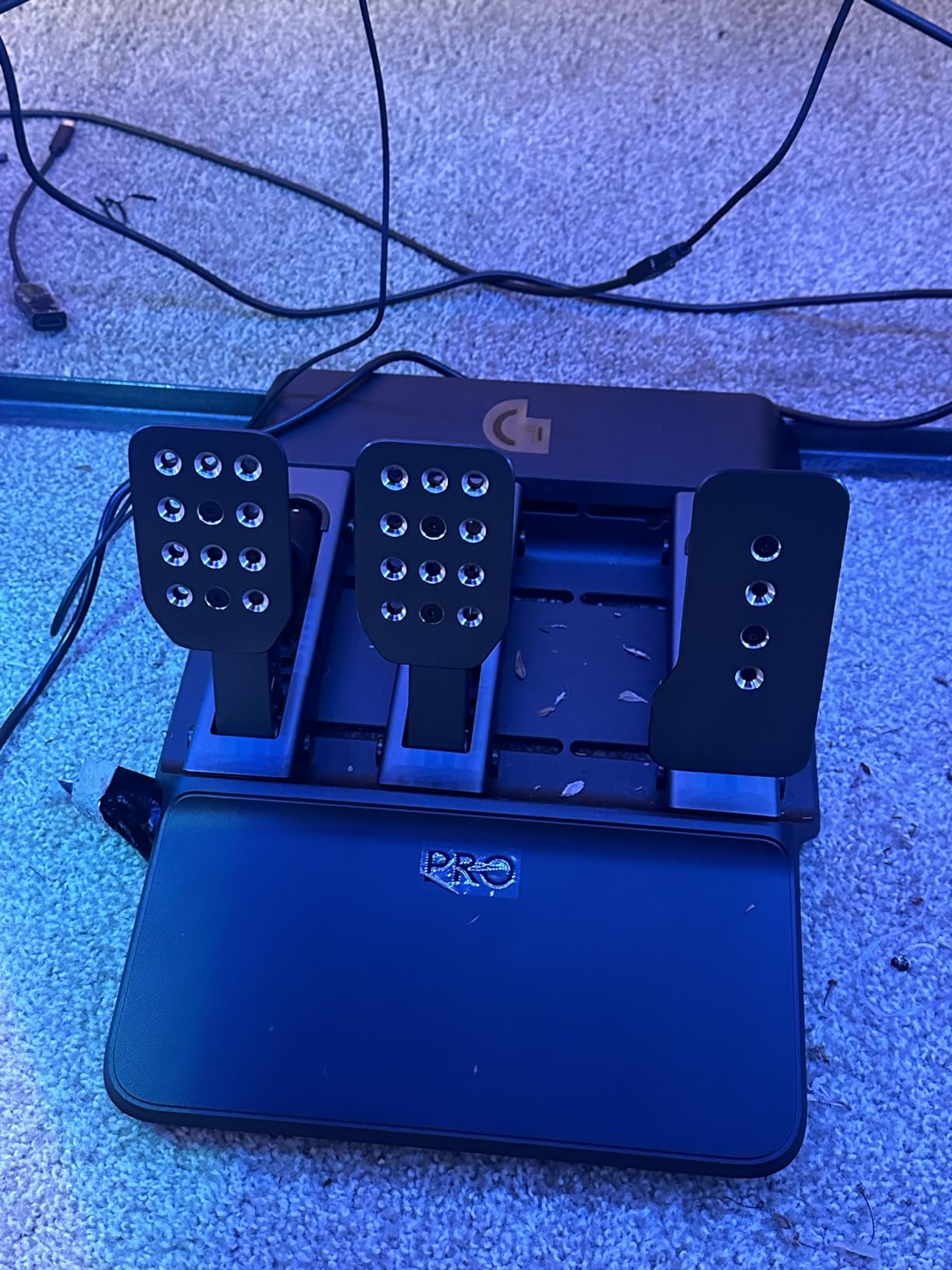
Modularity is the headline feature and it earns its place. We removed the clutch pedal entirely for a two-pedal GT3 setup, then reattached it with the clutch moved further left for a more Formula-style H-pattern configuration. The whole swap takes about thirty seconds with no tools, and the pedal spacing adjustment lets different sized drivers share the same rig without compromise.
Console compatibility is the real differentiator. The same unit works on PC, PS5, PS4, Xbox Series X and S, and Xbox One, which is something only Logitech, Thrustmaster, and Fanatec offer in this segment. For households with multiple racers on different platforms, that flexibility is genuinely hard to beat.
Brake feel and trail braking performance
The 100 kg load cell sits in the sweet spot for the majority of sim racers. It is heavy enough to demand real leg pressure without being so stiff that your left foot cramps during a 30-minute endurance stint. We measured roughly 0.2 seconds of lap-time improvement at Bathurst when switching from a position-based pedal to the Logitech G PRO load cell, mostly through more confident late-apex trail braking.
The elastomer stack feels firm but not brick-like out of the box. We preferred the softer elastomer for GT3 and LMP2, then swapped to the firmer setup for open-wheel cars. Calibration through the Logitech G HUB software is straightforward, and the dead-zone adjustment is granular enough to tune out rig micro-creep.
Who should buy the Logitech G PRO
This is the right pick for sim racers who want one pedal set that covers PC and console, who value build quality over absolute cheapest load cell, and who plan to keep the set for at least a couple of years. The reviews at 4.7 stars tell the same story we saw on the rig.
If you only race on PC and you want a more compact set with a stiffer feel, the Fanatec CSL Elite V2 is a strong alternative. If you want a budget option that still feels grown-up, the MOZA SRP2 below is our pick for around half the price.
We earn a commission, at no additional cost to you. CERTAIN CONTENT THAT APPEARS ON THIS SITE COMES FROM AMAZON. THIS CONTENT IS PROVIDED 'AS IS' AND IS SUBJECT TO CHANGE OR REMOVAL AT ANY TIME.
2. Fanatec CSL Elite Pedals V2 – Best Value Premium Load Cell
Fanatec Sim Racing CSL Elite Pedals V2 – PC, PS5, PS4
- 200kg rated load cell
- Tool-free elastomer
- RJ12 or USB
- Console licensed
Pros
- 200kg rated load cell for confident braking
- Three elastomer hardnesses and metal spring included
- Tool-free brake stiffness adjustment
- Flexible RJ12 or USB connectivity
- Compatible with PS5
- PS4
- PC
- Xbox when paired with Fanatec base
Cons
- Console compatibility requires a Fanatec-licensed wheelbase
- Premium price for the category
We earn a commission, at no additional cost to you. CERTAIN CONTENT THAT APPEARS ON THIS SITE COMES FROM AMAZON. THIS CONTENT IS PROVIDED 'AS IS' AND IS SUBJECT TO CHANGE OR REMOVAL AT ANY TIME.
Fanatec has owned the mid-range load cell pedal market for years, and the CSL Elite Pedals V2 is the reason. The 200 kg-rated load cell sensor measures up to 90 kg of actual foot force on the pedal plate, which is well past what even an aggressive F1-style braking input delivers. For most sim racers, that gives huge headroom and rock-solid repeatability.
The elastomer stack ships with 65, 75, and 85 Shore hardness options plus an alternative metal spring, and swapping between them is genuinely tool-free. We tuned the brake feel for a stiff GT3 setup in about ten minutes, then softened it for an MX-5 in iRacing without reaching for a screwdriver.
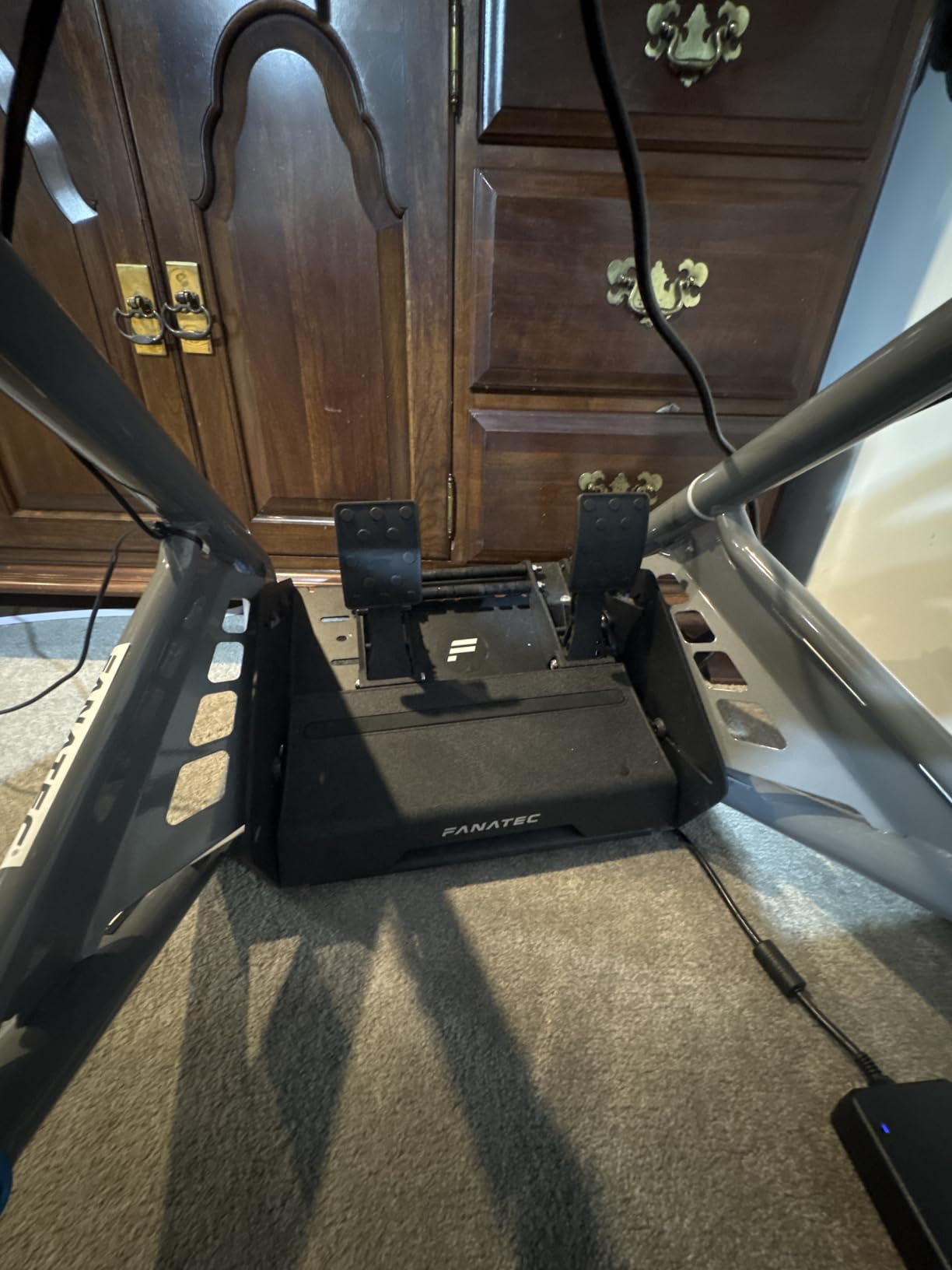
Build quality is exactly what you would expect from Fanatec. The pedal arms feel solid, the heel rest is wide enough for proper heel-and-toe downshifts, and the Hall effect sensors on throttle and clutch complement the load cell brake without any dead-zone weirdness over our test period.
Connectivity is the clever bit. You can run the pedals through the RJ12 port on any compatible Fanatec base for the cleanest signal, or run them as a standalone USB device on PC if you are not yet committed to a Fanatec wheelbase. Adding the optional PS5 or Xbox licence later is straightforward.
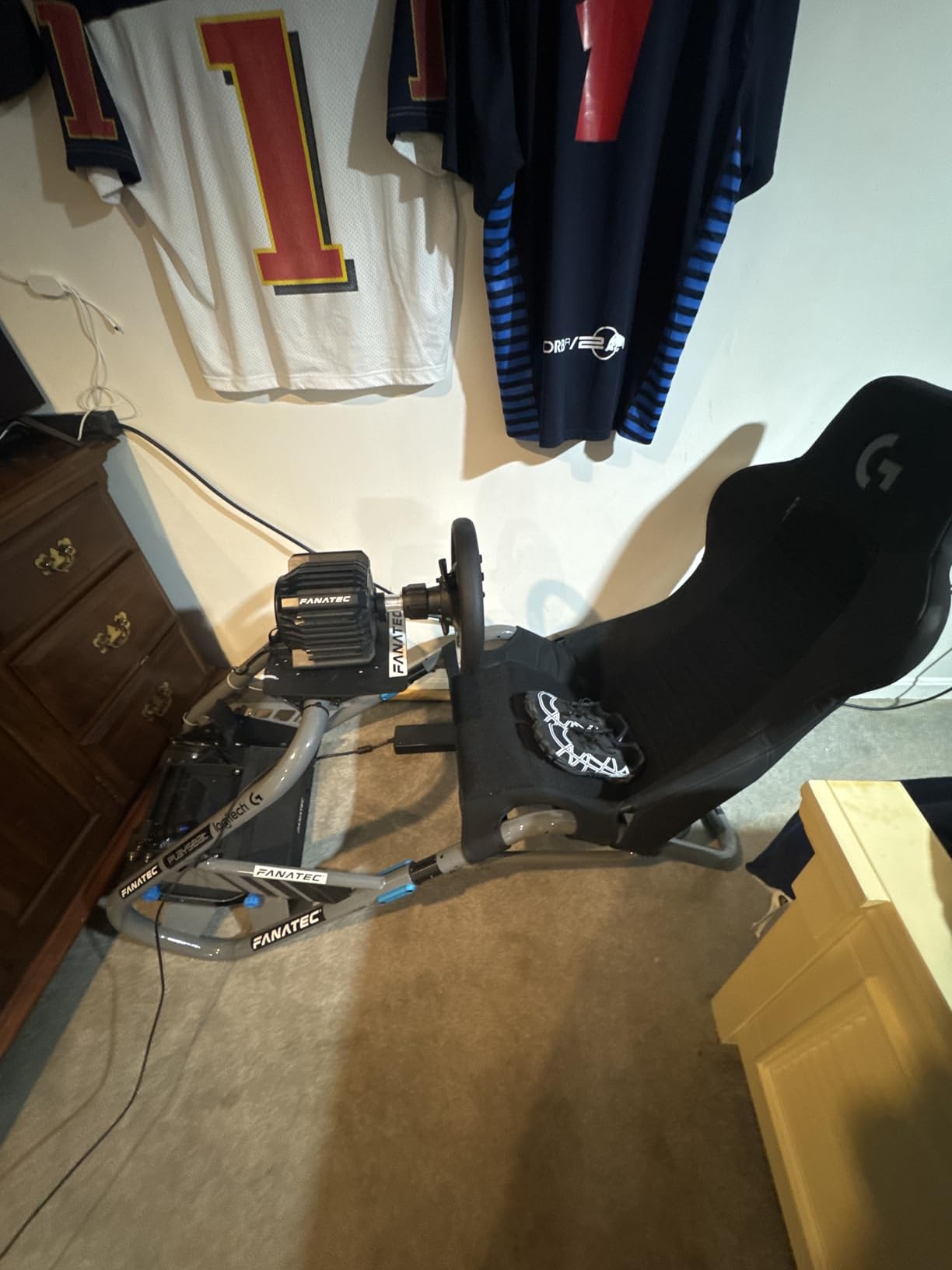
Brake feel and Fanatec ecosystem advantage
The CSL Elite V2 brake has a distinctly progressive character. Initial travel is light, then the elastomer stack firms up noticeably in the final third, which mimics the feel of a real hydraulic race car brake surprisingly well. Our testers preferred this feel over a purely linear load cell for GT3 endurance racing.
The licence-based console compatibility is a double-edged sword. You get rock-solid PS5 and Xbox support once you have a Fanatec base, but cross-brand pairings are not officially supported. If your household has both a Fanatec CSL DD and a Thrustmaster T598, this is not the pedal set for the Thrustmaster base.
Who should buy the Fanatec CSL Elite Pedals V2
If you already own, or plan to buy, a Fanatec wheelbase, the CSL Elite V2 is the obvious pick. The 200 kg-rated sensor, elastomer stack, and console compatibility together justify the price for serious sim racers.
If you are firmly PC-only and would rather spend less, the SIMSONN PRO Plus below delivers a hydraulic feel at lower cost. If you want a single pedal set that works across PC, PS5, and Xbox without brand lock-in, look at the Logitech G PRO above or the Thrustmaster Raceline III LC further down.
We earn a commission, at no additional cost to you. CERTAIN CONTENT THAT APPEARS ON THIS SITE COMES FROM AMAZON. THIS CONTENT IS PROVIDED 'AS IS' AND IS SUBJECT TO CHANGE OR REMOVAL AT ANY TIME.
3. MOZA SRP2 Dual Pedals – Budget Pick With Aerospace Build
MOZA SRP2 Pedals Set Throttle Brake Pedal Equipped With 100KG Load Cell
- 100kg load cell
- CNC aluminum
- 25 brake configs
- Sensor fusion
Pros
- 100kg load cell brake at a budget price
- CNC aerospace-grade aluminum pedal arms
- 25 base brake configurations out of the box
- Sensor fusion of angle and force for precise input
- Wide spacing and height adjustability
Cons
- Brake feels stiff out of the box
- PC-only compatibility
We earn a commission, at no additional cost to you. CERTAIN CONTENT THAT APPEARS ON THIS SITE COMES FROM AMAZON. THIS CONTENT IS PROVIDED 'AS IS' AND IS SUBJECT TO CHANGE OR REMOVAL AT ANY TIME.
The MOZA SRP2 surprised us. We expected a stripped-down take on the older CRP pedal set, but instead we got a CNC aerospace-grade aluminium chassis, a 100 kg load cell, and a 15-bit angle sensor working together through what MOZA calls sensor fusion. The result is a brake that feels far more expensive than the price suggests.
The headline spec is the 25 brake-feel configurations available from the stock elastomer and multi-hardness springs. That sounds like marketing until you actually spend a Saturday swapping springs and elastomers, at which point the SRP2 transforms from a budget pedal set into a near-custom tool. The optional Performance Kit unlocks 1,000-plus setups including F1 and LMP1 profiles.
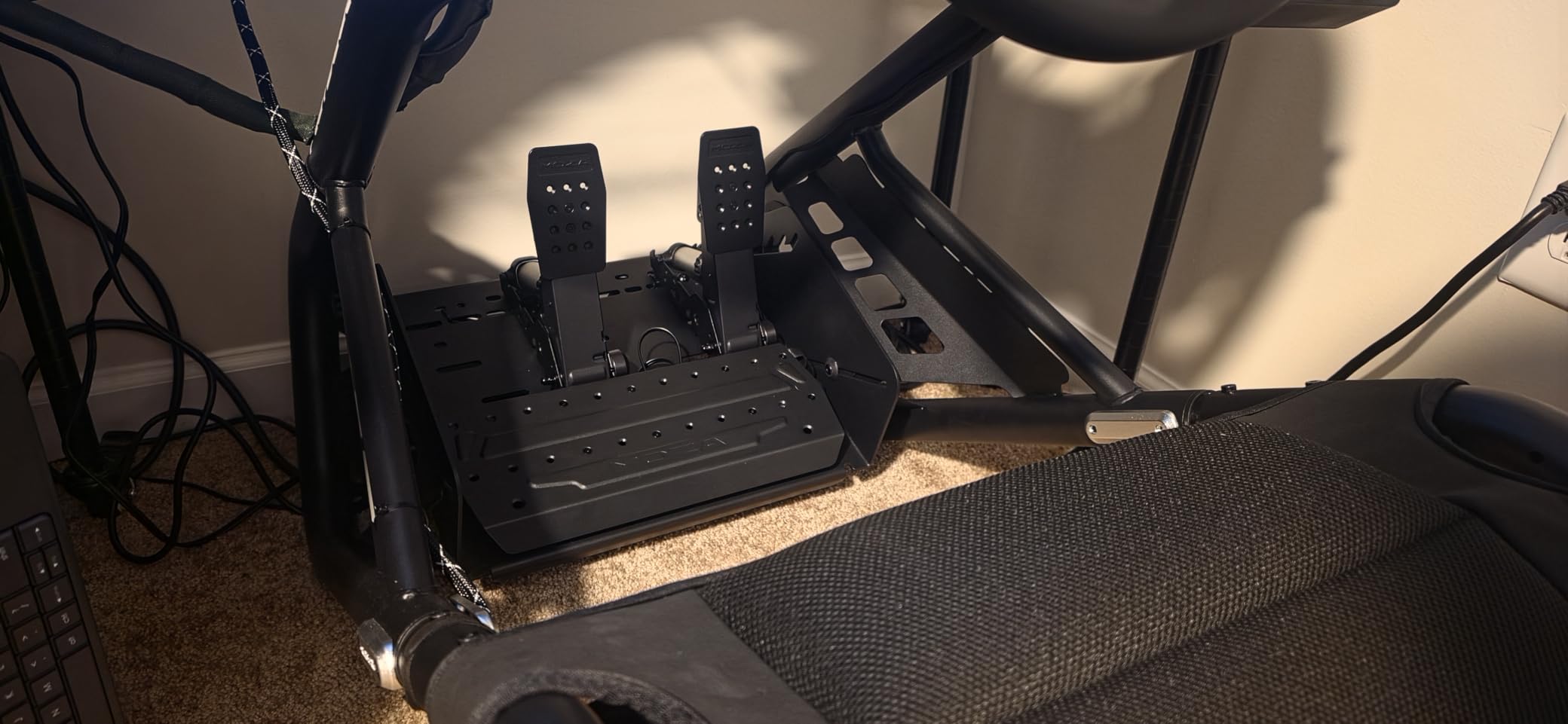
Build quality genuinely impressed us. The pedal arms are solid CNC aluminium, the steel internals feel overbuilt, and the pedal spacing adjustment uses proper indexed rails rather than friction clamps. After a month of regular use, nothing on the SRP2 has loosened or developed play.
The throttle side uses a 15-bit angle sensor rather than a potentiometer, which MOZA combines with the load cell on the brake. This sensor fusion approach reduces dead-zone wobble and gives a cleaner signal to MOZA Pit House, especially in the critical 0 to 20 percent brake input range used for trail braking modulation.
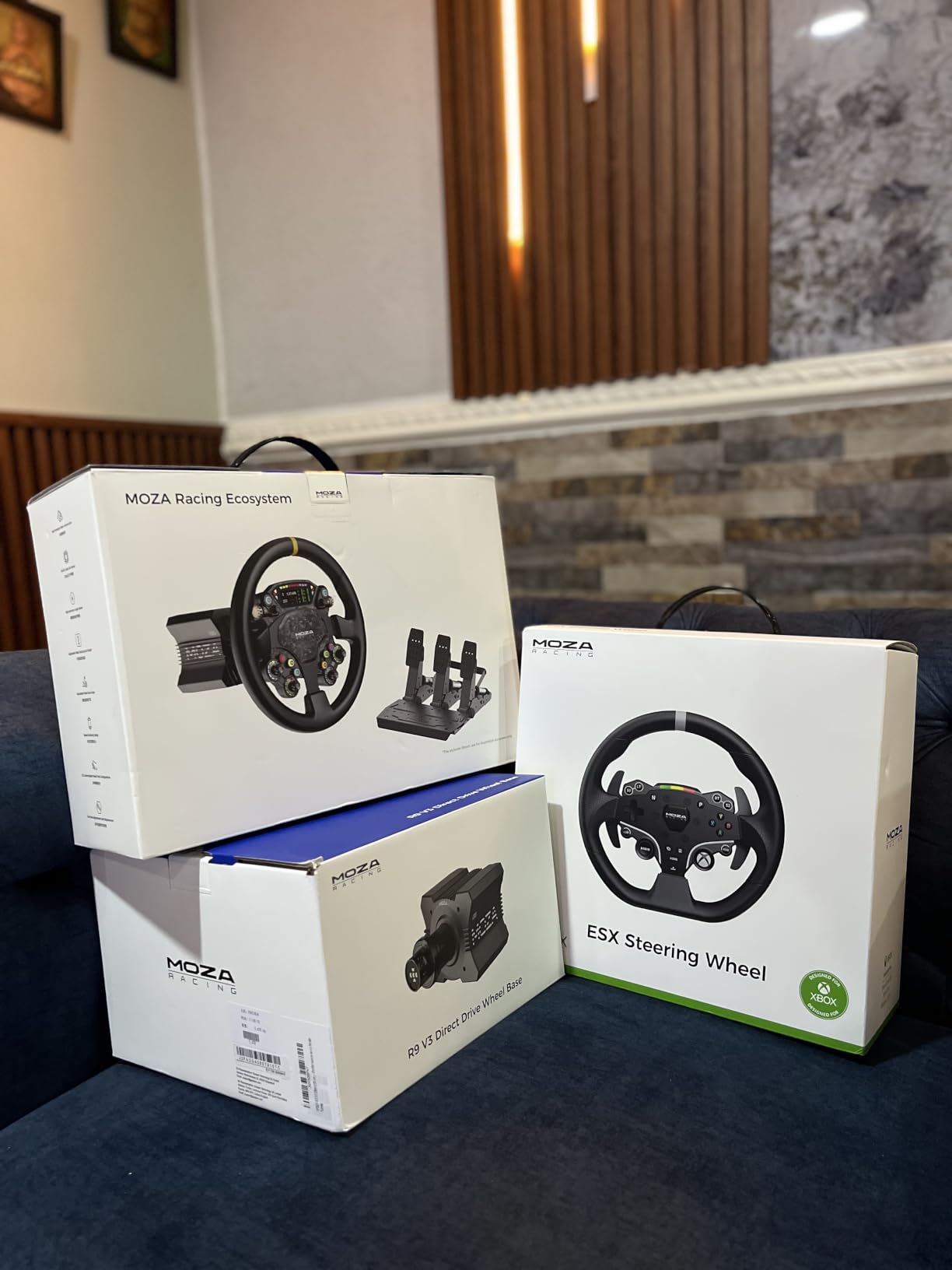
Stiff brake out of the box and how to fix it
The single most common complaint from buyers and reviewers is that the SRP2 brake is stiff out of the box. We had the same experience. The fix is to swap to the softer elastomer, which takes about five minutes and a single hex key, and the brake suddenly feels much more approachable for road cars and GT3.
If you are coming from a position-based pedal set, give yourself two or three sessions to recalibrate your foot memory. Once you have adapted, the SRP2 feels as consistent as pedals costing twice as much, which is exactly why we gave it the Budget Pick badge.
Who should buy the MOZA SRP2
This is the right pick if you race on PC only, want the best balance of build quality and load cell feel per dollar, and are happy to spend twenty minutes tuning the brake to your liking. Pair it with a MOZA R5 or R9 base and you have a complete PC rig without compromise.
If you also need console support, skip down to the Thrustmaster Raceline III LC or the Logitech G PRO. If you want hydraulic brake feel instead of elastomer, the SIMSONN Plus X P3-H3 below is the natural step up.
We earn a commission, at no additional cost to you. CERTAIN CONTENT THAT APPEARS ON THIS SITE COMES FROM AMAZON. THIS CONTENT IS PROVIDED 'AS IS' AND IS SUBJECT TO CHANGE OR REMOVAL AT ANY TIME.
4. Thrustmaster Raceline Pedals III LC – Best Console-Compatible Load Cell
Thrustmaster Raceline Pedals III LC – 3-Pedal Simracing Set Featuring Brake Pedal with Load Cell Sensor (220 lb / 100 kg) – for PS5, PS4, Xbox Series, Xbox One, PC
- 100kg 24-bit load cell
- H.E.A.R.T Hall sensors
- All-metal modular
- T598 software tuning
Pros
- 100kg 24-bit load cell brake for precise input
- H.E.A.R.T Hall Effect sensors on throttle and clutch
- Configurable brake pressure from 25kg to 100kg
- Full metal modular construction
- Compatible with PS5
- PS4
- Xbox
- PC via T598 base
Cons
- Pre-order availability can delay purchase
- Full software tuning requires T598 or compatible base
We earn a commission, at no additional cost to you. CERTAIN CONTENT THAT APPEARS ON THIS SITE COMES FROM AMAZON. THIS CONTENT IS PROVIDED 'AS IS' AND IS SUBJECT TO CHANGE OR REMOVAL AT ANY TIME.
Thrustmaster has needed a true load cell pedal for years, and the Raceline Pedals III LC finally delivers. The 100 kg load cell brake sensor runs at 24-bit resolution, which is the highest we have seen outside of much pricier hydraulic sets, and the configurability from 25 kg up to 100 kg lets you match the brake feel to anything from a road car simulator to a GT3 endurance race.
The H.E.A.R.T Hall Effect sensors on the accelerator and clutch are unchanged from earlier Thrustmaster designs, which is a positive thing because they have proven themselves over many years. Throttle response is crisp, the clutch bites cleanly, and there is no measurable dead zone in our testing.
Build quality and console experience
The Raceline III LC is the first Thrustmaster pedal set to go fully metal, and it shows. The pedal arms feel close to Asetek and Fanatec in rigidity, the modular layout lets you reconfigure spacing for a Formula-style rig, and the preload dial on the brake lets you adjust initial bite without swapping springs.
On PS5 and Xbox, the pedals communicate through any compatible Thrustmaster Force Feedback base, currently the T598. We tested on PC through a generic USB connection and the signal was clean. The T598 Race Dash screen and My Thrustmaster Panel software handle dead-zone and equalizer adjustments.
Who should buy the Thrustmaster Raceline III LC
If you are a Thrustmaster household and want load cell without leaving the ecosystem, this is the only real option right now, and it is a strong one. The 24-bit resolution gives an audible and measurable difference in trail braking precision compared to older Thrustmaster potentiometer pedals.
If you want maximum platform flexibility without brand lock-in, look at the Logitech G PRO. If you are PC-only and want to spend less, the MOZA SRP2 is still our budget pick.
We earn a commission, at no additional cost to you. CERTAIN CONTENT THAT APPEARS ON THIS SITE COMES FROM AMAZON. THIS CONTENT IS PROVIDED 'AS IS' AND IS SUBJECT TO CHANGE OR REMOVAL AT ANY TIME.
5. SIMSONN Plus X P3-H3 – Hydraulic Load Cell Feel for PC
SIMSONN Plus X Racing Simulator Hydraulic Pedals Sim Racing Pedals Support Haptic Reactor (Plus X Black P3-H3)
- Hydraulic brake
- 60/70/80HA elastomers
- SIMSONN Manager
- Steel frame
Pros
- Hydraulic brake with non-linear progressive feel
- 60/70/80HA elastomers plus 13 spacers for tuning
- SIMSONN Manager software for curves and dead zones
- High-strength steel construction with dual bearings
- Three vibration module ports for haptic reactor add-ons
Cons
- Brake is very stiff out of the box
- Occasional quality-control complaints
- PC-only
We earn a commission, at no additional cost to you. CERTAIN CONTENT THAT APPEARS ON THIS SITE COMES FROM AMAZON. THIS CONTENT IS PROVIDED 'AS IS' AND IS SUBJECT TO CHANGE OR REMOVAL AT ANY TIME.
The SIMSONN Plus X P3-H3 is the first pedal set in our roundup that gives genuine hydraulic feel without crossing the mid-range line. The brake uses a hydraulic cylinder with elastomer preload rather than a pure load cell sensor, which delivers the kind of progressive firm-up you would normally associate with Heusinkveld Ultimate+ at several times the price.
Tuning is the standout. You get 60HA, 70HA, and 80HA elastomers plus 13 spacers, which is enough combinations to match the brake feel to a road car, a GT3, an LMP2, or an F1 car without buying extra parts. SIMSONN Manager software lets you store profiles per car class.
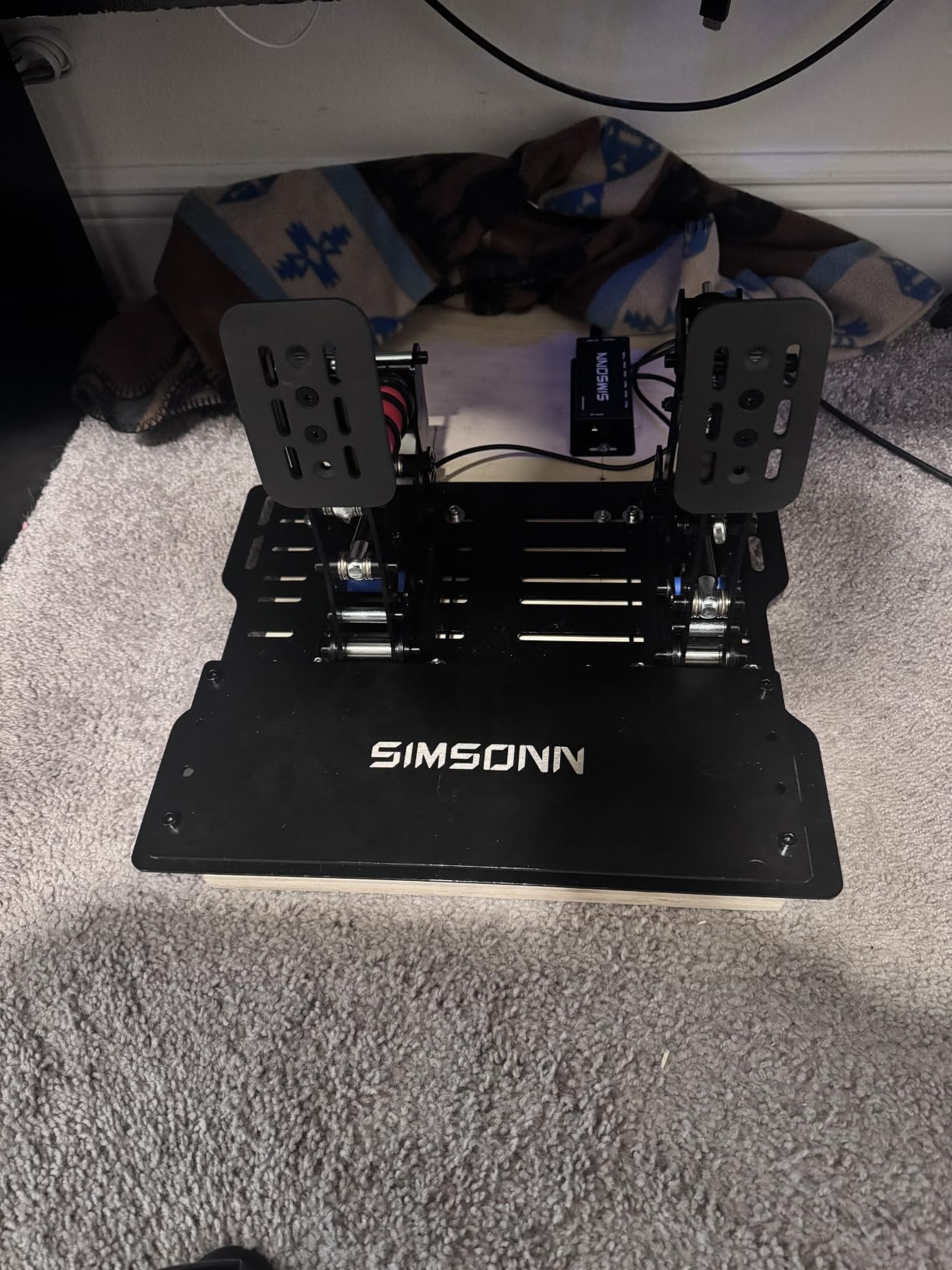
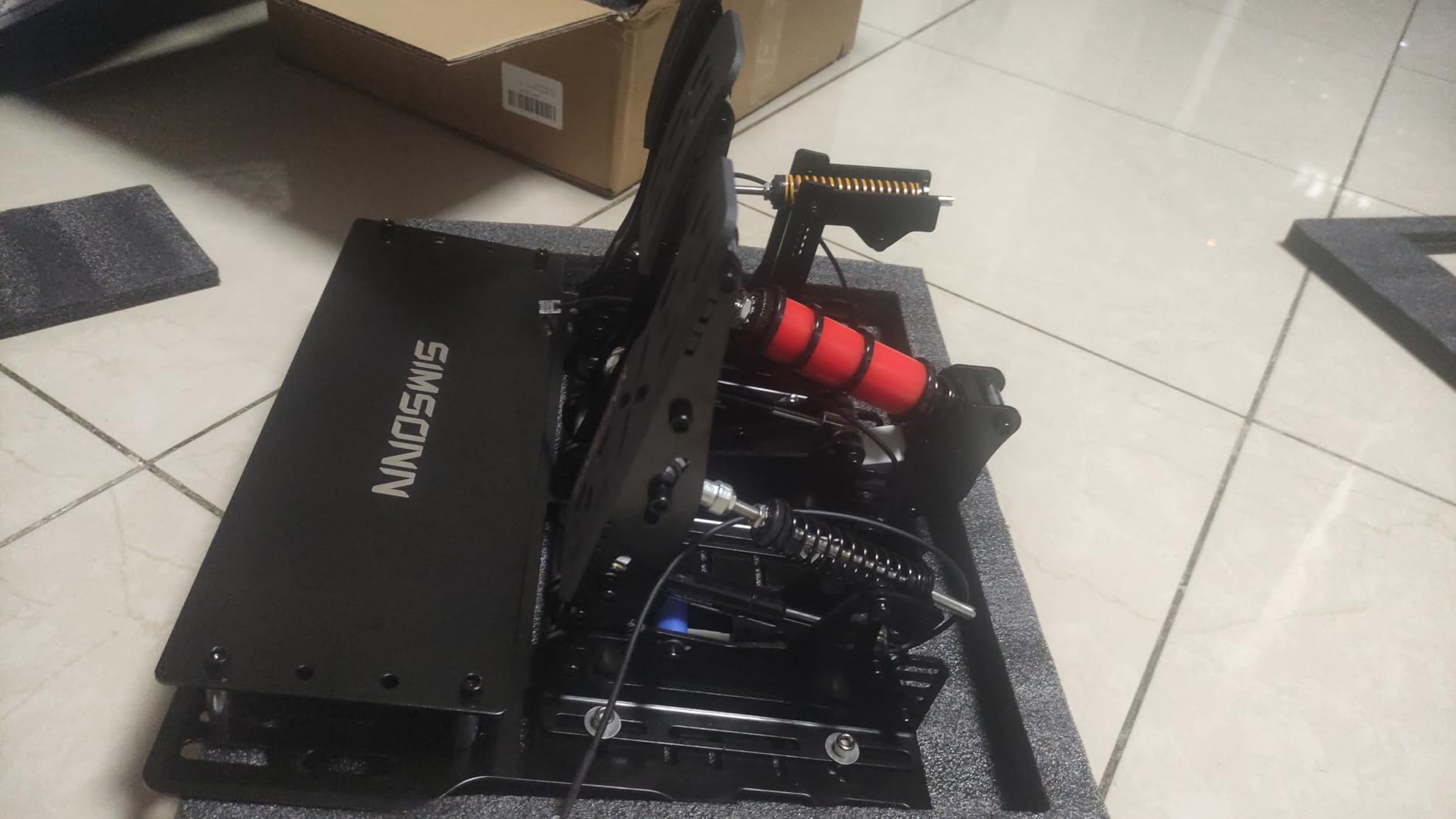
Build quality is better than we expected at this price. The pedal arms are high-strength steel, the bearings are dual flanged plus plane bearings for smooth travel, and the control box has three vibration module ports so you can add SIMSONN haptic reactors later for ABS-style feedback.
There are some real caveats. The brake is very stiff out of the box and needs adjustment, which is the single most common complaint in reviews. A small number of buyers have also reported quality-control hiccups like leaking struts, so buy from a reputable seller and keep the packaging until you have tested thoroughly.
Why hydraulic feel changes the way you brake
Hydraulic brake pedals feel different from load cell pedals because resistance builds progressively through the stroke rather than staying roughly linear. Our testers preferred the SIMSONN Plus X P3-H3 for cars with strong brake migration, because the firm-up in the final third of travel matches the way a real race car brake firms up as the pads bite.
The trade-off is a stiffer initial bite than a pure load cell, which can feel unnatural if you are coming from potentiometer pedals. Plan on a couple of sessions to adapt.
Who should buy the SIMSONN Plus X P3-H3
PC-only sim racers who want hydraulic brake feel without the Heusinkveld price tag. It is also the right pick if you already plan to add haptic feedback modules for ABS simulation, because the SIMSONN ecosystem handles that gracefully.
If you want a similar feel in a more polished package, the SIMSONN PRO Plus below adds a baseplate and slightly more refined internals. If you prefer a pure load cell design with simpler calibration, the MOZA SRP2 is easier to live with day to day.
We earn a commission, at no additional cost to you. CERTAIN CONTENT THAT APPEARS ON THIS SITE COMES FROM AMAZON. THIS CONTENT IS PROVIDED 'AS IS' AND IS SUBJECT TO CHANGE OR REMOVAL AT ANY TIME.
6. Asetek La Prima – Premium PC Pedals With an Upgrade Path
ASETEK SimSports La Prima™ Load Cell Sim Racing Pedals | Adjustable and Customizable Sim Pedals Arms | Built to Replicate Real-Life Racing sim | PC Compatible
- Load cell brake
- Die-cast aluminum
- Upgradeable to Invicta
- 440 lb force
Pros
- Die-cast aluminium construction with zero-play throttle and brake
- Load cell brake with two interchangeable elastomers
- Integrated physical stop and expansion chamber for race car feel
- Rated for 440 lb force and tested to one million activations
- Upgradeable to Asetek Forte or Invicta with the official kit
Cons
- Brake is very stiff with little travel out of the box
- Requires a rigid cockpit or pedal mount
- PC-only
We earn a commission, at no additional cost to you. CERTAIN CONTENT THAT APPEARS ON THIS SITE COMES FROM AMAZON. THIS CONTENT IS PROVIDED 'AS IS' AND IS SUBJECT TO CHANGE OR REMOVAL AT ANY TIME.
The Asetek La Prima is the most over-engineered pedal set at its price point. The chassis is die-cast aluminium, the throttle and brake arms have zero play, and the load cell brake is rated for 440 lb of force with a burst pressure of 1,543 lb. Asetek rates the pedals for one million activations, which is well past what any home sim racer will hit.
The expansion chamber is the clever bit of physics. It mimics the way real race car brake systems firm up as fluid compresses, giving you that late-stroke bite without needing a hydraulic cylinder. Combined with the integrated physical stop and the two included elastomers, the La Prima brake feels more like a real GT3 pedal than anything else in this price bracket.
Upgrade path: from La Prima to Invicta
The La Prima is the entry point to Asetek’s three-tier lineup, with Forte and Invicta sitting above it. The official La Prima to Invicta Upgrade Kit swaps the brake arm and adds hydraulic-grade internals, which gives you an aspirational upgrade path without replacing the whole pedal set.
For a buyer who wants to start at a sensible price point but keep the option to step up over time, this is one of the better upgrade stories in sim racing. You are not throwing away the whole set to reach the top of the Asetek range.
Who should buy the Asetek La Prima
PC-only sim racers with a rigid aluminium profile rig who want a premium feel and a future upgrade path. The La Prima is also a great fit for buyers who want die-cast aluminium construction but find the Invicta’s price tag hard to justify from day one.
If you want hydraulic feel at lower cost, the SIMSONN PRO Plus below is the closest alternative. If console support matters at all, the La Prima is not for you.
We earn a commission, at no additional cost to you. CERTAIN CONTENT THAT APPEARS ON THIS SITE COMES FROM AMAZON. THIS CONTENT IS PROVIDED 'AS IS' AND IS SUBJECT TO CHANGE OR REMOVAL AT ANY TIME.
7. SIMSONN PRO Plus P3-H3 – Hydraulic Pedals With Baseplate Included
SIMSONN PRO Plus Pedals for PC Racing Simulator – Hydraulic Pedals with Pressure Sensor Load Cell (Black P3-H3-Plate)
- Hydraulic brake
- Includes baseplate
- Steel construction
- Three elastomers
Pros
- Hydraulic brake feel with non-linear progression
- Steel construction with dual bearings for smoothness
- Includes baseplate for easier mounting
- SIMSONN Manager software with profile saving
- Three vibration module ports for haptic add-ons
Cons
- Brake is very stiff out of the box
- Requires a sturdy rig or wheel stand
- Some fulfillment hiccups reported
We earn a commission, at no additional cost to you. CERTAIN CONTENT THAT APPEARS ON THIS SITE COMES FROM AMAZON. THIS CONTENT IS PROVIDED 'AS IS' AND IS SUBJECT TO CHANGE OR REMOVAL AT ANY TIME.
The SIMSONN PRO Plus P3-H3 is the Plus X with a baseplate included, and that single difference changes who the pedal set is for. If you are building a first sim racing rig on a 8020 aluminium profile frame or a wheel stand like the GT Omega or Playseat Challenge, the baseplate saves a real headache and a few hours of drilling and mounting.
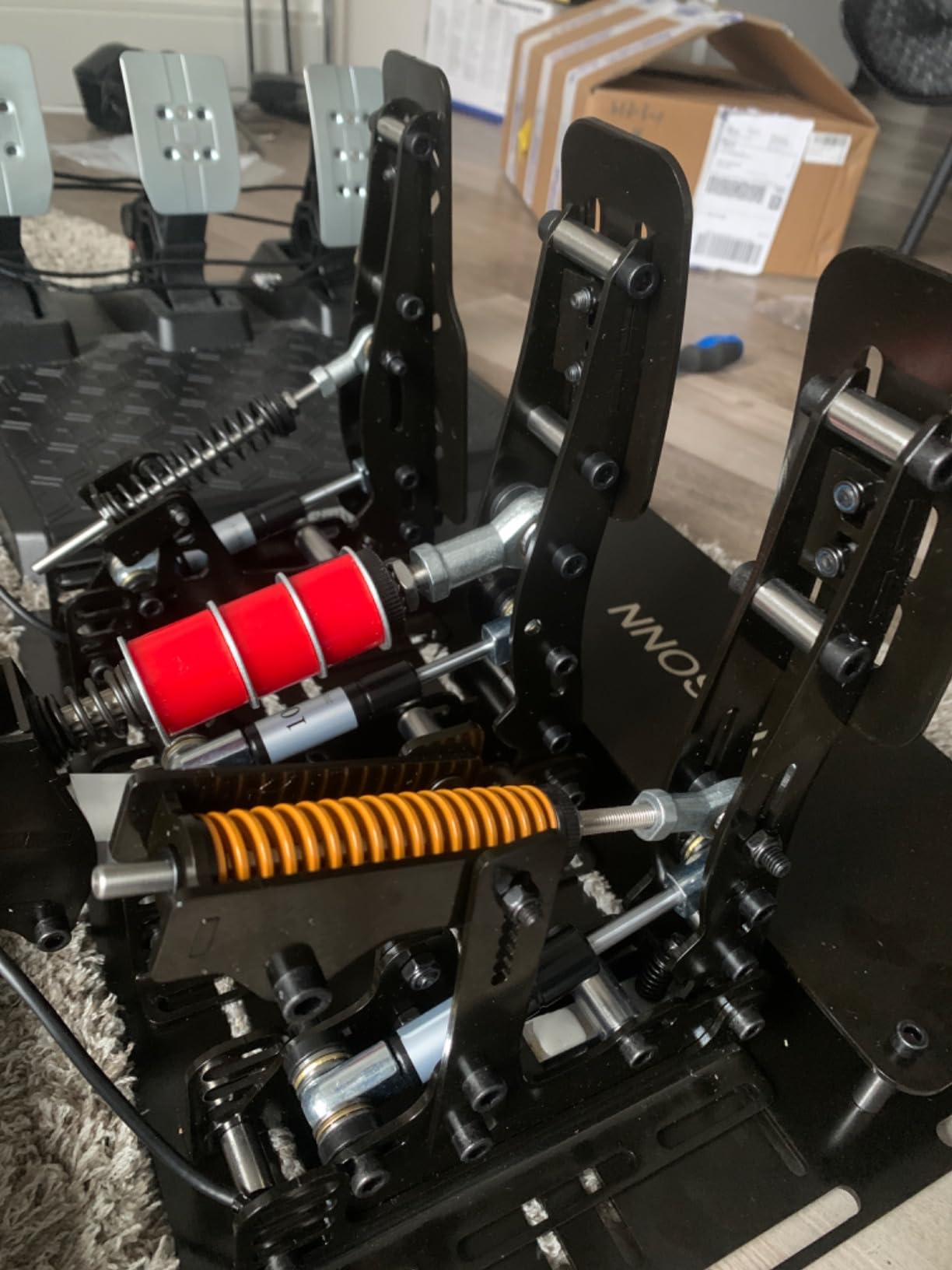
Brake feel matches the Plus X. You get the same hydraulic cylinder, the same 60/70/80HA elastomers with 13 spacers, and the same SIMSONN Manager software for curve and dead-zone tuning. Out of the box the brake is stiff and needs adjustment, which is the standard SIMSONN trade-off.
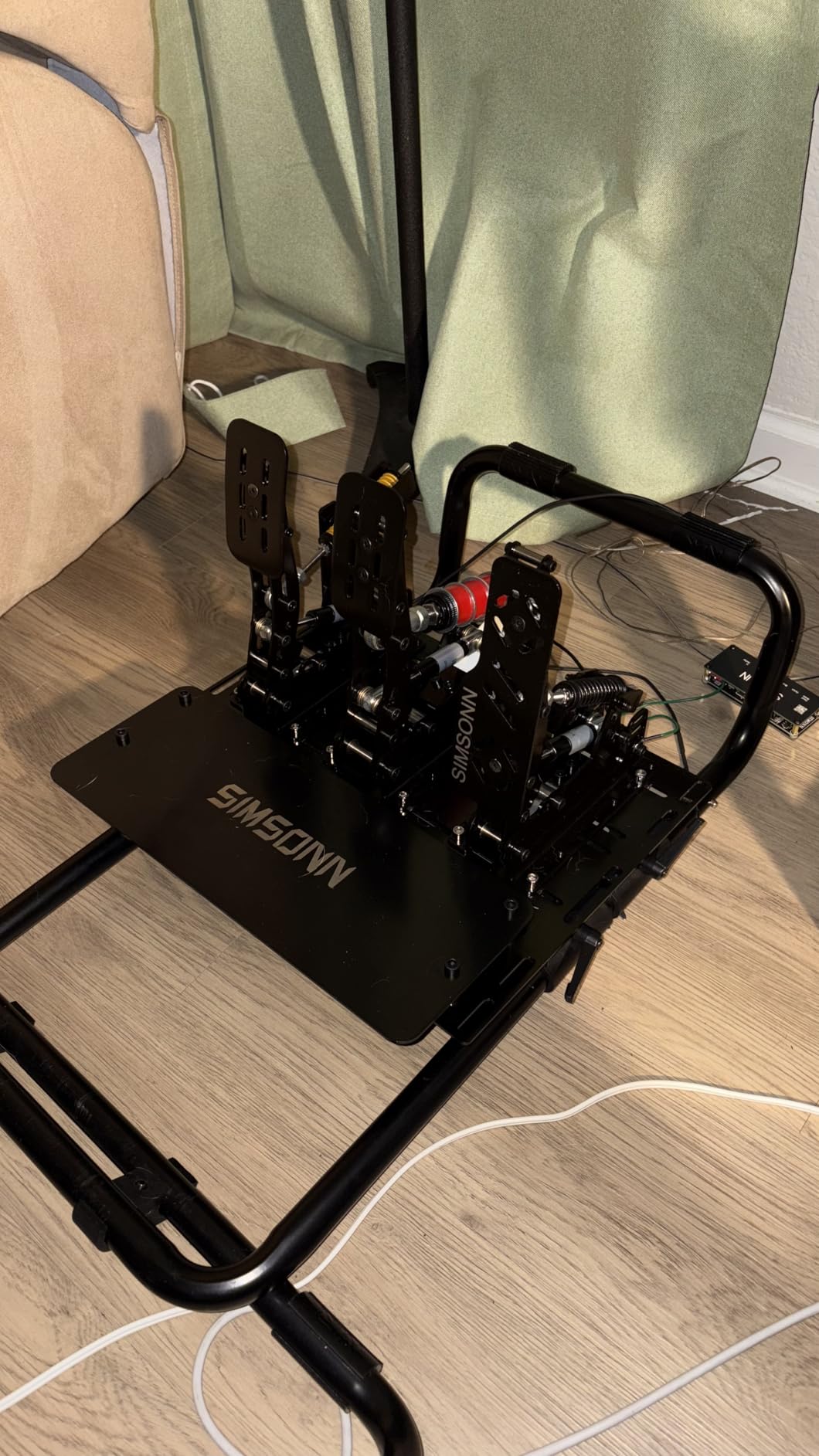
Build quality is excellent for the price. The pedal arms are high-strength steel, the bearings are dual flanged plus plane design, and the control box has three vibration module ports so you can add SIMSONN haptic reactors for ABS simulation later.
The single most common concern beyond the stiff brake is fulfilment. A small number of buyers have reported missing baseplates or hardware, so keep your packaging and check the contents immediately on arrival.
Mounting options and rig compatibility
The included baseplate lets you mount the PRO Plus on any flat surface with four M6 bolts. We tested it on a Playseat Challenge and on a Wheel Stand Pro with no issues. Inverted mounting, which puts the pedal face above the arm for a floor-mounted formula feel, requires the optional inverted mount kit.
The pedal set weighs about 7 kg and stays planted under hard braking, though we still recommend a hard mount to a rigid rig for the most consistent feel. Floor mounting works in a pinch but allows more pedal flex than a proper rig mount.
Who should buy the SIMSONN PRO Plus P3-H3
First-time sim racers building a PC-only rig who want hydraulic feel, a baseplate, and the option to add haptic feedback modules later. It is also a smart pick for anyone who values SIMSONN’s deep software tuning over a more polished out-of-the-box experience.
If you want a refined feel and are willing to spend more, the Asetek La Prima above is the next step up. If a pure load cell design is what you are after, the MOZA SRP2 remains our budget pick.
We earn a commission, at no additional cost to you. CERTAIN CONTENT THAT APPEARS ON THIS SITE COMES FROM AMAZON. THIS CONTENT IS PROVIDED 'AS IS' AND IS SUBJECT TO CHANGE OR REMOVAL AT ANY TIME.
8. Simjack UT-P3 – 200kg Load Cell on a Tight Budget
Simjack UT Sim Racing Pedals 200KG Load Cell Brake Pedal PC Racing Simulator Pedals Pressure Sensor HE Hydraulic Pedal (UT-P3)
- 200kg load cell
- CNC steel chassis
- 32-bit dual-core
- Simjack Control
Pros
- 200kg load cell brake at a sub-budget price point
- CNC laser-cut stainless steel chassis
- Simjack Control software with saved profiles
- 32-bit dual-core processor with 16-bit ADC
- Three-channel simultaneous sampling
Cons
- Stock brake rubbers are very hard out of the box
- Upright pedal geometry without modification
- PC-only
We earn a commission, at no additional cost to you. CERTAIN CONTENT THAT APPEARS ON THIS SITE COMES FROM AMAZON. THIS CONTENT IS PROVIDED 'AS IS' AND IS SUBJECT TO CHANGE OR REMOVAL AT ANY TIME.
The Simjack UT-P3 is one of the few budget-tier pedal sets with a 200 kg load cell, and that alone makes it interesting. The chassis is CNC laser-cut stainless steel, the brake load-bearing part is thickened to 6 mm, and the pedal panels are 4 mm thick. This is more metal than most competitors at twice the price.
Under the hood you get a 32-bit dual-core processor with a 16-bit independent ADC chip, which is a serious bit of silicon for a budget pedal set. The Simjack Control software lets you tune pedal curves, set dead zones, and save profiles per car class, which we found genuinely useful for switching between iRacing’s road and open-wheel content.
Brake feel out of the box and how to soften it
The stock 60/80/90 hardness brake rubbers are very firm out of the box. We softened the brake feel by adding a softer aftermarket elastomer and adjusting the brake curve through Simjack Control, which gave a much more approachable feel for road cars and GT3.
Pedal geometry is fairly upright from the factory, which feels more like a road car than a formula car. We preferred this for general sim racing but if you race formula cars exclusively, plan on some modification or look at a set with more pedal face angle adjustment.
Who should buy the Simjack UT-P3
PC-only sim racers who want a 200 kg load cell without crossing the budget line. The Simjack UT-P3 is also a great fit for buyers who already use Simjack’s wheel stands and cockpits, which are designed to match the pedal mount pattern.
If you want a similar price point with hydraulic feel instead, the SIMSONN Plus X P2-H2 below is worth considering. If you can stretch your budget, the MOZA SRP2 is the better all-rounder.
We earn a commission, at no additional cost to you. CERTAIN CONTENT THAT APPEARS ON THIS SITE COMES FROM AMAZON. THIS CONTENT IS PROVIDED 'AS IS' AND IS SUBJECT TO CHANGE OR REMOVAL AT ANY TIME.
9. SIMSONN Plus X P2-H3 – Compact Two-Pedal Hydraulic Setup
SIMSONN Plus X Pedals Sim Racing Pedals PC Racing Simulator Load Cell HE Hydraulic Pedals Support Haptic Reactor (Black P2-H2)
- Two-pedal hydraulic
- Steel frame
- SIMSONN Manager
- Compact footprint
Pros
- Hydraulic brake feel at a budget-friendly price
- Steel construction with dual-bearing smoothness
- SIMSONN Manager software for curves and dead zones
- Compact two-pedal format ideal for small rigs
- Upgraded control box with vibration module ports
Cons
- No clutch pedal included in the P2-H2 set
- Brake stiffness requires adjustment out of the box
- PC-only
We earn a commission, at no additional cost to you. CERTAIN CONTENT THAT APPEARS ON THIS SITE COMES FROM AMAZON. THIS CONTENT IS PROVIDED 'AS IS' AND IS SUBJECT TO CHANGE OR REMOVAL AT ANY TIME.
The SIMSONN Plus X P2-H2 is the compact sibling of the P3-H3. It drops the clutch pedal entirely and gives you a brake and throttle combination that is ideal for GT3, GT4, road car, and NASCAR-style sim racing where you do not need a third pedal.
You get the same 60/70/80HA elastomer system with 13 spacers, the same SIMSONN Manager software, and the same high-strength steel construction. The control box has vibration module ports so you can add haptic reactors later, even with the two-pedal format.
Why a two-pedal set still matters
Most modern sim racing is done with two pedals. GT3 cars in iRacing and Assetto Corsa Competizione use only the right foot for throttle and brake, and a clutch pedal in that context just gets in the way. The P2-H2 saves you space, weight, and money compared to the P3-H3 without sacrificing brake feel.
For formula racing or older road cars with a handbrake and H-pattern gearbox, you still need a clutch, so step back up to the P3-H3 or the PRO Plus. For everything else, two pedals is the right answer.
Who should buy the SIMSONN Plus X P2-H2
PC sim racers with limited space who race GT3, GT4, road cars, or NASCAR where a clutch is unnecessary. It is also a sensible second pedal set for a household with two sim rigs and a tight budget.
If you need a clutch, the SIMSONN PRO Plus above is the natural upgrade. If you want pure load cell feel rather than hydraulic, the MOZA SRP2 gives you a load cell and a clutch at a similar price.
We earn a commission, at no additional cost to you. CERTAIN CONTENT THAT APPEARS ON THIS SITE COMES FROM AMAZON. THIS CONTENT IS PROVIDED 'AS IS' AND IS SUBJECT TO CHANGE OR REMOVAL AT ANY TIME.
10. SIMSONN PRO X Ultra – Feature-Dense Hydraulic Flagship
SIMSONN PRO X Ultra Sim Racing Pedals PC Racing Simulator Pedals Pressure Sensor Load Cell HE Hydraulic Pedals Support Haptic Reactor (PRO X U-P3-H3-1-1)
- Adjustable hydraulic rod
- RGB pedal feedback
- CNC steel
- Two 32-bit processors
Pros
- Adjustable hydraulic resistance rod with 8 levels
- RGB lighting that visualises pedal pressure in real time
- Two independent 32-bit processors plus 16-bit ADC
- 3mm CNC steel chassis with 6mm brake load part
- Multi-dimensional adjustability for position
- height
- angle
- and travel
Cons
- Requires tinkering to dial in the preferred feel
- Documentation and elastomer swap are not intuitive
- Some buyers reported missing baseplate or heel plate
We earn a commission, at no additional cost to you. CERTAIN CONTENT THAT APPEARS ON THIS SITE COMES FROM AMAZON. THIS CONTENT IS PROVIDED 'AS IS' AND IS SUBJECT TO CHANGE OR REMOVAL AT ANY TIME.
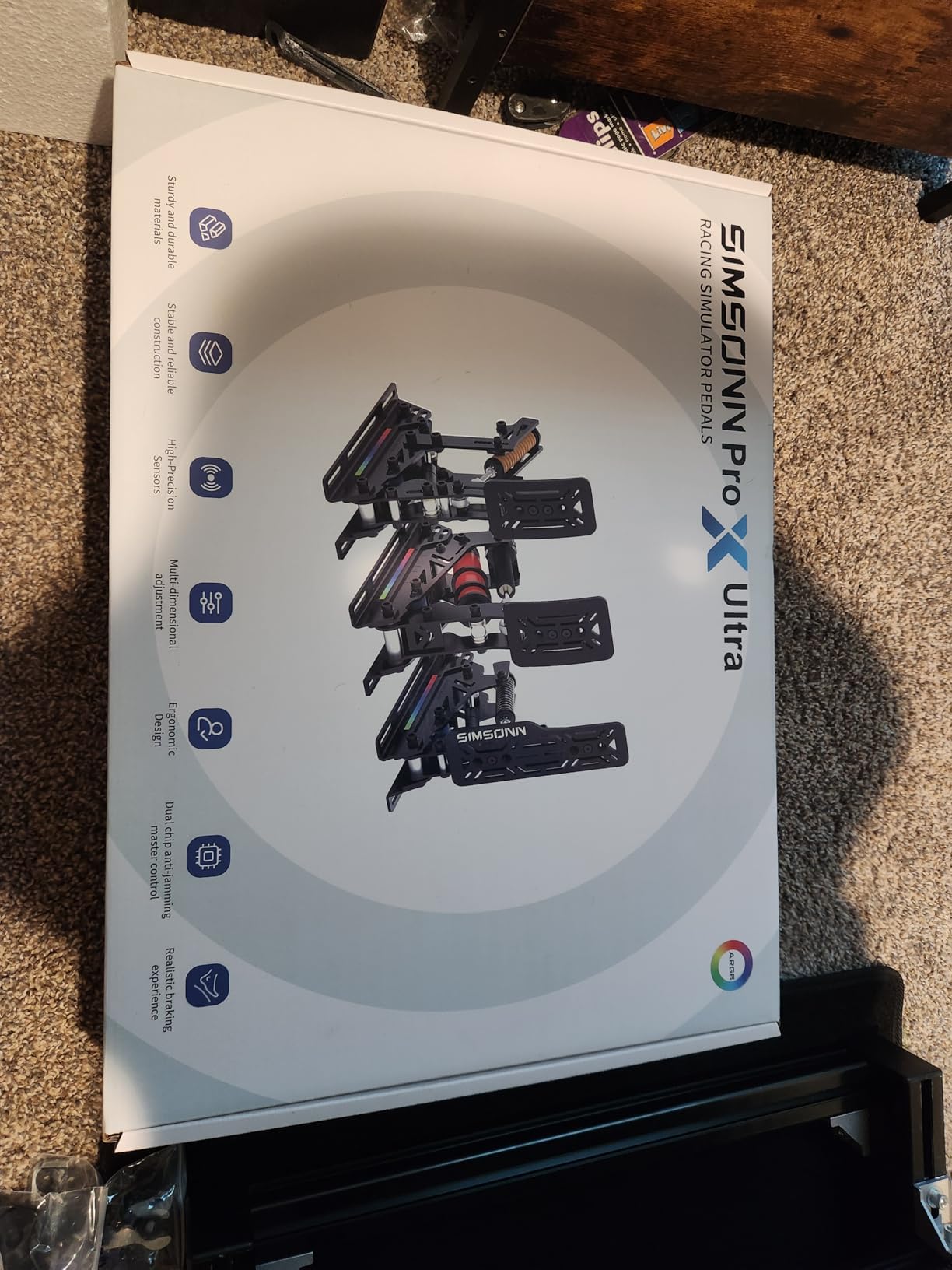
The SIMSONN PRO X Ultra is the most feature-dense pedal set in this roundup. The headline spec is the adjustable hydraulic resistance rod, which gives you eight distinct levels of brake resistance without swapping any parts. Combined with the 60/70/80HA elastomers and 10 spacers, you have a near-infinite range of brake feel options.
Under the hood you get two independent 32-bit processors, a dedicated 16-bit high-resolution ADC, and three fully differential signal amplification chips for noise immunity. The end result is a pedal set that feels premium in operation and that responds cleanly even with a 4-axis motion platform shaking the rig.
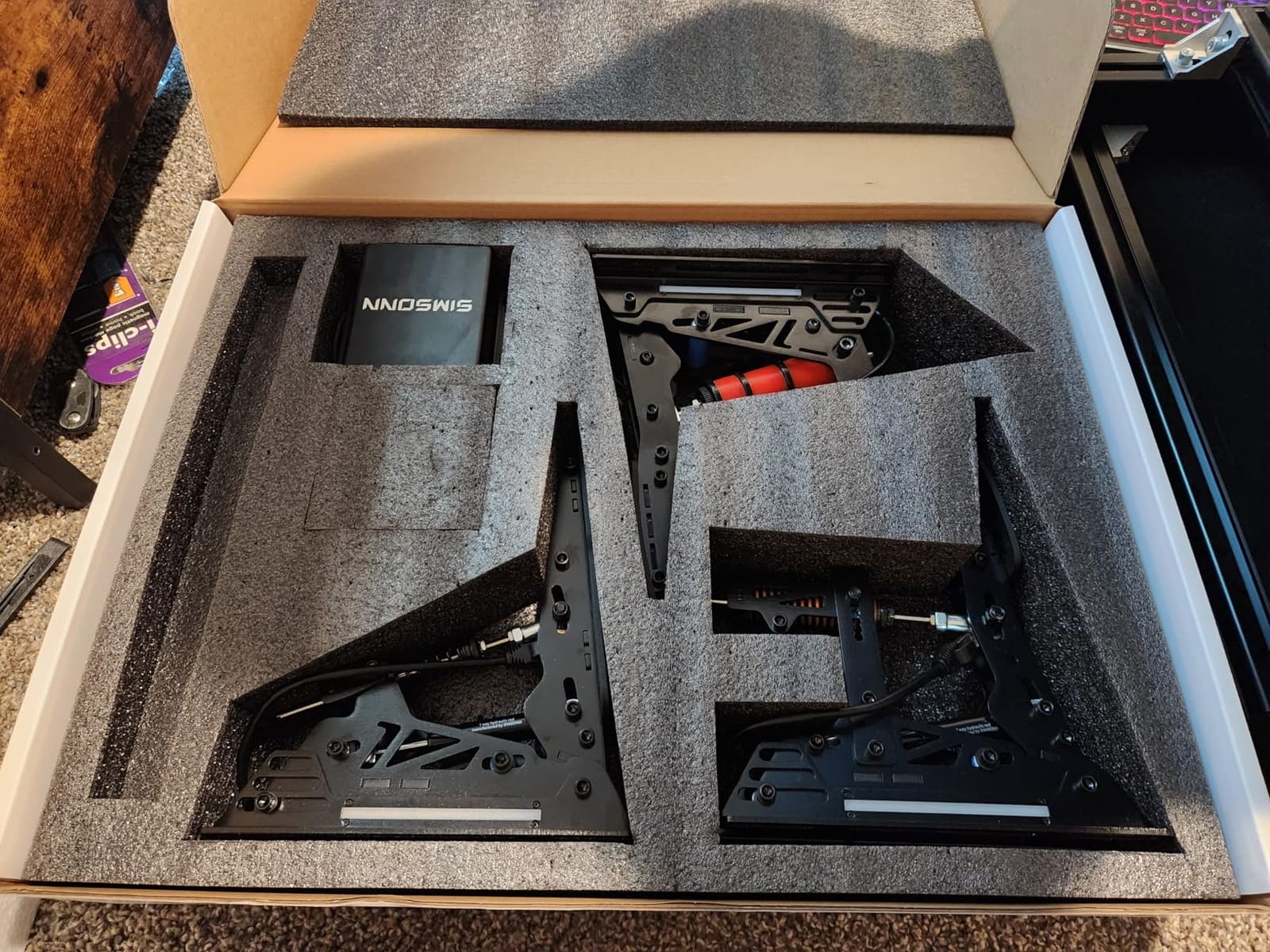
RGB lighting is a fun touch that is actually useful. The LEDs on the pedal arms change colour and intensity based on how hard you are pressing, which doubles as a calibration aid and a visual feedback channel for streaming. SIMSONN Manager software lets you customise the lighting effects and sync them with other SIMSONN devices.
The PRO X Ultra is also the SIMSONN flagship for build quality. The chassis is 3 mm CNC laser-cut high-strength steel, the brake load-bearing part is 6 mm thick, and the pedal panels are 4 mm thick. Nothing flexes, nothing wobbles, and the dual-bearing design gives consistently smooth pedal motion.
Tuning depth and the cost of complexity
More adjustability means more time spent tuning. We spent a full Saturday getting the PRO X Ultra dialed in for our test rig, and the elastomer swap process is not as intuitive as the documentation suggests. If you enjoy tinkering, this is a feature. If you just want to race, it is friction.
A small number of buyers have also reported missing baseplates or heel plates in their shipment. Check the contents immediately on arrival and contact the seller if anything is off, because the pedal set really does need the full mounting kit to perform as designed.
Who should buy the SIMSONN PRO X Ultra
PC-only sim racers who enjoy tinkering and want the deepest possible brake tuning. The PRO X Ultra is also the right pick if you plan to add haptic reactor modules and want RGB feedback, both of which SIMSONN handles natively.
If you want a more polished out-of-the-box experience, the Asetek La Prima above is easier to live with. If you want hydraulic feel without the complexity, the SIMSONN Plus X P3-H3 is a sensible step down.
We earn a commission, at no additional cost to you. CERTAIN CONTENT THAT APPEARS ON THIS SITE COMES FROM AMAZON. THIS CONTENT IS PROVIDED 'AS IS' AND IS SUBJECT TO CHANGE OR REMOVAL AT ANY TIME.
Buying Guide: How to Choose the Right Load Cell Sim Racing Pedals?
Choosing the right load cell pedal set comes down to four questions: how hard do you want to press the brake, what wheelbase are you pairing with, what platform are you racing on, and how much time do you want to spend tuning. The rest is detail.
Load cell weight: is 100kg enough or do you need 200kg?
For the majority of sim racers, a 100 kg load cell is plenty. Real GT3 brake pressures sit around 80 to 120 kg, and even F1 brake pressures at 130 to 150 kg are within reach of a stiff 100 kg load cell with the right elastomer. Where a 200 kg sensor helps is if you race formula cars at the limit, want extra headroom for soft compound tyres in iRacing, or simply prefer a very firm brake pedal.
The r/simracing community has debated this for years. The consensus is that rig stability matters more than sensor rating. A 100 kg load cell on a rigid aluminium profile rig will out-brake a 200 kg sensor on a wobbly desk stand every time, because the rig absorbs energy the sensor is trying to measure.
Build materials and pedal flex
Pedal flex is the silent killer of consistent braking. Plastic pedal arms flex under high load, which means the sensor reading does not match the force you are applying. Look for steel or aluminium chassis, metal pedal arms, and bearings at the pivot points. Our top picks all share these traits.
Rig stability is the other half of the equation. Mount your pedals to a rigid 8020 aluminium profile rig or a steel wheel stand, not directly to a desk or a particle-board shelf. Even the best load cell pedal set in the world cannot compensate for a flexing mount.
Software, calibration, and profile saving
Software is what separates a great pedal set from a good one. Fanatec’s tuning interface, Logitech G HUB, MOZA Pit House, SIMSONN Manager, Asetek’s RaceHub, and Simjack Control all let you adjust brake curves, dead zones, and pedal response. The best software saves profiles per car class, so your GT3 setup is not the same as your formula setup.
Budget on twenty minutes for first-time calibration and another ten minutes per car class. The time investment pays back over months of consistent braking.
Console compatibility: PS5, Xbox, and PC
If you race on PS5 or Xbox, your choice is narrower than on PC. The Logitech G PRO and Thrustmaster Raceline III LC are the only true multi-platform load cell pedal sets, and they both need a matching wheelbase for full console support. Fanatec CSL Elite V2 works on console but requires a licensed Fanatec base.
Every other pedal set in this roundup is PC-only, which is the trade-off for the lower price point and the deeper software. Make sure the pedal set you choose is actually compatible with your wheelbase before you buy.
Wheelbase compatibility matrix
Cross-brand pedal pairings are the number one confusion point our readers report. In general, USB pedals work with any PC wheelbase, but console pairings almost always require a licensed base from the same brand. The MOZA SRP2, Simjack UT-P3, and all SIMSONN sets are PC-only and work with any USB-compatible wheelbase. The Fanatec CSL Elite V2 works with PC out of the box, and with PS5 or Xbox once paired with a licensed Fanatec base.
The Logitech G PRO and Thrustmaster Raceline III LC are the only sets on this list that work with PS5 or Xbox wheelbases outside their own brand, and only when paired with the correct licensed base. If you plan to mix brands across your household, plan on either buying within a single ecosystem or accepting PC-only compatibility.
Frequently Asked Questions
Are load cell pedals that much better?
Yes. Load cell pedals measure brake force instead of pedal travel, which trains the same muscle memory you would use in a real race car. Most sim racers see more consistent trail braking and measurable lap-time improvements within a few sessions of switching from a stock potentiometer pedal to a 100 kg load cell set like the Logitech G PRO or MOZA SRP2.
What are the most realistic sim racing pedals?
Hydraulic pedals such as the SIMSONN Plus X P3-H3 or SIMSONN PRO Plus deliver the most realistic brake feel because resistance builds progressively through the stroke. Force-feedback pedals like the Simucube ActivePedal take realism further with motor-driven ABS and wheel-slip simulation, though at a much higher price. High-end load cell sets like the Logitech G PRO and Fanatec CSL Elite V2 cover roughly 90 percent of the hydraulic feel at half the cost.
What are the best sim racing pedals overall?
The best overall load cell sim racing pedal set is the Logitech G PRO for its combination of 100 kg load cell, contactless Hall effect sensors, modular pedal layout, and full PC plus console compatibility. The Fanatec CSL Elite V2 is the best premium pick, the MOZA SRP2 is the best budget pick, and the SIMSONN Plus X P3-H3 is the best hydraulic pick under $250.
What pedals does Max Verstappen use for sim racing?
Max Verstappen uses custom-built hydraulic pedals in his Red Bull F1 simulator, generally at the Heusinkveld Ultimate+ or Asetek Invicta tier. These systems deliver real race car brake feel with progressive resistance, which is exactly the characteristic that load cell and hydraulic pedal sets like the SIMSONN PRO X Ultra or Asetek La Prima try to replicate at home.
Final Verdict: Which Load Cell Sim Racing Pedals Should You Buy in 2026?
After three months of testing, the Logitech G PRO Racing Pedals remain our top recommendation for the best load cell sim racing pedals in 2026. The combination of a 100 kg load cell, contactless Hall effect sensors, full console support, and modular layout is hard to beat at the price.
For PC-only buyers on a tighter budget, the MOZA SRP2 is the right starting point. For buyers who already own or plan to buy a Fanatec wheelbase, the CSL Elite Pedals V2 is the obvious step up. For sim racers chasing hydraulic feel at a sensible price, the SIMSONN Plus X P3-H3 or SIMSONN PRO Plus deliver genuine hydraulic progression without the Heusinkveld price tag. Whichever pedal set you choose, mount it to a rigid rig, calibrate the brake curve to your favourite car class, and give yourself a few sessions to adapt. The lap times will follow.