
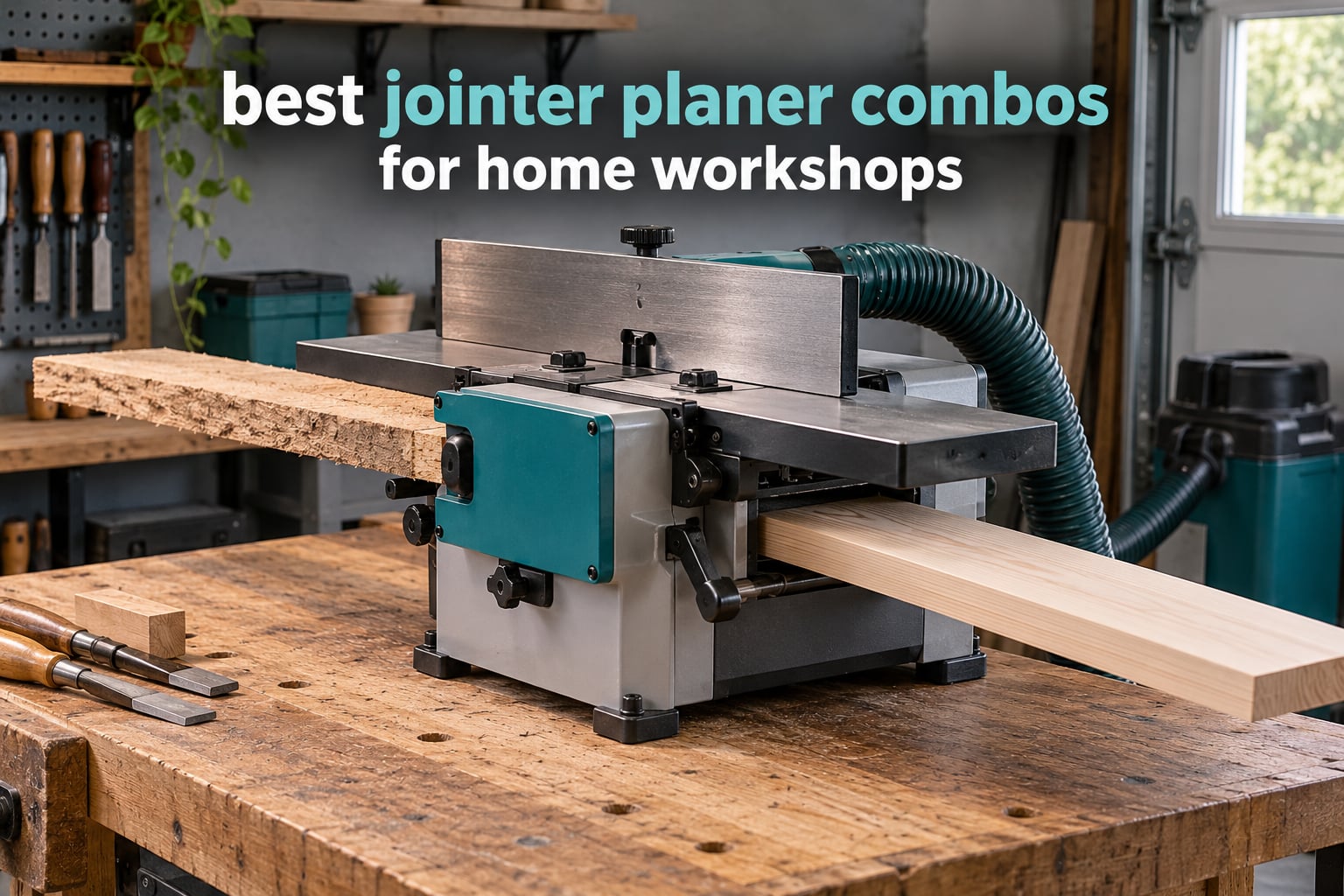
A jointer planer combo is a single woodworking machine with one cutterhead that switches between two jobs: jointing, which flattens a face and squares an edge to 90 degrees, and planing, which makes both faces parallel to a set thickness. One machine, one cutterhead, one stand footprint instead of two. For a garage or basement shop that cannot spare the floor space or the wiring for a dedicated jointer and a dedicated planer, that trade is usually worth making.
We pulled six combos together and read every rating we could find on them, then lined them up against the questions that actually stall a first-time combo buyer: how wide a bed do I need, does it run on 120V or does it force a 220V circuit, and what does a helical cutterhead really change about the surface coming off the machine. The honest answer to whether combos are worth it is yes for most home shops, with one real caveat that we will name plainly below.
Before the picks, one warning worth stating up front. The truth is that the machines we could source with real, meaningful owner feedback are a small group. Most listings in this category that appear at the top of search results carry no ratings at all, which tells you nothing useful about how they mill. So we limited this guide to machines with a genuine review base and told you exactly how many ratings each one carries, because a 4.8 average across six people is a different claim than a 4.4 across several hundred.
Table of Contents
Top 3 Jointer Planer Combos for Home Workshops (October 2026)

Scheppach HMS 850
- 1250W motor
- 8000 rpm knife speed
- 204 mm planing width
- 2-in-1 benchtop design

Scheppach HMS1080
- 1500W motor
- 254 mm planing width
- 9000 min-1 rotation
- fence 90 to 135 degrees

Hoteche 10-Inch Combo with…
- 13A 120V motor
- 10 inch cutting width
- 6 m/min feed speed
- stand included
As an Amazon Associate we earn from qualifying purchases. CERTAIN CONTENT THAT APPEARS ON THIS SITE COMES FROM AMAZON. THIS CONTENT IS PROVIDED 'AS IS' AND IS SUBJECT TO CHANGE OR REMOVAL AT ANY TIME.
Every Jointer Planer Combo We Compared in 2026
Six machines, one table, so you can see the whole field at once. Width is the single biggest factor in whether a combo fits your shop floor, and it ranges from a 6-1/8 inch jointer bed up to a full 12 inch.
| Product | Key Features | |
|---|---|---|
|
Scheppach HMS 850
|
|
Check Latest Price |
|
Scheppach HMS1080
|
|
Check Latest Price |
|
Hoteche 10-Inch Combo with Stand
|
|
Check Latest Price |
 Jet JPJ-12BHH Jet JPJ-12BHH
|
|
Check Latest Price |
 RIDGID JP0610 RIDGID JP0610
|
|
Check Latest Price |
 WEN PL1337 and JT630H Bundle WEN PL1337 and JT630H Bundle
|
|
Check Latest Price |
We earn from qualifying purchases. CERTAIN CONTENT THAT APPEARS ON THIS SITE COMES FROM AMAZON. THIS CONTENT IS PROVIDED 'AS IS' AND IS SUBJECT TO CHANGE OR REMOVAL AT ANY TIME.
Combo Machine or Two Separate Benchtop Machines
A combo replaces two machines with one, and the saving is real: one cutterhead, one table to align, one stand, one dust port, and roughly half the floor space. In a 10 by 12 foot basement shop, that difference decides whether the machines fit at all. What you give up is changeover friction, because converting between jointing and planing means repositioning the table, the fence and the dust shroud, and then re-checking squareness before you cut again.
For most home woodworkers, that friction barely registers because the honest workflow is to batch anyway. Joint every face you need flat, then switch once and plane every board to thickness. One changeover per session, not one per board. Owners who rushed the switch and left the fence out of position are the source of most bad reviews we read, and most of those reports describe a setup mistake rather than a broken machine.
Two separate benchtop machines win in one specific situation: if you already own a planer you are happy with and only need jointing, the case for the combo collapses. Buying a jointer just to flatten and square means paying for a second cutterhead and a second motor to do work you already own a machine for. That is the one situation where the combo is the more expensive path.
Snipe is worth addressing head on, because it is the complaint that shows up in every forum thread about these machines. A combo does not eliminate snipe, the planed dip you get at the end of a board where the feed rollers release. It comes from roller geometry, not from the jointer/planer decision, and it is handled the same way on every machine: back the board off slightly on the jointer side, use a sacrificial leading edge, or sand or plane that end square afterward. If a listing implies a combo fixes it, discount that listing.
1. Scheppach HMS 850 – The Most Popular Combo in This Group
Scheppach Dressing and Thickness Planer HMS 850
- 1250W motor
- 8000 rpm knife speed
- 204 mm planing width
- 2 mm chip removal
- 23 kg benchtop
Pros
- Deepest owner feedback in the group with 769 ratings
- Compact 2-in-1 benchtop footprint
- Die-cast aluminium tables feel stable under load
- Noise level reported as reasonable
Cons
- Jointer fence stop reads short
- near 91 degrees at the start of the fence
- Return side of the feed can over-plane slightly
- Not a professional duty machine
We earn a commission, at no additional cost to you. CERTAIN CONTENT THAT APPEARS ON THIS SITE COMES FROM AMAZON. THIS CONTENT IS PROVIDED 'AS IS' AND IS SUBJECT TO CHANGE OR REMOVAL AT ANY TIME.
Of everything we compared, the HMS 850 is the machine with the deepest bench of real owners behind it. Seven hundred and sixty-nine ratings at a 4.4 average is a much stronger signal than anything else in this category, and the pattern in that feedback is consistent: owners treat it as a capable weekend machine rather than a production tool, and they are happy with it in that role.
The mechanical case is straightforward. A 1250W induction motor drives two high-speed steel blades at 8000 rpm knife speed, and the planing side takes boards up to 204 mm wide with a 120 mm pass height. Maximum chip removal is 2 mm per pass, which is enough to clean up rough sawn material in two or three passes without pushing the motor. The tables are die-cast aluminium with vibration-damping rubber feet, and at 23 kg the whole thing stays portable enough to move off a bench for a weekend project.
The one issue that shows up repeatedly in those reviews is the jointer fence stop. Owners report it measuring short, registering around 91 degrees at the start of the fence run before it reaches true 90. That is a calibration problem you can fix at setup with a straightedge rather than a defect, but it is the first thing to check when you uncrate it. A smaller recurring note is that the return side of the feed can take a slightly heavy final pass, which is a feed-rate adjustment, not a fault.
How it handles rough lumber
The HMS 850 is dimensioned for exactly the kind of work a home shop sees: boards up to 8 inches wide, modest thickness, mixed softwood and hardwood. Owners report good results on small and medium material, with clean chip collection and no complaint about the dust port choking. For a person buying their first combo and milling a garage’s worth of rough boards, this is a realistic machine, not a toy.
What you should not do is ask it to run a full production board run. There is no digital thickness readout, the depth adjustment is a hand crank rather than a handwheel, and 8000 rpm knife speed with two HSS blades means the finish is good but not helical-quiet. If your work is mostly one-off furniture stock, that trade is fine. If you plan to flatten board after board every week, keep reading.
Who should skip it
Skip this machine if your largest material is wider than 8 inches, or if you need a fence that holds 90 degrees perfectly from the first pass without adjustment. Owners wanting commercial throughput report that it is not a professional-grade machine, and we agree with that framing.
Also consider the electrical side. This is a 220/240V 50Hz unit, so it needs a dedicated circuit rather than a household wall outlet. Plan for that before the machine arrives, because it changes where the machine can live in the shop. Spare part availability is listed at seven years for European-market models, which is a genuine plus for a machine you might keep for a decade.
We earn a commission, at no additional cost to you. CERTAIN CONTENT THAT APPEARS ON THIS SITE COMES FROM AMAZON. THIS CONTENT IS PROVIDED 'AS IS' AND IS SUBJECT TO CHANGE OR REMOVAL AT ANY TIME.
2. Scheppach HMS1080 – Wider Cut and More Power
Scheppach Planer & Jointer HMS1080 | Power 1500W | Planing Width 254 mm | Pass Height: 120 mm | Iron Rotation Speed 9000 min-1 | Plus 2 Extra Irons
- 1500W motor on 230V
- 254 mm width, 120 mm pass height
- Two knives at 9000 min-1
- Fence 90 to 135 degrees
Pros
- Generous 254 mm planing width for a benchtop unit
- Compact footprint that suits a small workshop
- Crank height adjustment plus a 90 to 135 degree fence range
- Bundled with two spare irons
Cons
- Motor labours when working at the full 254 mm width
- Boards from roughly 2 m can deflect or skew
- Fence must be unscrewed to connect dust extraction
We earn a commission, at no additional cost to you. CERTAIN CONTENT THAT APPEARS ON THIS SITE COMES FROM AMAZON. THIS CONTENT IS PROVIDED 'AS IS' AND IS SUBJECT TO CHANGE OR REMOVAL AT ANY TIME.
The HMS1080 is the wider, more powerful sibling of the machine above, and for a home shop that regularly mills boards wider than 8 inches it is the more sensible buy. A 1500W motor feeds two high-speed steel planing knives turning at 9000 min-1, with a 254 mm planing width and the same 120 mm pass height. That extra 50 mm of width is roughly two more inches of usable capacity, which is often the difference between jointing a board flat and jointing half of it and rotating.
Its 3.9 average across 75 ratings tells you it is not as settled a machine as the HMS 850, and the ratings distribution explains why: 48 percent five star, 27 percent four star, but 14 percent one star. That is a real spread, and the one-star reviews cluster on capacity rather than on quality of cut.
German-language owners across the range describe it as a usable entry-level hobby machine that fits a small workshop well and handles small and medium material competently.
Where the power runs out
The clearest limitation in the review data is what happens at full width. Owners report the motor complaining when working across the entire 254 mm, and boards longer than roughly 2 meters deflecting or skewing as they pass. In practice that means the machine wants to work in the middle of its range rather than at the edge of it. For battens, narrow stock, short boards and cabinet parts, that is a non-issue.
There is also a setup quirk that catches people out: the fence has to be unscrewed and removed before you can connect dust extraction. That is an annoying two-minute step every time you rearrange the shop, and it is worth planning your layout so the hose reaches without moving the fence. Vibration-dampening rubber feet are included, which helps stability on an uneven bench.
Who should pick this one
Pick the HMS1080 if you want more width and more power than the HMS 850 but you are still working on 230V single-phase power in a small shop. The jointer guide adjusts from 90 to 135 degrees, so beveled edge work is available in a way most machines at this size do not offer.
Skip it if your shop is clean and your board supply is long. This is a machine for short, medium and narrow material in a compact footprint, and it will tell you about that at the 2 meter mark. Check the planer table alignment on arrival too, since one detailed review documented uneven shavings across the width on a unit that needed adjusting before first use.
We earn a commission, at no additional cost to you. CERTAIN CONTENT THAT APPEARS ON THIS SITE COMES FROM AMAZON. THIS CONTENT IS PROVIDED 'AS IS' AND IS SUBJECT TO CHANGE OR REMOVAL AT ANY TIME.
3. Hoteche 10-Inch Combo with Stand – The Lowest Entry Point
Hoteche 10-Inch Benchtop Planer and Jointer Combo with Stand 13-Amp Heavy Duty Thickness Planer for Woodworking, Adjustable Depth 0-3mm
- 13A motor on 120V
- 10 inch cutting width
- 6 m/min feed speed
- 37.3 inch jointer table
- Stand included
Pros
- Runs on a standard 120V household circuit with no install
- Stand included so no separate bench is needed
- Large 37.3 inch jointer table gives real workpiece support
- Consistent 6 m/min feed speed
Cons
- Rating spread is wide
- 32 percent of ratings are one star
- Jointer cuts only 0 to 3 mm so heavy removal takes several passes
We earn a commission, at no additional cost to you. CERTAIN CONTENT THAT APPEARS ON THIS SITE COMES FROM AMAZON. THIS CONTENT IS PROVIDED 'AS IS' AND IS SUBJECT TO CHANGE OR REMOVAL AT ANY TIME.
Everything else in this group is 220V or 230V, which means a dedicated circuit and an electrician. The Hoteche runs on 120V at 13 amps, which in a garage or basement with a couple of open outlets is the difference between installing the machine this weekend and putting it on a list of things to do next year. That alone earns it a place in any home shop shortlist.
On paper the rest is competitive for the class. A 10 inch maximum cutting width, a 9000 rpm no-load speed, a steady 6 m/min feed, material thickness from 5 to 120 mm, jointer depth of 0 to 3 mm and planer depth of 0 to 2 mm. The jointer table measures 37.3 by 10 inches, which is a generous support area for a benchtop unit, and the planer table is 10.6 by 12 inches. A stand is included, so it is a floor-standing machine out of the box rather than a bench project.
The 3.5 average across 18 ratings is the part you should read twice. Half of buyers rate it five stars, and roughly a third rate it one star. That is not a consistent product, it is a lottery with good odds and bad ones, and the rank it holds among power benchtop planers shows there is real demand at this end of the market. Budget is the only reason to accept that spread.
What the shallow jointer cut costs you
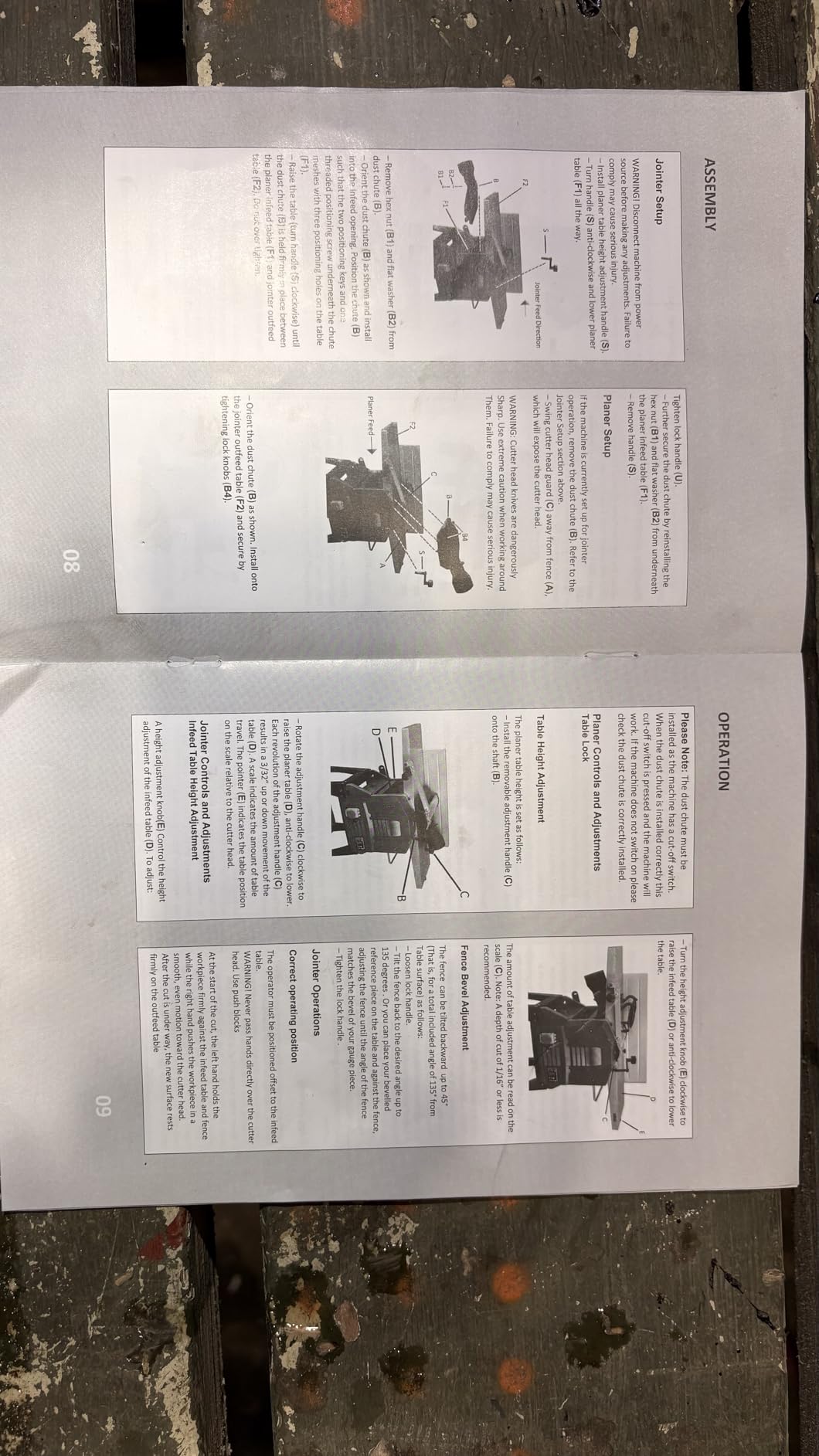
A 0 to 3 mm jointer depth means removing a quarter inch of cuppy rough material takes four or five passes instead of two. On softwood that is unremarkable. On reclaimed or warped hardwood, where the whole point of a jointer is flattening a twisted face in as few passes as possible, it adds up fast and it adds motor load. Know your material before you commit to this machine.
There is one more practical consideration: 120V 13 amps shares a circuit. Running it while a dust collector or a table saw starts can trip a breaker mid-cut. If you can, give it a circuit of its own on the 120V side even though the plug fits an ordinary wall.
Who it suits and who it does not
It suits a first-time buyer, a renter, or anyone whose shop has no subpanel and no patience for one. It suits softwood and short boards, and it suits a person who wants to learn jointing and planing on cheap before committing serious money.
It does not suit a serious woodworker. The one-star share of 32 percent is high enough that you should expect a call if something goes wrong, and there is no meaningful long-term owner history to fall back on. Buy it knowing what you are buying, or spend more and buy the HMS 850 next.
We earn a commission, at no additional cost to you. CERTAIN CONTENT THAT APPEARS ON THIS SITE COMES FROM AMAZON. THIS CONTENT IS PROVIDED 'AS IS' AND IS SUBJECT TO CHANGE OR REMOVAL AT ANY TIME.
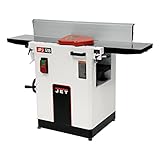
4. Jet JPJ-12BHH – Full 12-Inch Capacity With a Helical Cutterhead
Jet 12-Inch Planer/Jointer, Helical Cutterhead, 3 HP, 230V 1Ph (JPJ-12BHH)
- 42 four-sided carbide inserts
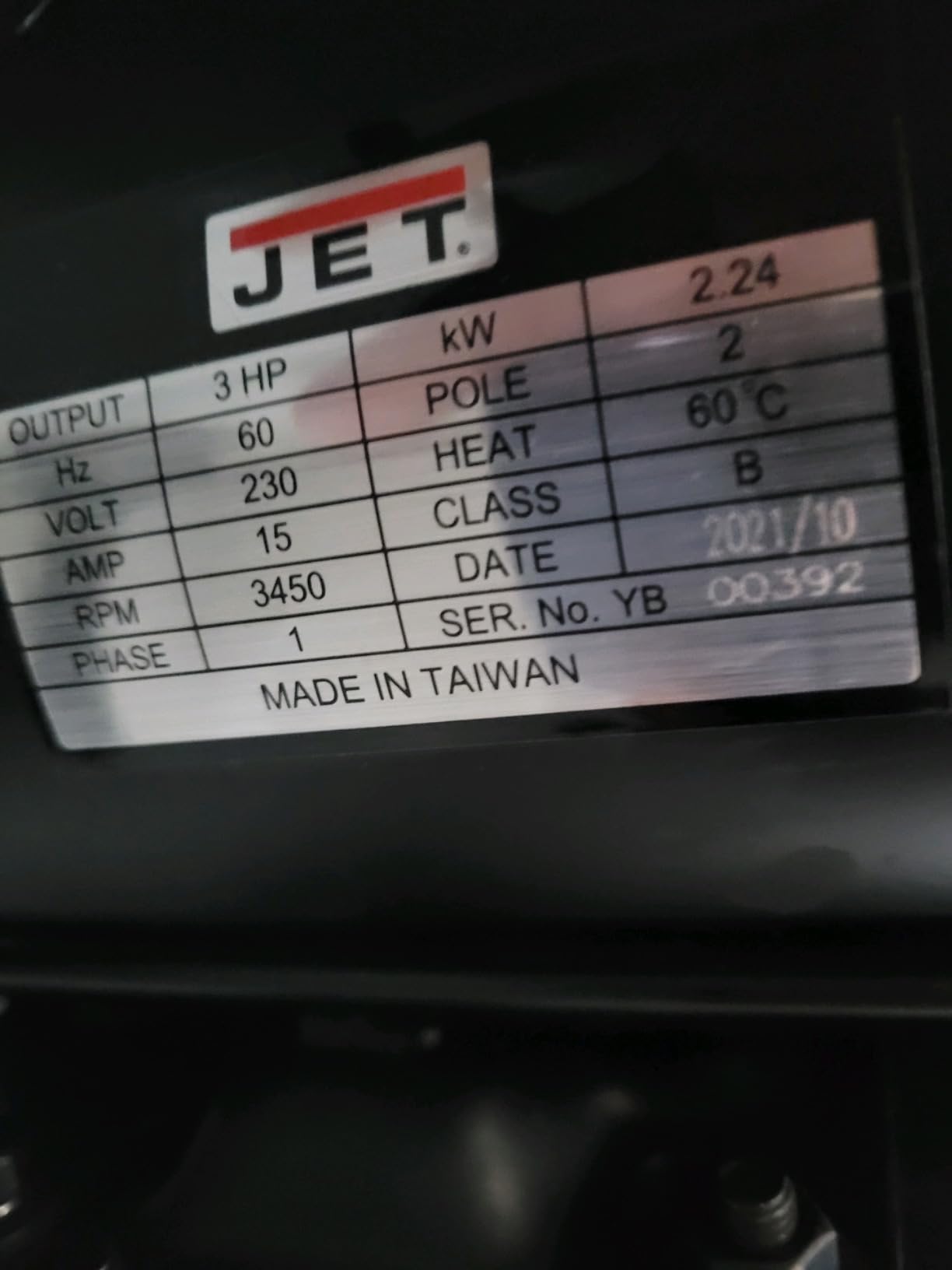
- 3 HP, 230V, 15A
- 5300 rpm cutterhead
- 12 inch width, 453 lb
Pros
- Helical cutterhead produces near-finished surfaces and runs quieter
- 42 four-sided inserts mean rotating an edge instead of changing a knife
- Quick changeover without removing the fence
- Cast iron tables and a one-piece steel closed stand
Cons
- Supplied 14-gauge cord conflicts with the manual's 30A breaker guidance
- 453 lb and a dedicated circuit make it a fixed installation
- Occasional commissioning QC issues reported
We earn a commission, at no additional cost to you. CERTAIN CONTENT THAT APPEARS ON THIS SITE COMES FROM AMAZON. THIS CONTENT IS PROVIDED 'AS IS' AND IS SUBJECT TO CHANGE OR REMOVAL AT ANY TIME.
What sets this machine apart from the benchtop units is the cutterhead. Forty-two four-sided tungsten carbide inserts run on a 3 HP, 230V single-phase motor at 5300 rpm. Because each insert has four usable edges, a dull edge is rotated in a couple of minutes with the screwdrivers included in the box, and when they are finally spent you replace a few dollars of carbide rather than a set of knives. That is a maintenance difference you feel every month for the life of the machine.
The finish is the other reason. Owners describe turning rough two-by-fours into clean, smooth lumber, with surfaces good enough to skip final sanding on many projects. A helical head also shears rather than slashes, which is why owners consistently report it running noticeably quieter than a two-knife head. At 4.6 across five ratings the feedback is small but strongly positive, with 86 percent of ratings at five stars.
Its physical specs are also a step up from everything else here. Twelve inch cutting width, 0.13 inch maximum cutting depth, heavy cast iron tables with a ground finish, a parallelogram table design that keeps the planer table close to the cutterhead for fine adjustment, and a large handwheel for moving the planer table quickly. The changeover from jointing to planing happens without removing the fence, which is faster than the benchtop machines that need the fence taken out of position.
Plan the install before it arrives
At 453 pounds and 55.5 by 29 by 40 inches, this is a fixed installation, not a movable bench machine. It ships as a one-piece closed steel stand with mounting tabs, which is excellent for stability and makes the unit nearly immovable once bolted down. If your shop is downstairs, budget for professional movers rather than a weekend with two friends and a set of stair-climbing dollies.
The electrical setup is where owners actually report friction. The supplied cord is 14 gauge while the owner’s manual calls for a 30 amp breaker, and that conflict generated enough confusion to send owners to technical support. Have an electrician run the circuit before delivery, and tell them it is a 15 amp, 230V single-phase load. If the machine has been used commercially the warranty drops from five years to two, so keep your purchase receipt and note your intended use.
Who should stretch for this one
Buy this if you are milling real quantities of hardwood, you want surfaces that need minimal sanding, and you have somewhere to put 453 pounds and a dedicated 230V circuit. The helical head pays for itself on insert longevity and quiet running long before the machine has finished a year of work.
Skip it if your shop is a rented garage with no subpanel, or if you cut a few boards a year. For occasional work the benchtop machines on this list do the same job for a fraction of the money and can be carried between rooms. Watch for the small commissioning issues one owner reported, a loose start-switch wire and an infeed that stuck in the down position, and check both before first power-up.
We earn a commission, at no additional cost to you. CERTAIN CONTENT THAT APPEARS ON THIS SITE COMES FROM AMAZON. THIS CONTENT IS PROVIDED 'AS IS' AND IS SUBJECT TO CHANGE OR REMOVAL AT ANY TIME.
5. RIDGID JP0610 – Narrow Bed, Heavy Frame, Built for Small Work
Ridgid JP0610 Planer, 6-1/8-Inch Jointer
- 1 HP heavy-duty motor
- 6-1/8 inch jointer width
- Alloy steel construction
- Dual bevel fence
- 208 pounds
Pros
- 4.8 star average across every rating it has
- Alloy steel heavy-duty construction
- Backed by a 3 year limited warranty and lifetime service agreement
- Dual bevel fence handles angled jointing
Cons
- Only 6 ratings give very little long-term feedback
- 6-1/8 inch width is the narrowest capacity here
- 208 pounds is heavy for a machine this small
We earn a commission, at no additional cost to you. CERTAIN CONTENT THAT APPEARS ON THIS SITE COMES FROM AMAZON. THIS CONTENT IS PROVIDED 'AS IS' AND IS SUBJECT TO CHANGE OR REMOVAL AT ANY TIME.
The RIDGID JP0610 sits at the other end of the width range. Its 6-1/8 inch bed will not flatten a full width board, and if your material is wider than that you will be working one edge at a time. What it offers instead is a 1 HP motor in alloy steel construction, at 208 pounds, with a dual bevel fence and a convenient dust port. That is a jointer-first machine that handles thickness planing on the side.
The 4.8 rating is earned without a single critical review, but it rests on six ratings. Eighty-three percent of those ratings sit at five stars and seventeen percent at four. Read that as a clean signal from a very small buyer base rather than a track record, and factor in that the listing returns no written customer review text, so there is nothing to mine for detail on cut quality, alignment drift or noise.
What is genuinely attractive is the ownership terms. A 90-day satisfaction guarantee sits alongside a limited three-year warranty and a lifetime service agreement, and the alloy steel body on a machine this size is heavier than you would expect. Parts availability on a well-supported brand like this matters more than it does on an import, particularly for fences and drive components.
Where a narrow bed still works
A 6-1/8 inch bed is not a compromise if your work is small. Picture frames, small boxes, drawer parts, battens, moldings and trim all fall inside that width, and for those a compact machine with a dual bevel fence is easier to maneuver than a 10 or 12 inch combo you cannot park.
The maximum cutting depth of 0.13 inch is a full-depth jointer pass, so it will flatten cupped and twisted material properly rather than only skimming it. With a 1 HP motor you can expect to work hardwood at sensible depths without straining it, provided you keep the pass within what the fence and depth scale allow.
What the six ratings cannot tell you
They cannot tell you how the fence holds up over a year, whether the table stays true after a move, or how the thickness side handles wide boards, because nobody has written enough about it. That thin evidence base is why its badge here marks a use case rather than a ranking, so treat this as a machine you verify yourself at setup rather than one you trust on reputation.
If you want a small, indestructible jointer for a cramped shop and you are comfortable verifying alignment yourself at setup, this is a reasonable buy. If you plan to mill furniture-grade stock, get a wider bed. Note also that at 208 pounds it still needs two people and a planned move, just not a professional crew.
We earn a commission, at no additional cost to you. CERTAIN CONTENT THAT APPEARS ON THIS SITE COMES FROM AMAZON. THIS CONTENT IS PROVIDED 'AS IS' AND IS SUBJECT TO CHANGE OR REMOVAL AT ANY TIME.
6. WEN PL1337 and JT630H Bundle – Two Machines in One Purchase
WEN Thickness Planer (PL1337) and Jointer (JT630H) Woodworking Machine Bundle
- PL1337 planer plus JT630H jointer
- 26 and 16 FPM two-speed feed
- 13 inch planer width
- 30 by 6 inch jointer table
Pros
- Genuinely separate machines rather than one shared cutterhead
- Two-speed feed lets you rough fast and finish slow
- 13 inch planer width is wide for the money
- 45 degree beveling fence on the jointer
Cons
- Only two ratings
- so reliability data is very thin
- You still own two machines to store and align
- Not a single-footprint option
We earn a commission, at no additional cost to you. CERTAIN CONTENT THAT APPEARS ON THIS SITE COMES FROM AMAZON. THIS CONTENT IS PROVIDED 'AS IS' AND IS SUBJECT TO CHANGE OR REMOVAL AT ANY TIME.
This is the one entry here that is not really a combo. The bundle pairs a WEN PL1337 thickness planer with a JT630H jointer, so you get two independent machines with their own cutterheads and their own tables. That defeats the entire point of a combination machine, which is space saving through a shared cutterhead, and it is worth being clear about that before anyone buys it for the wrong reason.
What it does offer is genuine convenience. The planer runs at two feed speeds, 26 FPM for quick rough dimensioning and 16 FPM for finishing passes, which lets you remove a lot of material quickly and then take a slower, cleaner cut. It handles boards up to 6 inches thick and 13 inches wide. The jointer has a 30 by 6 inch table, removes 0 to 1/8 inch per pass, and its fence bevels up to 45 degrees. Both machines use spiral cutterheads with staggered high-speed steel blades.
The rating is a perfect 5.0, from two verified-buyer ratings, with no written review text returned. Treat that as a data point rather than a verdict. There is no track record here at all, which is a real risk on machines with spiral cutterheads that need sharpening service.
When two machines beat one
If your shop has room for both and you want to avoid changeover entirely, this bundle works. You keep the jointer set up for squaring edges and the planer set up for thickness, and nothing moves between operations. For a person who does a lot of edge work on small parts, having a dedicated jointer is genuinely pleasant.
It also solves the 120V problem differently. These are benchtop machines meant for a normal household circuit, so there is no installation to plan. You need a bench sturdy enough to hold both, but nothing more.
Why it ranks last for a combo shortlist
Because it does not save space. Two machines occupy two footprints, need two alignments and two dust connections, and eventually one of them sits unused against a wall. If you want one machine to do two jobs, this is not it, and buying it as a combo solution sets up a disappointment.
Buy the bundle if you want a planer and a jointer and the pairing is convenient. Otherwise pick a true combo from this list and get one cutterhead doing both jobs, which is the entire premise we started with.
We earn a commission, at no additional cost to you. CERTAIN CONTENT THAT APPEARS ON THIS SITE COMES FROM AMAZON. THIS CONTENT IS PROVIDED 'AS IS' AND IS SUBJECT TO CHANGE OR REMOVAL AT ANY TIME.
How to Choose a Jointer Planer Combo for Your Shop
Match the bed width to the material, not the ambition
The widest board you actually need to flatten decides the machine, and nothing else does. In this group the range runs from 6-1/8 inches on the RIDGID, through 8 inches on the Scheppach HMS 850, 10 inches on the Hoteche and HMS1080, to a full 12 inches on the Jet. A shop working on 1x lumber, trim and cabinet parts is well served by 8 inches. Someone flattening hardwood slabs or wide table tops needs 12. Buying wide when you do not need it costs floor space and money, and buying narrow means rotating every board, which is the fastest way to make a jointer feel like a mistake.
Decide between a two-knife head and a helical head
A two-knife or three-knife head uses long HSS knives that you remove and sharpen as a set. A helical head uses many small four-sided carbide inserts that you rotate one at a time. That difference drives everything downstream: sharpening frequency, noise, finish quality and long-term cost. For a person who mills occasionally, the two-knife head is cheaper up front and easier to sharpen. For someone running real volume or wanting surfaces that skip sanding, the helical head earns its cost through insert longevity alone, since a dull insert is a ninety-second rotation rather than a full sharpening session.
Cutterhead speed compounds the effect. The benchtop machines here turn between 8000 and 9000 rpm, while the Jet runs 5300 rpm with 42 inserts cutting at once. More cutting edges at a moderate speed produces less noise and a finer surface than fewer blades at very high speed.
Sort out power and voltage before anything else
This is the step that disqualifies machines. The Hoteche runs on 120V at 13 amps and plugs into a household circuit. Everything else in this group is 220V or 230V and needs a dedicated circuit. A benchtop machine drawing around 1250W to 1500W will share a 15 amp 120V circuit uneasily with a dust collector, but a 230V circuit has far more headroom and lets you run the dust collector at the same time without a breaker trip.
Have the circuit installed before delivery, not after. For a 230V single-phase machine rated at 15 amps, an electrician running a properly sized branch circuit is an afternoon of work that removes the largest source of first-day frustration. If you are unsure whether your shop has the panel capacity for it, find out before you choose the machine rather than after.
Check the table, the fence and the dust connection
Table material decides how a machine behaves under load. Die-cast aluminium on the Scheppach HMS 850 is reported by owners as giving a stable, solid feel with vibration-damping rubber feet underneath, while the Jet rides on heavy cast iron tables with a ground finish. A thin extruded table will feel different under a full-width pass, which is why the table construction is worth checking before you choose.
Check fence adjustability next. The HMS1080 guide runs from 90 to 135 degrees, and the RIDGID carries a dual bevel fence, so angled edge work is available on more than one machine here even where the spec sheet is thin. Then check the dust port. The Jet and the RIDGID both list a convenient dust port, while on the HMS1080 the fence has to be unscrewed and removed before extraction can be connected. That is a small annoyance on day one and a recurring one forever, so plan your hose routing around it.
Size your dust collection to the port
Chip volume from a jointer is far higher than from a planer because the jointer has to move a full-width shaving on every pass. A collector sized for a table saw will feel undersized on a jointer, especially with the planer running through the same machine. Match the port diameter to your hose, check the CFM rating against the width of the cut, and if the machine ships with a reducer, spend the time to understand whether it is choking your airflow.
One recurring complaint worth planning around: on some of these machines the dust hood position puts the hose directly across the infeed side of the planer. Before you commit to a position for the machine, lay out the hose path and confirm it clears your stock feeding path.
Budget for maintenance, not just the machine
Two-knife heads need sharpening several times a year depending on volume, and they need it as a matched set. Helical heads need rotating, which is a few minutes per rotation cycle, and replacement inserts when the fourth edge finally dulls, which for most hobbyists is measured in years rather than months. Neither is expensive, but the frequency differs so much that it changes which machine fits your habits.
Whatever the head, the biggest maintenance risk is the material you feed it. Loose knots, brad nails and fasteners hidden in reclaimed lumber are what ruin cutterheads, and on a helical machine a single nail can take out several inserts at once. Run a metal detector or visually inspect reclaimed material, and feed it slowly on the first pass.
Plan the move before the machine arrives
Weights here range from 23 kg on the HMS 850 to 453 pounds on the Jet, and that range decides whether you can move your machine in an afternoon or need a crew. Benchtop units go up basement stairs with two people. A 200 pound unit needs a plan and a dolly. A 453 pound fixed machine belongs downstairs from the day it arrives, or it needs professional movers.
Long-time combo owners in woodworking forums consistently recommend the same three planning steps: decide the final location before delivery, remove the stand if it is detachable to reduce the awkwardness through doorways, and clear the entire infeed and outfeed clearance before you start. That last one matters more than people expect, because a 9 foot board needs about 9 feet of clearance on each side, once, instead of twice as it would with two separate machines.
Frequently Asked Questions
What is the best jointer and planer combo for woodworkers?
For most home shops the best all-round balance is a helical head machine like the Jet JPJ-12BHH, which gives near-finished surfaces, quiet cutting and inserts you rotate instead of sharpen. If your material is narrower than 12 inches and your budget is smaller, the Scheppach HMS 850 is the most proven choice, with the deepest owner feedback of any combo in its class.
Are planer jointer combos worth it?
For most home woodworkers, yes. A combo gives you jointing and planing from one cutterhead, one stand and one set of infeed and outfeed clearance, at roughly half the cost and footprint of two machines. The trade is changeover time between modes, which most owners solve by batching all jointing first and all planing second.
Is there a planer jointer combo that runs on 120V?
Yes. The Hoteche 10-Inch Benchtop Planer and Jointer Combo runs on a 13 amp, 120V circuit and ships with a stand, so no dedicated circuit or bench build is needed. Most larger combos, including every 220V and 230V machine we compared, require a dedicated circuit.
Do you really need a jointer and planer?
If you work with rough lumber you do, because rough material has to be flattened and squared before anything else can be done to it. If you only ever work with dimensioned sheet goods and finished lumber, you can skip the jointer entirely and use a planer with a sled for edge squaring. Buy a combo if rough lumber is part of your workflow.
Why are jointers so expensive?
Because a good jointer is a heavy, rigid, accurately aligned machine. Wide beds need long cast iron tables, the fence has to hold 90 degrees without drifting, and the motor has to absorb the shock of a full-width pass through cupped hardwood. Price rises with bed width, table mass and build quality, which is why the smallest jointers cost the least.
What is the best jointer planer combo for the money?
In this group the Scheppach HMS 850 is the value leader, pairing a 1250W motor, 8000 rpm knife speed and a 204 mm planing width with the largest body of owner feedback of any machine compared. The Hoteche is cheaper again if you need 120V power, but its rating spread is much wider.
Which Jointer Planer Combo Should You Buy in 2026
Our pick is the Scheppach HMS 850. It has the deepest owner feedback in the category at 769 ratings averaging 4.4, a 204 mm planing width that covers most home shop material, and a compact 23 kg benchtop footprint you can move when the bench is needed for something else. Check the jointer fence calibration on arrival and you have a machine that will handle rough lumber for years.
If you need more width, take the HMS1080. If you have no subpanel and no plan to install one, the Hoteche runs on a household circuit. If you are milling hardwood in real volume and have a place to put 453 pounds, the Jet JPJ-12BHH and its helical cutterhead are worth every step of the installation.
Whatever you choose, get the circuit sorted, batch your jointing before your planing, and go slowly on the first pass through reclaimed lumber.