
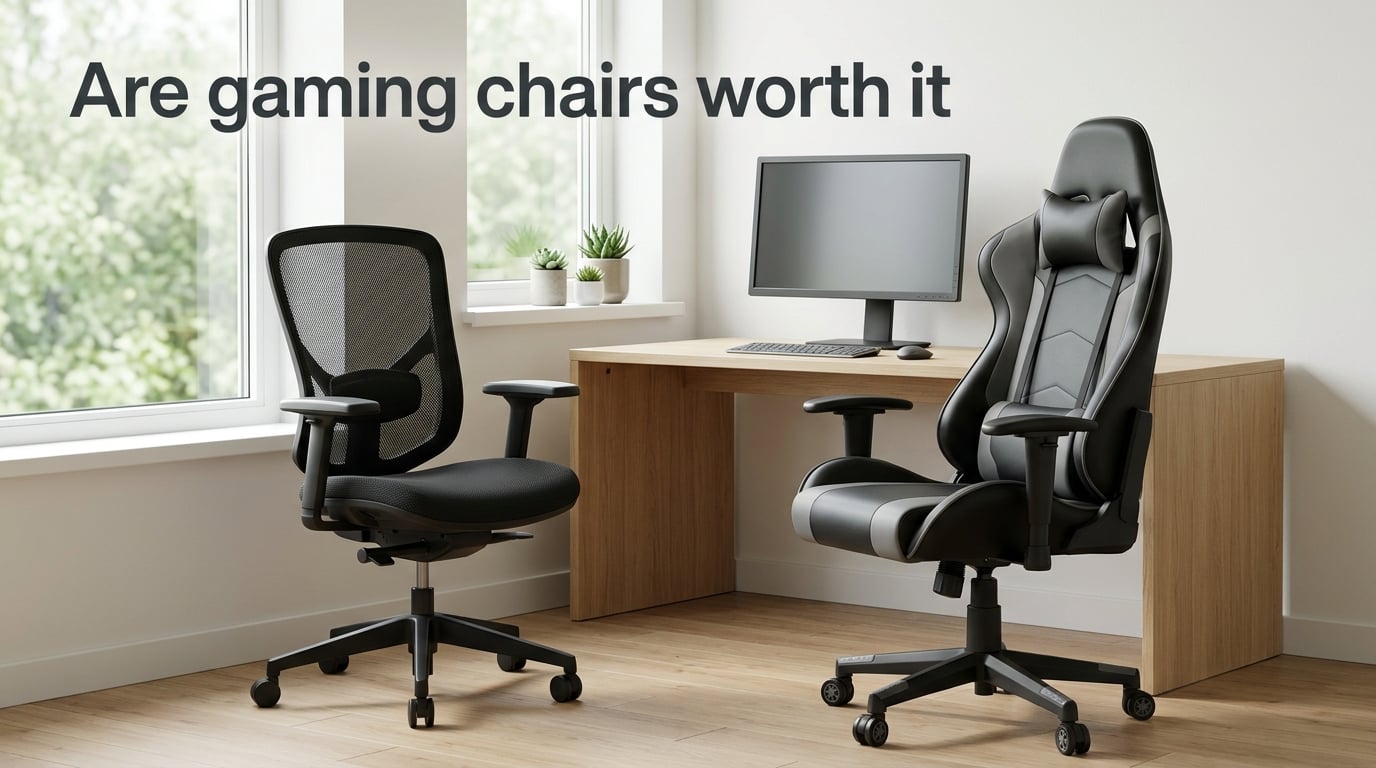
Gaming chairs are generally not worth it for pure ergonomics compared to similarly priced office chairs. If you sit more than four hours daily for work or study, a quality ergonomic office chair will serve your back better and last longer. Gaming chairs make sense mainly for short-session gamers who value the racing aesthetic and deep recline over long-term posture support.
Table of Contents
Are Gaming Chairs Worth It? The Short Answer
Here’s the honest answer from someone who’s sat in dozens of both: gaming chairs prioritize looks over lumbar science. A $300 ergonomic office chair with a synchro-tilt mechanism and adjustable lumbar depth will outperform a $300 racing-style gaming chair for anyone sitting more than four hours straight.
But “worth it” depends on your use case. If you game for two to three hours in the evening and want something that matches your RGB setup, a gaming chair fits. If you’re a developer, writer, or student spending eight hours in the seat, office chairs win hands down.
The data backs this up. Multiple r/buildapc users with six-to-eight-hour desk jobs report switching from gaming chairs to used Herman Miller Aerons and never looking back. Forum consensus across Reddit and Level1Techs leans heavily toward “gaming chairs are mostly aesthetic.”
What Gaming Chairs Actually Do (and Don’t Do)
Gaming chairs borrow their design from racing car seats. That means a bucket seat with side bolsters, a high backrest, and a reclining mechanism that often goes back 135 degrees or more. You get removable lumbar and neck pillows, adjustable armrests, and flashy color options.
What they do well: they look distinctive, recline far enough for nap breaks, and feel comfortable for the first two to three hours. The bucket design cradles your body during intense gaming moments. Brands like Secretlab and DXRacer have built loyal followings for delivering this experience consistently.
What they fail at: long-term ergonomic support. The bucket seat’s side bolsters, designed to hold race car drivers in place during turns, push your shoulders forward during normal desk work. The attached lumbar pillows flatten after 30 minutes and lose all benefit. PU leather upholstery traps heat, making summer sessions uncomfortable. And the center-tilt recline mechanism on most models brings your knees up awkwardly instead of maintaining proper posture.
Gaming Chair vs Office Chair: The Real Differences
Ergonomics and Posture Support
Ergonomic office chairs use science-backed designs developed over decades. Features like synchro-tilt mechanisms let the seat and backrest move together at a ratio that keeps your feet flat on the floor while reclining. Seat depth adjustment lets you match the chair to your leg length. Adjustable lumbar support moves in and out to match your spine’s natural curve.
Gaming chairs rely on removable pillows for lumbar and neck support. These pillows sit in fixed positions and cannot match the precision of an integrated lumbar system. The bucket seat design also restricts natural movement, which ergonomic experts say is bad for spinal health during extended sitting.
Build Quality and Materials
Premium office chairs from brands like Herman Miller, Steelcase, and Haworth use high-density foam, breathable mesh, and steel or aluminum frames. They undergo testing for tens of thousands of sit cycles. Warranties typically run 10 to 12 years, reflecting the manufacturer’s confidence in longevity.
Gaming chairs typically use cold-cure or high-density foam wrapped in PU leather or fabric. Steel frames are common, but quality varies wildly by price tier. Budget gaming chairs under $150 frequently squeak, peel, or break within 12 months according to forum reports. Premium options like Secretlab Titan Evo last five years or more, but they’re the exception rather than the rule.
Adjustability Features
Office chairs at the $300 and above tier typically offer four or more adjustment axes: seat height, seat depth, lumbar depth, armrest width and height, tilt tension, and backstop angle. This lets you fine-tune the chair to your exact body dimensions.
Most gaming chairs offer seat height, recline angle, and basic armrest adjustment. Premium models add 4D armrests that move in four directions, but seat depth adjustment is rare. You’re left with one-size-fits-most sizing that works poorly for anyone above 6 feet 2 inches or below 5 feet 6 inches.
Price-to-Value Analysis
At the $200 price point, you get a decent gaming chair with basic adjustments or a mid-range ergonomic office chair with better lumbar support and a longer warranty. At $400, office chairs like the EuroTech Vera or Haworth Soji offer professional-grade ergonomics while gaming chairs add aesthetic features like RGB lighting or team branding. At $600 and above, the gap widens further—office chairs deliver decade-long warranties and clinical-grade adjustability while gaming chairs offer diminishing returns on comfort.
Who Should Actually Buy a Gaming Chair
Gaming chairs make sense for a specific audience. If you game for two to four hours daily and spend the rest of your computer time on a couch or standing desk, the shorter sitting sessions mean ergonomic shortcomings matter less. Streamers and content creators who want their setup to look distinctive on camera benefit from the racing aesthetic. And if you genuinely prefer the bucket-seat feel and deep recline for casual use, that’s a valid personal preference.
The Secretlab Titan Evo stands out as the one gaming chair that even skeptical users call “actually ergonomic.” It uses softer bolsters, a knee-tilt mechanism instead of center-tilt, and integrated lumbar adjustment rather than a pillow. If you’re set on a gaming chair, that model gets the closest to office-chair ergonomics.
Why Most Office Workers Should Skip Gaming Chairs
If your job involves six or more hours of daily sitting, gaming chairs create real problems. The bucket bolsters cause shoulder strain by forcing your arms inward during typing. Lumbar pillows provide inconsistent support and encourage slouching as they compress. PU leather traps body heat, causing discomfort and sweat during long sessions.
Forum users on r/pcmasterrace report that the initial comfort of gaming chairs fades after the first hour. Back pain complaints spike around the three-to-four-hour mark. Multiple users describe developing lower back issues after months of gaming chair use that resolved when switching to ergonomic office chairs.
The warranty gap tells the story too. Premium office chair brands offer 10-to-12-year warranties because they build chairs to last. Most gaming chair brands offer one to three years. That difference reflects real-world durability expectations, not just marketing generosity.
The Used Ergonomic Office Chair Alternative
Here’s the angle no other guide covers, and it’s the smartest move for budget-conscious buyers: skip both new categories and buy a used premium ergonomic office chair. Facebook Marketplace, Craigslist, and office liquidation sales regularly feature Herman Miller Aerons, Steelcase Leaps, and Haworth Ferns at 30 to 50 percent of retail price.
A used Herman Miller Aeron that retails for $1,400 new can be found for $400 to $600 in good condition. That’s less than a new Secretlab Titan Evo and delivers superior ergonomics with a mesh seat that breathes, a synchro-tilt mechanism, and 12 years of warranty coverage that sometimes transfers to the second owner.
What to check before buying used: sit in the chair for at least 10 minutes and test every adjustment. Check the gas cylinder by sitting and standing several times—it should hold position without sinking. Inspect the mesh or fabric for tears, sagging, or worn spots. Test the armrests for wobble. Ask about the purchase date and whether the warranty is transferable. Avoid chairs with cracked bases or sticky tilt mechanisms.
Total Cost of Ownership Over 5 Years
Let’s do the math that no competitor covers. A $150 gaming chair replaced every 18 months costs $500 over five years and delivers inconsistent comfort throughout. A $300 ergonomic office chair that lasts five years costs $300 total and provides consistent support the entire time. A $500 used Herman Miller Aeron that lasts another decade costs $500 once.
Cost per hour of comfortable sitting is the real metric. A budget gaming chair at $150 with an 18-month lifespan and three hours of comfortable daily use gives you roughly 1,600 comfortable hours—that’s about 9 cents per hour. A $300 office chair with five years of comfortable eight-hour use gives you roughly 10,000 hours—about 3 cents per hour. The office chair wins by a factor of three on pure value.
Frequently Asked Questions
Are gaming chairs worth it for back pain?
Gaming chairs are not recommended for back pain sufferers. Their bucket-seat design and flat lumbar pillows lack the adjustable support needed for spinal alignment. Ergonomic office chairs with integrated lumbar systems and synchro-tilt mechanisms provide better support for back pain relief.
How long do gaming chairs last?
Gaming chairs last 2 to 5 years on average. Budget chairs under $150 often fail within 12 months due to squeaking, peeling, or broken gas cylinders. Premium options like the Secretlab Titan Evo can last 5 years or more with proper care.
Is it better to get an office chair or a gaming chair?
For sessions longer than 4 hours, office chairs are better due to superior ergonomics, adjustability, and build quality. For short gaming sessions of 2 to 3 hours where aesthetics matter, gaming chairs can work well.
Why are gaming chairs so uncomfortable?
Gaming chairs get uncomfortable because bucket-seat bolsters push shoulders forward during typing, lumbar pillows flatten after 30 minutes, and PU leather traps heat. The center-tilt recline also brings knees up awkwardly instead of maintaining proper posture.
Can you use a gaming chair as an office chair?
You can use a gaming chair for office work, but it’s not ideal for long hours. The bucket design restricts natural movement, the lumbar pillow provides inconsistent support, and the lack of seat depth adjustment means it rarely fits properly for desk work.
Should I buy a used ergonomic office chair instead?
A used premium ergonomic chair is often the smartest buy. Herman Miller Aerons, Steelcase Leaps, and Haworth Ferns are available at 30 to 50 percent retail through office liquidation sales and offer superior ergonomics with longer warranty coverage than most new gaming chairs.
Conclusion
So, are gaming chairs worth it? For most people who sit more than four hours daily, the answer is no. Ergonomic office chairs provide better lumbar support, longer warranties, and superior build quality at comparable price points. If you’re on a budget, a used Herman Miller Aeron or Steelcase Leap from an office liquidation sale delivers premium ergonomics at a fraction of retail cost.
Gaming chairs earn their place for short-session gamers who value the racing aesthetic and deep recline. If that’s you, the Secretlab Titan Evo is the best option available. For everyone else, your back will thank you for choosing an ergonomic office chair instead.