
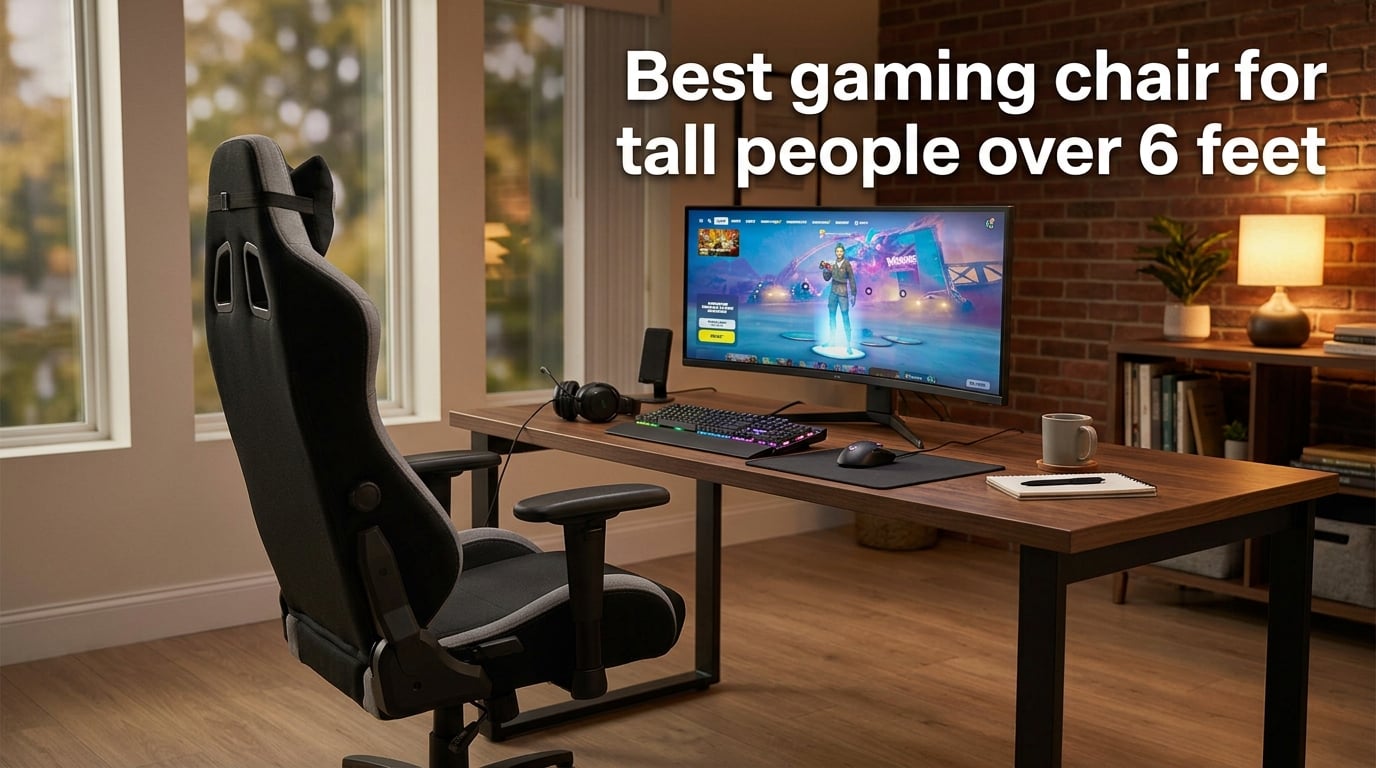
Finding the best gaming chair for tall people over 6 feet is harder than it should be. Most gaming chairs are designed for average-height users, and if you’re 6’2″ or taller, you’ve probably experienced the frustration of a backrest that stops at your shoulder blades or a seat edge that digs into the back of your knees. After spending months testing chairs and talking to tall gamers in communities like r/tall and r/gamingchairs, I’ve put together this guide to help you understand exactly what to look for.
The truth is, the gaming chair industry treats “big and tall” as a marketing label rather than a genuine design philosophy. A handful of brands actually engineer their chairs for taller frames, but most just slap a higher weight rating on the same undersized frame. This guide will walk you through every dimension, feature, and ergonomic consideration you need to evaluate before spending your money.
Table of Contents
Why Standard Gaming Chairs Fail Tall Gamers
Standard gaming chairs are built for people between 5’6″ and 6’0″. If you’re taller than that, you’ll run into a predictable set of problems that get worse the longer you sit.
Seat depth is too short. Most standard gaming chairs have a seat depth of 18-19 inches. For someone who is 6’3″ or taller, your thighs extend past the seat edge, leaving your knees unsupported. This creates pressure points that cut off circulation and cause your feet to swell — a complaint that comes up constantly in tall-gaming communities.
Backrest height stops too low. A standard backrest measures 28-30 inches from the seat. If you’re over 6’1″, that backrest ends at your mid-back or shoulder blades instead of supporting your full spine and neck. You end up slouching or using a headrest pillow that sits too low to be useful.
Weight capacity is inadequate. Many standard chairs are rated for 250-280 lbs. Even if you’re within that range, the gas lift cylinder, base, and casters are often the first components to fail. Tall users frequently report chairs breaking within 1-2 years because the frame wasn’t built to handle the leverage a taller body creates.
Armrests don’t align with your body. Standard 2D armrests have a limited height range. For tall torsos, they either sit too low (forcing your shoulders up) or too high (pushing your wrists into awkward angles). Both scenarios lead to shoulder and wrist pain during long gaming sessions.
Key Dimensions to Check Before Buying a Gaming Chair for Tall People
Before you buy any gaming chair, measure these six specifications against your body. If a chair doesn’t meet these minimums, it won’t work for you regardless of what the product listing claims.
Seat width: 21 inches or wider. Your hips need room to sit naturally without being squeezed by side bolsters. Narrow seats restrict hip angle and create pressure on the outer thighs.
Seat depth: 20 inches or deeper. This is the distance from the front edge of the seat to the backrest. You want at least 2-3 inches of clearance between the seat edge and the back of your knees. For someone who is 6’4″, aim for 21-22 inches.
Backrest height: 30 inches or taller. The backrest should reach at least the base of your neck. For users 6’5″ and above, look for 32-34 inches to get full cervical spine support.
Weight capacity: 400 lbs or more. Even if you weigh 220 lbs, a higher weight rating means the gas lift, base, and frame are built with heavier-duty components that will last longer. The rating is a proxy for overall build quality.
Recline range: 135 degrees or more. Tall users benefit from being able to recline further back because it opens up the hip angle and reduces lower back pressure. Look for chairs with a recline lock so you can set your preferred angle.
Seat height range: 18-22 inches. This is the height from the floor to the top of the seat. You need enough range to get your feet flat on the floor with your knees at roughly 90 degrees. If your desk is standard height (28-30 inches), you’ll need the chair to adjust accordingly.
Write these numbers down. When you’re comparing chairs, these six measurements will tell you more than any marketing description ever will.
How to Measure Yourself for a Gaming Chair
Most people skip this step and regret it. Measuring yourself takes five minutes and saves you from buying a chair that doesn’t fit.
Step 1: Measure your thigh length. Sit on a flat surface with your back against a wall. Measure from the wall to the back of your knee. This number is your ideal seat depth — add 1-2 inches for comfort.
Step 2: Measure your torso height. Sit against the wall again and measure from the seat surface to the base of your neck. This tells you the minimum backrest height you need.
Step 3: Measure your hip width. Sit on a flat surface and measure across the widest part of your hips. Add at least 2 inches on each side for your ideal seat width.
Step 4: Check your desk height. Measure from the floor to the top of your desk surface. Your armrests need to adjust to within 1-2 inches of this height so your forearms rest comfortably while you game.
Step 5: Weigh yourself accurately. Don’t guess. Use a scale and add 10-20 lbs as a safety margin when looking at weight capacity ratings. If you weigh 240 lbs, shop for chairs rated at 350 lbs or higher.
Tall gamers in online communities stress that these real-world measurements matter far more than “fits up to 6’5″” claims on product pages. The numbers tell you the truth; marketing copy doesn’t.
Gaming Chair vs Ergonomic Office Chair: Which Is Better for Tall People?
This is one of the most common questions in tall-gaming forums, and the answer depends on how you actually use your chair.
Gaming chairs typically offer more recline range (up to 165 degrees), side bolsters for a snug feel, and aesthetic designs that appeal to gamers. For tall users, the big and tall models from brands like Secretlab and AndaSeat provide the extended dimensions we discussed above.
Ergonomic office chairs prioritize adjustability and long-term comfort. Brands like Herman Miller, Steelcase, and Haworth design chairs with adjustable lumbar depth, seat angle tilt, and breathable mesh backs. For tall users, models like the Herman Miller Aeron (Size C) and Steelcase Leap offer genuine ergonomic support with taller backrests and deeper seats.
The trade-off: Gaming chairs give you more recline and a headrest by default, while ergonomic office chairs give you finer adjustments and typically better lumbar support. If you game for 2-3 hours and also work from home, an ergonomic office chair might serve you better. If you game for 4+ hours and want that immersive, reclined position, a big and tall gaming chair is the stronger choice.
Community consensus from r/OfficeChairs and r/gamingchairs: try before you buy whenever possible. Return policies matter more for tall users because fit is so specific to your body dimensions.
Health Effects of Poor Seating for Tall Gamers
If you’re sitting in a chair that doesn’t fit your frame, the effects go beyond simple discomfort. Here’s what actually happens to your body.
Circulation problems. When a seat is too short, the front edge presses into the back of your knees. This compresses the blood vessels in your legs and restricts blood flow to your lower extremities. The result: numbness, tingling, and foot swelling. Tall gamers on r/tall report that their feet swell noticeably after just two hours in a standard gaming chair.
Lower back pain. A backrest that stops at your mid-back forces your lumbar spine into an unsupported position. Over time, this leads to muscle fatigue, disc compression, and chronic lower back pain. The problem gets worse if you recline without proper lumbar support.
Neck and shoulder strain. When the headrest doesn’t reach your neck, your head drifts forward. For every inch your head moves forward of your shoulders, the effective load on your neck muscles increases by about 10 lbs. After hours of gaming, this creates significant tension headaches and shoulder stiffness.
Poor posture habits. Humans adapt to bad furniture. If your chair doesn’t support you properly, you’ll develop compensatory postures — slouching, crossing legs, leaning to one side — that become habitual and cause long-term musculoskeletal issues.
The fix is straightforward: a chair that fits your frame eliminates these problems before they start. The investment in a properly sized gaming chair pays for itself in reduced healthcare costs and better quality of life.
Materials and Breathability: What Works Best for Tall Users
Tall users generate more heat in a chair because of the larger surface area in contact with the seat and backrest. The material your chair uses matters more than you might think.
PU leather is the most common material in gaming chairs. It looks premium and cleans easily, but it traps heat against your body. After 2-3 hours, you’ll notice sweating on your back and thighs. If you game in a warm environment or tend to run hot, PU leather will be uncomfortable.
Mesh offers the best breathability. Air flows through the material, keeping your back cool. Mesh chairs like the Hinomi H2 Pro and Haworth Fern use tensioned mesh that also provides consistent support without sagging. The downside: mesh chairs typically have less padding on the seat, which matters if you prefer a plush feel.
Fabric upholstery sits between PU leather and mesh in terms of breathability. It wicks moisture better than leather and feels warmer than mesh in air-conditioned rooms. Secretlab’s SoftWeave fabric is a popular option among tall gamers who want breathability without sacrificing cushion feel.
Foam type is equally important. Cold-cure foam holds its shape longer than standard molded foam, which is critical for tall users who put more pressure on the seat. Memory foam conforms to your body but retains heat. Some newer chairs use pocket spring cushions that combine support with airflow.
Gaming Chair Budget Tiers for Tall Gamers
You don’t have to spend a fortune, but you should know what you get at each price point. Here’s how the market breaks down for big and tall gaming chairs.
Under $300: This tier exists, but options are limited for truly tall users. Brands like GTPLAYER and Dowinx offer chairs with 400 lb weight capacities and extended backrests in this range. You’ll get basic 2D armrests, standard foam, and PU leather. These chairs work for tall-but-lighter users (under 220 lbs) who need the extra height but don’t push the weight limits. Expect 1-2 years of solid use before the foam compresses.
$300-$600: This is the sweet spot for most tall gamers. Secretlab Titan Evo XL, AndaSeat Kaiser 3 XL, and E-Win Flash XL all fall in this range. You get 4D armrests, cold-cure foam, magnetic head pillows, and genuine 400+ lb weight ratings. These chairs are built on reinforced frames with better gas lift cylinders. Most come with 3-5 year warranties.
$600+: Premium options include the Herman Miller Aeron (Size C), Anthros Chair, and Haworth Fern. These are ergonomic-first designs with adjustability that gaming chairs can’t match — adjustable lumbar depth, seat angle tilt, and suspension systems. If you work from home and game, these dual-purpose chairs justify the cost over a longer lifespan (12-year warranties are standard).
My recommendation: if your budget allows, aim for the $300-$600 tier. The jump in build quality, adjustability, and durability from sub-$300 chairs is significant.
Desk Height Compatibility and Setup Tips for Tall Gamers
Buying the right chair is only half the equation. If your desk doesn’t match your chair, you’ll still end up with poor posture and discomfort.
Standard desks are 28-30 inches tall. If you’re over 6’2″ and your chair seat is at 20 inches, your armrests need to reach at least 27-28 inches to align with your desk surface. Many standard armrests top out at 25-26 inches, forcing you to shrug your shoulders or rest your arms at an awkward angle.
Consider a height-adjustable desk. A standing desk that adjusts from 25 to 50 inches lets you set the exact height that matches your chair’s armrests. This eliminates the mismatch problem entirely. For tall users, this is often a better investment than upgrading to a more expensive chair.
Monitor height matters too. Your monitor should be at eye level when you’re sitting upright. For tall users, this means raising the monitor 4-6 inches above where most people place it. A monitor arm or stand achieves this easily.
Footrest consideration. If your chair is set high enough to match your desk but your feet don’t rest flat on the floor, use a footrest. This keeps your knees at the proper angle and prevents the circulation problems that come from dangling feet.
Frequently Asked Questions
What is the best gaming chair for tall people?
The best gaming chairs for tall people have a seat depth of at least 20 inches, a backrest height of 30 inches or more, and a weight capacity of 400 lbs or higher. Popular options include the Secretlab Titan Evo XL, AndaSeat Kaiser 3 XL, and Herman Miller Aeron Size C. The right choice depends on your height, weight, and whether you need the chair purely for gaming or also for work.
How tall do I need to be to need a big and tall gaming chair?
If you are 6’1u0022 or taller, you will benefit from a big and tall gaming chair. Standard gaming chairs are designed for users up to about 6’0u0022. At 6’1u0022 and above, you will notice the seat depth is too short, the backrest does not reach your neck, and the headrest pillow sits too low to be useful.
What seat depth do I need if I am over 6 feet tall?
If you are over 6 feet tall, look for a seat depth of at least 20 inches. For every 2 inches of height above 6 feet, add roughly 1 inch of seat depth. A person who is 6’4u0022 should aim for 21-22 inches of seat depth to ensure proper thigh support without pressure behind the knees.
Are big and tall gaming chairs worth the extra cost?
Yes, big and tall gaming chairs are worth the investment if you are over 6 feet tall or weigh over 220 lbs. They use reinforced frames, heavier-duty gas lift cylinders, and denser foam that lasts significantly longer. Standard chairs often fail within 1-2 years under tall users due to frame stress and foam compression, while big and tall models typically last 3-5 years.
Can someone who is tall but not heavy still need a big and tall chair?
Yes. Tallness and weight are independent factors. A person who is 6’4u0022 and 180 lbs still needs the extended seat depth, taller backrest, and higher headrest that big and tall chairs provide. Standard chairs fail tall-but-slim users because the dimensions are wrong, not because of weight limits. Focus on seat depth and backrest height rather than weight capacity if you are tall but lighter.
Do big and tall gaming chairs fit differently in terms of armrest height?
Yes, big and tall chairs typically offer armrests with a taller height range. Standard 2D armrests top out around 25-26 inches from the floor, while big and tall models reach 28-30 inches. This is important because your armrests need to align with your desk surface (usually 28-30 inches) so your forearms rest comfortably without shrugging your shoulders.
What is the best chair height for someone who is 6’2u0022?
For someone who is 6’2u0022, the ideal seat height is 18-20 inches from the floor, with your feet flat on the floor and knees at roughly 90 degrees. The backrest should be at least 30 inches tall to support your full spine. Check that the seat depth is at least 20 inches so the front edge does not press into the back of your knees.
Conclusion
Choosing the best gaming chair for tall people over 6 feet comes down to knowing your measurements and matching them to the right specifications. Focus on seat depth, backrest height, and weight capacity as your three non-negotiable criteria. Whether you go with a big and tall gaming chair from Secretlab or AndaSeat, or invest in a premium ergonomic option like the Herman Miller Aeron, the key is getting a chair that fits your frame rather than forcing your body to adapt to a standard-size chair. Measure yourself, check the numbers, and your back will thank you.