
A dental implant is the one piece of hardware in your mouth that nothing can grow back into place once it is gone. Around a natural tooth, the gum attaches to the root. Around an implant, the gum forms a soft seal against a titanium post, and that seal is the only barrier between the bone and the bacteria in your mouth. When the seal breaks down, you have peri-implantitis, and the result is bone loss around an implant that is expensive, surgical, and slow to fix.
That is why picking the right irrigator matters more with implants than it does with ordinary teeth. Choosing among the best water flossers for implants comes down to pressure granularity and tip geometry, not suction power or marketing language. A stream that rinses a crown from the top is nearly useless. You need a narrow, sustained pulse that tracks along the gumline and flushes underneath it.
We spent weeks with ten of the most-reviewed countertop and cordless irrigators on the market, comparing pressure control, reservoir capacity, tip range, battery endurance, and what happens to a flosser after a year of daily use around implant hardware. The list below covers single implants, splinted molars, bridges, and full-arch All-on-4 cases, so you can match the machine to the work your mouth actually asks of it.
One thing to clear up first: a water flosser does not replace floss. Dental professionals consistently advise using both, with the irrigator reaching the areas string cannot enter safely. What it does do is flush the 3 to 4mm pocket around an implant where brushing bristles bend away and floss shreds. We will show you how to use it, how to pick a setting, and which tips to buy.
Table of Contents
Top 3 Water Flossers for Implants (October 2026)
Our best overall pick is the Waterpik Aquarius, which pairs ten pressure settings with a large reservoir and a Plaque Seeker tip built for crowns and bridges. The COSLUS C20 wins on value, holding ADA acceptance and a 300ml tank at a fraction of the cost of the big brands. The Aquasonic earns its premium slot because its ADA acceptance came from a published clinical trial rather than a marketing claim.

Waterpik Aquarius
- 10 pressure settings with massage mode
- 22 oz dishwasher-safe reservoir
- Plaque Seeker and Pik Pocket tips
- 90+ seconds per fill

COSLUS C20
- ADA accepted
- 300ml tank and 30-day battery
- IPX7 waterproof
- five interchangeable tips

AquaSonic Aqua Flosser
- ADA accepted via clinical study
- periodontal tip holds pressure
- three modes
- removable tank
As an Amazon Associate we earn from qualifying purchases. CERTAIN CONTENT THAT APPEARS ON THIS SITE COMES FROM AMAZON. THIS CONTENT IS PROVIDED 'AS IS' AND IS SUBJECT TO CHANGE OR REMOVAL AT ANY TIME.
All 10 Water Flossers for Implants Compared in 2026
Every model below made the cut for implant use, but they are not interchangeable. The table shows the pressure control, reservoir size, and tip range that decide how well each one handles the tight spaces beside a titanium post.
| Product | Key Features | |
|---|---|---|
|
Waterpik Aquarius Countertop
|
|
Check Latest Price |
 Waterpik Cordless Advanced Waterpik Cordless Advanced
|
|
Check Latest Price |
|
COSLUS C20 ADA Accepted
|
|
Check Latest Price |
 Bitvae C5 Cordless Bitvae C5 Cordless
|
|
Check Latest Price |
 COSLUS C30 DIY Mode COSLUS C30 DIY Mode
|
|
Check Latest Price |
 TUREWELL 600ml Countertop TUREWELL 600ml Countertop
|
|
Check Latest Price |
|
AquaSonic ADA Accepted
|
|
Check Latest Price |
 Waterpik ION Rechargeable Waterpik ION Rechargeable
|
|
Check Latest Price |
 COSLUS E40 Dial Control COSLUS E40 Dial Control
|
|
Check Latest Price |
 Philips Sonicare Power Flosser 3000 Philips Sonicare Power Flosser 3000
|
|
Check Latest Price |
We earn from qualifying purchases. CERTAIN CONTENT THAT APPEARS ON THIS SITE COMES FROM AMAZON. THIS CONTENT IS PROVIDED 'AS IS' AND IS SUBJECT TO CHANGE OR REMOVAL AT ANY TIME.
How We Picked Water Flossers for Implants
Implant cleaning punishes shortcuts, so our criteria were narrow on purpose. We weighted pressure granularity first, because a patient three weeks out of surgery and a patient five years along both need the same device but at opposite ends of its range. A two-setting flosser cannot serve both. The patient in the r/DentalHygiene thread asking whether to move from a cheap two-setting flosser to a brand multi-setting model for a bridge was asking exactly the right question.
Second, we looked hard at tip geometry. A wide general nozzle is fine for natural teeth and useless in the 2mm sulcus beside a post. We wanted periodontal and plaque-seeker style nozzles in the box or cheaply available for the brand.
Third, reservoir capacity, because interruptions break concentration around an implant. The 45-second tank on a compact cordless model means a mid-session refill with the tip still in your hand. Reviewers mention this constantly.
Fourth, battery and waterproofing for anyone who travels or shares a bathroom. Fifth, ADA acceptance, which implant patients consistently rank as their top trust signal, along with warranty length as a rough proxy for manufacturer confidence.
Finally, we read the durability reports, not just the star ratings. Several models here carry impressive averages alongside a steady stream of charging and tip-retention complaints. Those negatives are in each review below, not buried.
1. Waterpik Aquarius Countertop: Best Overall for Implants
Waterpik Aquarius Countertop Water Flosser with 10 Settings, 7 Tips, White
- 10 pressure settings plus massage mode
- 22 oz dishwasher-safe reservoir
- 7 tips included
- 3-year limited warranty
Pros
- Ten settings let a new implant patient start low and work up gradually
- Large reservoir covers a full session with no refilling
- Plaque Seeker and Pik Pocket tips are designed for crowns implants and bridges
- On-wand on and off toggle means no button to hold
Cons
- Takes noticeable counter space in a small bathroom
- Reservoir is awkward to scrub and the lid is not integral
- Two tip storage slots for seven included tips
We earn a commission, at no additional cost to you. CERTAIN CONTENT THAT APPEARS ON THIS SITE COMES FROM AMAZON. THIS CONTENT IS PROVIDED 'AS IS' AND IS SUBJECT TO CHANGE OR REMOVAL AT ANY TIME.
This is the flosser most hygienists hand patients a mental picture of, and after several weeks of daily use it earns the top slot for a simple reason: it has ten pressure levels. Everything else follows from that. Around an implant you want to start at the bottom of the range on tender tissue and climb as the seal firms up, and ten steps let you do that in one device instead of trading machines.
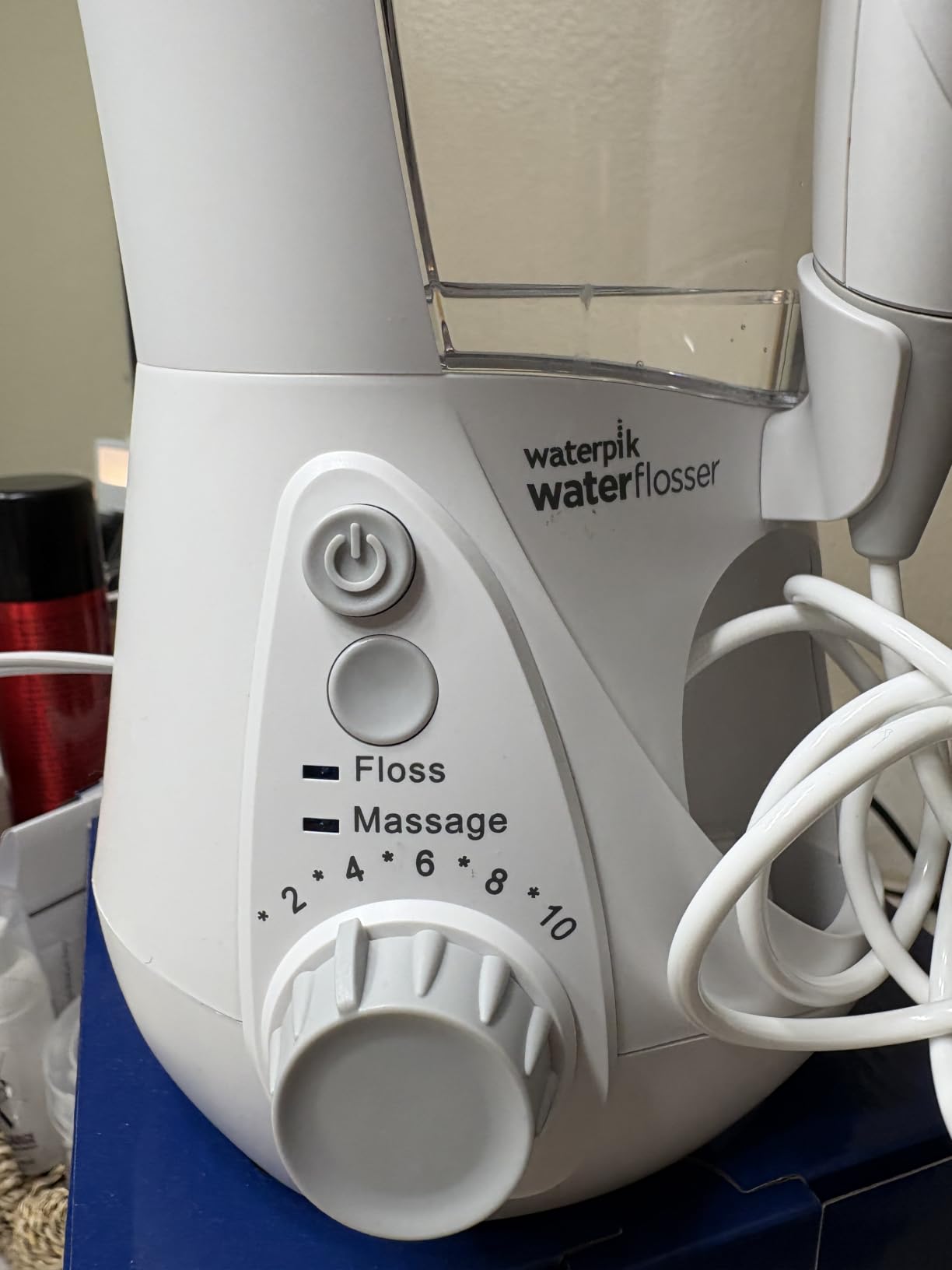
The 22 oz removable reservoir is the other half of the case. It runs 90 seconds or more of continuous flow, which is enough for a full-mouth pass around a bridge or a set of posterior implants without putting the tip down mid-clean. The tank lifts off and is dishwasher-safe, though the seam around the lid is the part you will end up scrubbing by hand.
Tip selection is where the implant value shows up. The Plaque Seeker tip has a narrow, tapered nozzle that tracks the gumline beside a crown, and the Pik Pocket tip is built to reach into a pocket. Three Classic Jet tips cover the rest, and a toothbrush attachment is included for the crown surface. The nozzle rotates 360 degrees, which matters when a lower molar implant sits behind a full arch and you have to reach it without craning.
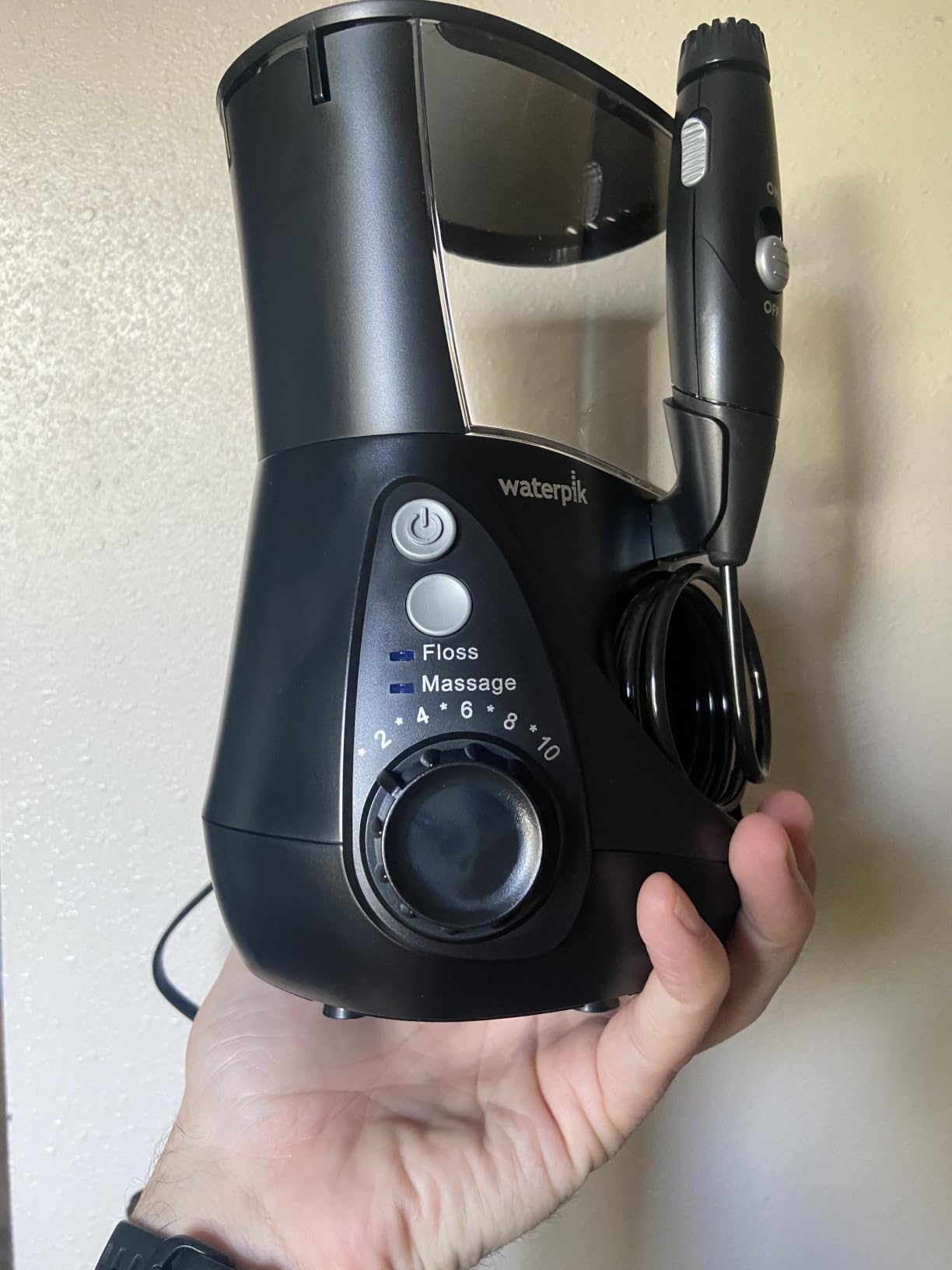
Reviewers describe dentists noticing less plaque at the next cleaning, and a few mention the Aquarius was the model a hygienist recommended. The mass-market support is deep enough that tips and parts stay easy to find years later, which is a genuine advantage over newer brands.
The honest drawbacks are physical rather than functional. At 3.8 by 4.7 by 10.3 inches it wants real counter space, and the wand switch is stiff until you learn it. The mains plug is 120VAC for North America, so anyone using this outside the region needs a different model. For anyone with multiple implants and no travel in the schedule, this is the safest long-term buy.
When to choose the Aquarius over a cordless model
Choose it when your implants are fixed, your bathroom has a shelf or vanity space, and you want the widest pressure range on the market. Nobody is coming to refill a tank mid-session when you have three or more implants and a bridge to clean.
Choose a cordless model instead if you travel regularly or your counter space is genuinely tight. The Aquarius does not fold, dock small, or run on a battery you can pack in a carry-on.
What the ten settings actually give you
Low settings deliver a gentle pulse that many post-surgical patients can tolerate immediately. The middle range handles routine maintenance around a healed implant, and the top settings suit experienced users flushing a bridge or an overdenture attachment. The massage mode pulses on and off rather than continuously, which some people find easier on tender tissue.
Whichever setting you choose, angle the nozzle along the gumline and let the water travel, rather than aiming directly into the pocket. The Aquadapter timer pauses at 30 seconds and one minute to move quadrants.
We earn a commission, at no additional cost to you. CERTAIN CONTENT THAT APPEARS ON THIS SITE COMES FROM AMAZON. THIS CONTENT IS PROVIDED 'AS IS' AND IS SUBJECT TO CHANGE OR REMOVAL AT ANY TIME.
2. Waterpik Cordless Advanced: Premium Pick With Implants
Waterpik Cordless Advanced Portable Water Flosser, Rechargeable, White
- Cordless and global voltage compatible
- 7 oz reservoir, about 45 seconds
- 3 pressure settings
- Up to 4 weeks per charge
Pros
- Travel bag and tip case included
- Waterproof for shower use
- 360-degree rotating tip reaches back molars
- Multi-week battery life between charges
Cons
- Only 3 pressure settings against 10 on countertop models
- Small tank means a refill mid-session
- USB wall adapter not included
We earn a commission, at no additional cost to you. CERTAIN CONTENT THAT APPEARS ON THIS SITE COMES FROM AMAZON. THIS CONTENT IS PROVIDED 'AS IS' AND IS SUBJECT TO CHANGE OR REMOVAL AT ANY TIME.
This is the machine to pack. At 12.8 ounces and 4 by 2.8 by 11.6 inches it disappears into a weekend bag, and the global voltage compatibility means it works on a foreign outlet without a converter. It is waterproof, so you can run it in the shower, which matters when the nearest basin is a hotel sink you do not want to lean over.
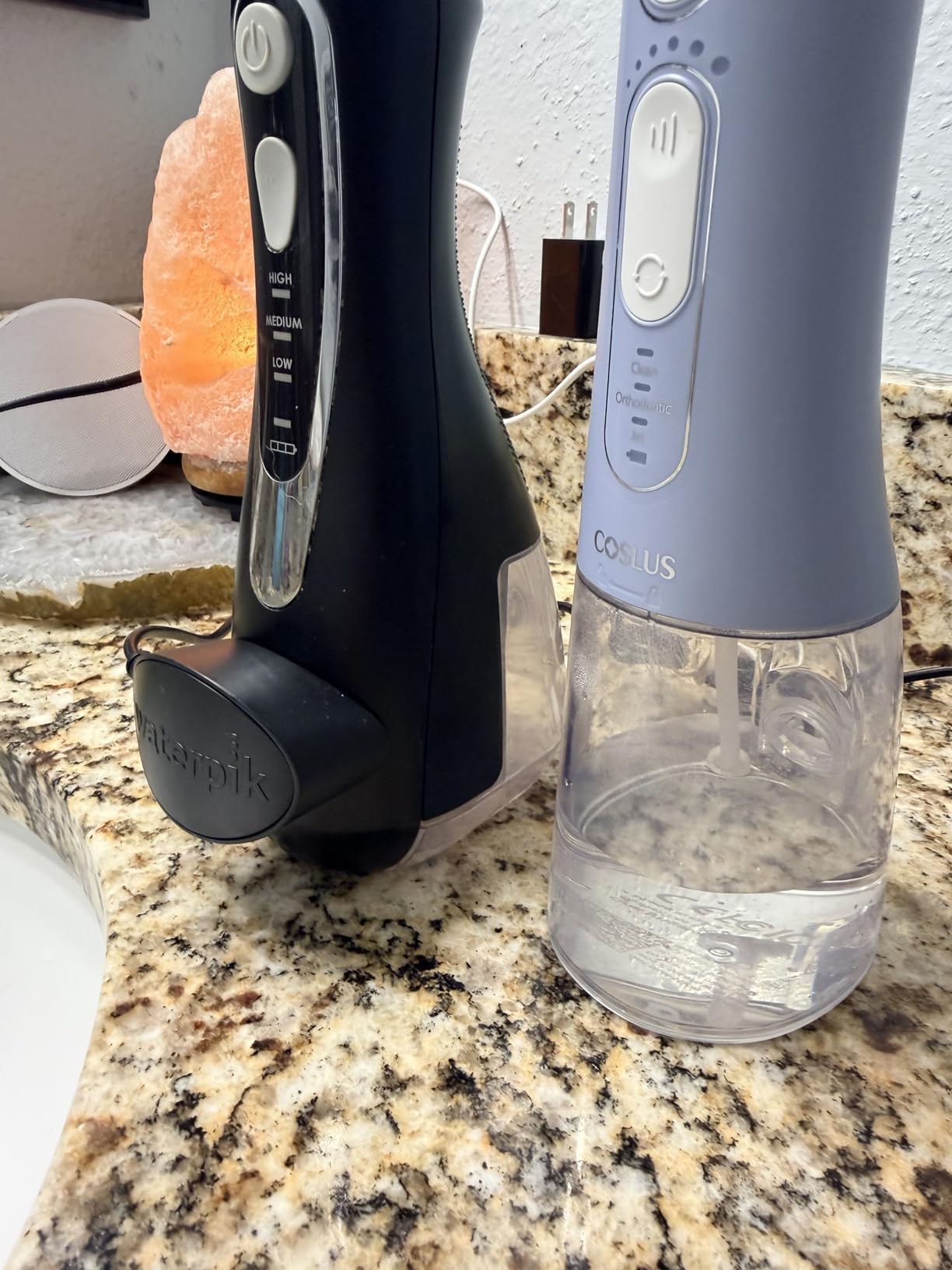
The 360-degree rotating tip is the feature that earns its place in an implant kit. Back-of-mouth posterior implants are the hardest site to reach, and a nozzle that pivots lets you sweep the gumline without contorting your wrist or stopping to reposition. Owners of full-arch restorations rate this tip highly for that reason.
Where it falls short is granularity. Three pressure settings is a narrow band, and a patient whose gum tissue is inflamed after surgery has very little room to adjust within it. Most travelers solve this by treating the cordless as a supplement, keeping a countertop model at home for the thorough clean.
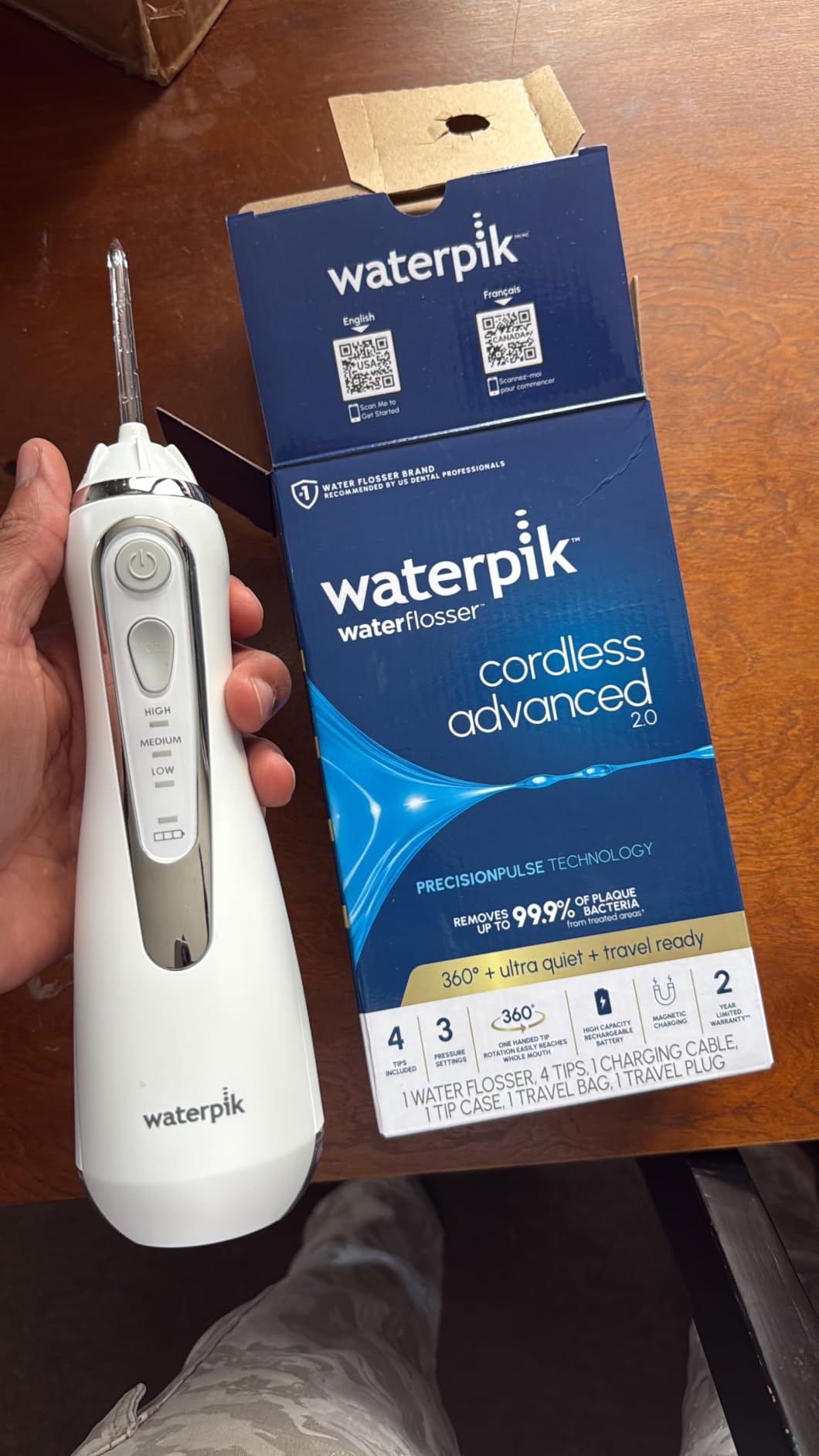
The 7 oz reservoir holds roughly 45 seconds of flow. That covers a focused clean around one or two implants comfortably, but a full-mouth session with a bridge will need a refill, and the tip has to come out of your mouth to get there. The included micro-fiber travel bag and tip case are nice touches that protect the nozzle in a suitcase.
Is the tank really too small for a bridge
For a single molar implant, no. Forty-five seconds is enough to flush the sulcus, the crown margins, and the tongue side without rushing. For an All-on-4 arch or a full bridge, you will refill at least once, and reviewers describe that interruption as the most common complaint with this model.
Battery life is not the problem. Owners report weeks between charges, and an LED indicator removes the guesswork. The genuine gap versus the Aquarius is pressure range, not endurance.
How to use it on an implant while travelling
Fill only what you need, tip down, and start at the low setting while you get oriented. Aim along the gumline from the cheek side, then from the tongue side, then finish with one pass through the embrasures where the crown meets the post.
Run the tank dry at the end of a session and leave the reservoir off the body overnight. Standing water in a sealed reservoir is how you get a smell on day three of a trip, and that is the fastest way to stop wanting to use the device.
We earn a commission, at no additional cost to you. CERTAIN CONTENT THAT APPEARS ON THIS SITE COMES FROM AMAZON. THIS CONTENT IS PROVIDED 'AS IS' AND IS SUBJECT TO CHANGE OR REMOVAL AT ANY TIME.
3. COSLUS C20: Best Value With ADA Acceptance
COSLUS ADA Accepted C20 Water Dental Flosser Pick, Professional Set Black
- ADA Scientific Council accepted
- 300ml tank, 30-day battery
- 1400-1800 pulses per minute
- IPX7 waterproof
Pros
- ADA accepted at a far lower cost than the big brands
- Large tank means far fewer refills than most portable models
- 30-day battery holds up over years
- IPX7 waterproofing makes shower use practical
Cons
- Even the softest setting can feel too powerful for very sensitive gums
- Proprietary charging connector with a loose easily lost cover
- Handle is wide and can slip from smaller hands
We earn a commission, at no additional cost to you. CERTAIN CONTENT THAT APPEARS ON THIS SITE COMES FROM AMAZON. THIS CONTENT IS PROVIDED 'AS IS' AND IS SUBJECT TO CHANGE OR REMOVAL AT ANY TIME.
The C20 sits at number one in its category and pulls more than 54,000 ratings, and for implant patients the reason is specific: it carries ADA acceptance at a price point most people assume means compromise. A dental hygienist reviewer recommended it to her own patients, which is the kind of signal that matters more here than on a general oral care page.
The 300ml tank is the feature that changes daily use. It is roughly four times the capacity of a compact cordless tank, so a full-mouth session around multiple implants happens without a refill. The pump delivers 1400 to 1800 pulses per minute using dual-thread ultra-fine pulse technology at 0.3mm, which is a tight stream that fits beside a post rather than blasting the whole quadrant.
Three modes with multiple pressure settings cover gentle through deep clean, and five interchangeable tips ship in the box. A 30-day battery after a three-hour charge removes the charging anxiety that cordless buyers complain about most, and IPX7 waterproofing means the sink and shower are both fine.
Why the sensitive-gum complaint matters for new implants
Several reviewers note that even the softest setting feels aggressive. For someone a few weeks out of implant surgery that is a real barrier, and it is the one drawback worth testing before committing. Two weeks is the usual window before a surgeon clears you for irrigator use, and the tissue is still tender then.
Post-surgery patients who report the lowest setting as too strong can pair this flosser with warm water rather than cold. Warm water takes the edge off the pulse without diluting the cleaning, and it is the single change that most often converts a complaint into a habit.
The charging connector is the real annoyance
It uses a proprietary connector rather than a standard USB cable, and the little cover that protects it is a part you will lose in a suitcase. Plan on keeping the cable with the flosser permanently, or buy a second one immediately.
On durability the picture is strong. Multiple long-term owners report multi-year reliability, with a minority reporting a failure inside the first year. The stated durability rating is three years under typical use, and the handle is wide enough that anyone with limited grip strength should try it in a shop first.
We earn a commission, at no additional cost to you. CERTAIN CONTENT THAT APPEARS ON THIS SITE COMES FROM AMAZON. THIS CONTENT IS PROVIDED 'AS IS' AND IS SUBJECT TO CHANGE OR REMOVAL AT ANY TIME.
4. Bitvae C5: Most Versatile for Beginners
Bitvae Water Dental Flosser for Teeth, Cordless Water Teeth Cleaner Picks
- 5 intensity settings with 2-second gentle start
- 261ml wide-mouth reservoir
- 40-day battery from a 4-hour charge
- IPX7 waterproof
Pros
- Gentle two-second start suits sensitive teeth and first-time users
- 40-day battery and universal USB charging reduce charger anxiety
- 261ml reservoir covers a 60-second full-mouth clean
- Six tips with 360-degree rotation and color coding
Cons
- Reservoir is smaller than 300ml and 600ml rivals
- Splash-prone if the nozzle is started outside the mouth
- Non-standard charging cable to keep track of
We earn a commission, at no additional cost to you. CERTAIN CONTENT THAT APPEARS ON THIS SITE COMES FROM AMAZON. THIS CONTENT IS PROVIDED 'AS IS' AND IS SUBJECT TO CHANGE OR REMOVAL AT ANY TIME.
The most useful thing about the Bitvae C5 for an implant patient is the two-second start ramp. The pressure eases in rather than slamming on at full force, which is exactly what a nervous user with a new implant needs. It removes the most common reason people abandon a cordless flosser in the first week.
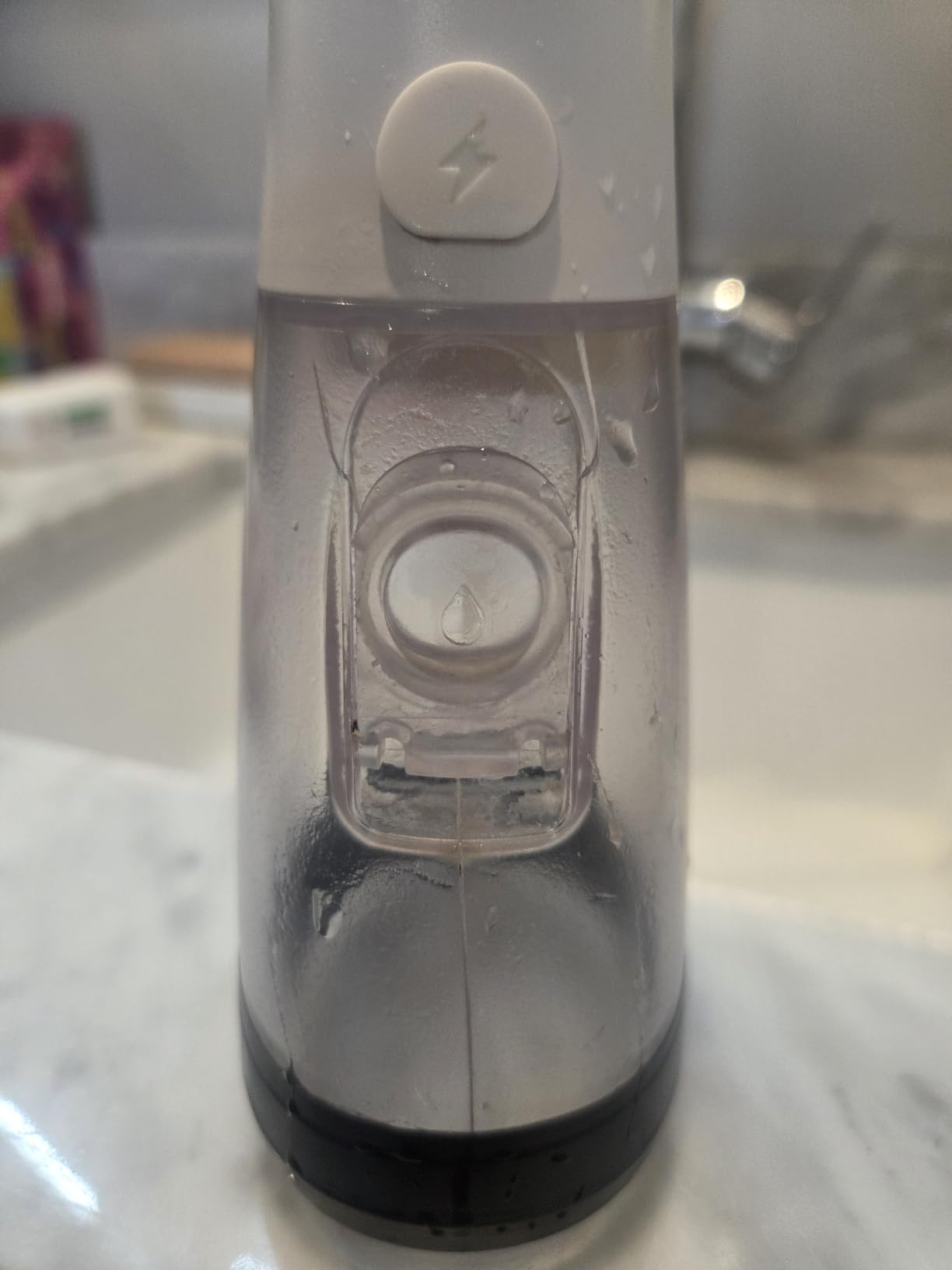
Five intensity settings give you more room than the three-setting cordless models without pushing the price up. The 261ml wide-mouth reservoir holds a 60-second full-mouth session, so a single posterior implant or a two-unit bridge finishes in one fill. The wide mouth is easier to fill, rinse, and dry than a narrow-neck design, and that matters more than it sounds when you are cleaning it twice a day.
Battery life is 40 days from a four-hour charge, with universal USB charging, and the body is IPX7 waterproof. Six tips come in the set, five standard nozzles plus a tongue cleaner, all on 360-degree rotation. The nozzles are color coded, which turns out to be a genuine advantage in a family where more than one person has implants and nobody wants to swap tips by accident.
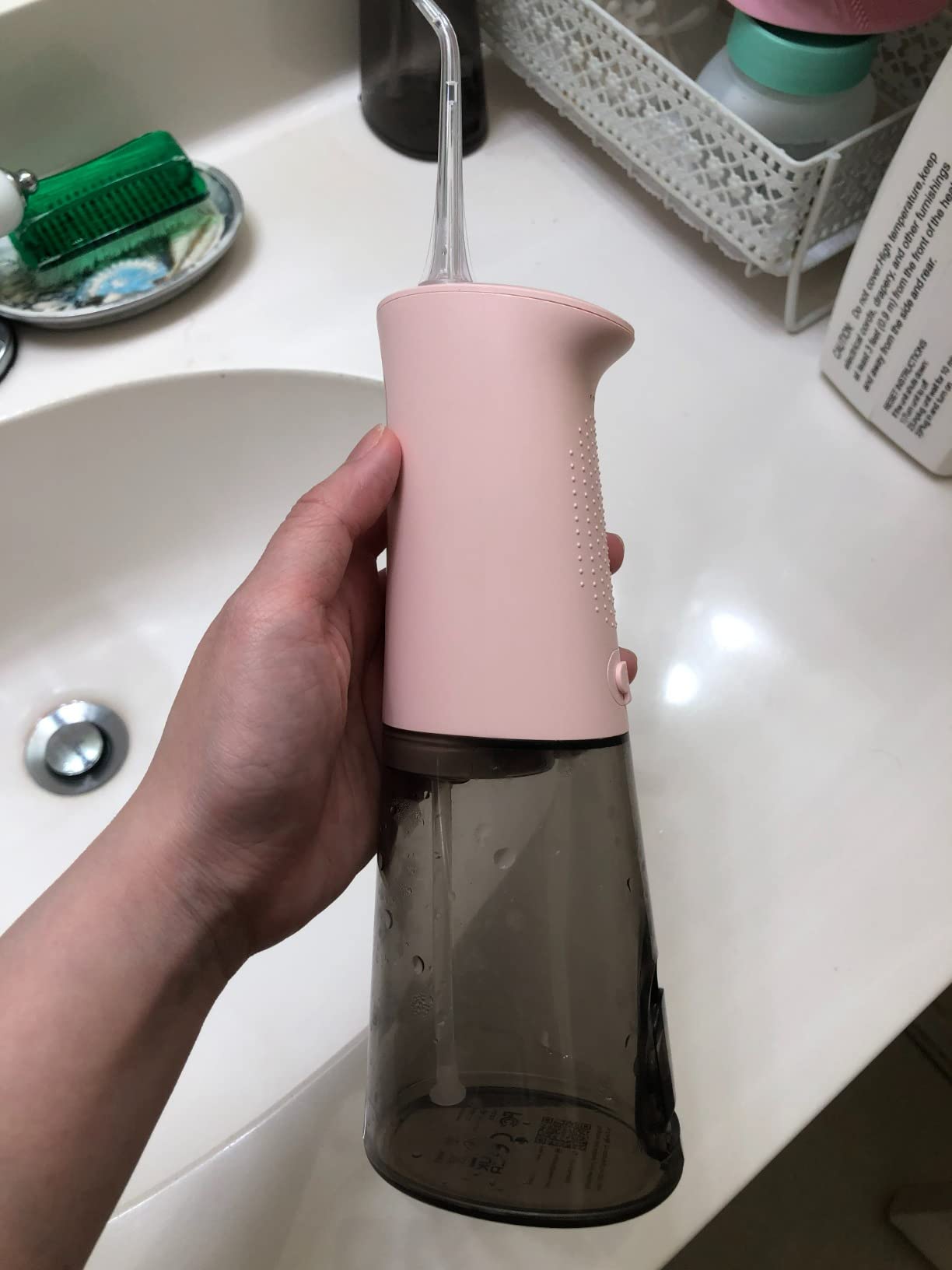
Reviewers are positive on cleaning performance and travel convenience, and the 2.6 by 3.7 by 8.78 inch footprint is small enough for a drawer or a carry-on. Several mention it performing competently alongside a countertop model rather than replacing one.
The constraints are honest ones. The 261ml tank is smaller than the 300ml and 600ml models in this list, so a full-arch All-on-4 user will refill. The unit is splash-prone if you start the nozzle outside your mouth or pull it out mid-use, which costs you about five sessions of learning. And the charging cable is not a common standard, so keep it with the device.
Is a 261ml tank enough for one implant
More than enough. A single molar implant with a crown, cleaned on all four surfaces plus the sulcus, uses well under a minute of flow. The tank is only a problem for four or more implants, a full bridge, or a denture bar.
For those cases, fill the tank while the device is still charging in the morning and keep it topped up. The wide mouth accepts a syringe or a small jug without a funnel, so a mid-session refill takes seconds.
Who should skip this one
Skip it if you have heavy plaque build-up around an implant that needs sustained high pressure. Five levels top out well below a 10-setting countertop model, and reviewers who came from a Waterpik note the difference in raw pressure.
Otherwise it is the easiest machine in this roundup to hand to someone who has never used an irrigator. The gentle start, the color-coded tips, and the six-week battery cycle remove almost every reason to quit.
We earn a commission, at no additional cost to you. CERTAIN CONTENT THAT APPEARS ON THIS SITE COMES FROM AMAZON. THIS CONTENT IS PROVIDED 'AS IS' AND IS SUBJECT TO CHANGE OR REMOVAL AT ANY TIME.
5. COSLUS C30: Best for Custom Pressure Control
COSLUS C30 Water Dental Flosser, Upgraded DIY Mode, Black, 1Pcs
- 30-150 PSI adjustable pressure
- 4 modes including DIY with 8 levels
- 300ml BPA-free tank
- 3-hour charge, 60 uses
Pros
- DIY mode gives unusually fine pressure control for a compact unit
- 300ml wide-mouth tank is easy to fill clean and dry
- Four nozzles target braces implants gums and tongue
- Lightweight and compact for office or travel
Cons
- No power adapter included so a 5V charger must be sourced separately
- Cordless pressure is weaker than countertop models for heavy plaque
- Low setting still too strong for very tender gums
We earn a commission, at no additional cost to you. CERTAIN CONTENT THAT APPEARS ON THIS SITE COMES FROM AMAZON. THIS CONTENT IS PROVIDED 'AS IS' AND IS SUBJECT TO CHANGE OR REMOVAL AT ANY TIME.
The C30 is the only cordless model in this group that publishes a real pressure figure, 30 to 150 PSI, and pairs it with a DIY mode that gives you eight custom levels on top of Normal, Soft, and Pulse. That matters for implants because you will want a different pressure for a healing site and for a loaded bridge, on the same machine, without swapping devices.
The 1400 to 1800 dual-pulse streams per minute produce a sustained rather than pulsed flow, and the nozzle set is explicitly built for braces and implants. Four multi-functional nozzles cover the implant sulcus, the gumline, the tongue, and any orthodontic hardware, which makes it a sensible two-in-one for someone with both.
The 300ml detachable BPA-free tank gives about 90 seconds of continuous cleaning, enough for a thorough pass on a full arch. A memory function stores your setting so a repeat session starts exactly where you left off, which removes a small daily friction that most people do not notice until it is gone.
Is DIY mode genuinely better than stepped buttons
It gives you eight intermediate levels where most cordless machines give you two or three. For a patient cleaning a fresh implant on one side and an older restored tooth on the other, that is the difference between one device and two.
Reviewers who own the E40 dial version prefer that for the same reason, describing one-handed mid-session adjustment as a genuine improvement. If you want the widest control, the C30 and E40 are the two in this roundup built around it.
Where the cordless compromise shows up
At the top of its range the C30 still delivers less sustained pressure than a plug-in model, and buyers moving from a Waterpik notice it around heavy plaque. For a well-maintained implant with a healthy seal, that gap rarely shows. For a bridge with a history of inflammation, it might.
Also plan for the missing adapter. A compatible 5V charger has to be sourced separately, and the unit takes three hours for a fast charge that covers up to 60 uses. Some buyers with tender tissue still find even the low setting strong, so warm water remains the standard workaround.
We earn a commission, at no additional cost to you. CERTAIN CONTENT THAT APPEARS ON THIS SITE COMES FROM AMAZON. THIS CONTENT IS PROVIDED 'AS IS' AND IS SUBJECT TO CHANGE OR REMOVAL AT ANY TIME.
6. TUREWELL 600ml: Best for Large Reservoirs and Quiet Use
TUREWELL Water Dental Flosser for Teeth/Braces, Water Teeth Cleaner
- 600ml reservoir, about 90 seconds
- 10 pressure settings, 30-125 PSI
- 8 tips including periodontal and orthodontic
- 1 meter leakproof hose
Pros
- Quiet operation with a suction-cup base
- Compact footprint for a countertop model
- Largest reservoir here at 600ml so refills are rare
- Periodontal and orthodontic tips suit implants and braces
Cons
- On-switch knob also sets pressure so intensity cannot be memorized
- Maximum setting is weaker than a Waterpik top setting
- Tips can pop loose from the handle and spray water
We earn a commission, at no additional cost to you. CERTAIN CONTENT THAT APPEARS ON THIS SITE COMES FROM AMAZON. THIS CONTENT IS PROVIDED 'AS IS' AND IS SUBJECT TO CHANGE OR REMOVAL AT ANY TIME.
The TUREWELL is the value pick among countertop models, and its 600ml reservoir is the largest in this roundup by a wide margin. That tank runs about 90 seconds of uninterrupted flow, so a full-arch All-on-4 case or a long bridge gets cleaned in one fill. Reviewers who switched from a Waterpik cite the larger tank and lower noise as the two reasons they stayed.
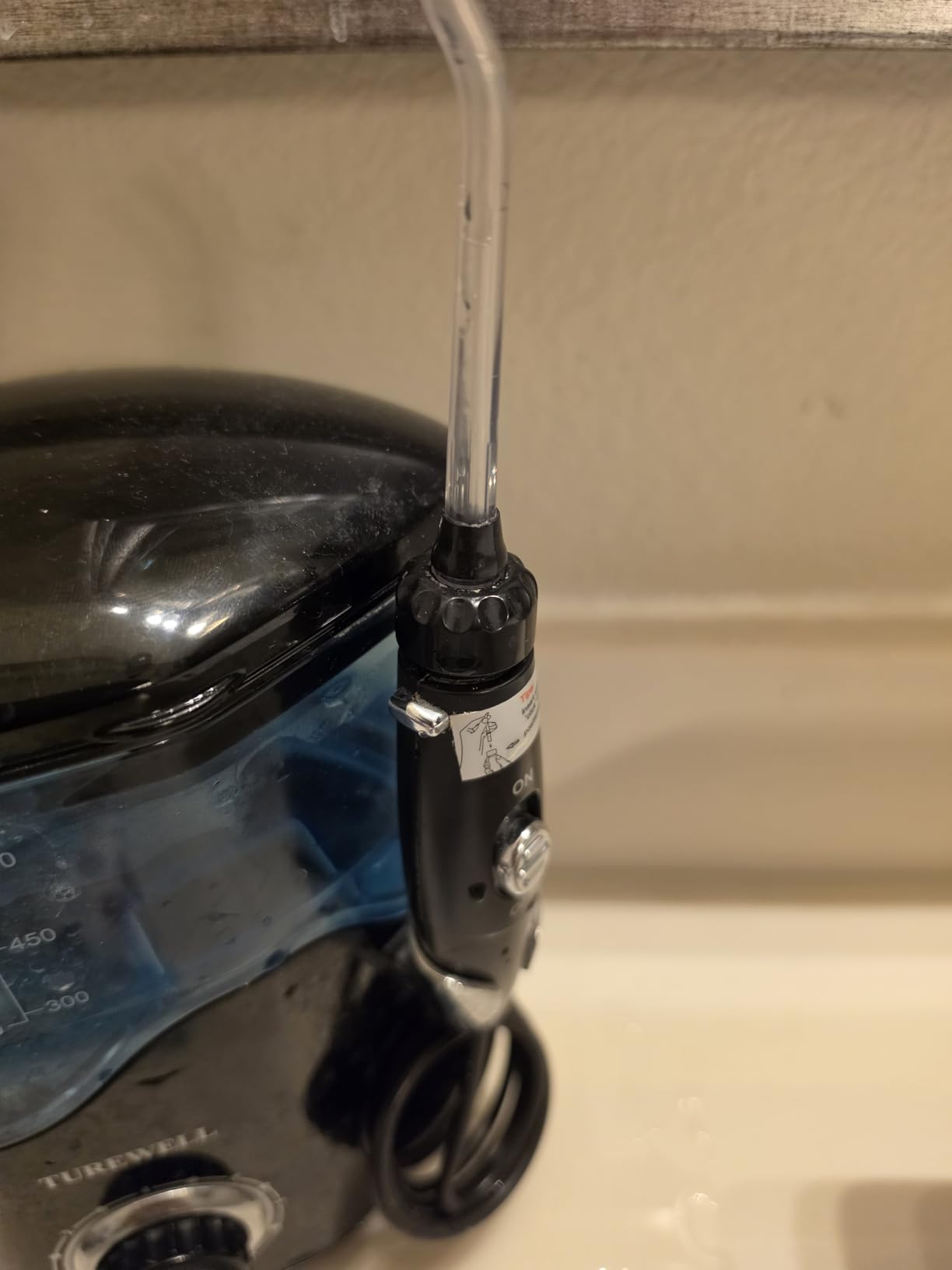
The tip range is genuinely implant-relevant. Eight tips ship in the box: three standard jets plus Orthodontic, Tongue Cleaner, Periodontal, Tooth Stain, and Toothbrush. The Periodontal tip is the narrow one you want beside a post, and it works with Waterpik replacement brushes if you already own that ecosystem.
Pressure runs across 10 settings from 30 to 125 PSI at 1250 to 1700 pulses per minute. The manual suggests settings 1 to 4 for kids and sensitive teeth, 5 and 6 for general use, and 7 to 10 for experienced adults, which is a sensible default ramp for someone building up to implant maintenance.
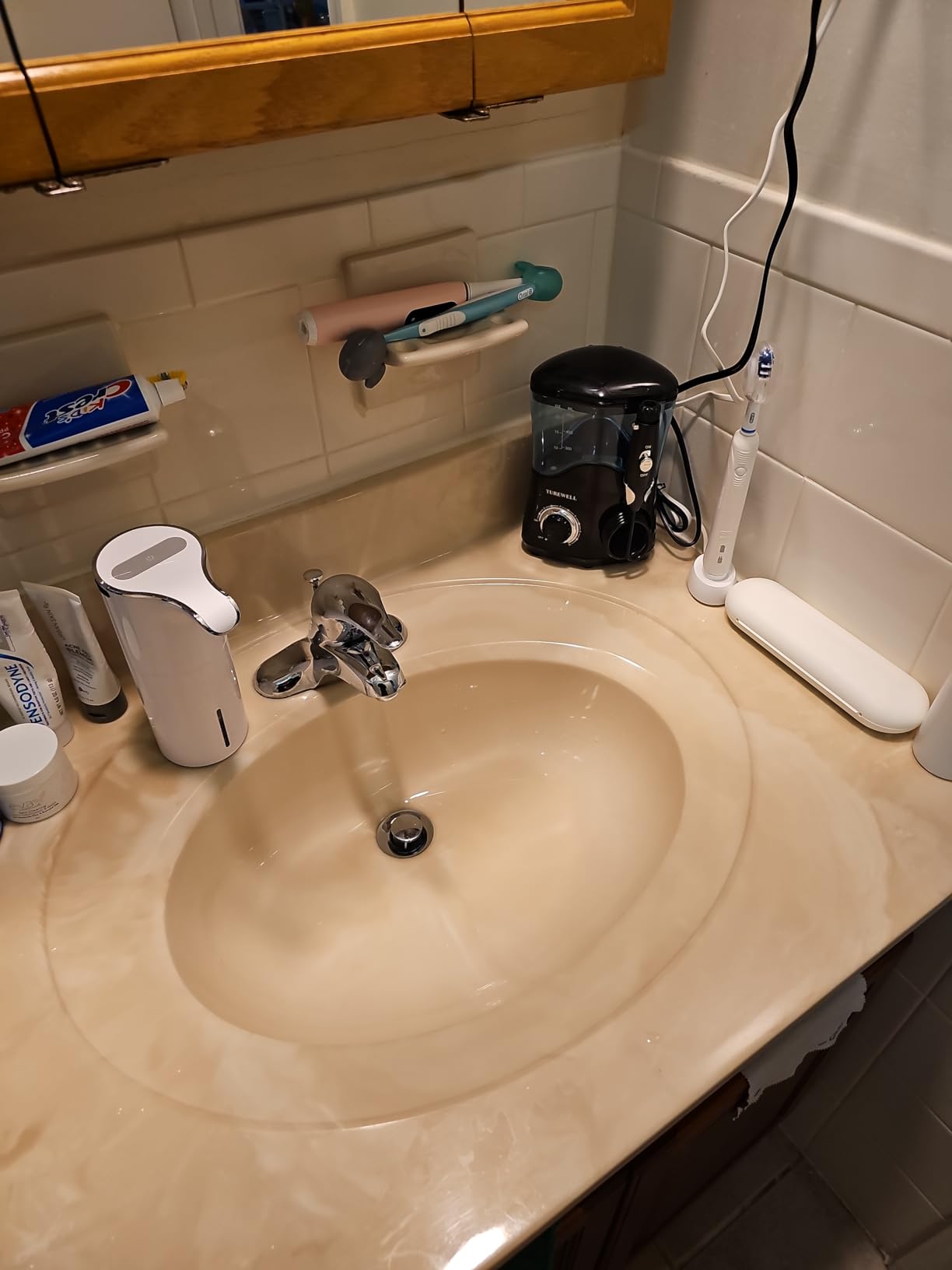
A one-meter flexible hose with a leakproof design gives you real reach, and the 360-degree rotating nozzle plus suction-cup base keep it steady on a small vanity. The 100V to 240V range means it works outside North America, unlike several rivals here.
The design flaw owners complain about most is the control. The same knob powers the machine and sets pressure, so you readjust from scratch every session and cannot store an intensity. Tips also pop loose from the handle during use, which sprays water. Maximum pressure is weaker than a Waterpik top setting, and cleaning instructions are thin with a non-integral lid. Multi-year durability reports, including nearly four years of daily use, offset much of this.
When the combined power and pressure knob matters
It matters if you have more than one user, or if your tissue sensitivity changes week to week. Re-dialing the same setting twice a session is the kind of small irritation that quietly ends a habit.
It also removes any chance of a memory function. Nobody can store a setting, which is a genuine downgrade for an implant patient cleaning several sites that need different pressures in the same pass.
Periodontal tips and where to aim them
Set the nozzle into the sulcus at a shallow angle, roughly 45 degrees toward the bone, and let the pulse run along the pocket for two seconds before moving on. Do not point straight down into the base of the pocket, which many people do instinctively and which is uncomfortable at any pressure.
Sweep the crown margin, then the interproximal spaces between implants, then the tongue side. Two full passes beat one fast pass, and the wide tank means you can afford to take the second one.
We earn a commission, at no additional cost to you. CERTAIN CONTENT THAT APPEARS ON THIS SITE COMES FROM AMAZON. THIS CONTENT IS PROVIDED 'AS IS' AND IS SUBJECT TO CHANGE OR REMOVAL AT ANY TIME.
7. AquaSonic Aqua Flosser: Best With Clinical Backing
AquaSonic Aqua Flosser Water Flosser, ADA Accepted, White
- ADA Seal of Acceptance from a clinical study
- 5 rotating interchangeable tips
- 3 modes from gentle to strong
- Cordless, waterproof, removable tank
Pros
- ADA acceptance backed by a formal trial with published figures
- Periodontal tip holds pressure where standard tips pop off
- Gentle low setting suits sensitive gums
- Quiet and lightweight at 3.02 ounces
Cons
- Small tank typically needs a refill or two per full mouth
- Standard tips can detach the moment it is switched on
- Mode cannot be changed before the water starts spraying
We earn a commission, at no additional cost to you. CERTAIN CONTENT THAT APPEARS ON THIS SITE COMES FROM AMAZON. THIS CONTENT IS PROVIDED 'AS IS' AND IS SUBJECT TO CHANGE OR REMOVAL AT ANY TIME.
Most brands treat ADA acceptance as a checkbox. This one is different. The ADA Seal came through a 30-day randomized controlled study with 30 subjects under institutional review board supervision, and that study reported up to an 87.1 percent reduction in plaque and up to a 93.8 percent improvement in gum health. Implant patients rate ADA acceptance as their single most important trust signal, and this is the model in the roundup where that signal is backed by published data.
It is also extremely light at 3.02 ounces and 2.6 by 8.07 by 3.98 inches, which makes it comfortable for anyone with reduced grip strength or hand tremor. The removable tank fills easily and a travel bag is included, so the same device works at home and in a hotel.
Five interchangeable jet tips come with it, including standard, orthodontic, periodontal, and a tongue scraper, and all rotate 360 degrees. Three modes run from gentle to strong, and the gentle mode is the one most sensitive-gum users default to.
What the clinical study actually changes for you
It does not prove superiority over every other irrigator, and no single 30-day study should carry that weight. What it does give you is a documented measurement rather than a marketing line, which matters when you are spending money on a device to protect a surgical investment.
The periodontal tip deserves specific mention. Reviewers report that it stays attached and holds pressure when the standard tips pop off the handle on start-up, which is the more reliable of the two behaviors exactly where you need it, inside a pocket.
The control quirks that catch people out
Switch it on and water sprays immediately, so you cannot choose a mode before the stream starts. Plan for a few seconds of wasted water and a sink within reach, or start with the tip already positioned in your mouth.
The tank is small enough to need a refill or two across a full mouth, and the mode resets to the same pulse setting on each use, so anyone who wants the gentle setting wastes water getting there. There is no smooth-flow mode, which some users with sensitive tissue find harsh. Those are the honest costs of the smallest footprint in this list.
We earn a commission, at no additional cost to you. CERTAIN CONTENT THAT APPEARS ON THIS SITE COMES FROM AMAZON. THIS CONTENT IS PROVIDED 'AS IS' AND IS SUBJECT TO CHANGE OR REMOVAL AT ANY TIME.
8. Waterpik ION: Best Cordless With Full Pressure Control
Waterpik ION Rechargeable Water Flosser with 10 Settings, 7 Tips, White
- 10 pressure settings without a mains cord
- 20 oz reservoir, 90+ seconds
- Up to 4 weeks per charge
- 3-year limited warranty
Pros
- Countertop-level 10-setting control with no mains cord
- Compact body fits a small bathroom
- 20 oz reservoir gives 90+ seconds per fill
- Magnetic wand holder keeps the handle off the counter
Cons
- Lowest rating among the Waterpik models here with a 12 percent one-star share
- Reservoir is smaller than the Aquarius tank so refills are more frequent
- USB-A wall adapter not included
We earn a commission, at no additional cost to you. CERTAIN CONTENT THAT APPEARS ON THIS SITE COMES FROM AMAZON. THIS CONTENT IS PROVIDED 'AS IS' AND IS SUBJECT TO CHANGE OR REMOVAL AT ANY TIME.
The ION exists to solve one problem: you want ten pressure settings without a machine and a cable bolted to the vanity. It delivers exactly that, at 5.7 by 5.9 by 7.3 inches with a magnetic handle holder that keeps the wand off the counter. For a small bathroom shared by two people with implants, that footprint is the whole argument.
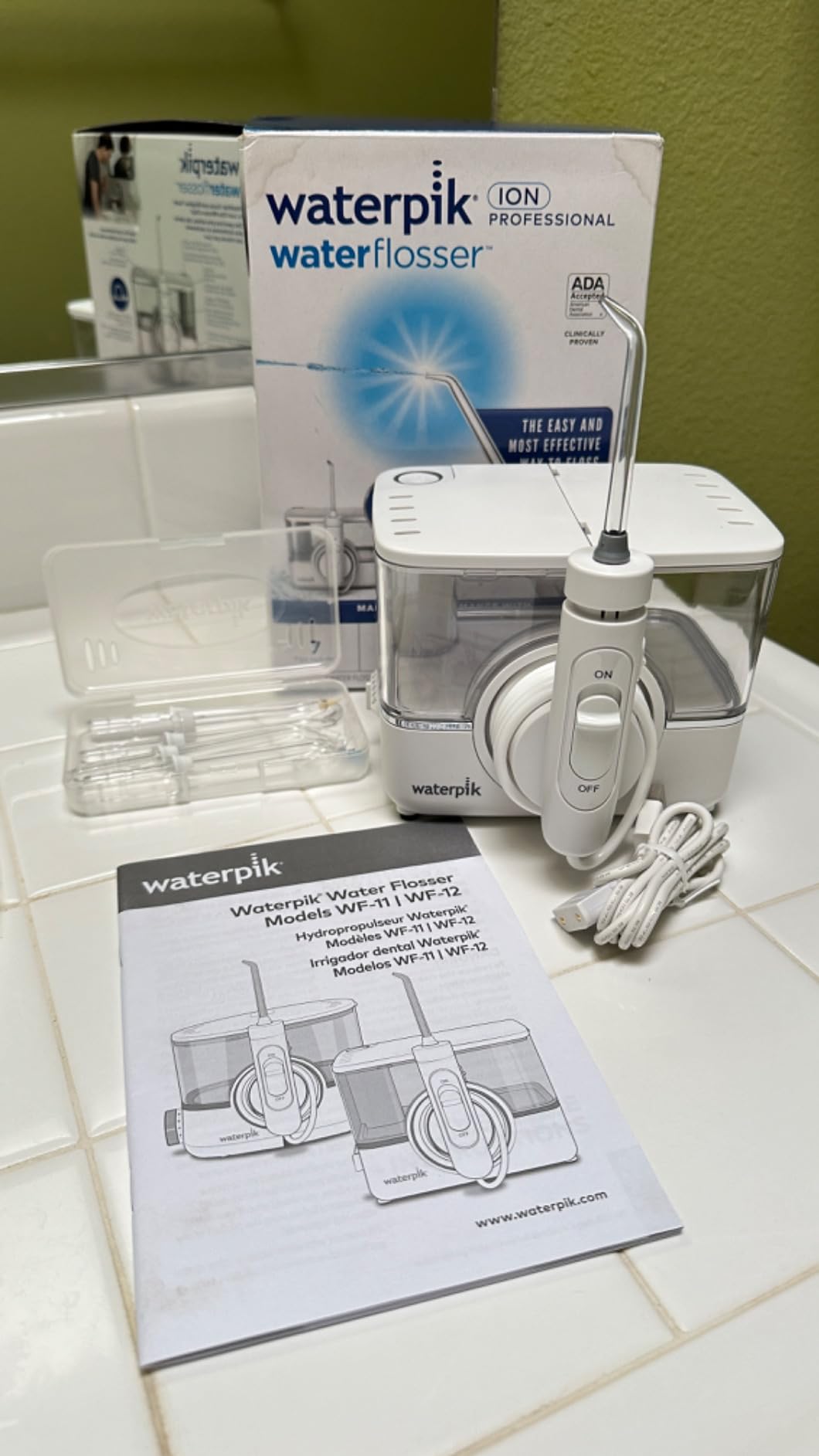
The pressure range matches the Aquarius, ten settings with a timer and pacer that pauses at 30 seconds and one minute, and the same PrecisionPulse technology for up to 99.9 percent plaque removal from treated areas. Seven specialty tips are included and the nozzle rotates 360 degrees, so the implant tip selection matches the plug-in model.
Battery life runs up to four weeks per charge, which for most households means charging roughly once a month. The 20 oz removable dishwasher-safe reservoir gives 90+ seconds of capacity, so you are not fighting the tank during a full-mouth pass.
Reviewers who want full countertop control in a cordless body rate it highly, and several say the timer and pacer plus the multi-week battery are the features they notice daily. The three-year limited warranty matches the Aquarius, which is reassuring for a device expected to last years.
It is also the lowest-rated Waterpik in this group, at 4.1 with a 12 percent one-star share, and owners point at the smaller tank against the Aquarius and the missing USB-A wall adapter. With fewer reviews and a lower sales rank than the other models here, parts availability is thinner. Anyone settled on this one should expect to charge it from a computer or an existing adapter rather than expecting a plug in the box.
ION versus Aquarius for the same household
They perform the same cleaning work. The Aquarius gives you a mains-powered stream, a 22 oz tank, and a mains cable to hide. The ION gives you the same ten settings, a slightly smaller tank, and no cable.
Choose the ION when counter space is the binding constraint. Choose the Aquarius when you want a larger tank and do not mind the footprint, or when you want the higher owner satisfaction that comes with a longer review history.
What the timer and pacer do for an implant routine
The pacer pauses at 30 seconds and one minute so you work in quadrants instead of losing four minutes to the upper left without noticing. Around a bridge that is the difference between cleaning the whole span and cleaning the part nearest the mirror.
Run the first pass at a low setting and the second at a medium one, using the pauses as your transitions. On a post-surgical implant, keep both passes gentle and extend the routine rather than the pressure.
We earn a commission, at no additional cost to you. CERTAIN CONTENT THAT APPEARS ON THIS SITE COMES FROM AMAZON. THIS CONTENT IS PROVIDED 'AS IS' AND IS SUBJECT TO CHANGE OR REMOVAL AT ANY TIME.
9. COSLUS E40: Best for One-Handed Pressure Adjustment
COSLUS ADA Accepted E40 Water Dental Flosser, 10 Pressure Levels, Black Pro
- ADA accepted with 10 pressure levels
- Stepless dial for one-handed control
- 300ml tank
- Up to 30 days of use per charge
Pros
- Stepless dial lets you change pressure one-handed mid-session
- Light enough to hold through a full session with limited grip strength
- Orthodontic and periodontal nozzles cover implant and appliance needs
- Customer service reported as responsive and helpful
Cons
- Reservoir empties quickly with some users refilling 5 to 7 times per session
- Charging is sensitive to the charger and non-original cables may not work
- Requires a USB cable rather than a wall plug
We earn a commission, at no additional cost to you. CERTAIN CONTENT THAT APPEARS ON THIS SITE COMES FROM AMAZON. THIS CONTENT IS PROVIDED 'AS IS' AND IS SUBJECT TO CHANGE OR REMOVAL AT ANY TIME.
The E40 is the only model here with a stepless dial, and that single design decision is aimed straight at implant patients. Instead of ten stepped buttons, you roll a dial and the pressure changes continuously from 1 to 10 under your thumb. You can back off a specific spot mid-pass without breaking rhythm or looking away from the mirror.
It is ADA accepted, built on patented dual-flow technology developed over six years of research, and uses BPA-free safety-certified materials. The 300ml tank is sized for cordless use and up to 30 days of use per charge on a one-to-two-times-daily routine.
Standard, orthodontic, and periodontal nozzles are included, so the implant tip you actually need is in the box. Reviewers with arthritis and reduced grip strength specifically call out the dial as the reason they can complete a full session unaided, and it weighs 15.17 ounces.
Why a stepless dial beats ten stepped buttons
Stepped buttons force you to choose between a level that is too gentle and one that is too strong. A dial closes that gap. When you are working along a bridge where one section is healing and the next is fully integrated, that fine control is the difference between tolerating the clean and skipping a spot.
The 10 pressure levels here match the count on the Waterpik countertop models, but you reach them continuously rather than in ten clicks.
Reservoir capacity and charger quirks
Capacity is the weak point. Some users report refilling five to seven times in a session, which is a lot of interruptions for a full-arch case. The 300ml figure sounds generous until you run the top pressure settings, where flow is higher.
Charging is picky. Non-original cables may not charge it at all, and the unit needs a USB cable rather than a wall plug. Budget for buying the correct cable and keeping it with the device. One reviewer also reported an earlier COSLUS flosser that stopped charging before its warranty period ended, so keep the receipt.
We earn a commission, at no additional cost to you. CERTAIN CONTENT THAT APPEARS ON THIS SITE COMES FROM AMAZON. THIS CONTENT IS PROVIDED 'AS IS' AND IS SUBJECT TO CHANGE OR REMOVAL AT ANY TIME.
10. Philips Sonicare Power Flosser 3000: Best for Gentle Gumline Cleansing
Philips Sonicare Cordless Power Flosser 3000, Water Flosser, 2 Nozzles
- Quad Stream X-shaped rotating tip
- 250ml removable easy-fill tank
- Up to 40 days per charge
- Deep Clean mode with Pulse Wave
Pros
- Quad Stream tip covers more gumline per pass with less effort
- Reservoir removes and cleans easily with few crevices to trap water
- QuadPacer every 15 seconds paces a clean without refilling
- Wall adapter and two tips included in the box
Cons
- 250ml tank runs out before a full cycle on medium pressure
- Nozzles can break off and replacement tips are hard to source
- Exterior crevices collect hard water and can stain over time
We earn a commission, at no additional cost to you. CERTAIN CONTENT THAT APPEARS ON THIS SITE COMES FROM AMAZON. THIS CONTENT IS PROVIDED 'AS IS' AND IS SUBJECT TO CHANGE OR REMOVAL AT ANY TIME.
The Sonicare Power Flosser 3000 is built around tip shape rather than pressure range. The Quad Stream tip has an X-shaped nozzle that splits the stream into four quadrants, covering more of the gumline in a single pass than a conventional round jet. Around a smooth titanium-supported crown, where a narrow pulse can overshoot into tender tissue, that wider coverage is genuinely useful. Philips claims up to 150 percent better gum health results than floss and up to 99 percent plaque removal below the gumline.
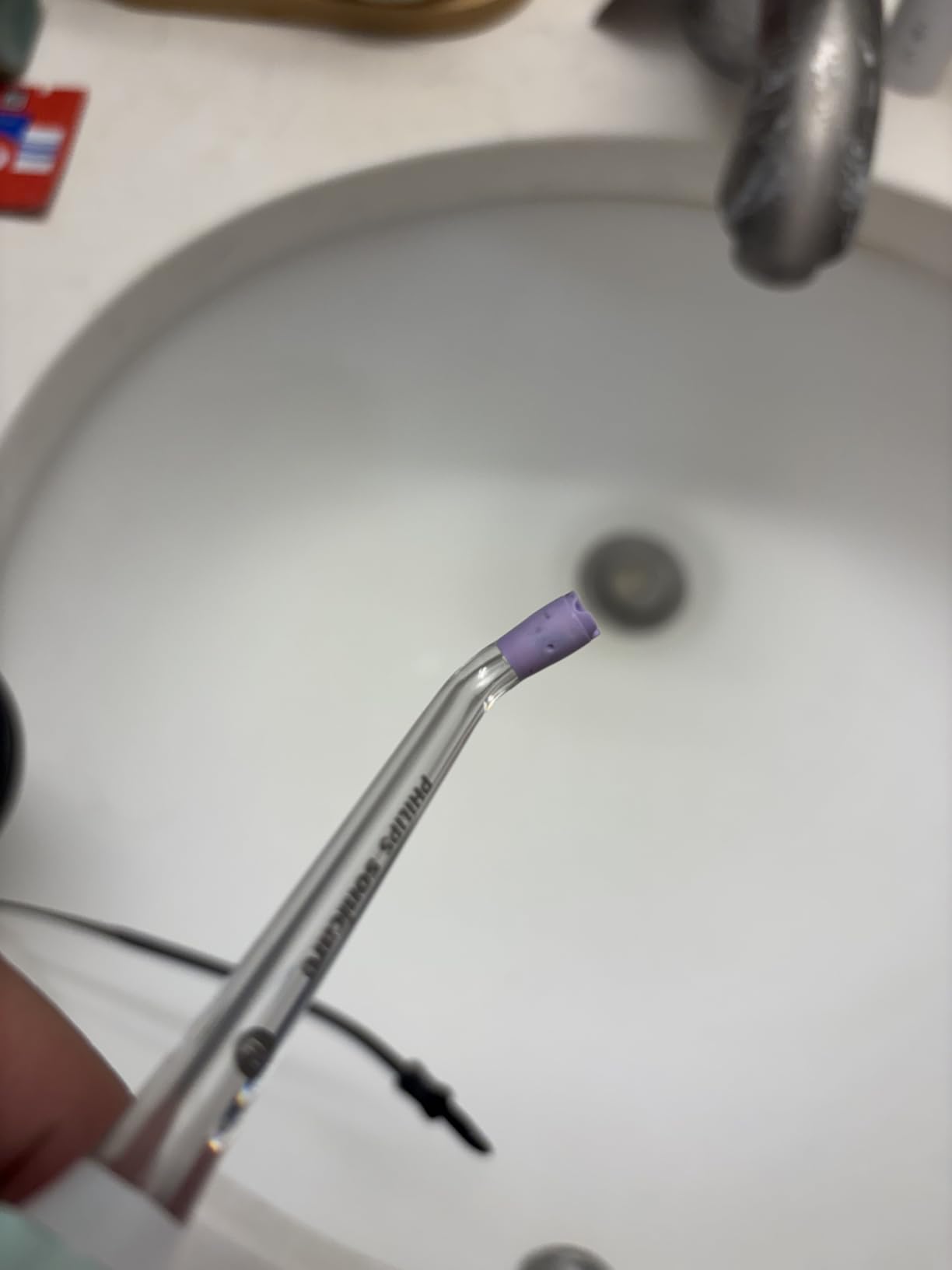
Two cleaning modes are available, Clean and Deep Clean with Pulse Wave, across three pressure settings. The QuadPacer pauses every 15 seconds, which is a tighter rhythm than the 30-second pace on a Waterpik and a useful prompt for someone cleaning four implants who tends to rush the back of the arch.
The 250ml tank removes completely for filling and cleaning, with a top fill or a side port so you can top it up without dismantling anything. The body has few crevices that trap water, which matters over months of daily use. Both tips rotate 360 degrees, and the box includes an F1 Standard tip, an F3 Quad Stream tip, a USB-A cable, and a wall adapter, which almost nothing else in this roundup includes.
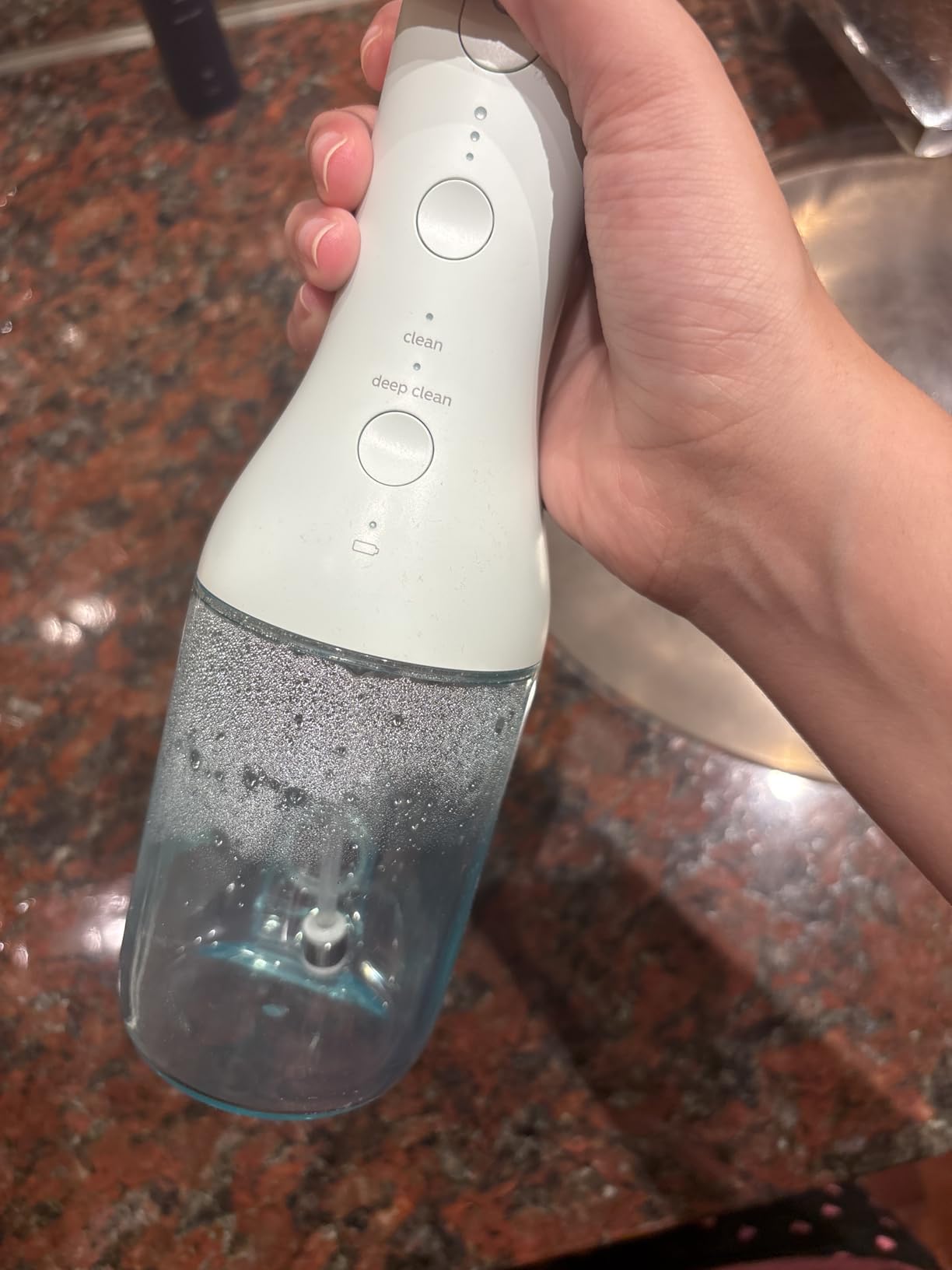
Battery life is up to 40 days per charge, and several owners describe outperforming a previous countertop unit for travel purposes. The compact 3.62 by 5.28 by 9.72 inch body stores its tips inside the reservoir.
The complaints are specific and worth weighing. The 250ml tank runs out before a full cycle on medium pressure, forcing a refill, and that is the most common gripe. Nozzles can break off while attached to the pump, and replacement tips are harder to source than for the Waterpik models. The flush touch-sensitive buttons are easy to trigger while gripping the unit, hard water stains the exterior crevices over time, and at least one user reported a leak from a hole at the back along with a weak stream.
Quad Stream versus a narrow periodontal tip
They solve different problems. Quad Stream is a wide, forgiving, gumline-coverage tip, which suits a healed implant with a healthy seal and a smooth crown surface. A narrow periodontal tip is a precision instrument for a specific pocket or a post-surgical site.
If you have a mix of both, the ideal setup is this flosser for daily maintenance and a countertop model with periodontal and plaque seeker tips for deeper periodic work. The F1 standard nozzle in the box handles most of that already.
Who should pass on it
Pass if you are sensitive to replacement part availability. A broken nozzle on a flagship cordless product with harder-to-source tips is an annoyance that compounds over years of daily use.
Also consider skipping it if you have four or more implants, because the 250ml tank will interrupt a full-arch clean more than once. For one implant or a short bridge, the Quad Stream tip and the included wall adapter make it a strong, tidy package.
We earn a commission, at no additional cost to you. CERTAIN CONTENT THAT APPEARS ON THIS SITE COMES FROM AMAZON. THIS CONTENT IS PROVIDED 'AS IS' AND IS SUBJECT TO CHANGE OR REMOVAL AT ANY TIME.
How to Choose a Water Flosser for Implants in 2026
Implant hardware changes what matters in a flosser. On natural teeth, a strong single stream is a feature. On an implant, pressure control and tip geometry decide whether you can clean the sulcus without aggravating the tissue that is sealing the post. Here is the order we would weigh these factors.
Pressure settings: the single most important feature
Look for five or more levels, and ten if you can find it. A two-setting flosser forces a choice between too gentle to remove anything and too strong to be comfortable on tender tissue, and that is the exact problem raised in the implant communities when people ask whether an off-brand model is worth replacing.
The published range matters less than the granularity. The COSLUS C30 states 30 to 150 PSI, the TUREWELL covers 30 to 125 PSI across ten settings, and the top Waterpik models do not publish figures but are widely considered the strongest at the top end. For a patient whose tissue changes week to week, a dial or fine-grained steps beat a wide range you cannot land on precisely.
Tips: periodontal and plaque seeker or it does not matter
Check the box before you buy, not after. You want a periodontal tip for the pocket beside a post and a plaque seeker or similar narrow tip for crown margins and bridges. The Aquarius, TUREWELL, AquaSonic, COSLUS C30, and COSLUS E40 all include a periodontal-class tip as standard. The Cordless Advanced ships four tips, so confirm which ones you are getting.
For a full-arch All-on-4 restoration, budget for a spare set of tips. They are consumables, they wear at the narrow nozzle, and implant sites need them in good condition.
Reservoir capacity: match it to your implant count
One molar implant needs about 30 to 45 seconds. A two or three-unit bridge needs 60 to 90. A full-arch All-on-4 case or an implant-supported overdenture needs 90 seconds or more, and ideally no refill at all.
On that basis: the 600ml TUREWELL and the 22 oz Aquarius handle the largest cases. The 20 oz Waterpik ION is close behind. The 300ml COSLUS models and the 261ml Bitvae cover most situations. The 7 oz Waterpik Cordless Advanced and the 250ml Sonicare are built for one or two implants rather than a full arch.
Countertop or cordless
Choose countertop if your implants are fixed and you never travel. You get stronger sustained pressure, a bigger tank, and no charging. Choose cordless if you travel, share a small bathroom, or want the device in the shower. A countertop unit as the main tool with a compact cordless for trips is a common and sensible pairing.
Hygienists advising patients on forums consistently favour full-sized models for the reservoir reason alone, and that is a sound basis if you have a fixed arch.
ADA acceptance, battery, waterproofing, and warranty
ADA acceptance is the trust signal implant patients rate highest. In this roundup the Aquarius carries it through brand heritage, the COSLUS C20 and E40 are ADA accepted, the AquaSonic earned it through a published trial, and the Cordless Advanced sits within the brand’s ADA heritage. If clinical backing matters to you, that shortlist is where to start.
Battery figures are less comparable than they look. Four weeks per charge on a multi-user countertop unit and 40 days on a single-user cordless are measuring different routines, so read the assumption: most of these figures assume one or two uses a day. IPX7 waterproofing appears on the COSLUS, Bitvae, AquaSonic, and Sonicare units and lets you use any of them in the shower. Warranty length ranges from two years on the Cordless Advanced to three years on the Aquarius, ION, and COSLUS models.
Water temperature and mouthwash additives
Fill the reservoir with warm water during healing. Cold water on tender post-surgical tissue is uncomfortable enough to end the habit, and warm water measurably reduces the perceived sting of the pulse without diluting the cleaning. This is the practical fix most often cited for sensitive-gum complaints on aggressive low settings.
On additives, keep it simple. Most manufacturers use plain water, and some add a flavour or a mild mint. Adding a full-strength antiseptic mouthwash to the tank is not something the manufacturers design for, and undiluted alcohol-based rinses can irritate peri-implant tissue. If you want a rinse, use it as a rinse, at the dilution on its own label, and keep the flosser reservoir filled with plain water or warm water.
A Step-by-Step Cleaning Routine Around Implants
Peri-implantitis is inflammatory bone loss around an implant, and it is the failure mode everything above is aimed at preventing. The protocol is not complicated, but the order and the pressure are what make the difference.
Daily routine for a healed implant
Brush twice daily with an implant-specific or extra-soft brush, angling the bristles slightly into the gumline at the base of the crown. Then floss or use a flosser pick to clear the contacts between the crown and neighbouring tooth, because those surfaces do not move and a water stream will not dislodge wedged food reliably.
Then irrigate. Fill the tank with warm water, choose a low to medium pressure for a healed site, and aim the periodontal tip at a shallow angle into the sulcus beside the post. Let the pulse run two to three seconds at each point, sweep the buccal side, then the lingual, then the occlusal surface. Finish with a full-arch pass at the same setting to catch anything you missed.
Finish by rinsing with a clean glass of water. Flushing your mouth afterwards clears the loosened bacteria rather than leaving them to resettle.
After implant surgery: the first six weeks
For the first 24 hours, do nothing beyond gentle rinsing. Most surgeons advise waiting at least 10 to 14 days before using an irrigator, and your dentist’s timeline overrides any general advice here.
From week two, if cleared, use the lowest setting with warm water and a periodontal tip only. Keep the nozzle at a shallow angle and never aim directly at the healing tissue. Twice a day is plenty at this stage.
From week four, you can begin increasing to a low-medium setting and add a second pass to cover the occlusal surface. From month two onward, move to your normal maintenance routine. If any setting produces bleeding that does not settle within a minute, step down one level rather than pushing through it.
Matching the routine to your implant type
A single tooth implant needs the shortest routine: 30 to 45 seconds, one fill, low to medium pressure, and no special technique beyond angling at the gumline. A splinted molar or a two or three-unit bridge is where a 60 to 90 second capacity earns its keep, because you are cleaning both abutment margins and the underside of the span.
An All-on-4 full arch is the hardest case. You need a reservoir of 300ml or more, ideally 600ml, and a plan rather than a single pass. Work arch by arch, spending extra time at the four post sites where bone support matters most, and use the interdental brush or flosser pick for the spaces between the temporary and final teeth that a stream cannot enter. An implant-supported overdenture takes the same approach, plus a deliberate pass along the underside of the bar and the tissue-facing surface of the denture every time you take it out.
Frequently Asked Questions
Can you use a water flosser on implants?
Yes. A water flosser is one of the recommended tools for cleaning around dental implants because the pressurised pulse flushes bacteria from the 3 to 4mm pocket around the implant post, where a toothbrush cannot reach and string floss shreds. Start on the lowest pressure setting, aim the tip at a shallow angle along the gumline rather than straight into the pocket, and check with your dentist about timing after surgery. Most surgeons clear patients for irrigator use around 10 to 14 days post-op.
Which Waterpik tip is best for implants?
The Plaque Seeker tip is the best general choice for crowns, implants, and bridges because its narrow tapered nozzle tracks along the gumline. For a specific pocket beside a post, the Pik Pocket tip is built to reach into it. The Classic Jet tips work for the broad surfaces of the crown itself. Whichever tip you use, aim along the gumline at roughly 45 degrees and let the pulse travel rather than forcing the nozzle into the base of the sulcus.
Which Waterpik is best for implants?
The Waterpik Aquarius is the strongest all-round choice because it combines ten pressure settings with a 22 oz reservoir and a Plaque Seeker tip designed for crowns, implants, and bridges, which lets you start gentle on healing tissue and increase pressure as the site matures. If you need cordless portability, the Waterpik Cordless Advanced has the same 360-degree rotating tip for reach but only three pressure settings and a 7 oz tank. The Waterpik ION gives you ten settings without a mains cord for a smaller bathroom footprint.
What is the difference between the Waterpik Aquarius and Promax?
The Aquarius is the mid-range countertop model with ten pressure settings, a massage mode, a 22 oz reservoir, and seven tips including the Plaque Seeker and Pik Pocket nozzles, which is why it is the one we recommend for implants. The Promax is the higher-output model in the same family, delivering stronger pressure for heavy plaque and larger-arch cleaning, with a larger reservoir. For implant maintenance where the priority is controlled, gentle access to the sulcus rather than maximum power, the Aquarius is usually the better match.
How often should I water floss with implants?
Twice a day, once in the morning and once in the evening, is the standard recommendation. Each session takes 30 to 90 seconds depending on how many implants you have. Keep your regular brushing and interdental cleaning in place as well, because a water flosser flushes the pocket but does not clear the contact points between teeth. After surgery, most surgeons advise waiting 10 to 14 days before starting, then using the lowest setting with warm water until you are cleared to increase the pressure.
Do water flossers help prevent peri-implantitis?
They help, and they are not sufficient on their own. Peri-implantitis is inflammatory bone loss caused by bacteria breaking the seal between gum tissue and the titanium post, and the irrigator removes biofilm from the sulcus where brushing and floss struggle. Dental professionals consistently advise using a water flosser alongside brushing and interdental cleaning rather than as a replacement, and anyone who notices bleeding that does not settle, swelling, or a bad taste should see their dentist rather than increasing the pressure themselves.
Our Verdict on the Best Water Flossers for Implants
After weeks with all ten, the Waterpik Aquarius remains the best water flosser for implants overall. Ten pressure settings, a 22 oz reservoir, and the Plaque Seeker and Pik Pocket tips cover everything a single implant, a bridge, or a fixed full arch requires, and the deep owner review history means parts will still be available years from now.
If you want clinical documentation behind the ADA seal, the AquaSonic is the one to shortlist. If you travel often, the Waterpik Cordless Advanced wins on portability with the same rotating tip. For a full-arch All-on-4 case, the TUREWELL’s 600ml tank means no mid-session refills. For pressure control on a healing site, the COSLUS C30 and E40 give you the finest adjustment in the group.
Whichever you pick, the routine matters more than the machine. Warm water, a low starting setting, a shallow angle along the gumline, twice a day, and a dentist’s review at every appointment will do more for an implant than any specification on a box.