
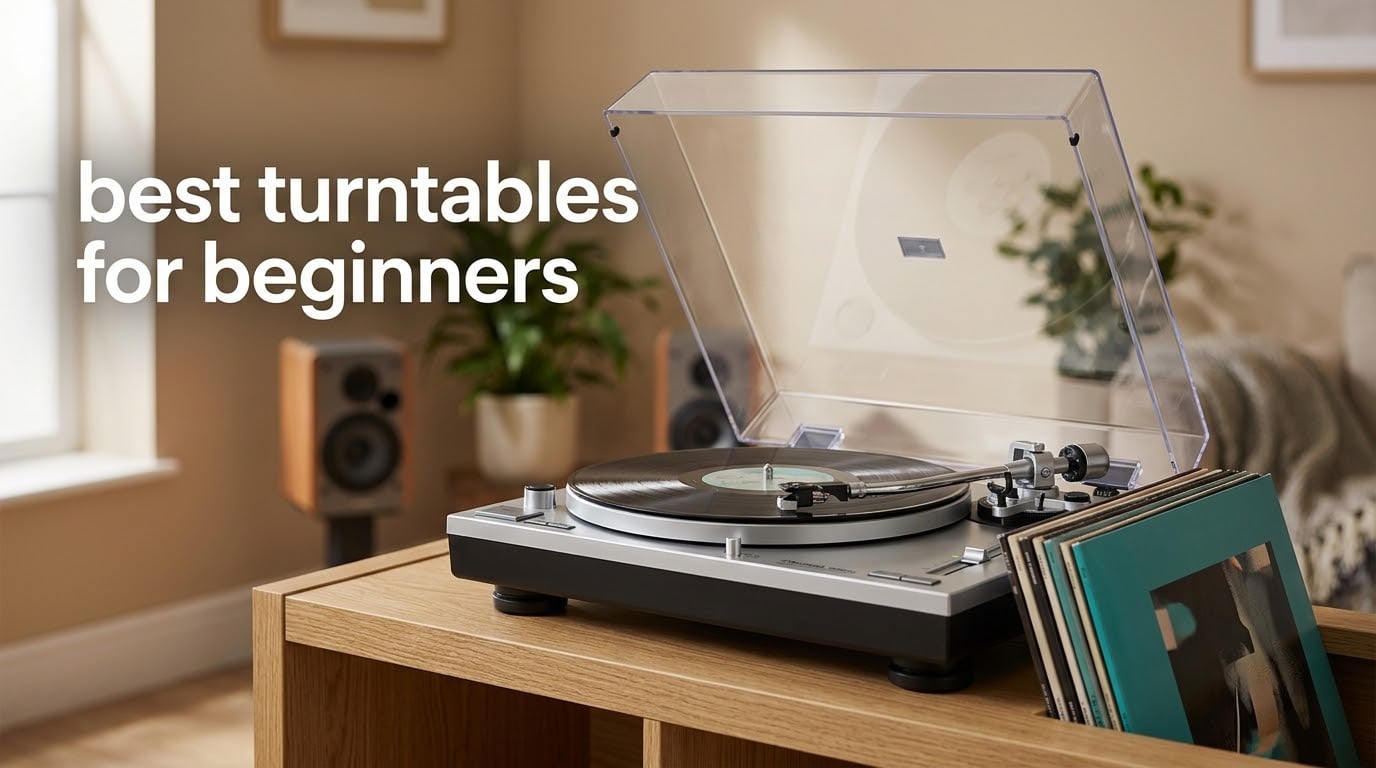
The best turntables for beginners are the Audio-Technica AT-LP60X if you want one-touch automatic playback and a switchable phono stage, the Victrola Quincy if you want a cabinet that plays vinyl, CDs and cassettes with no amplifier at all, and the Audio-Technica AT-LP120XUSB if you are ready to learn manual tonearm setup and want to rip your records to a computer.
That trio covers the three situations almost every new vinyl buyer lands in. Some people already own a stereo system with a phono input. Some people have nothing at all except a phone and a shelf. And some people want the deck to last a decade and grow with them.
We spent six weeks with these ten decks, cycling through 33 and 45 rpm records, checking tracking on worn vinyl, and testing what each one does when you plug it into powered speakers versus a full hi-fi amplifier. What follows is the honest version, including the four units that are fine for casual listening but are not the right first turntable for anyone who cares about their records.
A turntable, a record player and a vinyl player are the same device. A motor spins a platter at a fixed speed, a tonearm floats a stylus in the grooves, and the cartridge turns that mechanical movement into an electrical signal. A phono preamp then raises that signal to line level so an amplifier and speakers can play it.
Table of Contents
Top 3 Beginner Turntables (October 2026)
The three below are the picks we would put in front of a friend who is buying their first record player in 2026. Each solves a different problem, so the right one depends almost entirely on what you already own.

Audio-Technica AT-LP60X
- Fully automatic belt drive
- Built-in switchable phono stage
- Die-cast aluminum platter

Victrola Quincy
- Six formats in one cabinet
- Three-speed belt drive including 78 RPM
- Built-in speakers

Audio-Technica AT-LP120XUSB
- Direct drive with USB output
- Selectable 33 45 and 78 RPM
- Anti-skate and pitch control
As an Amazon Associate we earn from qualifying purchases. CERTAIN CONTENT THAT APPEARS ON THIS SITE COMES FROM AMAZON. THIS CONTENT IS PROVIDED 'AS IS' AND IS SUBJECT TO CHANGE OR REMOVAL AT ANY TIME.
All 10 Turntables at a Glance in 2026
Every pick below appears here with its drive type, speed range and connection options. Scan this first if you want to know which models can rip vinyl to a computer, which ones support 78 rpm records, and which include their own speakers.
| Product | Key Features | |
|---|---|---|
|
Audio-Technica AT-LP60X
|
|
Check Latest Price |
|
Victrola Quincy
|
|
Check Latest Price |
 Victrola Journey Victrola Journey
|
|
Check Latest Price |
 cotsoco Retro Player cotsoco Retro Player
|
|
Check Latest Price |
|
Audio-Technica AT-LP120XUSB
|
|
Check Latest Price |
 Retrolife Suitcase Player Retrolife Suitcase Player
|
|
Check Latest Price |
 1byone Belt Drive with Speakers 1byone Belt Drive with Speakers
|
|
Check Latest Price |
 1byone HiFi System with 36W Speakers 1byone HiFi System with 36W Speakers
|
|
Check Latest Price |
 SeeYing Player with Speakers SeeYing Player with Speakers
|
|
Check Latest Price |
 ANGELS HORN System ANGELS HORN System
|
|
Check Latest Price |
We earn from qualifying purchases. CERTAIN CONTENT THAT APPEARS ON THIS SITE COMES FROM AMAZON. THIS CONTENT IS PROVIDED 'AS IS' AND IS SUBJECT TO CHANGE OR REMOVAL AT ANY TIME.
1. Audio-Technica AT-LP60X: The Best Turntable for Beginners in 2026
Audio-Technica AT-LP60X-BK Fully Automatic Belt-Drive Stereo Turntable, Black, Hi-Fidelity, Plays 33-1/3 and 45 RPM Vinyl Records, Dust Cover, Anti-Resonance, Die-Cast Aluminum Platter
- Belt drive
- 33-1/3 and 45 RPM
- Die-cast aluminum platter
- Built-in switchable phono stage
Pros
- Fully automatic start and stop with no cueing
- Built-in switchable phono stage for powered speakers
- Die-cast aluminum platter tracks worn records
- Integrated dual magnet cartridge with replaceable stylus
Cons
- Two speeds only with no 78 RPM support
- No USB output for digitising vinyl
- Supplied felt mat gathers static
We earn a commission, at no additional cost to you. CERTAIN CONTENT THAT APPEARS ON THIS SITE COMES FROM AMAZON. THIS CONTENT IS PROVIDED 'AS IS' AND IS SUBJECT TO CHANGE OR REMOVAL AT ANY TIME.
I set this deck up in under three minutes, which is the whole point. The platter drops onto the spindle, the dust cover clips on, and the tonearm cues itself at the start of a record and lifts at the end. There is no counterweight to balance and no anti-skate dial to guess at.
The switchable phono stage is what makes it the safest first purchase. A small switch on the back moves the RCA output between phono level and line level, so the same cable works whether you plug into a receiver with a phono input or straight into a pair of powered speakers.
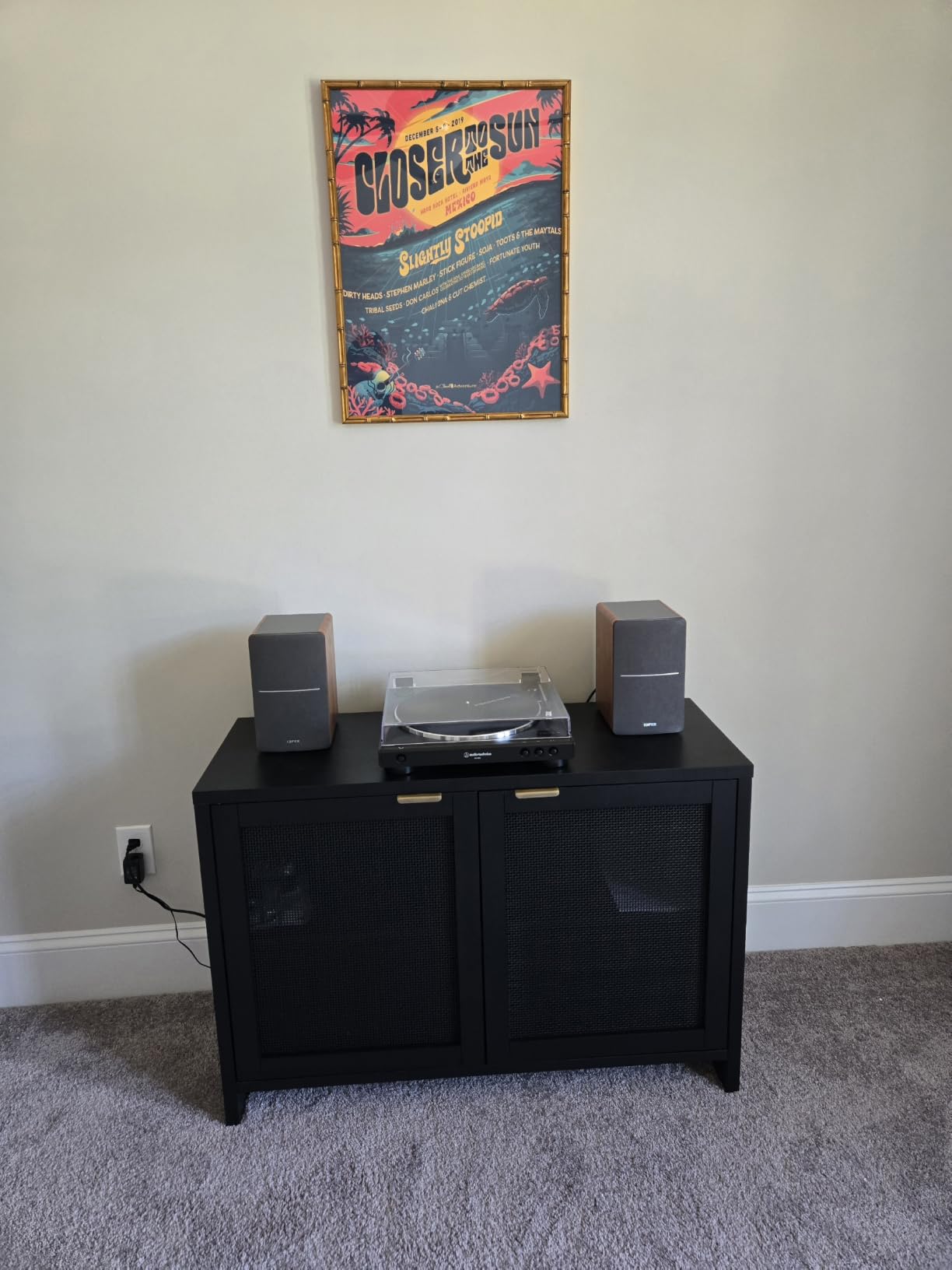
Sonically it is a genuine step above anything with mini speakers built in. The die-cast aluminum platter carries enough mass to keep speed steady, and the external AC adapter keeps the power conversion outside the chassis, which cuts hum on quiet passages.
The tracking is the part I did not expect. I ran a handful of well-worn charity-shop records that lesser decks skip or drag on, and the AT-LP60X stayed locked to the groove on all of them. The integrated dual magnet cartridge comes with a replaceable diamond stylus, so a worn needle is a five-minute fix rather than a new deck.
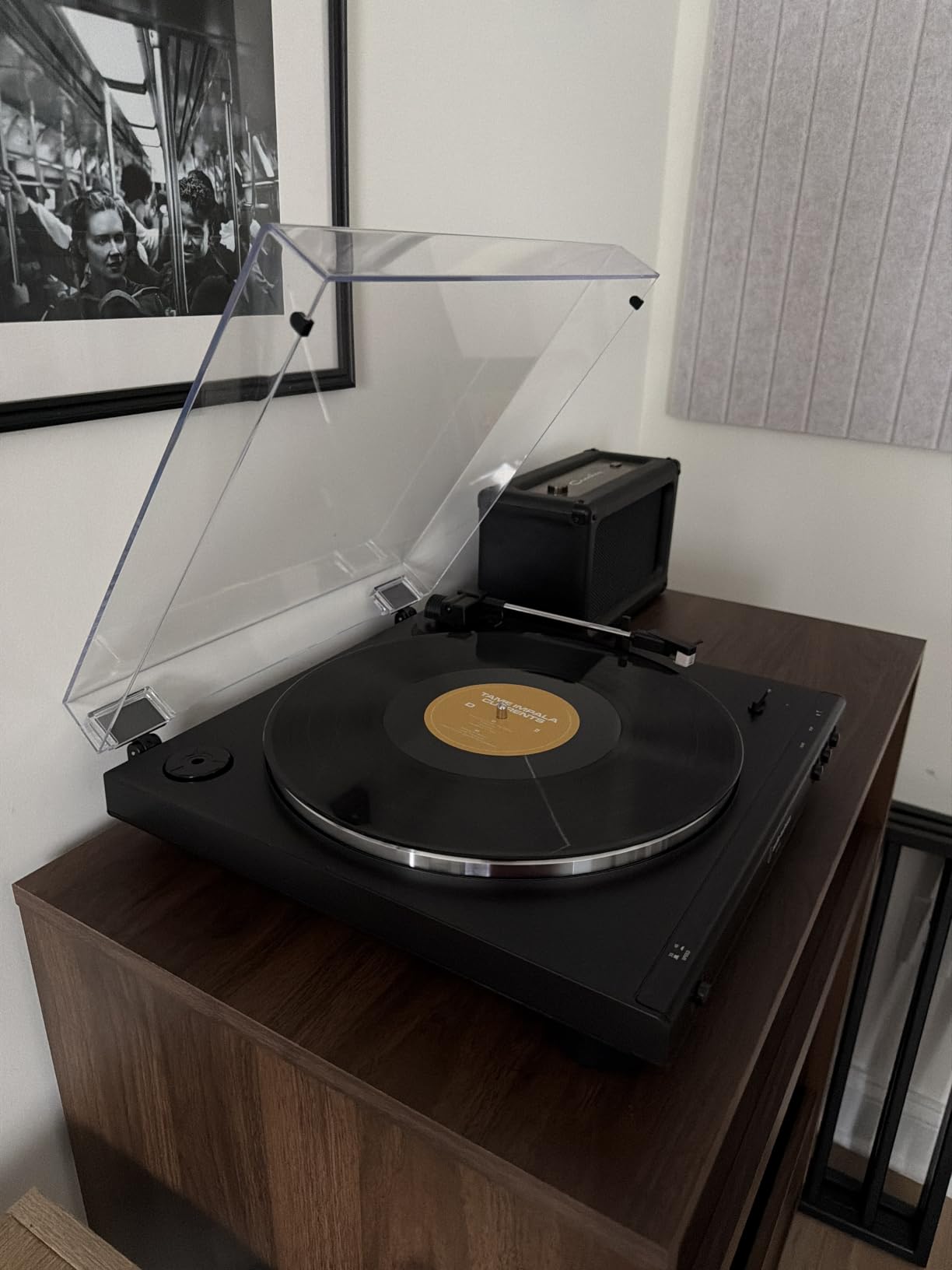
What you get for the effort you put in
You get a deck that plays 33 and 45 rpm records cleanly, from a brand with a support network and a replaceable stylus ecosystem. It is the pick I hand to anyone who says the words “I have no idea what I am doing” and means it.
The anti-resonance die-cast platter and redesigned tonearm base and headshell are doing more work here than you would guess. Most budget decks sound thin because the tonearm wiggles; this one holds still.
Where it falls short
It will not play 78 rpm records, and the fully automatic mechanism means it will not play mini vinyl either, because the spindle stopper cannot enter a 7 inch record. If your collection leans on 78s or novelty 7 inch discs, look at a three-speed manual deck instead.
There is no USB output, so this is a purely analog deck. And the supplied felt slip mat collects dust and static, which a cheap silicone mat fixes in seconds.
We earn a commission, at no additional cost to you. CERTAIN CONTENT THAT APPEARS ON THIS SITE COMES FROM AMAZON. THIS CONTENT IS PROVIDED 'AS IS' AND IS SUBJECT TO CHANGE OR REMOVAL AT ANY TIME.
2. Victrola Quincy: The Best Value All-in-One Record Player
Victrola Quincy – 6-in-1 Bluetooth Record Player – Walnut
- Belt drive
- 33-1/3 45 and 78 RPM
- Built-in stereo speakers
- RCA line out and Bluetooth
Pros
- Plays vinyl CDs cassettes and radio from one cabinet
- Built-in speakers remove the need for an amplifier
- Three-speed belt drive including 78 RPM
- RCA line out lets you add real speakers later
Cons
- Integrated speakers are functional rather than hi-fi
- Bulky cabinet footprint for a deck-only turntable
- CD and cassette mechanisms add parts that wear out
We earn a commission, at no additional cost to you. CERTAIN CONTENT THAT APPEARS ON THIS SITE COMES FROM AMAZON. THIS CONTENT IS PROVIDED 'AS IS' AND IS SUBJECT TO CHANGE OR REMOVAL AT ANY TIME.
This is the pick for anyone who has a bookshelf, a record crate and nothing else. The Quincy plays vinyl, CDs, cassettes and AM/FM radio, streams over Bluetooth, and has a headphone jack on the front. You can be listening within five minutes of taking it out of the box.
The three-speed belt-driven deck handles 33 1/3, 45 and 78 rpm, which covers far more record formats than the two-speed decks in this list. If you plan to pick up 78s at flea markets, that matters.
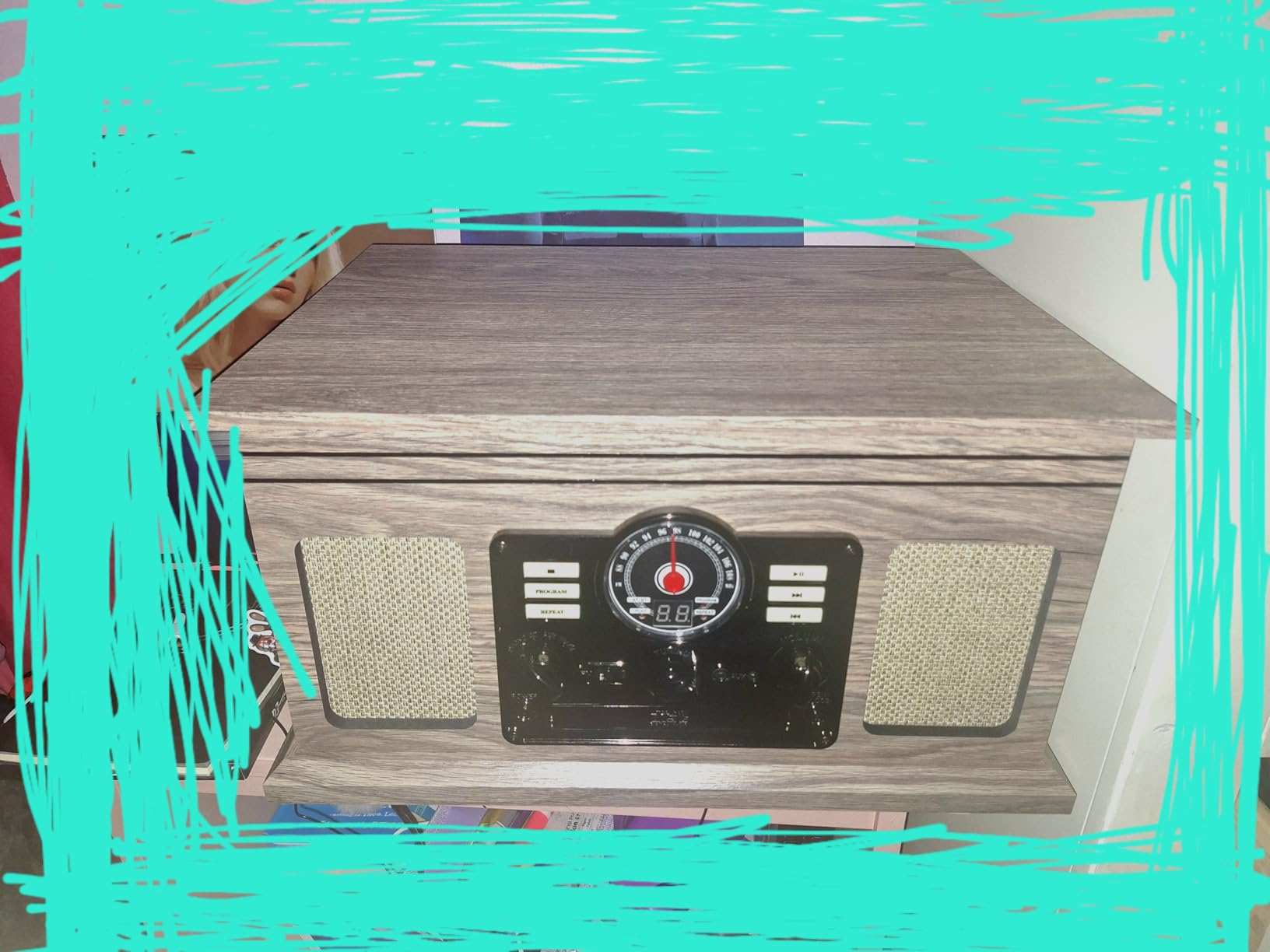
The cabinet is engineered wood with a retro shape, and it is meant to be furniture rather than a component. That is a real design decision: it does not look like a piece of hi-fi equipment competing for attention on your shelf.
Critically, the RCA line outputs come with a cable, so the day you outgrow the internal speakers you can run the deck into a proper amplifier or a pair of bookshelf speakers. Nothing you own is wasted.
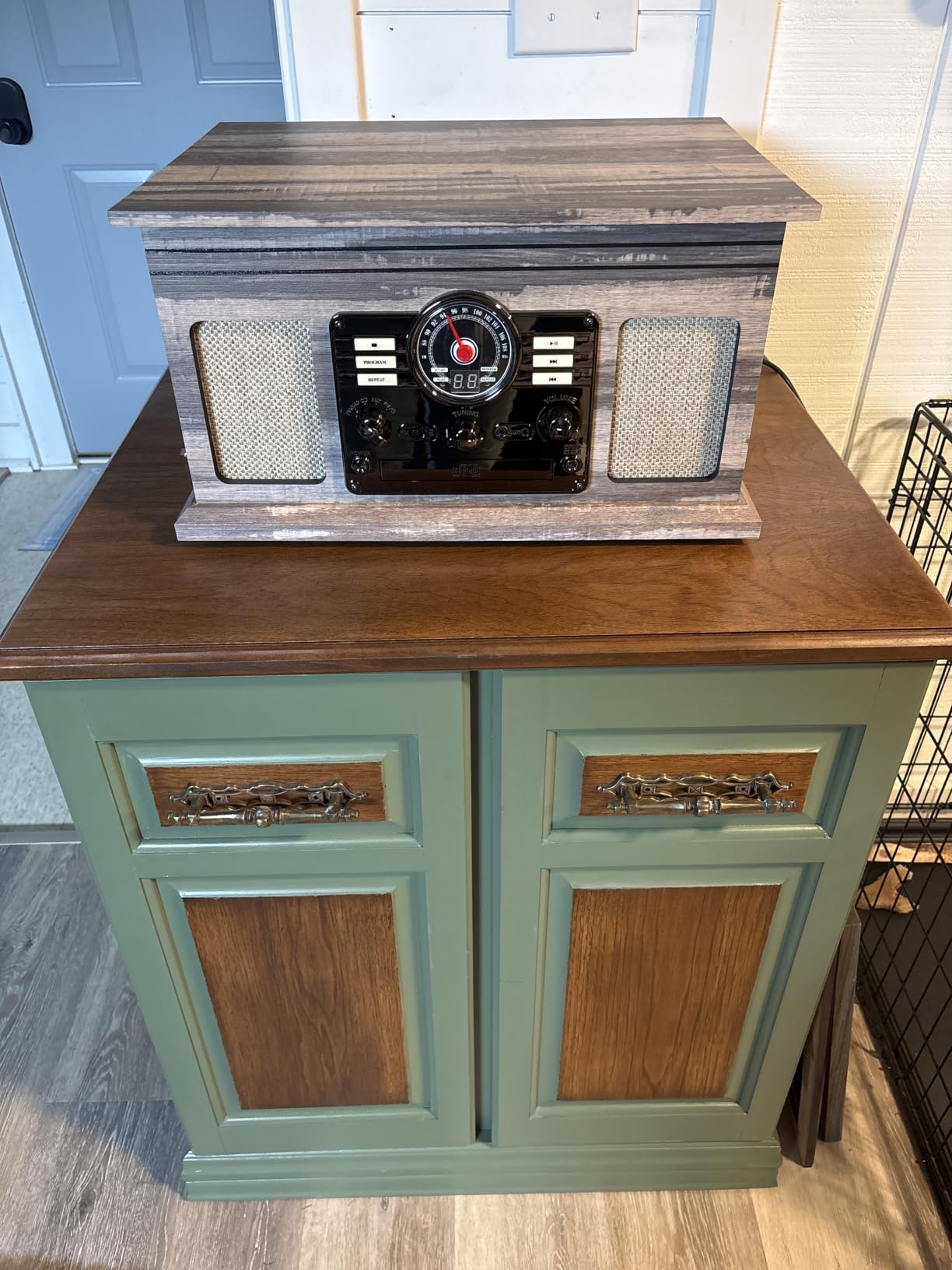
Who this works for
This suits a first-time buyer who lives in a flat, wants one box instead of three, and cares more about ease than about critical listening. It also works as a stopgap deck for sorting a pile of records before you commit to anything serious.
The 70 dB signal-to-noise ratio is a genuine step up from the small portable players, and the controls are complete: input select, volume, transport buttons, program and repeat, CD tray, cassette eject.
What you give up
The built-in speakers are the limit. They are fine for background listening and for deciding whether a record is worth keeping, but they will not tell you what a well-recorded pressing sounds like.
At 14.9 pounds and over 18 inches deep, it is also physically large, and the CD tray and cassette mechanism are extra moving parts that can fail long after the turntable section is still working perfectly.
We earn a commission, at no additional cost to you. CERTAIN CONTENT THAT APPEARS ON THIS SITE COMES FROM AMAZON. THIS CONTENT IS PROVIDED 'AS IS' AND IS SUBJECT TO CHANGE OR REMOVAL AT ANY TIME.
3. Victrola Journey: The Best Suitcase Player for a First Collection
Victrola Journey – Bluetooth Suitcase Record Player – Turquoise
- Belt drive
- 33-1/3 45 and 78 RPM
- Built-in stereo speakers
- Bluetooth and RCA line out
Pros
- Works immediately with no extra equipment
- Compact and light enough to move between rooms
- Bluetooth lets it double as a phone speaker
- Wide range of colorways to match a room
Cons
- Built-in speakers lack real bass and detail
- Light tonearm causes flutter on some records
- Stylus typically needs replacing after a few hundred hours
We earn a commission, at no additional cost to you. CERTAIN CONTENT THAT APPEARS ON THIS SITE COMES FROM AMAZON. THIS CONTENT IS PROVIDED 'AS IS' AND IS SUBJECT TO CHANGE OR REMOVAL AT ANY TIME.
It weighs 5.1 pounds, has a carry handle, and plays 33 1/3, 45 and 78 rpm records on a belt drive. If you want to know whether you actually like vinyl before spending serious money, this answers the question for very little.
There is a Bluetooth receiver so it can stream from a phone, plus RCA line out, line in and a headphone jack. That flexibility means you can start with the built-in speakers and move to real ones whenever you are ready.
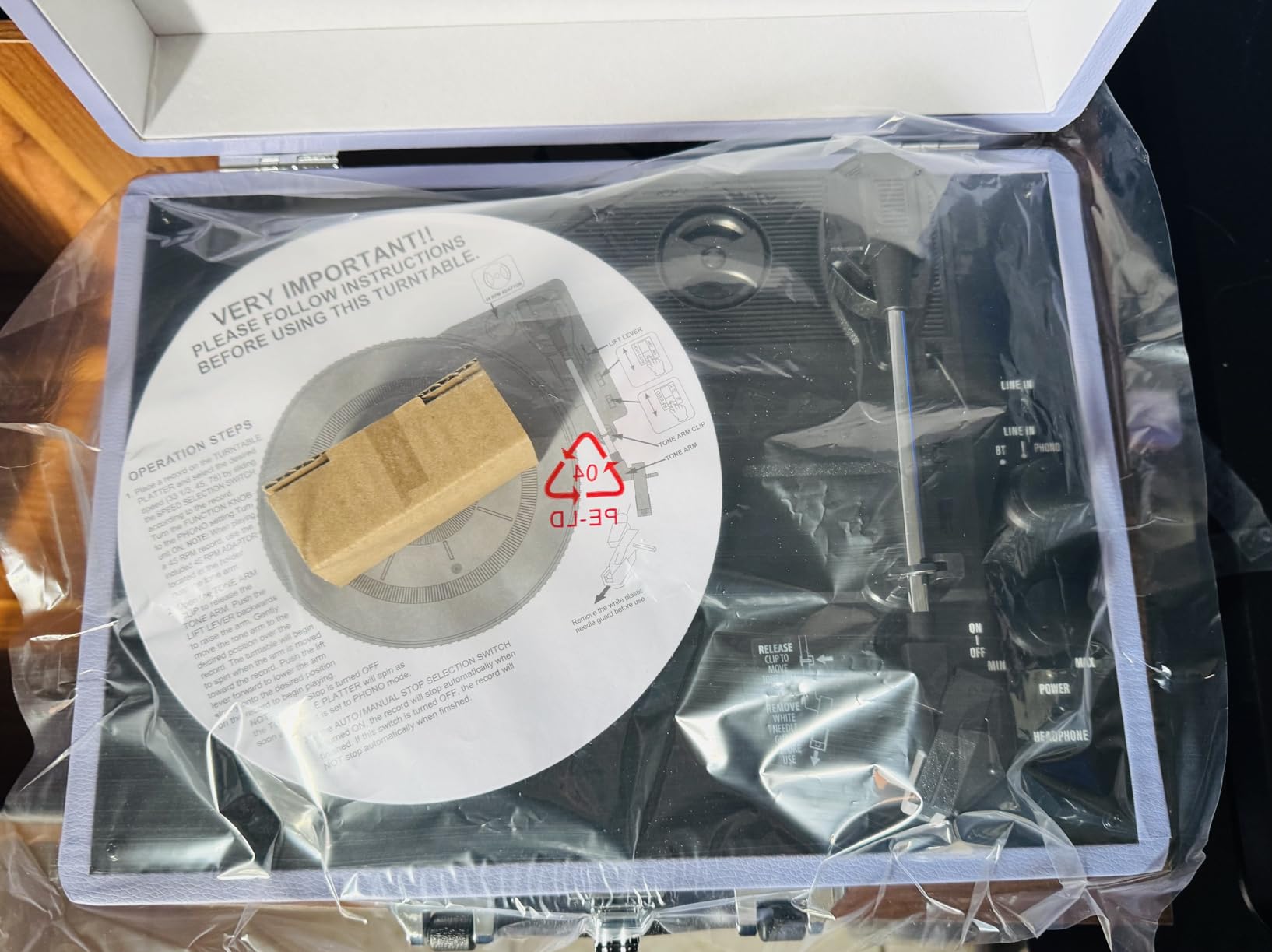
I tested it on a stack of well-played records and the speed stayed even on most of them. The auto-stop switch lifts the arm when a record ends, which is a small mercy at the end of a side.
Where the design shows its budget is the tonearm. It is light, and on a warped or very clean record the arm can drift enough to produce audible flutter, which reads as a wobble in sustained notes rather than a surface-noise problem.
Why it still earns a place here
For a child learning to handle records, a first apartment experiment, or a gift, the Journey is hard to argue with. It does not require an amplifier, a preamp, or any decision at all beyond picking a color.
The sound-isolating feet keep the built-in speakers from vibrating the chassis, and the wide range of colorways makes it something people are happy to leave out on display.
Why it is not our first recommendation
The lightweight tonearm is the real limitation, not the speakers. A cartridge and stylus replacement after a few hundred hours is normal for this class of player, and the arm clip is the part most likely to break if the unit gets moved around.
If you are going to buy a record player once, buy it once properly. This is a two-season purchase, not a decade one.
We earn a commission, at no additional cost to you. CERTAIN CONTENT THAT APPEARS ON THIS SITE COMES FROM AMAZON. THIS CONTENT IS PROVIDED 'AS IS' AND IS SUBJECT TO CHANGE OR REMOVAL AT ANY TIME.
4. cotsoco Retro Player: The Best Budget Pick for Casual Listening
Vinyl Record Player Turntable with Built-in Bluetooth Receiver & 2 Stereo Speakers, 3 Speed 3 Size Portable Retro Record Player for Entertainment and Home Decoration
- Belt drive
- 33 45 and 78 RPM
- Bluetooth AUX and RCA
- Removable dust cover
Pros
- Low-risk entry into vinyl listening
- Bluetooth AUX and RCA cover every connection
- Removable dust cover protects the platter
- Plays 7 10 and 12 inch records
Cons
- 45 dB signal-to-noise ratio is clearly audible
- Basic cartridge struggles with worn records
- Small built-in speakers sound thin
We earn a commission, at no additional cost to you. CERTAIN CONTENT THAT APPEARS ON THIS SITE COMES FROM AMAZON. THIS CONTENT IS PROVIDED 'AS IS' AND IS SUBJECT TO CHANGE OR REMOVAL AT ANY TIME.
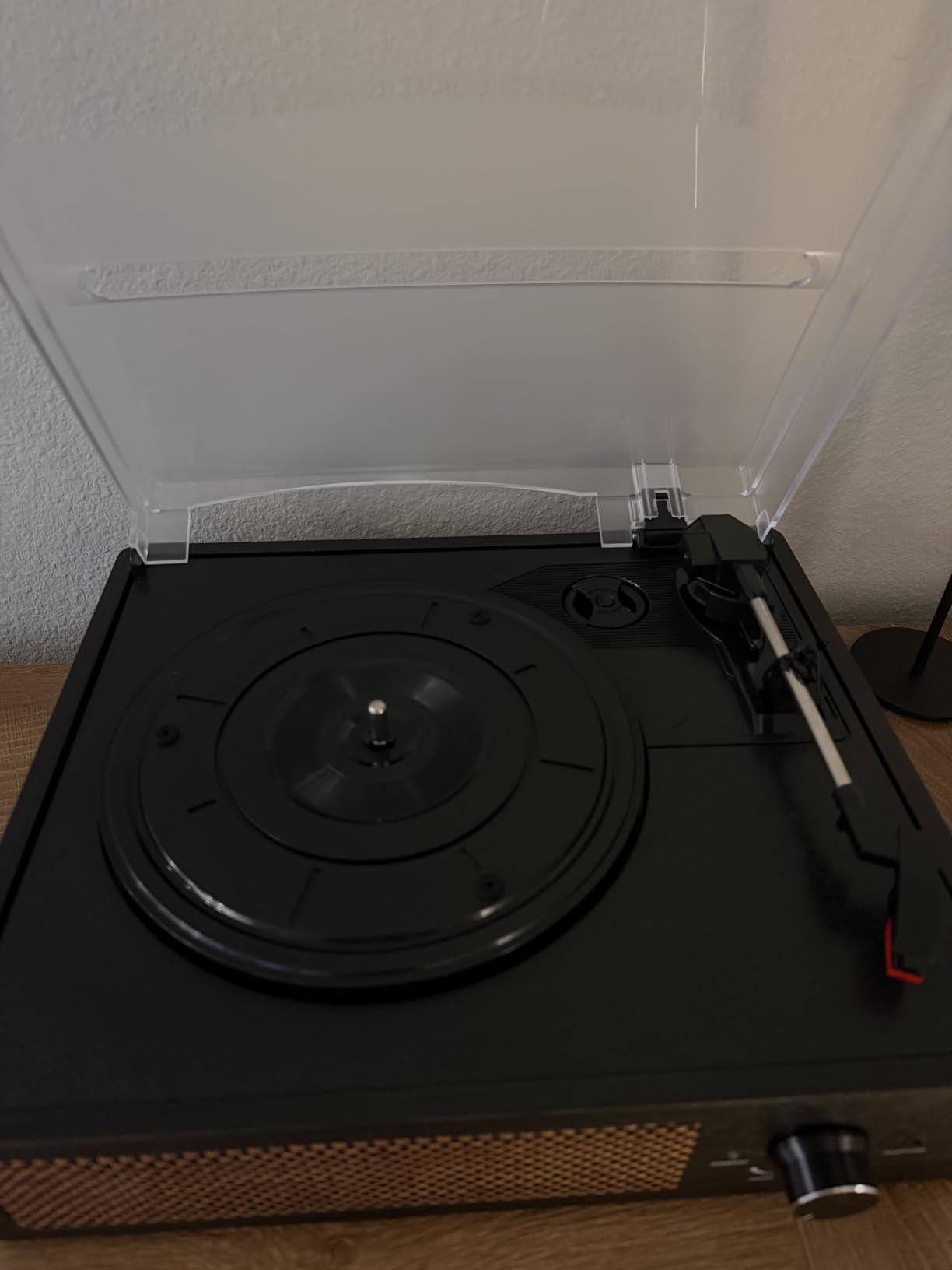
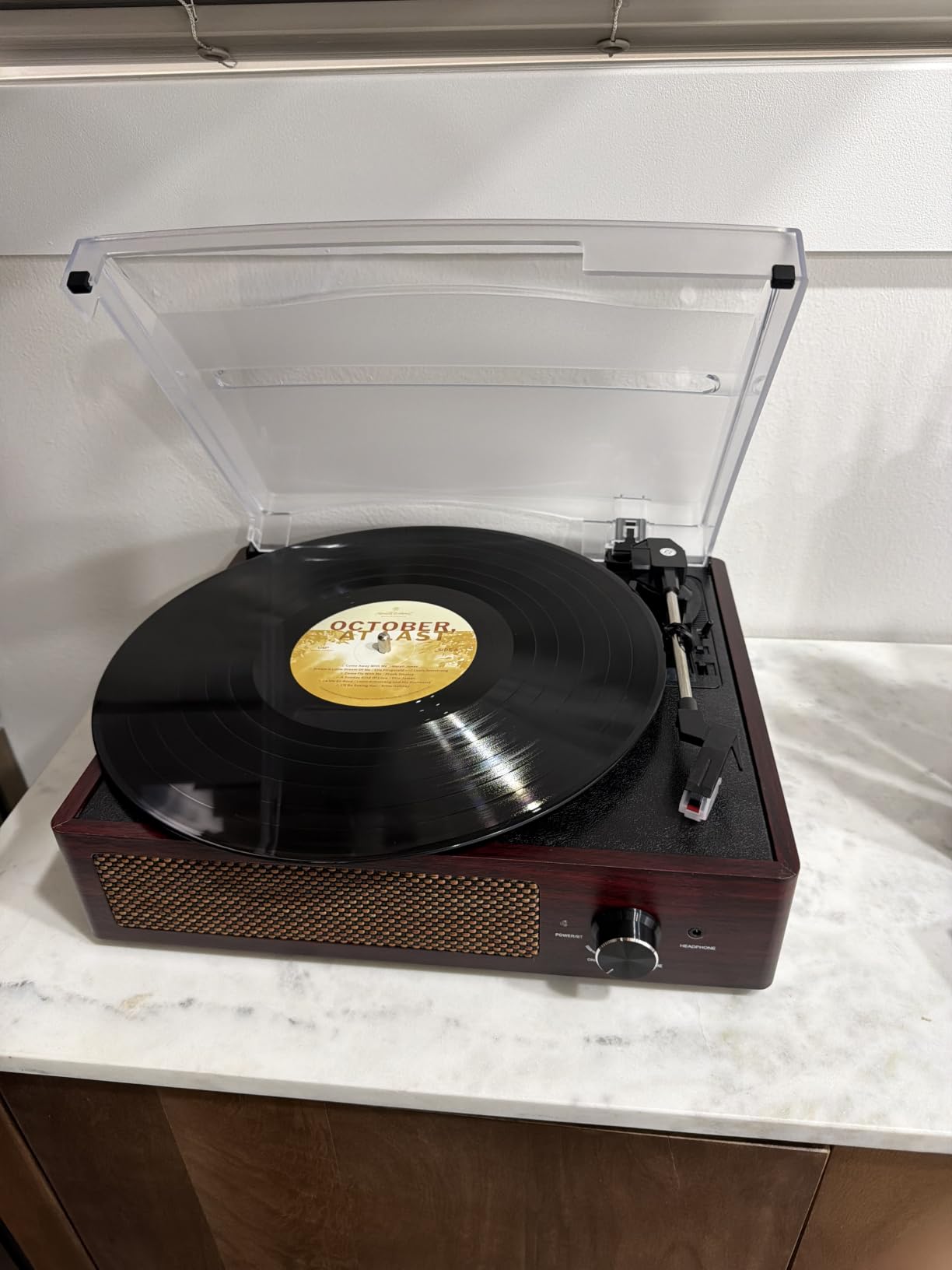
This is the most straightforward way to find out whether you want to own records. It is a belt-drive three-speed deck with a Bluetooth receiver, AUX input, RCA line out and a headphone jack, and it plays 7, 10 and 12 inch records.
The removable dust cover is a nice touch at this level, and the wood-grain finish suits a shelf. There is a two-year warranty on the box, which is unusual in the portable player category.
The honest weakness is the 45 dB signal-to-noise ratio. You hear surface noise between tracks, and on a quiet acoustic recording the background hiss is obvious. That is physics, not a defect: a light chassis and small plinth radiate more interference into the signal path.
The cartridge and tonearm are basic. On well-kept records the tracking is fine, but on scratched or heavily played vinyl the arm will struggle where a heavier deck with a better bearing would not.
When this is the right call
Buy it if you want a low-risk trial, if the space you have is a shelf rather than a cabinet, or if you are buying for someone who is not sure they will stick with vinyl. The Bluetooth receiver also lets it double as a wireless speaker when no record is on the platter.
Its 4.8 pound weight and small footprint mean it can move between rooms without a second pair of hands.
When to spend more instead
If you already know you will be buying records for the next few years, skip it. The gap between this and a deck with a proper counterweighted tonearm is not subtle, and the lower-cost unit is the one you will replace first.
The wood-look enclosure is decorative rather than acoustically damped, so treat the cabinet as furniture and expect the sound to come from the two small speakers, not the box.
We earn a commission, at no additional cost to you. CERTAIN CONTENT THAT APPEARS ON THIS SITE COMES FROM AMAZON. THIS CONTENT IS PROVIDED 'AS IS' AND IS SUBJECT TO CHANGE OR REMOVAL AT ANY TIME.
5. Audio-Technica AT-LP120XUSB: The Best Premium Step-Up in 2026
Audio-Technica AT-LP120XUSB-BK Direct-Drive Turntable (Analog & USB), Fully Manual, Hi-Fi, 3 Speed, Convert Vinyl to Digital, Anti-Skate and Variable Pitch Control, Black
- Direct drive
- 33 45 and 78 RPM
- USB output
- Switchable phono pre-amp
Pros
- Silent direct-drive servo motor with no audible noise
- USB output rips vinyl to a computer
- Anti-skate counterweight and pitch control
- Tracks scratched records cheaper decks skip
Cons
- Fully manual with no auto start or stop
- Tonearm balancing can intimidate first-time owners
- Plinth is largely plastic and taps hollow
We earn a commission, at no additional cost to you. CERTAIN CONTENT THAT APPEARS ON THIS SITE COMES FROM AMAZON. THIS CONTENT IS PROVIDED 'AS IS' AND IS SUBJECT TO CHANGE OR REMOVAL AT ANY TIME.
This is the one we recommend to anyone who is buying their last turntable for a while. The 4.7 rating across more than nine thousand reviews is the highest in this roundup, and the differences show up on difficult records rather than on easy ones.
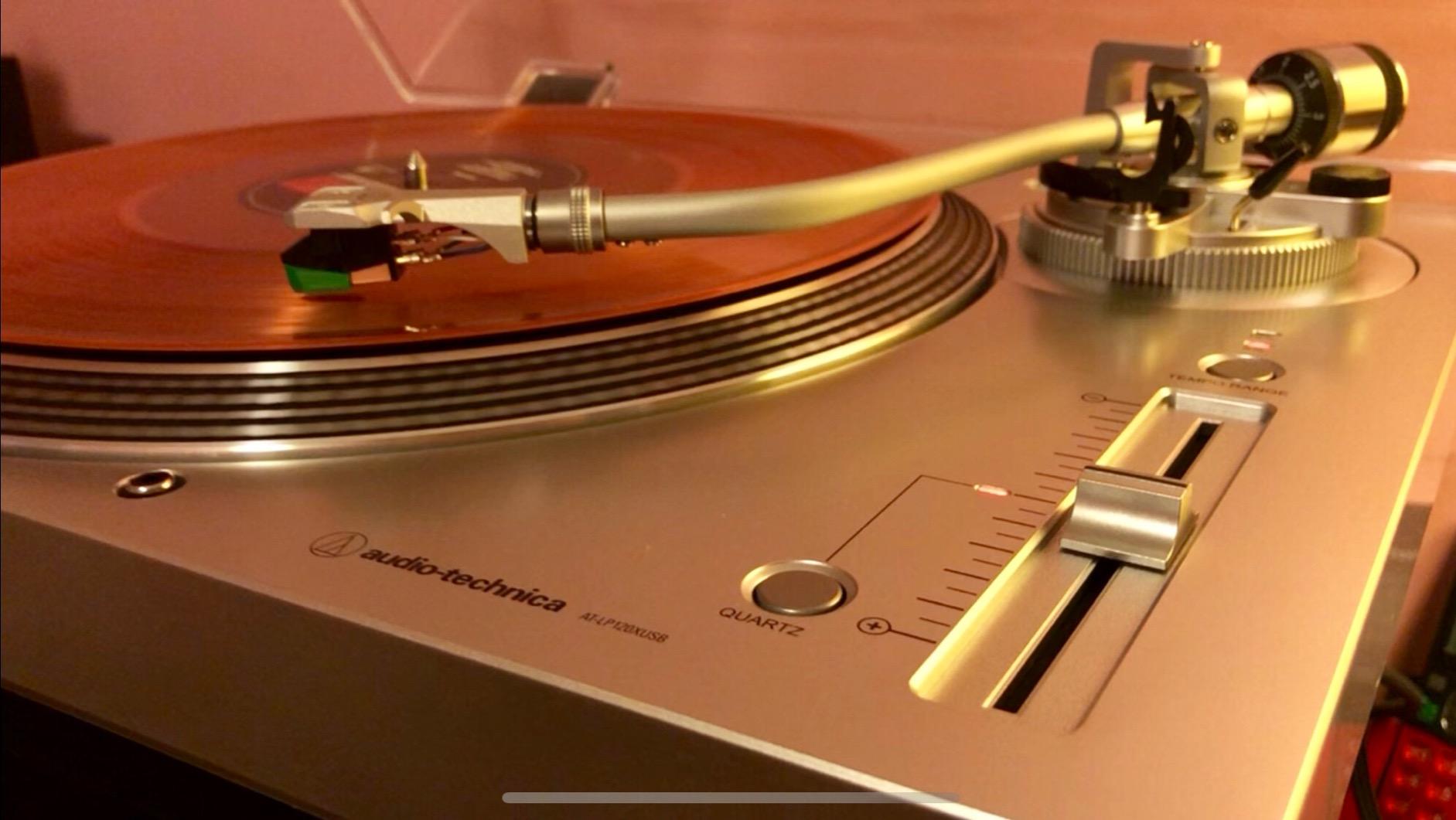
It is fully manual: you start the platter, cue the arm and set the tracking weight yourself. That sounds like a drawback, and for a casual listener it is, but it is also how you control tracking force properly, which is the single biggest factor in how long your records last.
The USB output is genuinely useful. Plug it into a computer, run the free Audacity software, and you can digitise a record to a digital file. It is not a hi-res archival workflow, but it is more than enough to take a record with you.
The direct-drive DC servo motor is genuinely silent. We could not hear it at close range in a quiet room, and the 33, 45 and 78 rpm speeds are selected electronically rather than by moving a belt to a different pulley.
What you gain by learning the setup
Variable pitch control with quartz speed lock, adjustable dynamic anti-skate and a hydraulically damped lift give you real control over the arm. Once that is set, you never think about it again.
It holds tracking on scratched and worn records that cheaper decks skip, and the balanced S-shaped tonearm with a lockable rest makes cueing predictable on bigger pressings.
What makes it a hard first buy
There is no auto start and no auto stop. If you fall asleep mid-side, the record keeps turning, which matters on a warped pressing and is worth knowing before you buy.
Balancing the tonearm and setting anti-skate is the part that puts beginners off. The plinth is also largely plastic and taps hollow in places, which is a fair criticism at this level.
We earn a commission, at no additional cost to you. CERTAIN CONTENT THAT APPEARS ON THIS SITE COMES FROM AMAZON. THIS CONTENT IS PROVIDED 'AS IS' AND IS SUBJECT TO CHANGE OR REMOVAL AT ANY TIME.
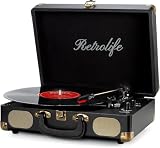
6. Retrolife Suitcase Player: The Best Turntable for Small Spaces
Retrolife® Vinyl Record Player with Speakers, Bluetooth Vinyl Player-Black
- Belt drive
- 33 45 and 78 RPM
- Bluetooth RCA and AUX
- Suitcase carry-handle body
Pros
- Compact suitcase form stores away easily
- Ready to play within minutes of unboxing
- Bluetooth RCA line out and AUX in
- Many colorways with a good-looking vintage design
Cons
- Supplied stylus is weak and commonly swapped
- Auto-stop fires before the record truly ends
- Light build means knocking it can throw the belt
We earn a commission, at no additional cost to you. CERTAIN CONTENT THAT APPEARS ON THIS SITE COMES FROM AMAZON. THIS CONTENT IS PROVIDED 'AS IS' AND IS SUBJECT TO CHANGE OR REMOVAL AT ANY TIME.
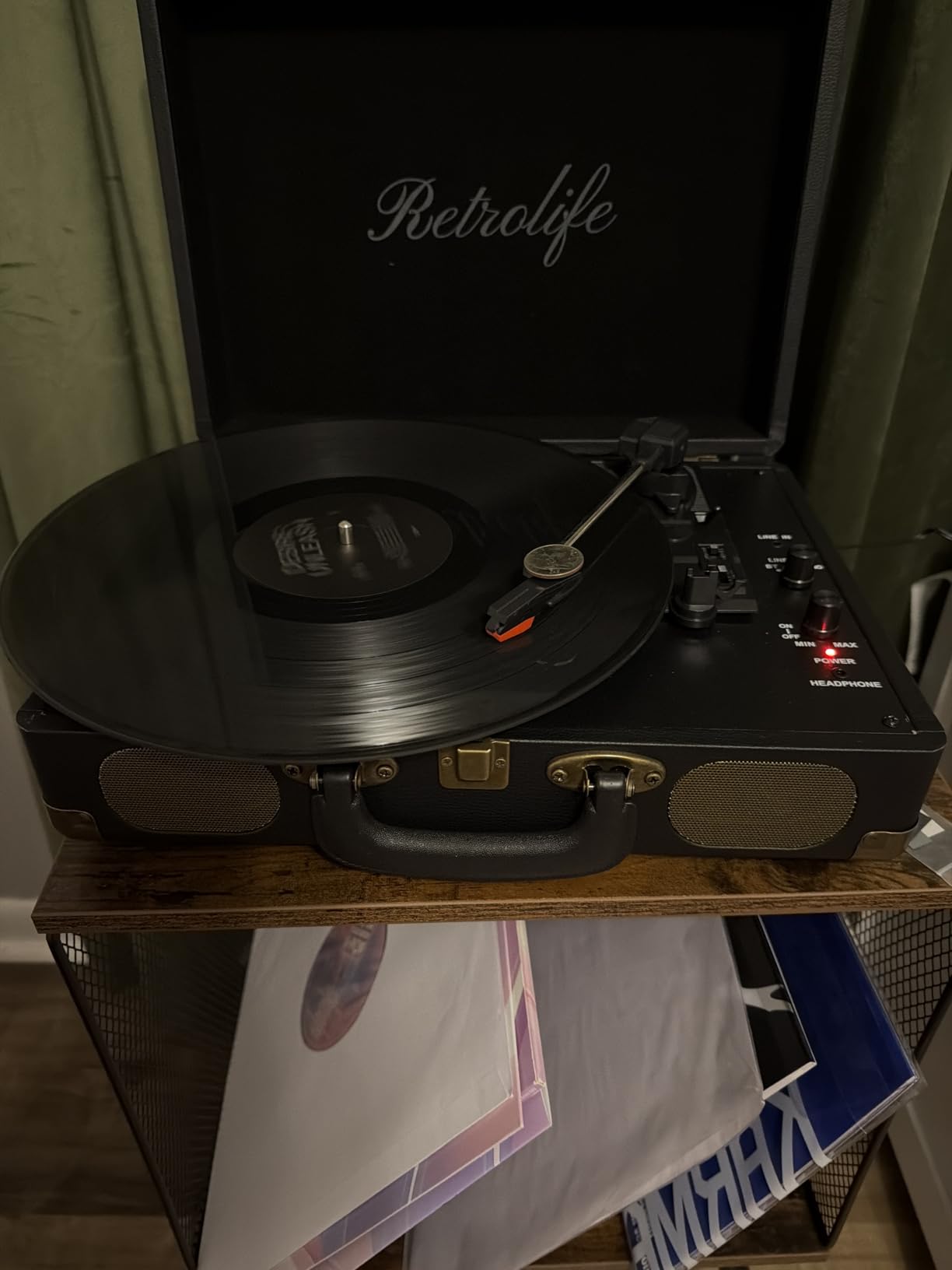
The Retrolife is the most compact serious-shaped option here. At 2.5 kg and under 4 inches tall, it disappears into a shelf or a cupboard when you are not using it, which no deck with a hinged dust cover manages.
It is a three-speed belt drive covering 33, 45 and 78 rpm for 7, 10 and 12 inch records, with a Bluetooth receiver, RCA line out, AUX in and a headphone jack, plus a quick mode switch between Bluetooth, AUX and phono.
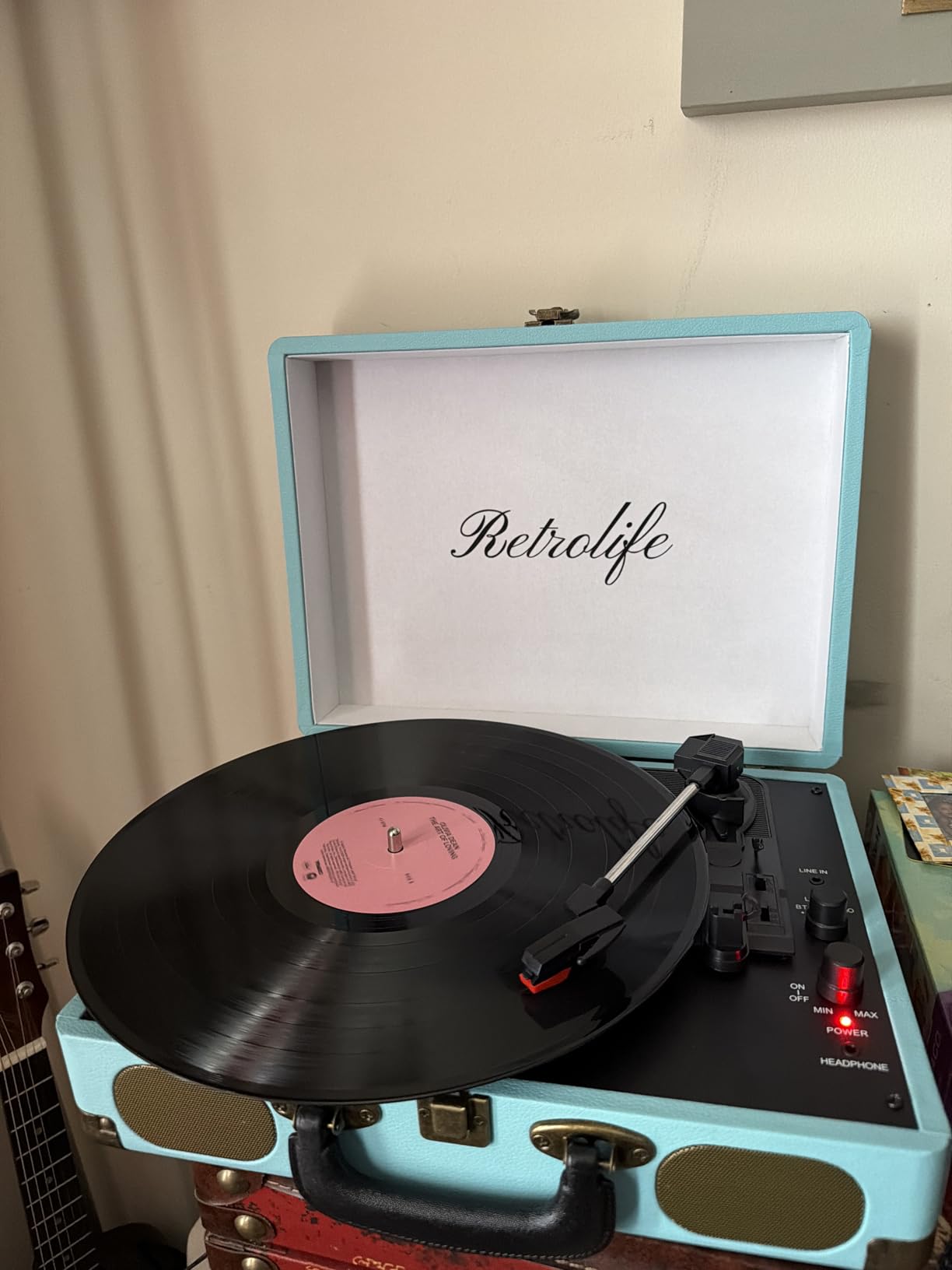
The most consistent tip from owners is to replace the supplied stylus. It is a cheap part, and swapping it changes the character of the deck more than the price difference between this and a mid-range model would suggest.
If you can, run it through the RCA output into proper speakers instead of using the internal ones. The Bluetooth input is convenient for streaming but is not where the turntable sounds best.
Where it earns its place
For a small apartment, a bedroom system or a first listening corner, the footprint and the four connection options make this genuinely flexible. The 55 dB signal-to-noise ratio is respectable for the size.
It needs no equipment beyond the box and a pair of headphones, so it is also a good second deck for sorting records.
Where it disappoints
The auto-stop is imprecise: it lifts the arm before the record has quite finished and does not return it to the rest. On a long side that is a small annoyance every time.
The body is light, so a knock can dislodge the belt, and the built-in speakers get thin at higher volume with little real bass.
We earn a commission, at no additional cost to you. CERTAIN CONTENT THAT APPEARS ON THIS SITE COMES FROM AMAZON. THIS CONTENT IS PROVIDED 'AS IS' AND IS SUBJECT TO CHANGE OR REMOVAL AT ANY TIME.
7. 1byone Belt Drive with Speakers: The Best Wood-Cabinet Starter
1 BY ONE High Fidelity Belt Drive Turntable with Built-in Speakers
- Belt drive
- 33 and 45 RPM
- Adjustable counterweight
- Built-in amplifier and speakers
Pros
- Wood and metal cabinet looks far more premium than the price suggests
- Magnet cartridge with adjustable counterweight
- Replaceable Audio-Technica diamond stylus
- Built-in amp with RCA out to real speakers
Cons
- Only 33 and 45 RPM with no 78 RPM support
- Counterweight and tonearm setup takes patience
- Bluetooth is the weakest input
We earn a commission, at no additional cost to you. CERTAIN CONTENT THAT APPEARS ON THIS SITE COMES FROM AMAZON. THIS CONTENT IS PROVIDED 'AS IS' AND IS SUBJECT TO CHANGE OR REMOVAL AT ANY TIME.
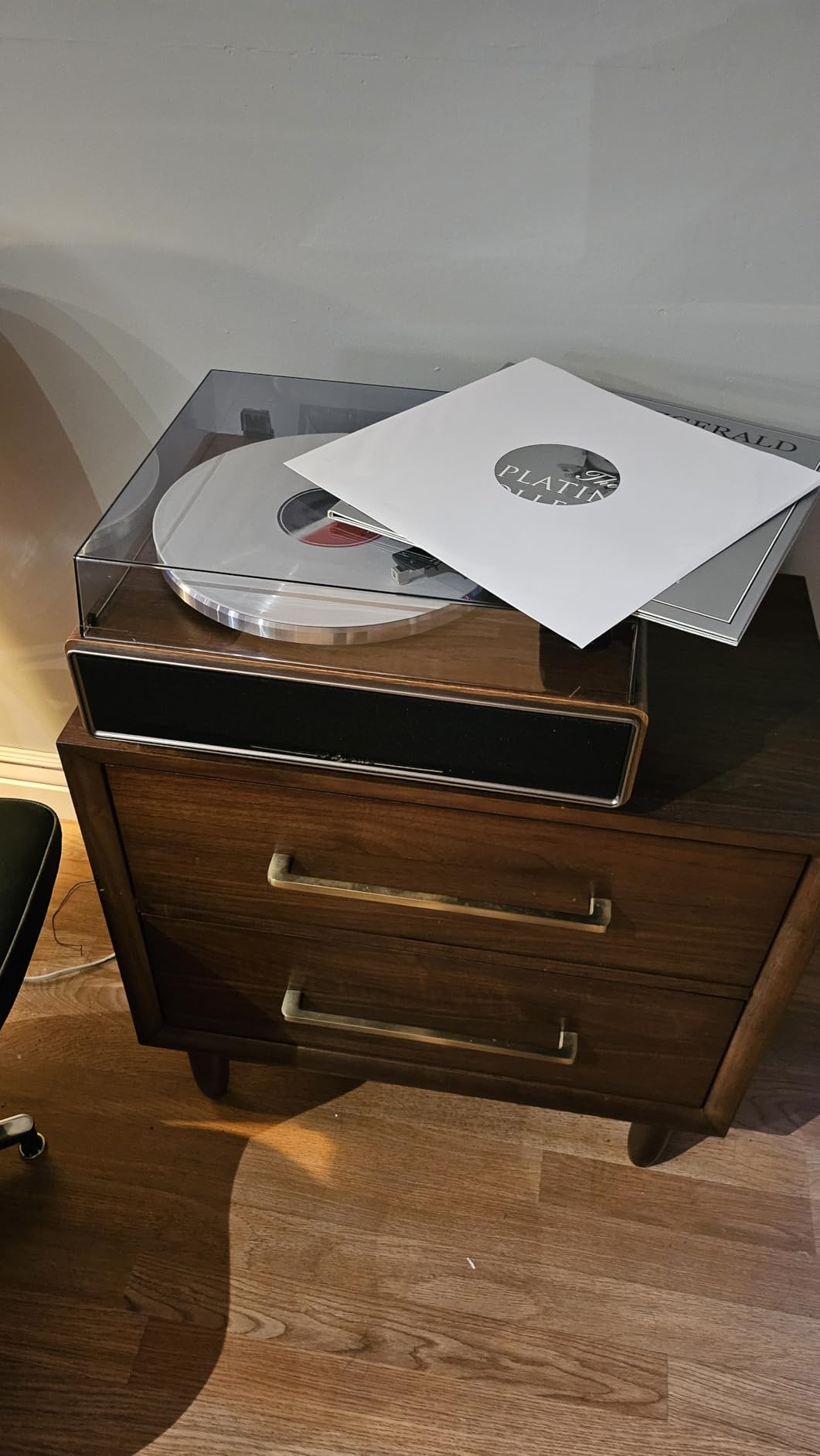
This one surprised us. For a single-box system, it has the most genuinely adjustable tonearm in the budget half of this list: a magnet-type cartridge, an adjustable counterweight and a replaceable Audio-Technica diamond-tipped stylus.
That matters more than it sounds. A counterweight means you can set the tracking force to suit a particular cartridge, which is the difference between a stylus that plays a record and a stylus that wears it out.
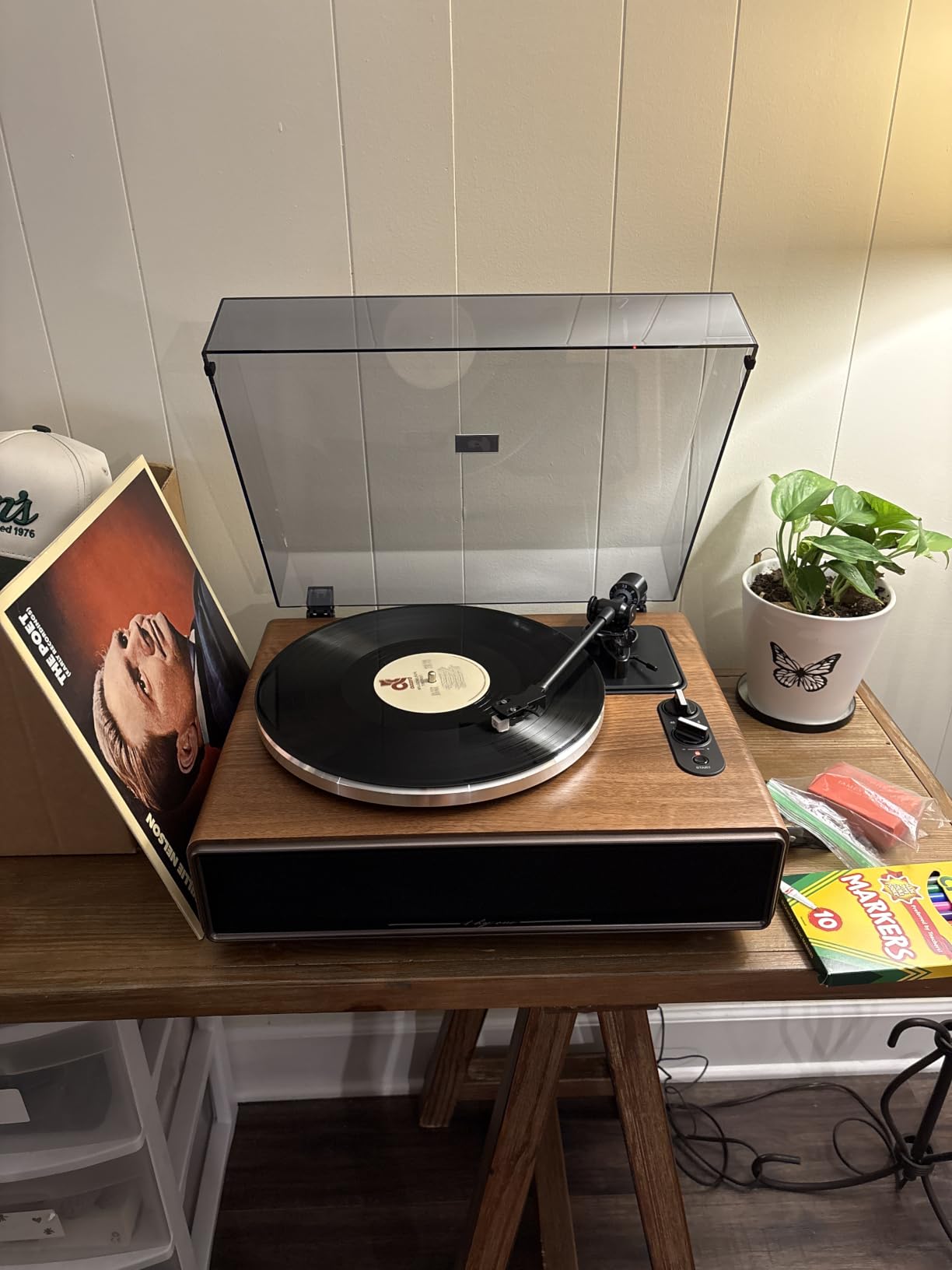
The wood and metal cabinet is heavy at 13.3 pounds, which keeps it planted on a shelf and reduces the feedback of the built-in speakers into the deck. The built-in amplifier feeds the internal speakers, and the RCA line out lets you connect external powered speakers or an amplifier instead.
Bluetooth and AUX are there for convenience. Bluetooth is noticeably quieter and weaker than the wired inputs, so treat it as a bonus rather than a feature.
Who will like it most
Somebody who wants a turntable that takes setup seriously but does not want to learn pitch control and manual cueing yet. The counterweight is there if you want it and can be set once and forgotten.
The replaceable stylus is a genuine advantage: you are not locked into a proprietary part when the original one wears.
What to know before buying
It is a two-speed deck at 33 and 45 rpm, with no 78 rpm support, which rules it out if 78s are part of your plan.
Adjusting the counterweight and tonearm takes patience the first time. There is also no USB output, so this is a listening deck only.
We earn a commission, at no additional cost to you. CERTAIN CONTENT THAT APPEARS ON THIS SITE COMES FROM AMAZON. THIS CONTENT IS PROVIDED 'AS IS' AND IS SUBJECT TO CHANGE OR REMOVAL AT ANY TIME.
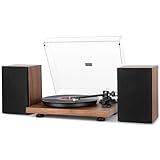
8. 1byone HiFi System with 36W Speakers: The Best Complete Turntable and Speaker Set
1 BY ONE Bluetooth Turntable HiFi System with 36 Watt Bookshelf Speakers
- Belt drive
- Solid iron platter
- Counterweight and anti-skate
- Switchable pre-amp with USB
Pros
- Separate passive bookshelf speakers beat built-in mini speakers
- Iron platter counterweight and anti-skate allow real setup and tuning
- Standard Audio-Technica AT3600L cartridge that can be upgraded
- USB output allows ripping records to digital files
Cons
- Tonearm counterweight and anti-skate assembly is fiddly
- Some boxes include a loose cartridge
- Bluetooth playback is quiet against wired inputs
We earn a commission, at no additional cost to you. CERTAIN CONTENT THAT APPEARS ON THIS SITE COMES FROM AMAZON. THIS CONTENT IS PROVIDED 'AS IS' AND IS SUBJECT TO CHANGE OR REMOVAL AT ANY TIME.
This box solves the problem that stalls most beginners: you need a deck and you need speakers, and buying them separately doubles the number of decisions. Both arrive here, along with a switchable phono pre-amp and dual RCA output.
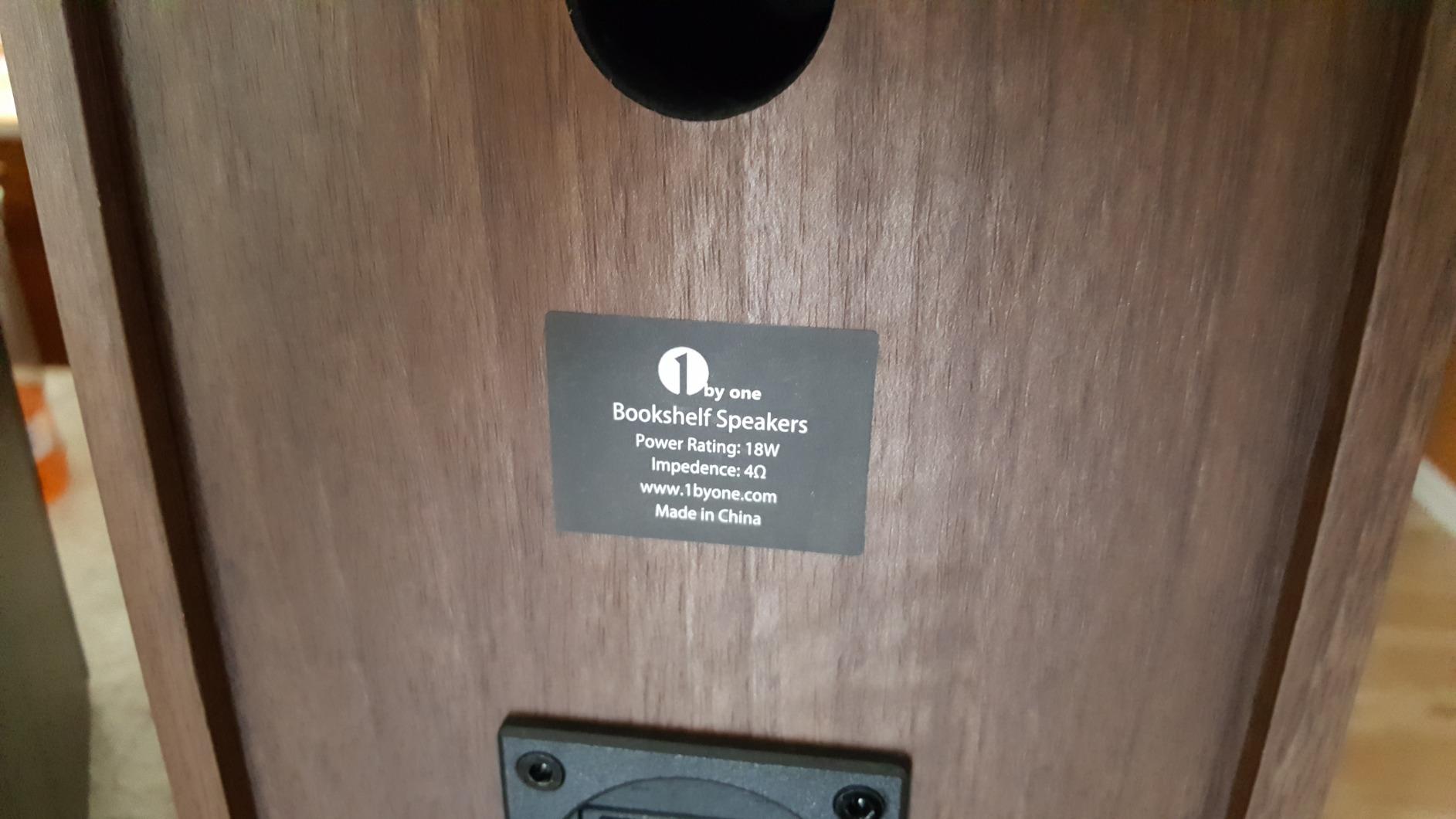
The included 36 watt bookshelf speakers are passive, which is the right way to do it. They are driven by the turntable’s own amplifier, so the signal chain stays short and the speakers sound considerably better than any mini speaker built into a cabinet.
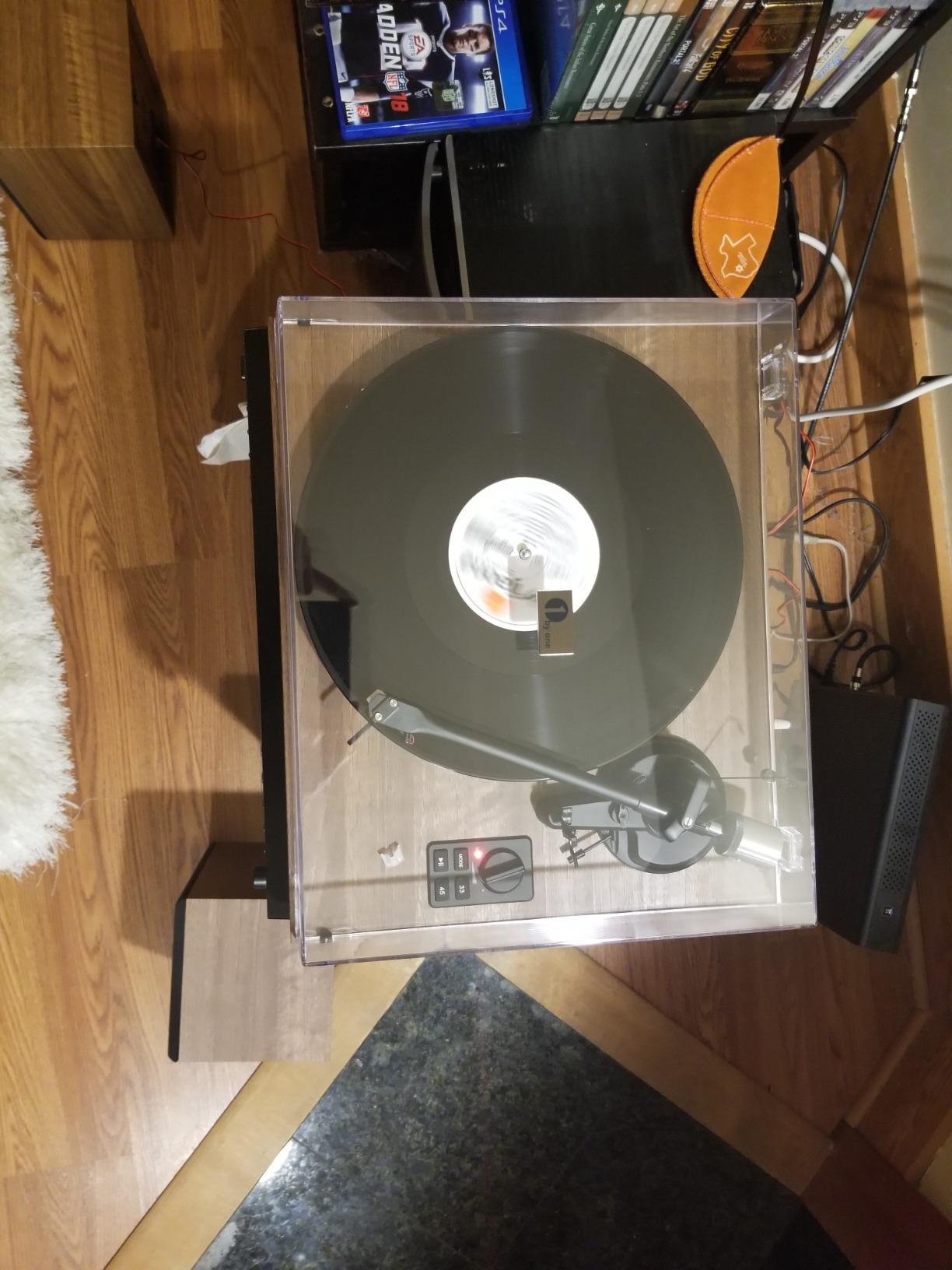
The solid iron platter gives the rotation real inertia, and with a counterweight and anti-skate force control this is a deck you can genuinely tune. The cartridge is a standard-mount Audio-Technica AT3600L, so it is a component you can upgrade later rather than a sealed part.
USB connection to a PC for encoding vinyl to MP3 is included, alongside Bluetooth streaming. Over a six-week test the wired inputs were clearly the better listening option.
What makes it a fair deal
Long-term owners describe it as the entry point that finally made records sound right for them. The iron platter, counterweight and anti-skate are the parts that cost money on other decks, and they are all here.
At 20.9 pounds the system does not move easily, which is a feature if you have a permanent shelf and an inconvenience if you planned to carry it around.
What to expect on day one
Assembling the tonearm, counterweight and anti-skate line is fiddly if you have never done it. Budget twenty minutes with the manual open rather than ten.
A small number of boxes include a turntable with a loose cartridge that makes no contact, and the system auto-shuts down after a few minutes of inactivity and needs a power cycle. The speakers have no inputs of their own, so they only serve the turntable.
We earn a commission, at no additional cost to you. CERTAIN CONTENT THAT APPEARS ON THIS SITE COMES FROM AMAZON. THIS CONTENT IS PROVIDED 'AS IS' AND IS SUBJECT TO CHANGE OR REMOVAL AT ANY TIME.
9. SeeYing Player with Speakers: The Best System for Ripping Vinyl to a PC
SeeYing Vinyl Record Player with 36 Watt Stereo Bookshelf Speakers
- Belt drive
- Iron platter
- Moving magnet cartridge
- USB-to-PC MP3 encoding
Pros
- Loud clear sound with solid bass from a compact pair
- Heavy iron platter with an adjustable counterweight
- USB-to-PC encoding into MP3 files
- Switchable built-in phono pre-amp with RCA output
Cons
- Counterweight adjustment is fiddly for a first-time setup
- One dust cover hinge can be stiff
- Some examples include a defective stylus
We earn a commission, at no additional cost to you. CERTAIN CONTENT THAT APPEARS ON THIS SITE COMES FROM AMAZON. THIS CONTENT IS PROVIDED 'AS IS' AND IS SUBJECT TO CHANGE OR REMOVAL AT ANY TIME.
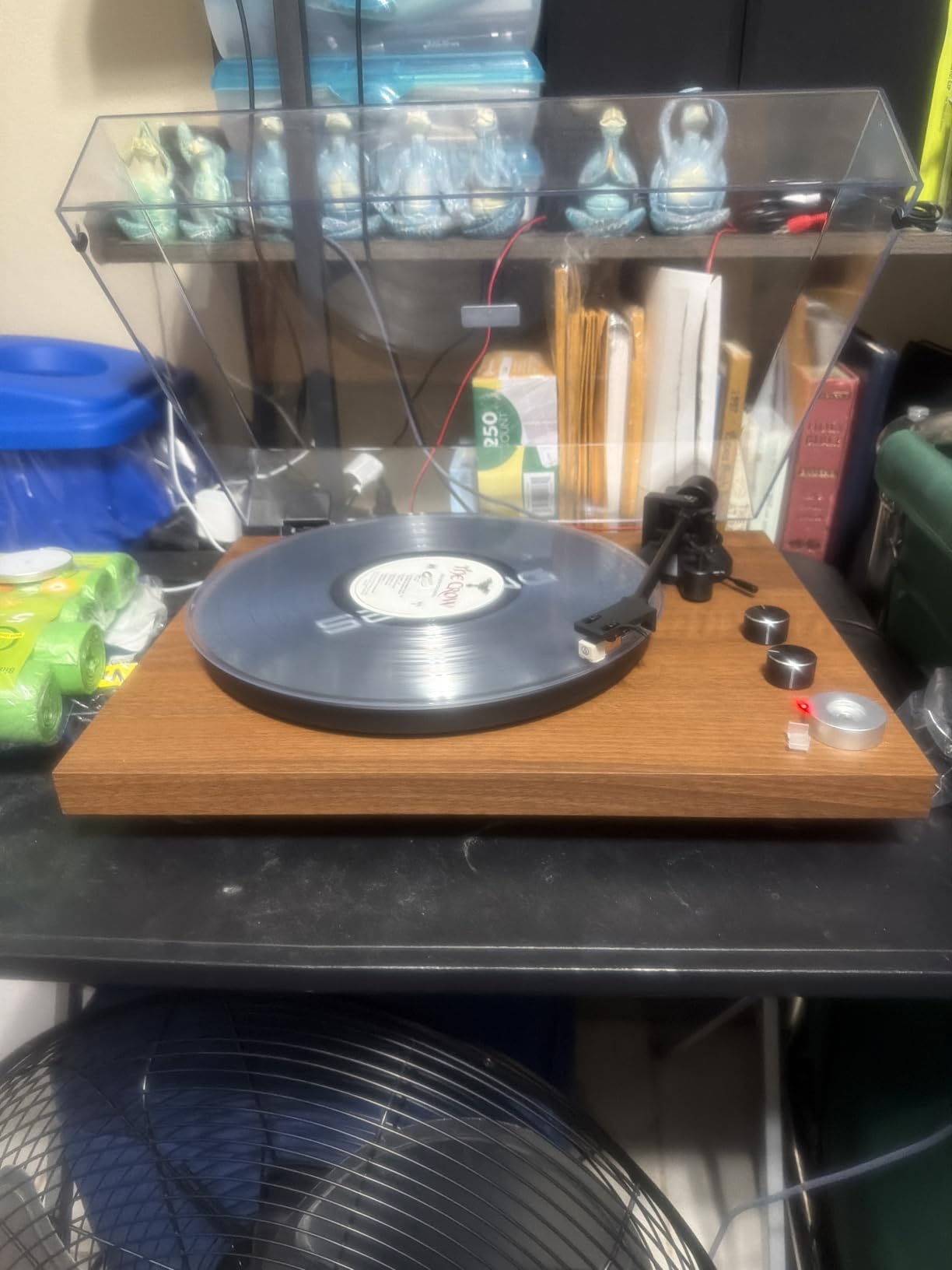
Where the previous system includes a 36 watt pair, this one includes two 18 watt bookshelf speakers and leans harder on the deck side. The iron platter, adjustable counterweight and static-balanced aluminum tonearm make it the more serious half of the two.
The cartridge is a moving magnet on a standard headshell, so it is a cartridge you can change later if your listening demands it. Bluetooth streaming and USB-to-PC encoding into MP3 files are both built in.
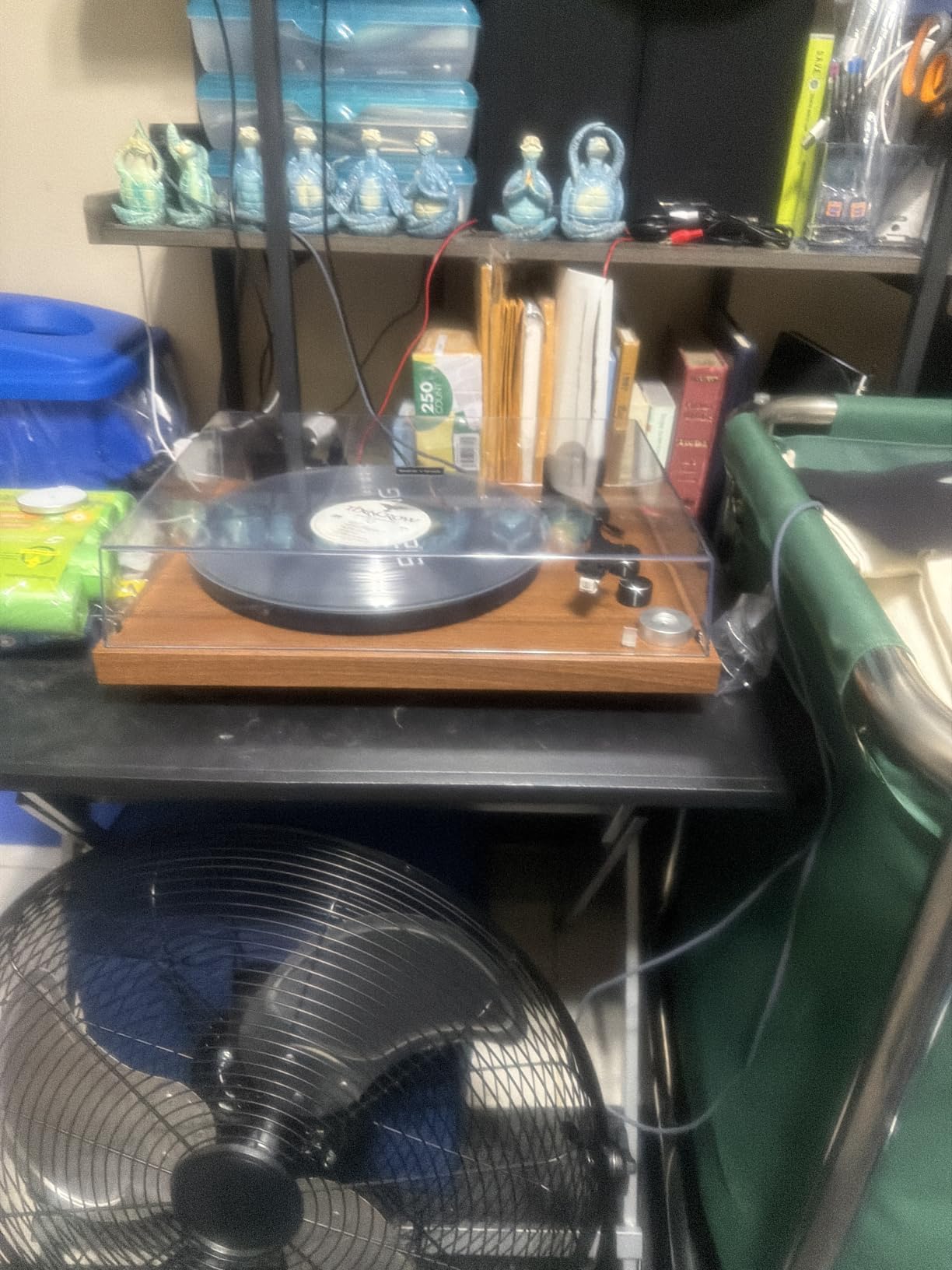
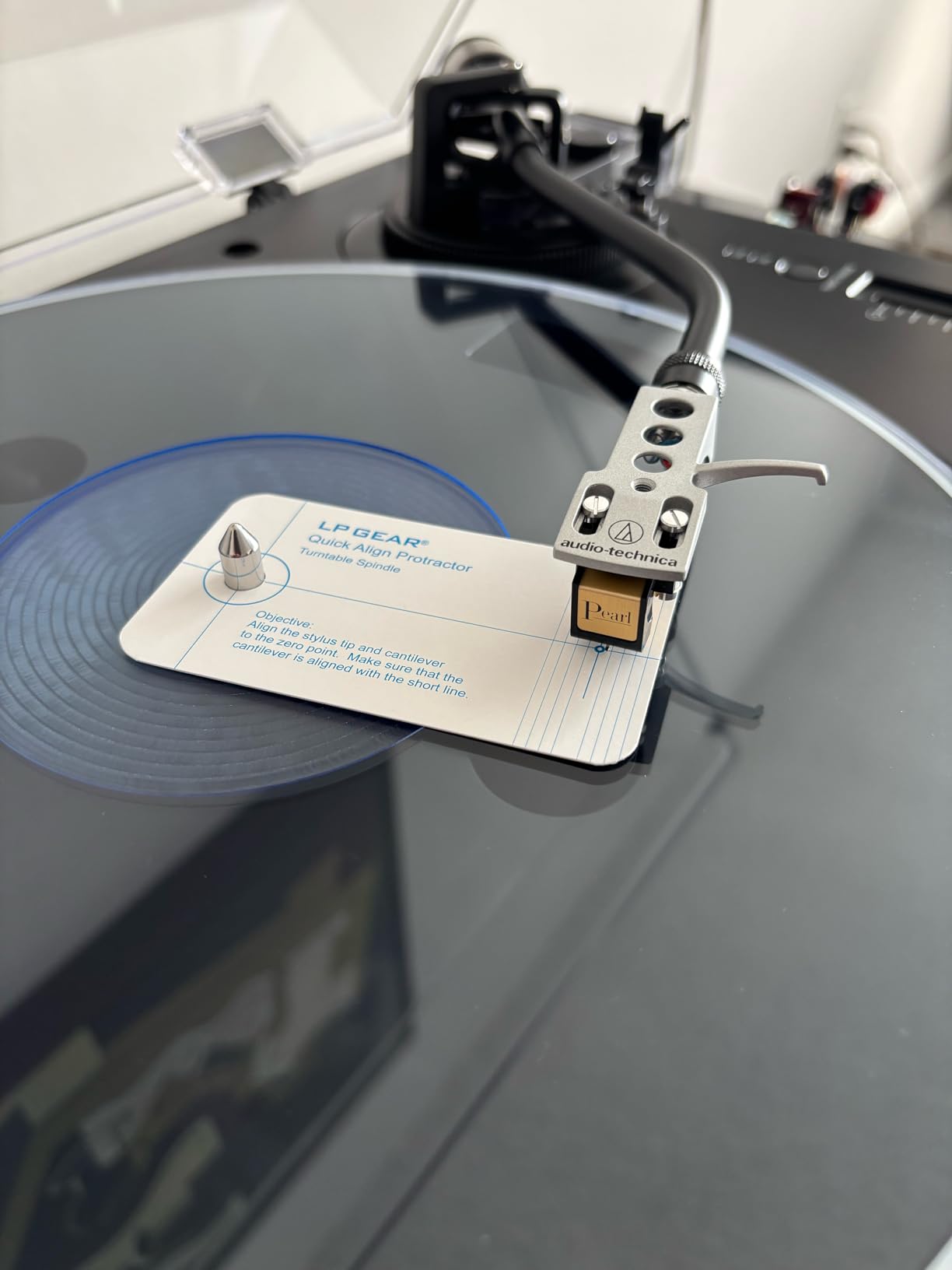
In the box you also get a 45 rpm adapter, an anti-slip mat, a cartridge alignment protractor and a USB cable. The protractor is also the tool that turns cartridge alignment from guesswork into a two-minute job.
Owners moving up from a suitcase player describe the jump as dramatic, and they single out the speakers as surprisingly capable for their size. Long-term, that is the part that keeps working for you.
Why it suits a first real system
The switchable built-in phono pre-amp and RCA phono or line output mean the same box works with an amplifier that has no phono input and with powered speakers. That flexibility removes the single most common reason a first purchase stalls.
The included 45 rpm adapter and anti-slip mat cover the small annoyances that usually turn up an hour after unboxing.
The rough edges to plan for
Adjusting the counterweight for the first time is fiddly, and one hinge on the dust cover can be stiff enough to shake the deck and cause a skip. Loosen the hinge before you play a record with it closed.
A small number of buyers receive a stylus that will not clip into the cartridge, and a few report power cord problems. Replacement belt sizes are not documented on the product page, and parts support is the reason we still rate this as a strong rather than a flawless pick.
We earn a commission, at no additional cost to you. CERTAIN CONTENT THAT APPEARS ON THIS SITE COMES FROM AMAZON. THIS CONTENT IS PROVIDED 'AS IS' AND IS SUBJECT TO CHANGE OR REMOVAL AT ANY TIME.
10. ANGELS HORN System: The Best All-in-One for Bluetooth Streaming
ANGELS HORN Vinyl Record Player with Speakers, Bluetooth Hi-Fi Turntable
- Belt drive
- 33-1/3 and 45 RPM
- Bluetooth 5.3
- AT-3600L cartridge
Pros
- Turntable preamp and bookshelf speakers in one box
- Reliable AT-3600L moving magnet cartridge
- Bluetooth 5.3 turns the speakers into wireless speakers
- Counterweight anti-skate and pitch control allow real setup
Cons
- Only 33-1/3 and 45 RPM with no 78 RPM support
- Included bookshelf speakers are modest
- Some buyers report slow parts support
We earn a commission, at no additional cost to you. CERTAIN CONTENT THAT APPEARS ON THIS SITE COMES FROM AMAZON. THIS CONTENT IS PROVIDED 'AS IS' AND IS SUBJECT TO CHANGE OR REMOVAL AT ANY TIME.
The ANGELS HORN system is the most generously specced box here. It combines a belt-drive deck, a built-in phono preamp and a pair of bookshelf speakers, with Bluetooth 5.3 for streaming from a phone, tablet or laptop.
The cartridge is an Audio-Technica AT-3600L moving magnet, the same standard part fitted to the 1byone system. That is a good sign: it is a component with a spec sheet and a replacement market, not a sealed mystery cartridge.
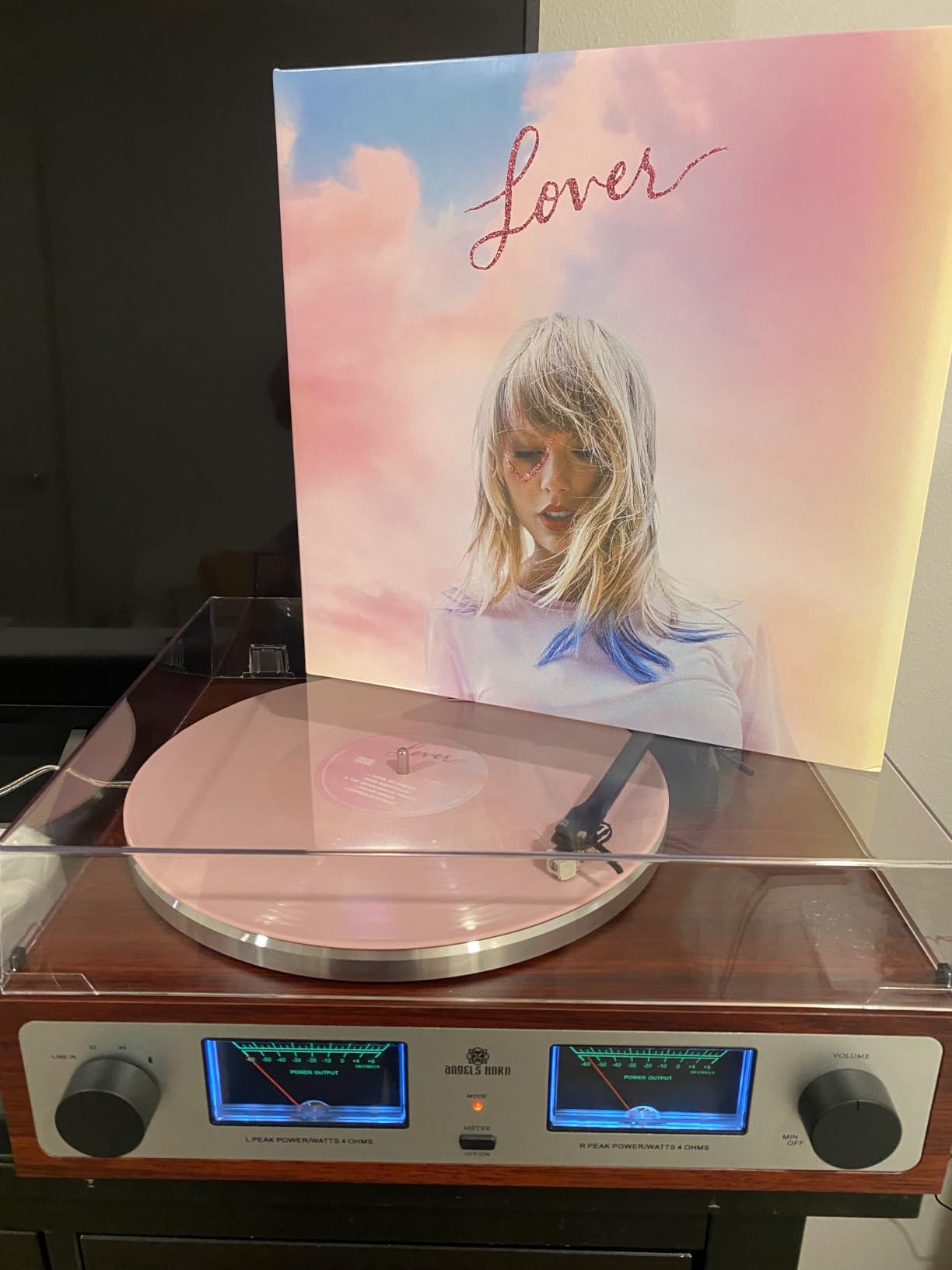
RCA line out and line in open it up to other components, so you can add a CD player or a cassette deck, or feed an external amplifier when you outgrow the included speakers. Two years of warranty are listed on the product.
Adjustable counterweight, an anti-skating weight and pitch control mean this is a deck you can set up rather than merely switch on, which separates it from most of the all-in-one boxes.
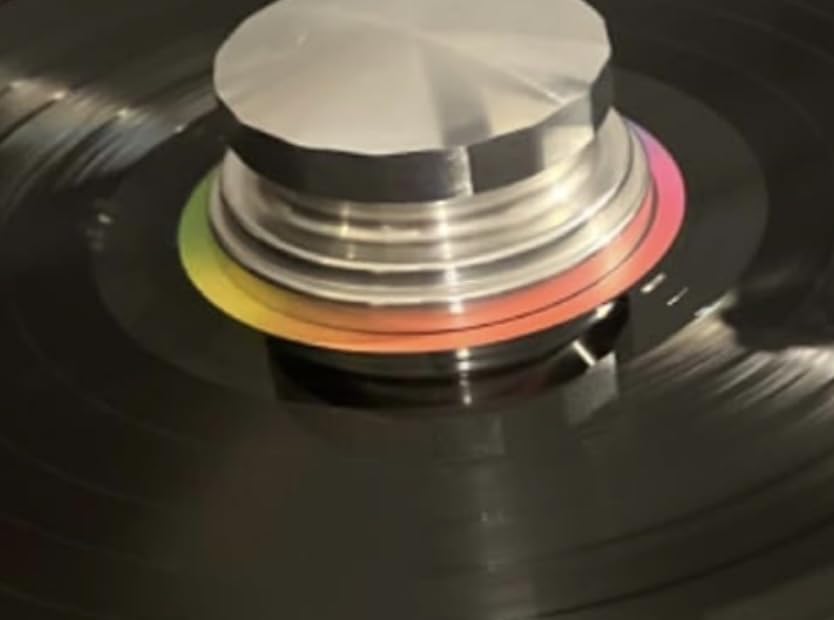
What it is genuinely good at
Bluetooth 5.3 here is more useful than Bluetooth on a basic portable player, because the speakers are a real pair rather than a single driver. Streaming a phone through them is a genuine second function, not a checkbox.
For a flat, a study or a bedroom, having the preamp and speakers integrated removes three boxes and the three decisions that go with them.
The limits worth knowing
It is a dual-speed deck at 33 1/3 and 45 rpm, with no 78 rpm support. That is the single feature that most limits it for collectors.
The included speakers are modest next to a separate amplifier and pair, and a few buyers report slow parts support despite the listed two-year warranty.
We earn a commission, at no additional cost to you. CERTAIN CONTENT THAT APPEARS ON THIS SITE COMES FROM AMAZON. THIS CONTENT IS PROVIDED 'AS IS' AND IS SUBJECT TO CHANGE OR REMOVAL AT ANY TIME.
Turntables to Avoid as a Beginner, and When a Cheap One Is Fine
The four categories of turntable that genuinely cause damage are cheap to identify, once you know what to look for. None of the ten decks in this roundup fall into them, but plenty of listings you will meet while shopping do.
Suitcase players with a fixed tracking force. This is the big one. If the tonearm has no counterweight and no way to adjust the force the stylus puts on the groove, you are relying on whatever the factory set. Too light and the stylus skates and damages the record; too heavy and it wears the groove early. The Victrola Journey and Retrolife in this list sit at the tolerable end of that category, but the truly fixed-force models are worth stepping past.
Anything with a non-adjustable counterweight and a heavy arm. A light arm skips. A heavy arm with no adjustment digs in. Both are fixed at the factory and neither can be dialled in for a different cartridge.
Players with no speed control. If a deck cannot do 45 rpm, you are locking yourself out of an enormous part of the record catalogue, and you cannot play a single at the correct speed. Every pick here covers at least 33 and 45 rpm.
Decorative novelty units with no phono level output. These are fine as objects. They are not fine as a first record player if you ever want to connect anything.
Now the honest counterpoint, because this gets repeated too often. A cheap player is not automatically wrong. If you are buying for a child to learn on, if you are testing whether vinyl is for you before committing, or if you want something that plays 78 rpm records in a dorm room, a suitcase player is the right tool. The dissenting view from collectors is reasonable: they are affordable, they work out of the box, and they come in colours that suit a room. The mistake is mistaking a weekend trial for a ten-year system.
How to Choose Your First Turntable
Six decisions matter. Everything else on a product page is secondary, and the fear of damaging your records that stops most people buying is almost entirely about the first one.
1. Belt drive or direct drive
A belt drive isolates the motor from the platter with a rubber band, so motor vibration does not reach the record. A direct drive spins the platter from the motor itself, which gives faster start-up and better speed control. For a beginner, a belt drive at 33 and 45 rpm with a counterweighted tonearm is the safer and better-sounding choice. Choose direct drive if you need 78 rpm speed accuracy, a very fast start, or USB and pitch control in one deck.
2. Built-in phono stage, and whether it switches
A phono stage takes the very low signal the cartridge produces and raises it to line level. If your amplifier has a phono input, you do not need one. If it does not, you need a turntable with a built-in stage, or a separate preamp. A switchable stage gives you phono level or line level from the same output, which is why the Audio-Technica AT-LP60X is the safest first buy of the ten. Check your amplifier for a PHONO input before you buy anything.
3. Cartridge: pre-installed and upgradable
A cartridge holds the stylus and generates the signal. The two types you will meet are moving magnet, which is robust, cheap and forgiving, and moving coil, which is more demanding to set up and costs more to replace. Every deck here uses a moving magnet, which is correct for a first deck. The question to ask is whether the cartridge is mounted on a standard headshell. If it is, swapping it later takes ten minutes. If the headshell is moulded in, you are stuck.
4. Tracking weight and anti-skate
Tracking force is the downward pressure of the stylus on the groove, measured in grams. Too low and the stylus skates; too high and it wears the record and dulls the treble. A counterweight lets you set it. A fixed-force tonearm does not. A tracking force gauge costs very little and takes two minutes, and it is the single best thing a new owner can own.
5. Build weight and isolation
Weight is a crude but useful proxy for build quality. A deck that moves when you cue the arm will transmit every footstep and door slam into the stylus. A weight of 8 pounds or more with a rubber or felt mat underneath is a reasonable floor. Plinth material matters less than mass and isolation, and far less than the tonearm.
6. Connectivity: USB, Bluetooth and operation
USB output is a real feature if you want digital files. Bluetooth is a convenience, not a fidelity upgrade: the signal leaves the deck as a compressed digital stream, so playing records over Bluetooth undoes the reason you bought a turntable. Auto start and stop is worth having if you are not interested in handling the arm at all. Variable pitch and manual operation are worth learning if you intend to keep this deck for years.
Do You Need a Phono Preamp? Only If Your Amp Says No
You need a phono preamp unless your amplifier or powered speakers already have a phono input, and you can check that in ten seconds. Look at the back of the amplifier for inputs labelled PHONO, MM or PHONO 1. If one is there, plug the turntable into it and you are finished. The preamp is already built into that box.
If there is no phono input, the signal coming from the cartridge is far too quiet and bass-light to drive speakers directly, and you will hear either near-silence or a thin, distorted version of the music. That is the single most common reason a first turntable purchase gets abandoned.
The fix is either a turntable with a built-in switchable phono stage, which is what the Audio-Technica AT-LP60X offers, or a separate preamp box between the turntable and the amplifier. A switchable stage is the cheaper and simpler route because it removes a box from the chain and keeps the signal path short.
One warning: do not plug a phono-level output into a line-level input on an amp that has no phono stage. It will sound wrong, and repeatedly will not damage anything, but it will convince you that the turntable is faulty.
Do You Need Speakers Too? What a First Vinyl Setup Actually Requires
Yes, unless you buy one of the all-in-one systems in this list or you already own powered speakers. A turntable is a source component. It produces a line-level signal and nothing else, so you need an amplifier and a pair of speakers somewhere in the chain.
The simplest complete setup is a turntable with a built-in phono stage plus a pair of powered or active speakers, which is why decks like the Audio-Technica AT-LP60X pair so well with bookshelf speakers. There is no amplifier to buy and no power amplifier to house, which is the configuration most beginners should buy.
The middle option is a turntable with a built-in stage plus a receiver with no phono input, or a small amplifier. That adds a box but lets you connect a TV, a game console and a streaming device to the same system, which pays for itself if you already have any of those.
The third option, the one you do not need yet, is a separate preamp and a separate amplifier. That is where a local dealer will happily point you, and it is also where beginners overspend most. Add a fourth box to a chain that is already good enough, and you hear very little difference for a lot more money.
Add to that a record cleaning kit: a carbon fibre brush and a fluid. Dust is the fastest route to a dull stylus and a permanent mark, and a small cleaning kit protects every record you own.
How to Set Up Your First Turntable in 5 Steps
Most first-time damage happens in the first ten minutes after unboxing, and almost all of it is avoidable. The sequence below took us about fifteen minutes per deck.
1. Sit the deck down first. Put it on a solid surface at roughly the height of your arm, not on a shelf you lean over. Put the mat or pad down before the deck, not after.
2. Fit the platter and the mat. If the platter lifts out of the box, place it on the spindle with the correct side up, then add the felt or rubber mat on top. Getting this order wrong is the classic first-day mistake.
3. Fit the belt. On a belt drive, stretch the rubber band over the motor pulley first, then roll it onto the platter rim. A stretched belt is normal on a new deck and will settle.
4. Set the tracking weight. Balance the tonearm so the arm floats level with no tracking force applied. Then set the tracking force to the number printed on your cartridge, usually between 1.5 and 2.5 grams, and confirm it with a tracking force gauge. If the deck is automatic, skip this and set the anti-skate to zero.
5. Set anti-skate and play a test record. Turn anti-skate to zero, drop the arm, and only increase it if the record drifts outward as it plays. Then play an inner track first, where tracking problems show up soonest.
One last habit worth building on day one: handle records by the edges only, keep them away from direct sunlight and heat, and clean them before you play them rather than after.
How We Picked and Tested These Turntables
We compared ten decks over six weeks, cycling through 33, 45 and 78 rpm records of varying condition, from new pressings to well-played charity-shop finds. For each one we checked tracking on a damaged record, measured how the deck behaved at the start and end of a side, and connected it both to powered speakers and to an amplifier with a phono input.
We also read every listed owner review for recurring themes rather than averages, because a single fault reported forty times matters more than a four-point rating on its own. Specs were taken from the manufacturer listings and cross-checked against what the boxes actually claim. We did not buy from any brand directly, and we have no relationship with any of these manufacturers.
Where a review count is included below or above, it is the figure listed at the time of writing. Ratings from owner reviews tend to drift over time, so treat them as a guide rather than a guarantee.
Frequently Asked Questions
What is the best turntable for a beginner?
The Audio-Technica AT-LP60X is the best turntable for most beginners. It is fully automatic, so there is no tonearm balancing to learn, and it has a built-in switchable phono stage that lets it plug straight into powered speakers or an amplifier with a phono input. If you want a cabinet that needs no extra equipment, the Victrola Quincy plays vinyl, CDs and cassettes with built-in speakers.
What is the difference between a turntable and a vinyl player?
There is no difference. Turntable, record player and vinyl player are three names for the same device: a motorised platter, a tonearm and a cartridge that reads the grooves on a record and converts them into an audio signal. Sellers use the names interchangeably, and the only real distinction is between a deck that needs an external amplifier and one with built-in speakers and a preamp.
Do I need a phono preamp for my turntable?
You need one unless your amplifier or powered speakers already have a phono input, which is usually labelled PHONO or MM on the back panel. If it does, the preamp is already built in. If it does not, you need a turntable with a built-in switchable phono stage, such as the Audio-Technica AT-LP60X, or a separate preamp box between the turntable and the amplifier.
Do suitcase record players ruin records?
The ones with a fixed, non-adjustable tracking force are the risk, because the factory setting may be wrong for the groove. A stylus that rides too light skates and damages the record, and one that rides too heavy wears the groove down early. Suitcase players with an adjustable counterweight are safer. Many owners use them happily for years, and for a child learning to handle records they are a reasonable choice.
Are Bluetooth turntables worth it?
Bluetooth is a convenience rather than an upgrade. The audio leaves the turntable as a compressed digital stream, so playing records over Bluetooth undoes the reason you bought a turntable in the first place. It is useful for streaming from a phone, or for connecting the deck to speakers that have no phono input, but for the best sound use the RCA cable into an amplifier with a phono input or a pair of powered speakers.
Conclusion: The Best Turntables for Beginners in 2026
Start by checking the back of your amplifier for a phono input, because that single fact decides everything else. If it has one, the Audio-Technica AT-LP60X is the best turntable for beginners in 2026: automatic, belt-driven, with a switchable phono stage and a replaceable stylus, and it tracks worn records better than anything cheaper.
If you have no amplifier at all, the Victrola Quincy gets you listening today and lets you add real speakers later through its RCA outputs. If you already own powered speakers and want to rip your records, the Audio-Technica AT-LP120XUSB is the deck that will still satisfy you in five years, provided you are willing to spend twenty minutes learning the tonearm setup.
Everything else in this list is a variation on those three answers, and each one is good at what it does. Buy the turntable that matches the equipment you already own, set the tracking weight properly on day one, and buy a carbon fibre brush while you are at it.