
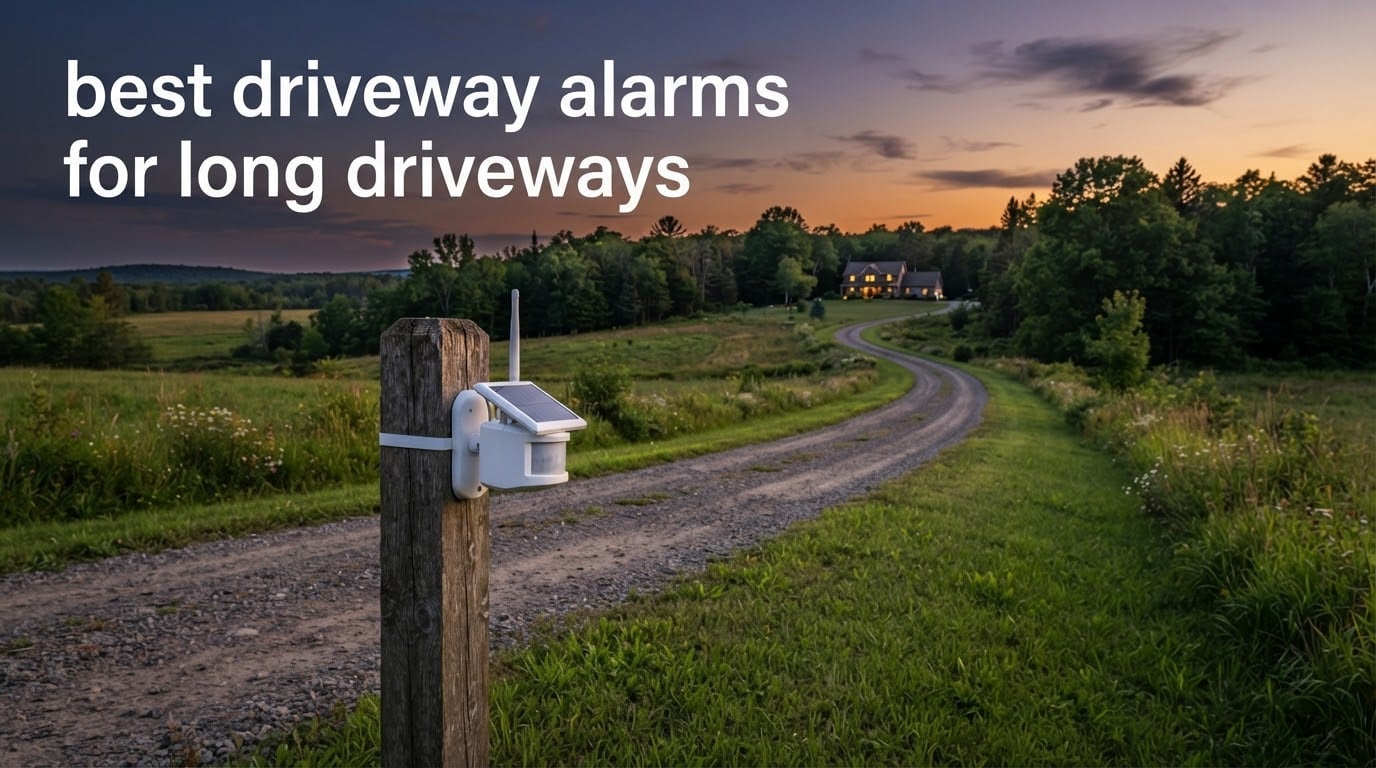
The HTZSAFE 1/2 mile driveway alarm kit is the best overall pick for most long driveways, and the Dakota Alert DCMA-4K Plus takes the crown once your drive runs past a quarter mile. I compared all ten systems in this roundup on the only three things that matter at that distance: how far the signal genuinely carries, what the sensor will and will not detect, and how much maintenance the far end of the drive demands from you.
That last point is why long-driveway alarms are not like short-run chimes. On a 900 ft rural drive, by the time somebody walks from the gate to your front door they have been standing on your property for four or five minutes. The alarm is not about catching them at the door. It is about giving you enough warning to look at a camera, turn on the porch lights, or pick up the phone while the vehicle is still down at the bottom of the hill.
Every unit below reaches at least 500 ft, and most claim a half mile or more. The catch is that those are open-condition figures, which means clear line of sight and clean air between the sensor and the receiver. Real-world performance drops once a barn, a stand of trees, a grade change or a neighbouring house enters the signal path. I have broken down rated range against realistic range further down so you can size the sensor to your actual driveway rather than the number on the box.
One detection technology dominates this list. Nine of the ten are passive infrared (PIR) motion sensors, which detect heat movement and therefore cannot tell the difference between a pickup truck and a large deer. The tenth pairs microwave radar with infrared and only alarms when both agree. The alternative category in the wider market, buried magnetic probes and break beams, reacts to metal or interrupts a beam instead, so it is largely indifferent to wildlife but far more involved to install. That single decision has a bigger effect on your day-to-day experience than the range figure does, so it is worth getting right before you spend anything.
Table of Contents
Top 3 Picks for Long Driveways (October 2026)

HTZSAFE Half Mile Kit
- 0.5 mile FSK+FHSS link
- 35-50 ft adjustable detection
- expands to 32 sensors

Betterlink Half Mile Solar Kit
- 0.5 mile open-area range
- IP65 all-weather housing
- 120 dB sound and light alert
As an Amazon Associate we earn from qualifying purchases. CERTAIN CONTENT THAT APPEARS ON THIS SITE COMES FROM AMAZON. THIS CONTENT IS PROVIDED 'AS IS' AND IS SUBJECT TO CHANGE OR REMOVAL AT ANY TIME.
All 10 Driveway Alarms Compared in 2026
| Product | Key Features | |
|---|---|---|
|
HTZSAFE Half Mile Driveway Alarm Kit
|
|
Check Latest Price |
 eMACROS Solar 1/2 Mile Driveway Alarm eMACROS Solar 1/2 Mile Driveway Alarm
|
|
Check Latest Price |
 Wuloo Solar 1760 ft Driveway Alarm Wuloo Solar 1760 ft Driveway Alarm
|
|
Check Latest Price |
 TECKNET Non-APP Solar RGB Driveway Alarm TECKNET Non-APP Solar RGB Driveway Alarm
|
|
Check Latest Price |
|
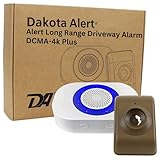
Dakota Alert DCMA-4K Plus
|
|
Check Latest Price |
 FREETIM Weatherproof Driveway Alarm FREETIM Weatherproof Driveway Alarm
|
|
Check Latest Price |
|
Betterlink Half Mile Solar Driveway Alarm
|
|
Check Latest Price |
 Bistee Microwave Plus IR Driveway Alarm Bistee Microwave Plus IR Driveway Alarm
|
|
Check Latest Price |
 Wuloo 1760 ft Rechargeable Driveway Alarm Wuloo 1760 ft Rechargeable Driveway Alarm
|
|
Check Latest Price |
 Driveway Informer 1000 ft Motion Alarm Driveway Informer 1000 ft Motion Alarm
|
|
Check Latest Price |
We earn from qualifying purchases. CERTAIN CONTENT THAT APPEARS ON THIS SITE COMES FROM AMAZON. THIS CONTENT IS PROVIDED 'AS IS' AND IS SUBJECT TO CHANGE OR REMOVAL AT ANY TIME.
1. HTZSAFE 1/2 Mile Kit – Best Overall for Long Driveways
Driveway Alarm- 1/2 Mile Long Range Motion Sensor- 1 Receiver+2 Sensors
- Range: 0.5 miles
- Motion: 35-50 ft adjustable
- Power: 3 x AA alkaline
- Expands to 32 sensors
Pros
- Half mile FSK+FHSS wireless link
- Two sensitivity levels at 35 ft and 50 ft
- Transmitter and receiver arrive pre-paired
- Expands to 32 sensors and unlimited receivers
- Rated for -30 to 150 degrees F
Cons
- AA batteries not included
- 50 ft cone can trip on small animals and foliage
- Only one receiver in the box
We earn a commission, at no additional cost to you. CERTAIN CONTENT THAT APPEARS ON THIS SITE COMES FROM AMAZON. THIS CONTENT IS PROVIDED 'AS IS' AND IS SUBJECT TO CHANGE OR REMOVAL AT ANY TIME.
This is the kit I keep coming back to, and it is the most heavily reviewed product in the roundup by a wide margin at more than 20k reviews and a 4.4 star average. The transmitter and receiver are paired at the factory, so the setup is genuinely plug-and-play. Mount the sensor, mount the receiver, point it at the driveway, and you have an alert in minutes with no wiring run.
Two things set it apart from the cheaper kits. The first is FSK+FHSS transmission, which is frequency-hopping spread spectrum, and in practice it holds its link in areas where cheaper fixed-frequency kits drop out around neighbouring Wi-Fi routers and cordless phones. The second is the expansion ceiling. You can learn up to 32 sensors into one receiver and drive as many receivers as you like from a single sensor, which covers a house, a shop and a barn without a second system.
The receiver gives you four volume levels and 35 melodies to choose from, which is more tonal range than most of the field. Set it loud and you will hear it from the back bedroom on a 900 ft drive. Reviewers commonly pair it with a second receiver in the workshop so the same trigger chimes in two places.
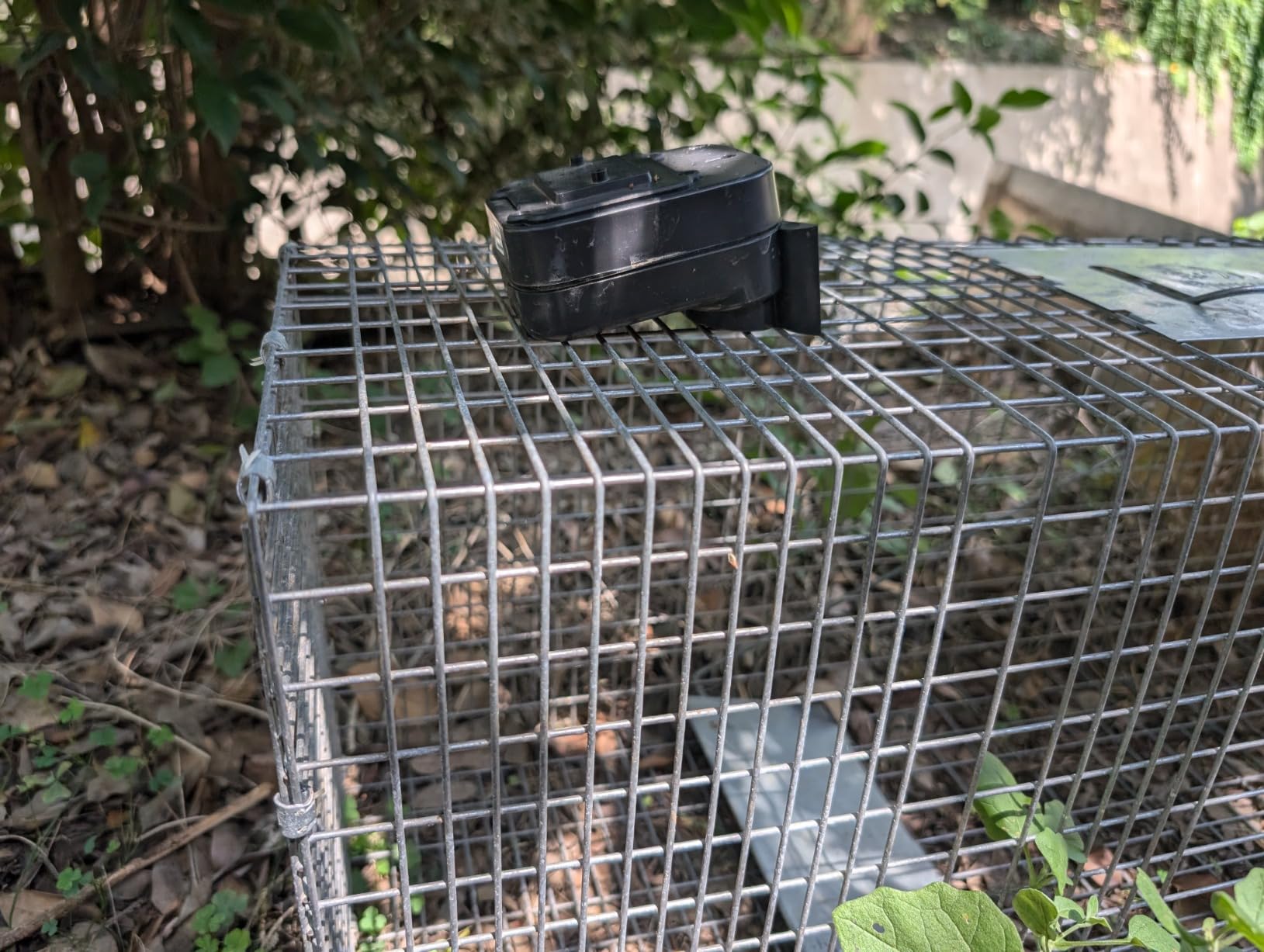
The detection cone is the weak point, not the radio. At the high setting the sensor watches roughly 50 ft of the drive, and anything warm that moves through that cone sets it off. Buyers on wooded rural property report deer, dogs and swinging branches as the recurring nuisance triggers. Dropping to the low 35 ft setting and trimming the vegetation inside the cone is what most people end up doing.
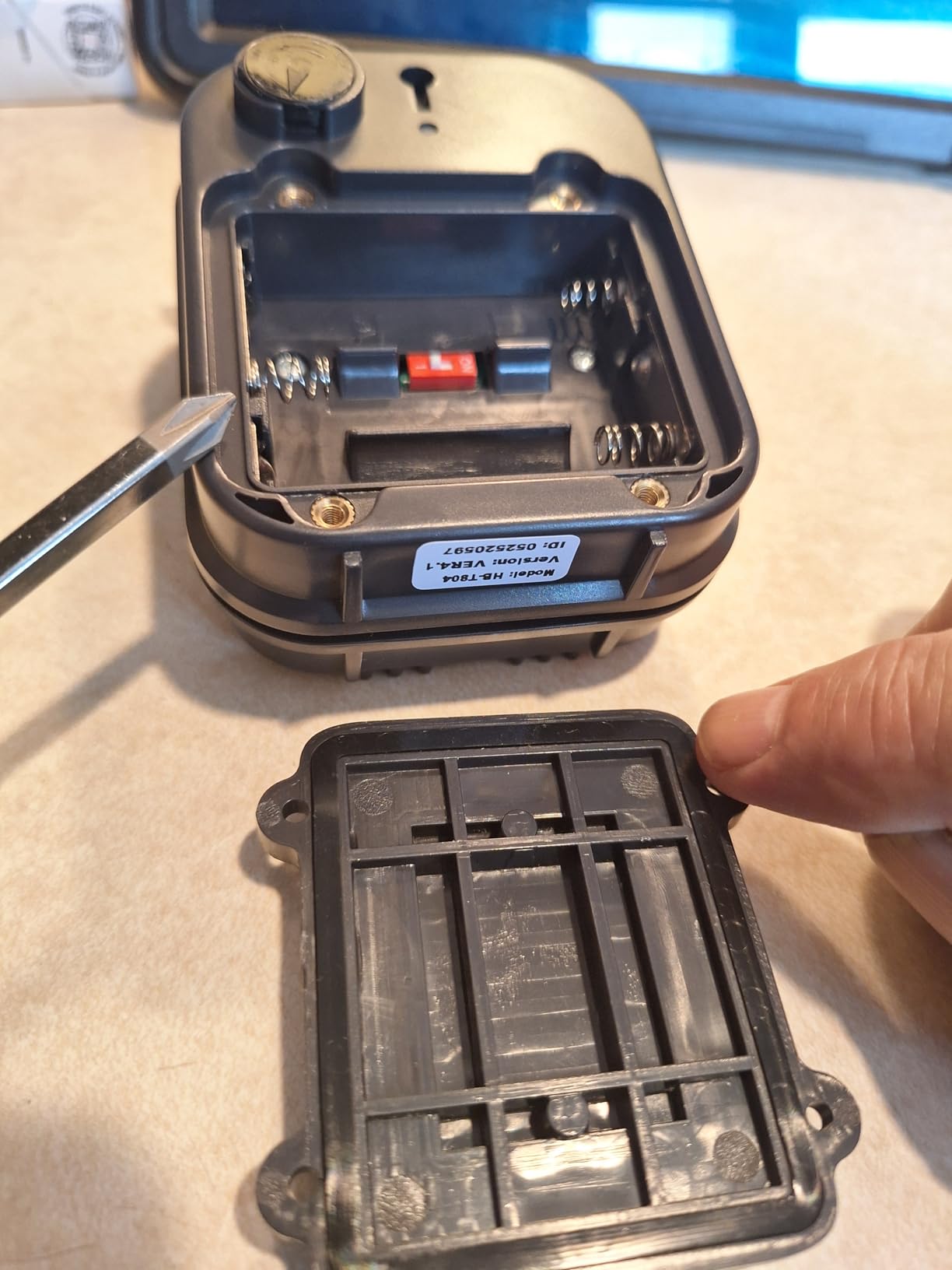
Note the operating range runs from -30 to 150 degrees Fahrenheit, which is genuinely useful if your drive is in a northern climate. The sensor takes three AA batteries and the box does not include them, so add a pack to your order. One receiver is included, which is the other reason many people order a second unit.
How the half-mile link actually performs
The 0.5 mile figure assumes open conditions. On a straight drive with nothing but air between the sensor and the house, owners report solid reception out toward the full distance. Once you add a stand of timber, a rise in the ground or a side wall, treat the usable figure as closer to 1,000 to 1,200 ft, which matches what reviewers describe as their dependable working range.
Because you can pair unlimited receivers, the smart move on a long property is to add a second receiver rather than push the signal further. Mount it in the shop or the barn and the sensor behaves like it doubled its range.
Where it will frustrate you
It is a PIR sensor, so a deer walking up your drive at 4am sounds exactly like a person walking up your drive at 4am. Nothing in the hardware fixes that. If your drive runs through heavy wildlife country and you plan to sleep through the night, this is the wrong detection type and you should be looking at a probe or beam system instead.
The batteries are not included, and the sensor has no solar option, so this is a once-a-year trip to the drawer rather than a zero-maintenance install.
We earn a commission, at no additional cost to you. CERTAIN CONTENT THAT APPEARS ON THIS SITE COMES FROM AMAZON. THIS CONTENT IS PROVIDED 'AS IS' AND IS SUBJECT TO CHANGE OR REMOVAL AT ANY TIME.
2. eMACROS Solar 1/2 Mile Kit – Best for Driveways With No Mains Power
eMACROS 1/2 Mile Solar Wireless Driveway Alarm, 1 Receiver & 1 Sensor
- Range: 2640 ft at 433 MHz
- Motion: 20-30 ft adjustable
- Power: solar plus lithium polymer
- Expands to 64 sensors
Pros
- Solar panel keeps the internal battery topped up
- Half mile link tested in forests and storms
- Detects people and cars and large animals
- No wiring or trenching required
- Expands to 64 sensors and unlimited receivers
Cons
- No app or phone notifications
- Shaded installs lean on the internal battery
- Default 30 ft setting needs trimming back to 20 ft
We earn a commission, at no additional cost to you. CERTAIN CONTENT THAT APPEARS ON THIS SITE COMES FROM AMAZON. THIS CONTENT IS PROVIDED 'AS IS' AND IS SUBJECT TO CHANGE OR REMOVAL AT ANY TIME.
If your driveway has no mains power at the far end, the solar argument decides the purchase before anything else does. The transmitter carries a solar panel feeding an internal lithium polymer battery, so there is nothing to dig a cable trench for and nothing to replace on a schedule. The manufacturer rates the internal battery at about two years.
Range is 2,640 ft at 433 MHz, and the maker describes the link as tested in forests, storms and heavy rain, which is a stronger claim than most of the budget tier makes. Detection runs 20 ft on the low setting to 30 ft on the high setting, so you can dial the reach down when the drive is narrow. The package includes a receiver, a sensor, charging cables and adapters.
It also has the highest expansion ceiling in the roundup at up to 64 sensors on a single receiver, with unlimited receivers sharing the load. If you have a house, a shop, a barn and a gate, this is the kit that scales with the property rather than forcing a second system.
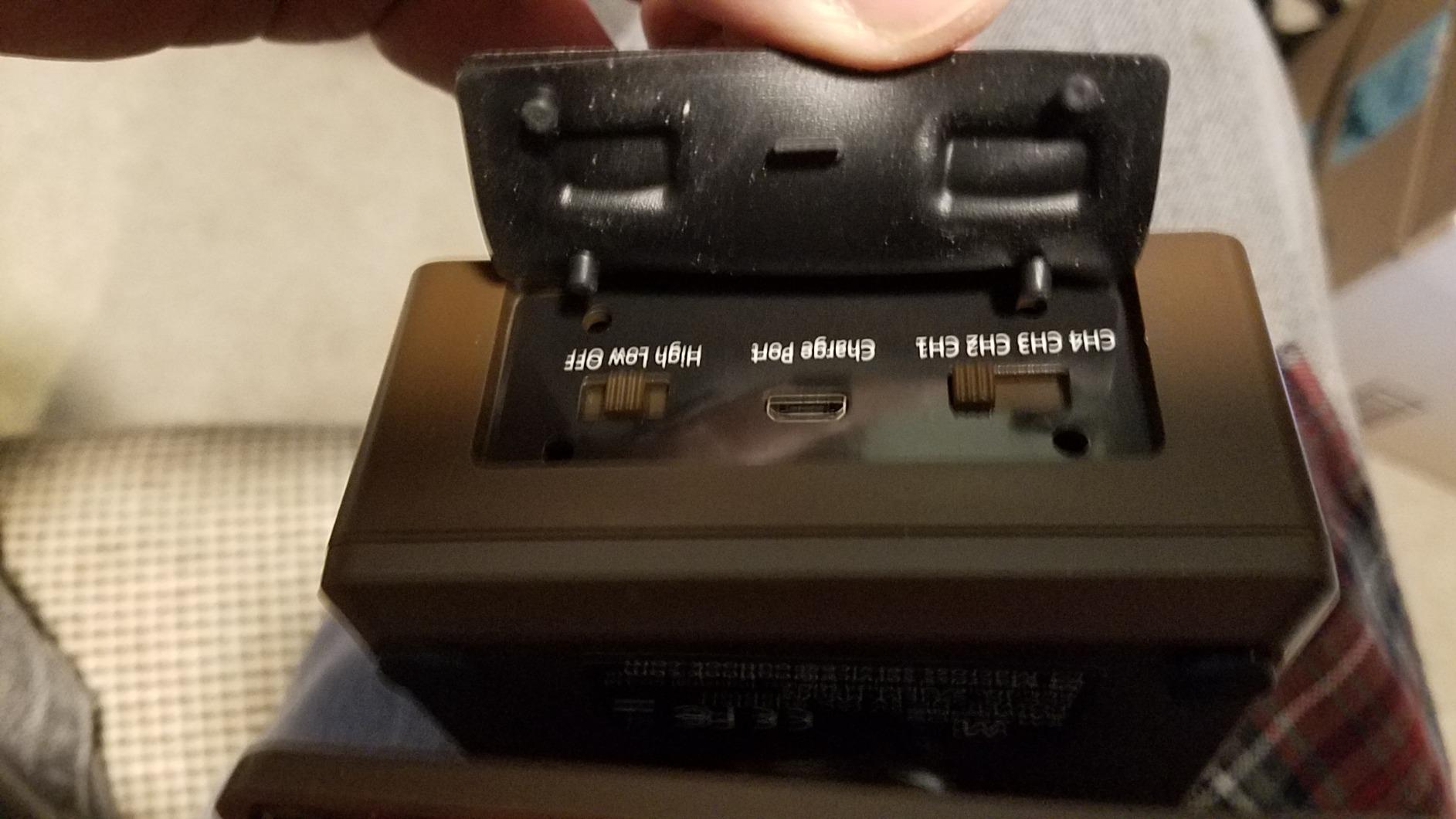
There is no app and no phone notification, which is the trade-off buyers mention most often. The receiver is a plug-in unit that chimes in the house and nothing else. If you want to know about a vehicle arrival while you are out at work, this will not tell you.
The solar panel needs a sensible place to sit. Face it toward the south where you can and give it an unobstructed view of the sky. Where the only mounting point is shaded by trees or the house, the install quietly becomes a battery device again and you are back to periodic charging through the shoulder season.
On the detection side, the default 30 ft distance is generous enough that people and larger animals inside the cone will trigger it. Setting it to 20 ft is the single most useful thing you can do in the first hour. Owners in wooded areas find that the difference between the two settings is the difference between a usable alarm and one you switch off.
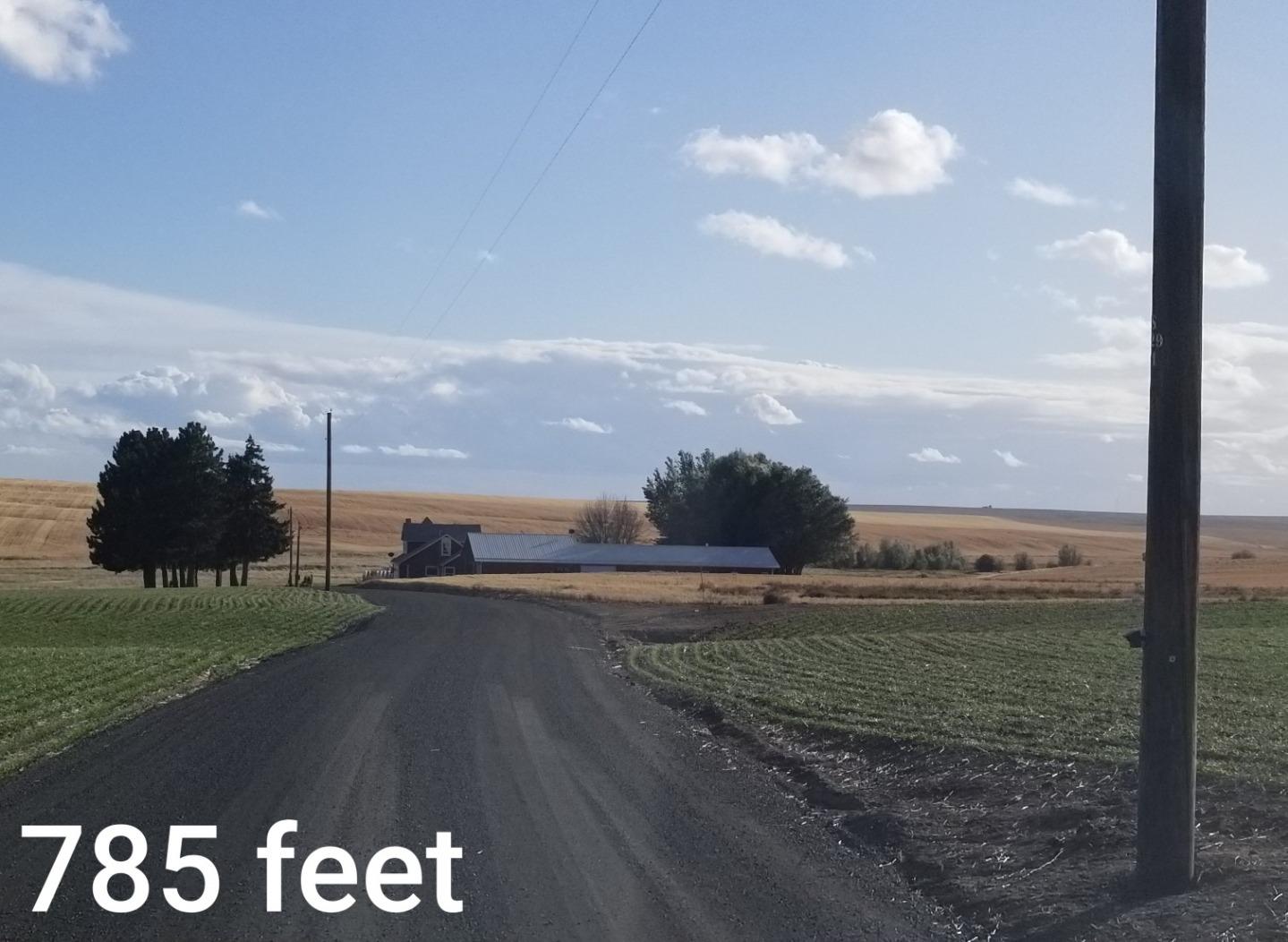
How the solar sensor holds up through a real winter
The honest answer is that it depends entirely on your sun. A panel mounted in open southern sky will carry a northern winter comfortably, because even short winter days deliver enough charge to offset overnight draw. Users running these in low-sun climates report the opposite, and the fix is always placement rather than the panel itself.
One useful trick from people who have installed these: aim the panel south so it recharges across successive cloudy days rather than relying on a single bright afternoon. If you can mount the sensor on a post at the far end of the drive rather than on a shaded tree, do that.
Where it will frustrate you
No smart home integration and no app. This is a pure chime system, and on a property where you actually want remote awareness it will feel like a step back from the security kit you already own.
It is still a PIR sensor, so wildlife inside the cone triggers it. The 433 MHz link is also a fixed frequency rather than a hopping one, so in a dense RF environment with several neighbours running similar kits the odds of interference go up.
We earn a commission, at no additional cost to you. CERTAIN CONTENT THAT APPEARS ON THIS SITE COMES FROM AMAZON. THIS CONTENT IS PROVIDED 'AS IS' AND IS SUBJECT TO CHANGE OR REMOVAL AT ANY TIME.
3. Wuloo Solar 1,760 ft Kit – Best Multi-Purpose Receiver
Solar Driveway Alarm Wireless Outside 1800ft Range, Outdoor Motion Sensor & Detector Driveway Alert System with Rechargeable Battery/Weatherproof/Mute Mode(1&2-Brown)
- Range: 1760 ft tested in real conditions
- Motion: up to 30 ft
- Power: solar 24 month battery
- Expands to 8 sensors
Pros
- Range tested through trees buildings and vehicles
- Solar battery rated up to 24 months on a charge
- Weatherproof housing for rain and snow
- Receiver doubles as a clock and alarm
- Adjustable sensitivity trims leaves and small animals
Cons
- 1760 ft is short of the half-mile kits
- Mute mode needs manual re-enabling
- Expansion capped at 8 sensors
We earn a commission, at no additional cost to you. CERTAIN CONTENT THAT APPEARS ON THIS SITE COMES FROM AMAZON. THIS CONTENT IS PROVIDED 'AS IS' AND IS SUBJECT TO CHANGE OR REMOVAL AT ANY TIME.
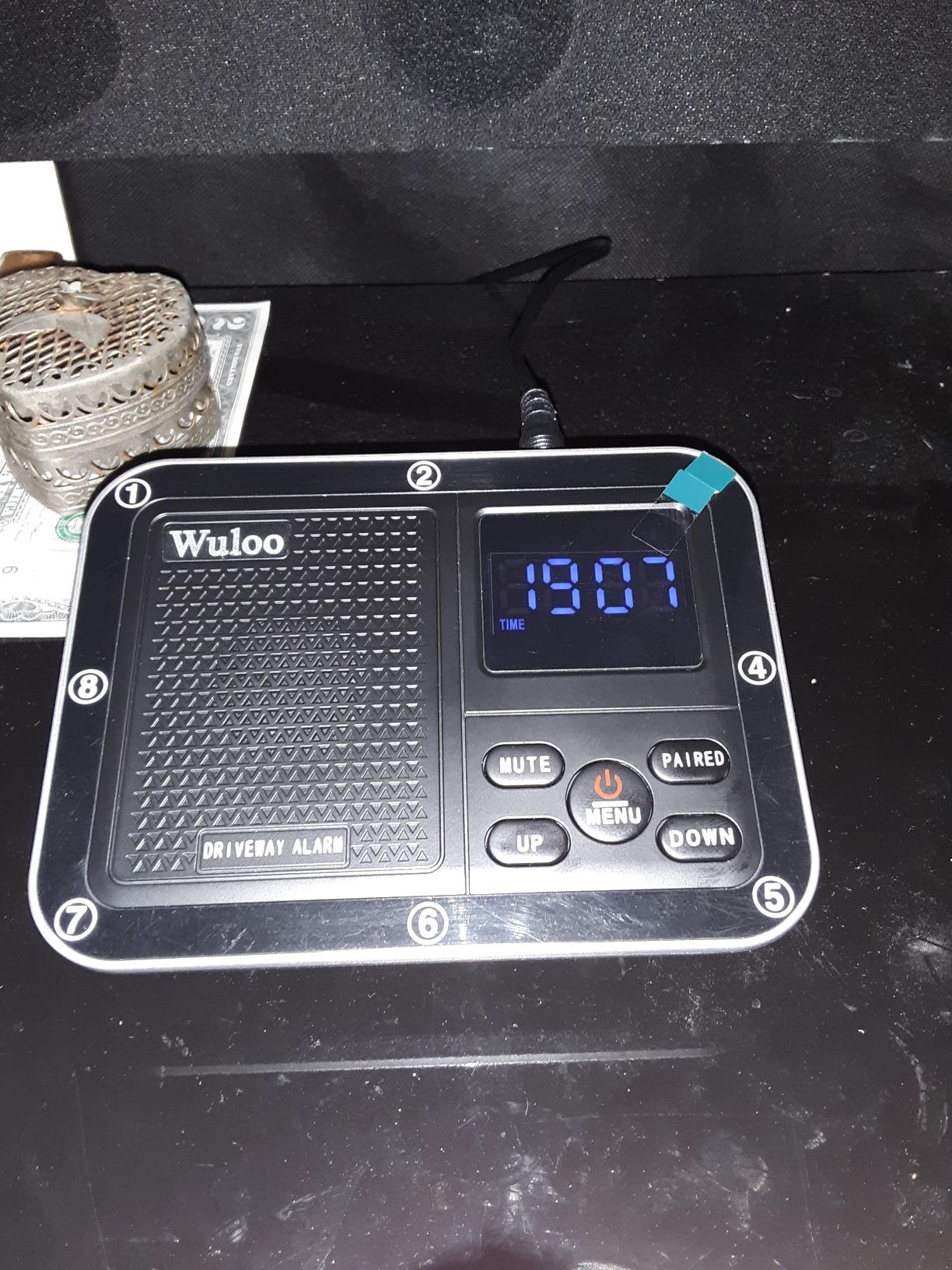
The receiver is the reason to buy this one. It is not only a driveway chime, it also works as a bedside clock and alarm with adjustable chimes and volume, and each additional sensor can be given its own tone. On a property with a driveway, a garden path and a shop entrance, that one box covers three areas with three distinct sounds.
The package includes one receiver and two sensors, which is unusual at this level. The sensors are solar with a rechargeable lithium polymer battery rated at up to 24 months on a full charge, and the housing is described as weatherproof for rain and snow.
Range is quoted at 1,760 ft, which the maker describes as real-world tested through trees, buildings, walls and vehicles rather than a laboratory number. That honesty is useful. It is a shorter claim than the half-mile kits, but it is closer to what you will actually get on a property with a house and a treeline in the way.
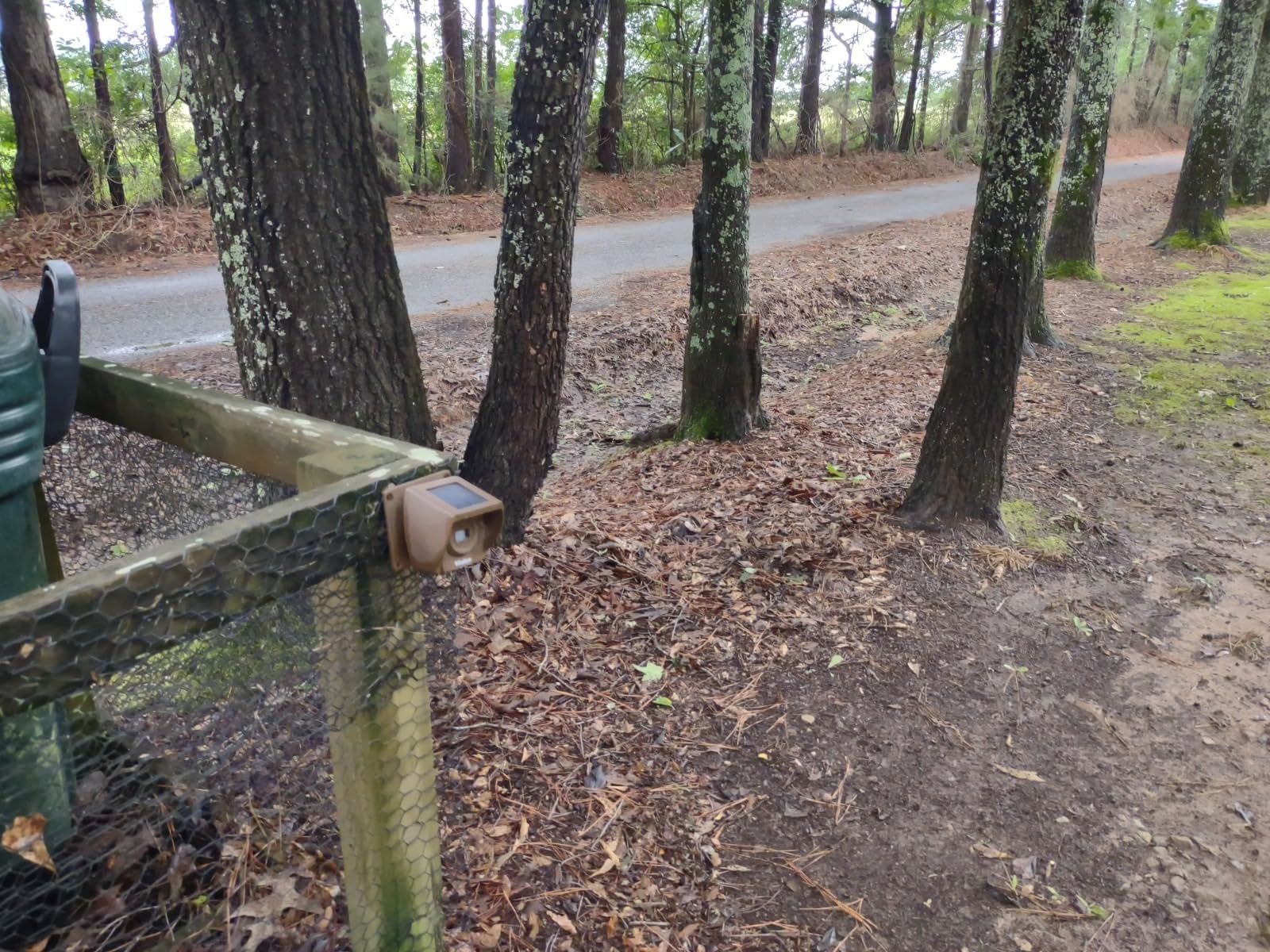
Two things to plan around. First, the expansion limit is eight sensors, which is fine for most homes and tight for a working acreage. Second, the mute mode is a manual switch rather than a schedule, so if you mute it for the night you need to remember to unmute it in the morning. Several owners mention exactly that forgetting.
Detection reaches up to 30 ft with adjustable sensitivity, and the adjustment is what handles the leaf-and-animal problem. Reviewers who trimmed back the sensitivity report a noticeable drop in nuisance alerts without losing vehicle detection.
Note that the listing gives a 30 ft maximum range for the detection field while the transmission distance is the 1,760 ft figure. Those are two different numbers and it is worth keeping them straight in your head when sizing the install.
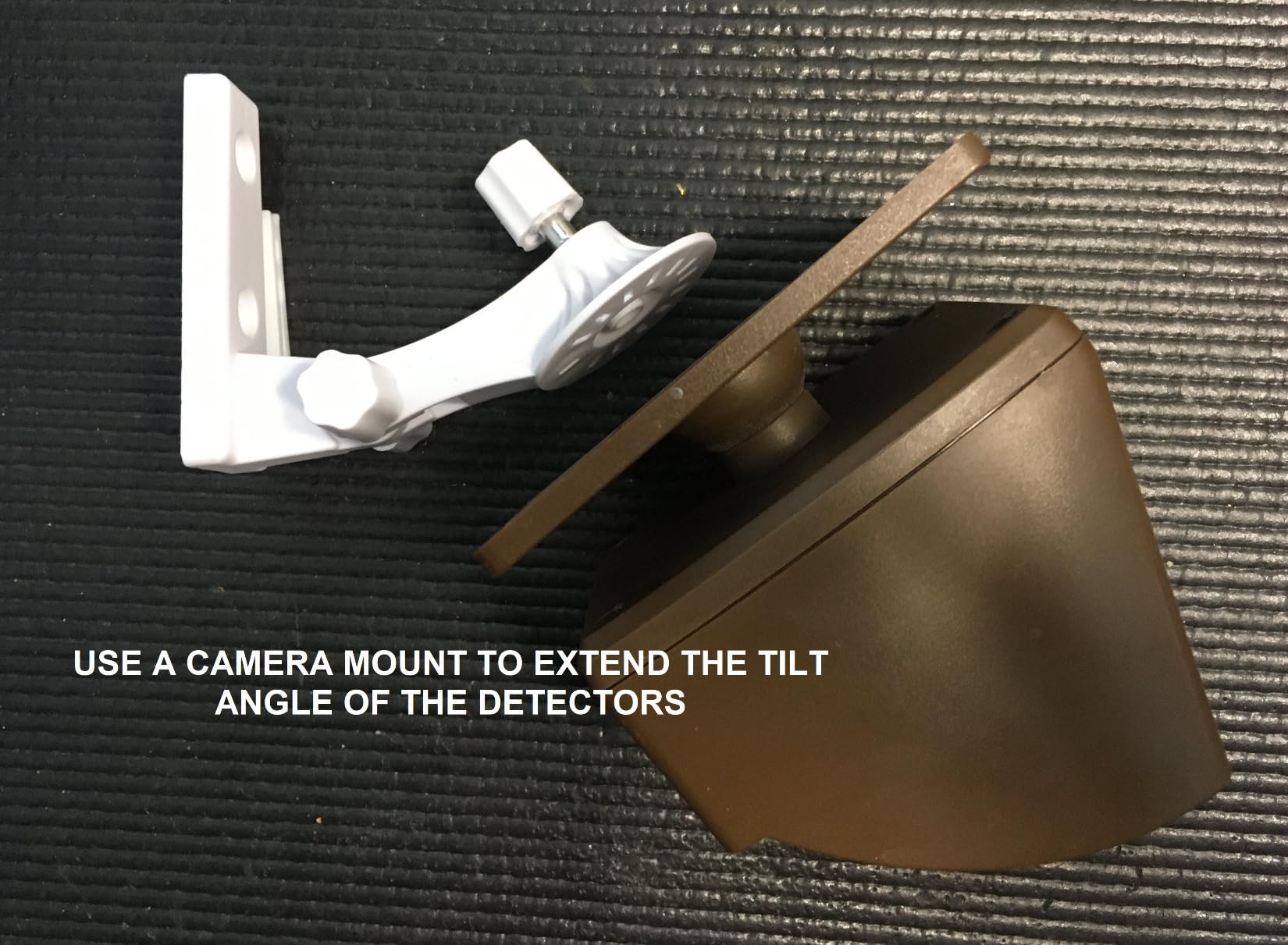
What 1,760 ft really covers
On an open straight drive, 1,760 ft is a long way and comfortably covers the majority of rural driveways in this price bracket. Where the path bends around a building or drops into a hollow, plan on 400 to 600 ft of dependable signal, which is what owners report when trees and a house sit in the line.
If your drive is under about 1,200 ft with some obstruction, this is a strong pick. If it is 1,800 ft or longer with terrain in the way, step up to a half-mile kit rather than buying one and hoping.
Where it will frustrate you
The cap of eight sensors is the ceiling on this design. If you later want to cover a second driveway on a different tone, a shop and a gate, you will be replacing hardware rather than adding to it.
It is a heat-based motion sensor, so deer and dogs inside the detection cone will set it off. Tune the sensitivity or aim it away from the treeline and it becomes manageable, but it will never be indifferent to wildlife the way a buried magnetic probe is.
We earn a commission, at no additional cost to you. CERTAIN CONTENT THAT APPEARS ON THIS SITE COMES FROM AMAZON. THIS CONTENT IS PROVIDED 'AS IS' AND IS SUBJECT TO CHANGE OR REMOVAL AT ANY TIME.
4. TECKNET Non-APP Solar RGB Kit – Best for Aiming Out Wildlife False Alerts
TECKNET Non-APP Solar RGB Wireless Driveway Alarm
- Range: 2600 ft
- Motion: 16 ft low or 33 ft high
- Power: solar plus USB
- IPX5 from -15C
Pros
- Adjustable lens caps narrow the detection slice
- Half mile link holds through trees and hills
- IPX5 housing with a rubber USB port flap
- 36 melodies and 4 alert zones with RGB flash
- Receiver runs on AA batteries or USB
Cons
- Blue trigger LED announces the detection
- No latching event record on the receiver
- Short USB cable with no AC adapter
We earn a commission, at no additional cost to you. CERTAIN CONTENT THAT APPEARS ON THIS SITE COMES FROM AMAZON. THIS CONTENT IS PROVIDED 'AS IS' AND IS SUBJECT TO CHANGE OR REMOVAL AT ANY TIME.
This is the best-rated kit in the roundup, sharing a 4.5 star average, and it is the one buyers use to cut nuisance alerts. What earns those marks is aim. The sensor has adjustable lens caps that physically narrow the detection field to a very thin slice of the drive, plus a rotating mounting bracket, which together let you exclude the treeline where the deer come from and keep only the road surface.
That combination is the best wildlife mitigation available in a PIR system, and it is why this is the pick I would put on a drive that runs past woodland. Reviewers repeatedly confirm dependable reception between 1,000 and 1,200 ft with trees, hills and concrete walls in the path, even though the headline claim is 2,600 ft.
Power is handled well. The sensor has a solar panel charging an internal battery with USB recharging as a fallback, and the IPX5 housing is rated from -15C to 50C with a rubber flap protecting the USB port and power switch. The receiver runs on four AA batteries or USB, so you can move it around the house without running a cable.
Four alert zones with their own ringtones and RGB flashing on the receiver is genuinely useful on a property with more than one monitored area. The green flash tells you which zone fired before you get to the receiver to read the display. Thirty-six melodies across five volume levels give you plenty of room to make one area distinct from another.
Now the flaws, because they are real. There is a blue LED on the tip of the sensor that lights when motion is detected, which announces to anyone standing at your gate that the alarm is armed and has just seen them. If that matters to you, cover it with a dab of exterior paint.
There is also no latching event indicator on the receiver, so a chime you missed leaves no record that it happened. On the Driveway Informer further down there is a counter that does exactly that, and on a property where nobody is home during the day it is worth weighing.
Lastly, the included USB cable is short and comes without an AC adapter, and some examples arrive with a mounting bracket that has no screw holes so the adhesive-only fix is the only option. Screw it to a post if you can.
How the lens caps change nuisance alerts
A standard PIR sensor throws a wide cone across whatever is in front of it. The lens caps on this one let you mask most of that cone down to a narrow band, and paired with the rotating bracket you can walk the detection line from the far edge of the gravel to the near edge. Owners with wooded drives report that this single change eliminated most of their deer alerts.
Set the detection to the low 16 ft setting first, confirm a vehicle trips it reliably, then widen toward 33 ft only if you need pedestrians caught earlier. The tuning is a two-minute job and it is the difference between an alarm you keep and one you mute.
Where it will frustrate you
The non-app design is deliberate, with no subscription and no software, but it also means no push notifications. If you want a phone alert when a vehicle arrives you need a different category of product entirely.
The visible trigger LED and the missing event history are the two things owners criticise most. Neither is a deal breaker on a home alarm, but both are worth knowing before you mount it next to a public road.
We earn a commission, at no additional cost to you. CERTAIN CONTENT THAT APPEARS ON THIS SITE COMES FROM AMAZON. THIS CONTENT IS PROVIDED 'AS IS' AND IS SUBJECT TO CHANGE OR REMOVAL AT ANY TIME.
5. Dakota Alert DCMA-4K Plus – Best for Half-Mile to Mile Driveways
Dakota Alert Wireless Driveway Alarm DCMA-4K Plus 1-Mile Motion Sensor Kit
- Range: 1 mile
- Alert: 110 dB maximum
- Power: one 9V alkaline battery
- 16 sensors per receiver
Pros
- One mile range for extreme drive lengths
- 110 dB alert audible deep inside a home
- Code-learning setup with no wiring
- Single 9V battery lasts a year or more
- Fits the wider Dakota Alert 4000 Series
Cons
- Not solar powered so the 9V needs replacing
- No app or smart home integration
- Bulkier housing than the compact plastic kits
We earn a commission, at no additional cost to you. CERTAIN CONTENT THAT APPEARS ON THIS SITE COMES FROM AMAZON. THIS CONTENT IS PROVIDED 'AS IS' AND IS SUBJECT TO CHANGE OR REMOVAL AT ANY TIME.
This is the only one-mile system in the roundup, and if your driveway is genuinely long or the terrain cuts the line of sight, the radio is the reason to buy it. The transmitter and receiver use code-learning technology, so pairing takes minutes with no wiring, and the whole thing is built around a 4000 Series ecosystem that expands to 16 sensors per receiver with unlimited receivers per sensor.
The alert output reaches 110 dB across four volume levels. That matters more than it sounds. On a long drive the receiver often ends up in a building far from the person who needs to hear it, and a chime that sounds adequate in the kitchen is inaudible in a workshop over a running generator.
Power is a single 9V alkaline battery in the sensor, rated at a year or more of service. That is a far lower maintenance burden than three AA cells and no solar panel to orient, though it is still a yearly job.
The detection field is listed at 50 ft, and this is a motion sensor, so the same wildlife caveat applies as with every other PIR kit here. Owners on long rural driveways report it simply works, which is the practical summary you want from a system whose main job is covering distance.
Two practical notes. There is no app and no phone notification, so like the eMACROS this is a house chime rather than a remote monitoring system. And the housing is a larger, older design compared with the compact plastic kits further up this list, which is the trade for the 1 mile claim.
It also sits at the top of the price range in the group, and that outlay buys you range rather than features. Nothing here is smart, and nothing here is app-driven.
How a one-mile claim holds up in the field
A mile is a genuinely large number for a wireless link, and it is worth being honest that it assumes open conditions. On a straight drive across open country with clear air it is a reasonable expectation. Add a tree line, a dip in the road or a house and the working figure drops to something closer to 1,000 to 1,500 ft, which still beats every other kit here in the same conditions.
That gap is the real argument for this product. If your drive is 1,600 ft and obstructed, a 1,760 ft system is marginal and a 2,600 ft system is a coin flip. The one-mile system absorbs the obstruction and still arrives. On acreage where the driveway is measured in a quarter mile or more, that headroom is the feature you are paying for.
Where it will frustrate you
It is not solar powered, so you will be replacing a 9V battery every year or so, and in deep cold months that interval shortens. Users who dislike routine battery swaps tend to migrate to solar after a few winters.
The other limitation is integration. If your household already runs alerts through a smart home hub, nothing here bridges into it. This is a standalone chime and you will not get a phone notification from it.
We earn a commission, at no additional cost to you. CERTAIN CONTENT THAT APPEARS ON THIS SITE COMES FROM AMAZON. THIS CONTENT IS PROVIDED 'AS IS' AND IS SUBJECT TO CHANGE OR REMOVAL AT ANY TIME.
6. FREETIM Weatherproof Kit – Budget Pick for Shorter Runs
Driveway Alarms Wireless Outside, Weatherproof Motion Sensor Alarm System
- Range: 500 ft unobstructed
- Detection: 19-65 ft adjustable
- Power: 3 x AAA
- IP44 with anti-freeze
Pros
- Detection adjusts across a wide 19 to 65 ft span
- 360 degree swivel mount for curved entries
- Infrared tuning rejects fog rain and sun
- IP44 waterproof with anti-freeze materials
- 60 ringtones and 4 volume levels
Cons
- 500 ft ceiling suits shorter drives only
- No solar option so cells need replacing
- Listed for temperatures under 91 degrees F
We earn a commission, at no additional cost to you. CERTAIN CONTENT THAT APPEARS ON THIS SITE COMES FROM AMAZON. THIS CONTENT IS PROVIDED 'AS IS' AND IS SUBJECT TO CHANGE OR REMOVAL AT ANY TIME.
This is the entry-level kit here and the one I would hand to somebody with a 300 ft drive who wants an alarm today. It scores 4.4 stars across roughly 1,270 reviews with 70 percent at five stars, and the sensor runs on three AAA cells with a plug-in receiver in the house.
Where it earns its rating is the adjustment. The detection field swings from 19 ft to 65 ft, which is the widest adjustment range of anything in this roundup, and the 360 degree swivel mount makes it easy to aim down a curved or angled entrance where a fixed bracket would be pointing into the hedges.
Sixty ringtones across four volume levels is generous for the money, and up to eight sensors can be learned into one receiver with a different melody per area while a single sensor drives unlimited receivers.
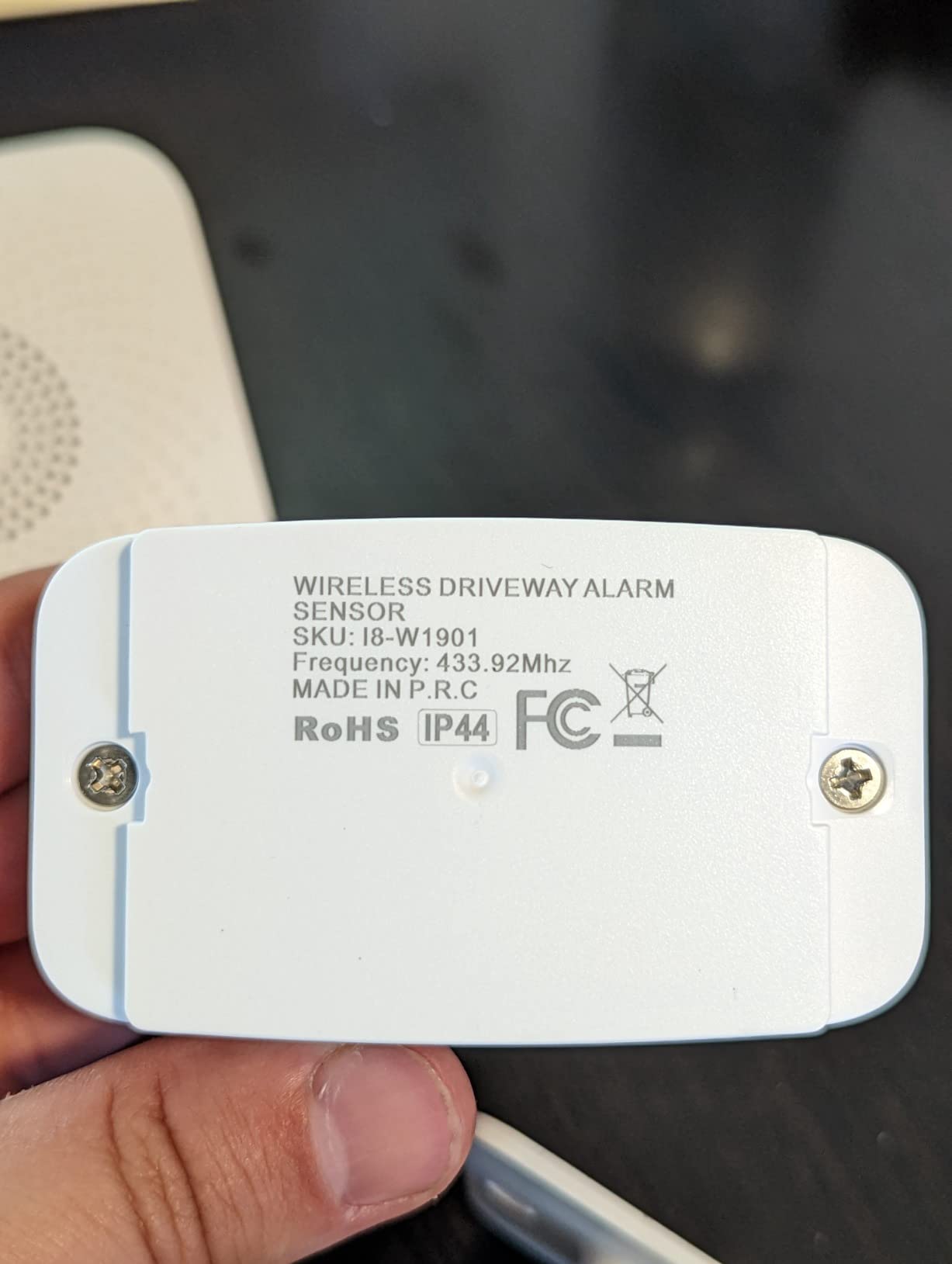
The honest limitation is the 500 ft transmission ceiling, which is the shortest in this list by a considerable margin. It is fine for a suburban drive or a short rural lane. It is not a solution for the driveways this article is actually about, and I would rather say so than let you find out at installation.
The temperature listing is worth reading carefully too. The housing uses anti-freeze materials and is IP44 rated, but the specification is listed as under 91 degrees Fahrenheit, which is an unusual way to express an upper limit. In a mild climate that is irrelevant. In a place with genuine winters, treat the cold specification as unproven and consider a kit with an explicit low-temperature rating.
There is no solar option, so you are replacing AAA cells on a schedule, and no app or smart home integration.
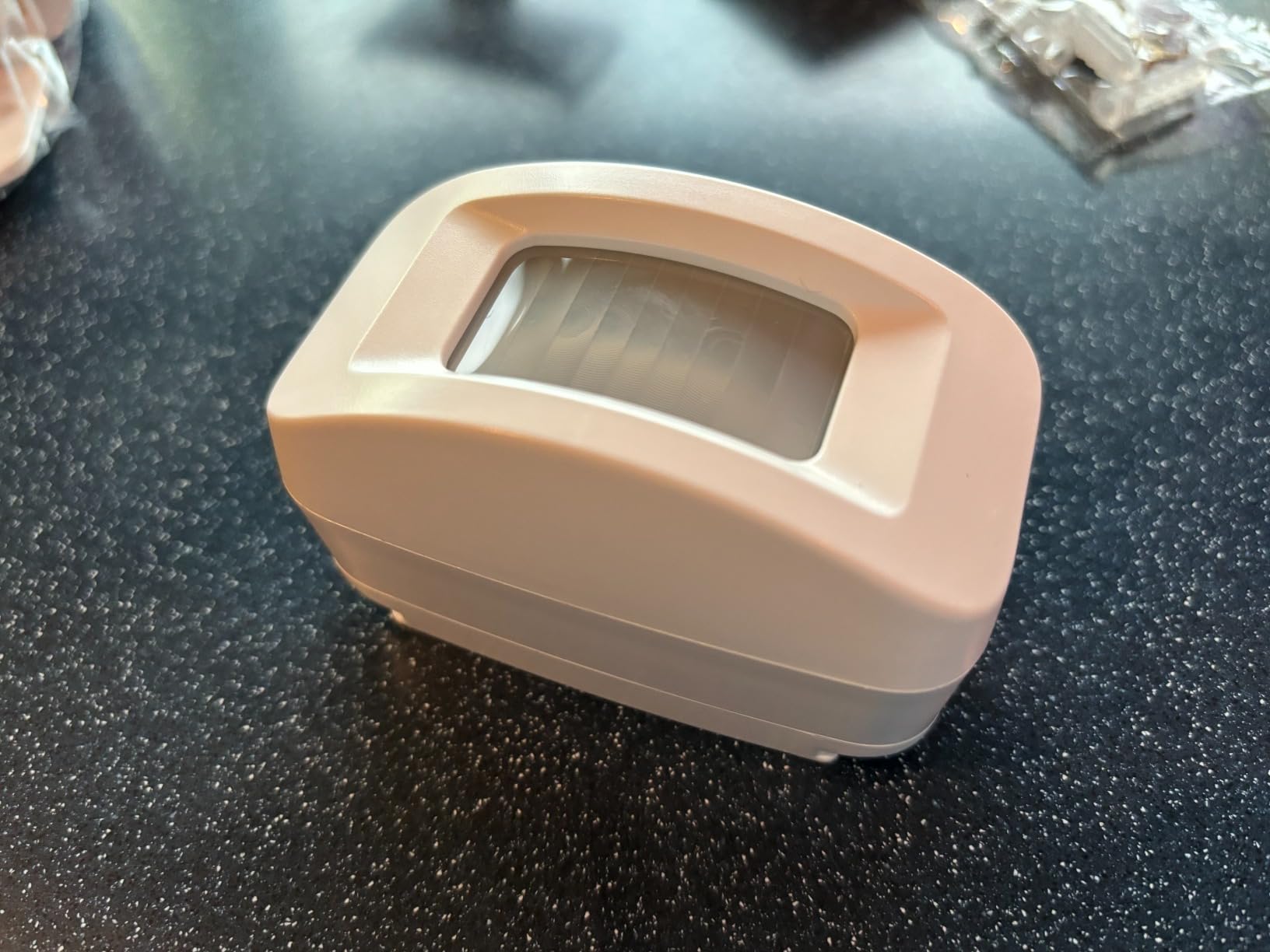
What the 500 ft ceiling means in practice
Measure your drive from the point where you would mount the sensor to the nearest wall of the house. If that figure is comfortably under 500 ft, this kit does the job at a fraction of the cost of the long-range systems. If the drive is longer, or if the direct path runs alongside rather than through the house, move up a tier.
The 19 to 65 ft detection adjustment is still a genuine advantage even on a short drive, because it lets you set the trigger point at the gate rather than at the house end where visitors walk the last stretch on foot.
Where it will frustrate you
Range is the whole problem. There is no configuration that turns 500 ft into a long-driveway solution, and adding sensors does not extend the link.
On cold-weather reliability the listing is ambiguous, and on cold-climate driveways the PIR cone will also pick up deer with the same enthusiasm as the expensive kits. If you are north of the frost line, buy a different unit.
We earn a commission, at no additional cost to you. CERTAIN CONTENT THAT APPEARS ON THIS SITE COMES FROM AMAZON. THIS CONTENT IS PROVIDED 'AS IS' AND IS SUBJECT TO CHANGE OR REMOVAL AT ANY TIME.
7. Betterlink 1/2 Mile Solar Kit – Best Value at Half-Mile Range
BetterLink 1/2 Mile Long Range Solar Wireless Driveway Alarm System 1R1S
- Range: 0.5 mile in open areas
- Motion: up to 30 ft
- Power: solar plus USB-C
- IP65 from -4F to 140F
Pros
- Reliable alerts at 400 ft through dense woods
- 120 dB alert with optional flashing light
- IP65 housing rated -4F to 140F
- Solar power with USB-C backup charging
- Two year manufacturer warranty
Cons
- Solar panel is fixed to the rotating head
- Sensor can stop charging after about two years outdoors
- Receiver is rechargeable rather than wall powered
We earn a commission, at no additional cost to you. CERTAIN CONTENT THAT APPEARS ON THIS SITE COMES FROM AMAZON. THIS CONTENT IS PROVIDED 'AS IS' AND IS SUBJECT TO CHANGE OR REMOVAL AT ANY TIME.
At 4.5 stars from around 840 reviews with 76 percent five-star, this shares the highest average in the roundup and it undercuts the better-known half-mile systems. The sensor has a half-mile range in open areas, a 30 ft PIR detection field, and a solar panel with USB-C backup charging.
The weatherproofing is the standout specification. The housing is IP65 rated from -4F to 140F, which is an explicit temperature range rather than a marketing phrase, and that is exactly the sort of detail that matters if your driveway alarm lives at the far end of a drive in an exposed position all winter.
Owners on rural properties report reliable alerts at 400 ft through dense forest and at 700 ft with clear line of sight, and they consistently praise the accuracy of the PIR detection once it is aimed and set at the right height. The alerting options are unusually flexible, with four modes: audible alarm, light alarm, sound and light, and working with the receiver.
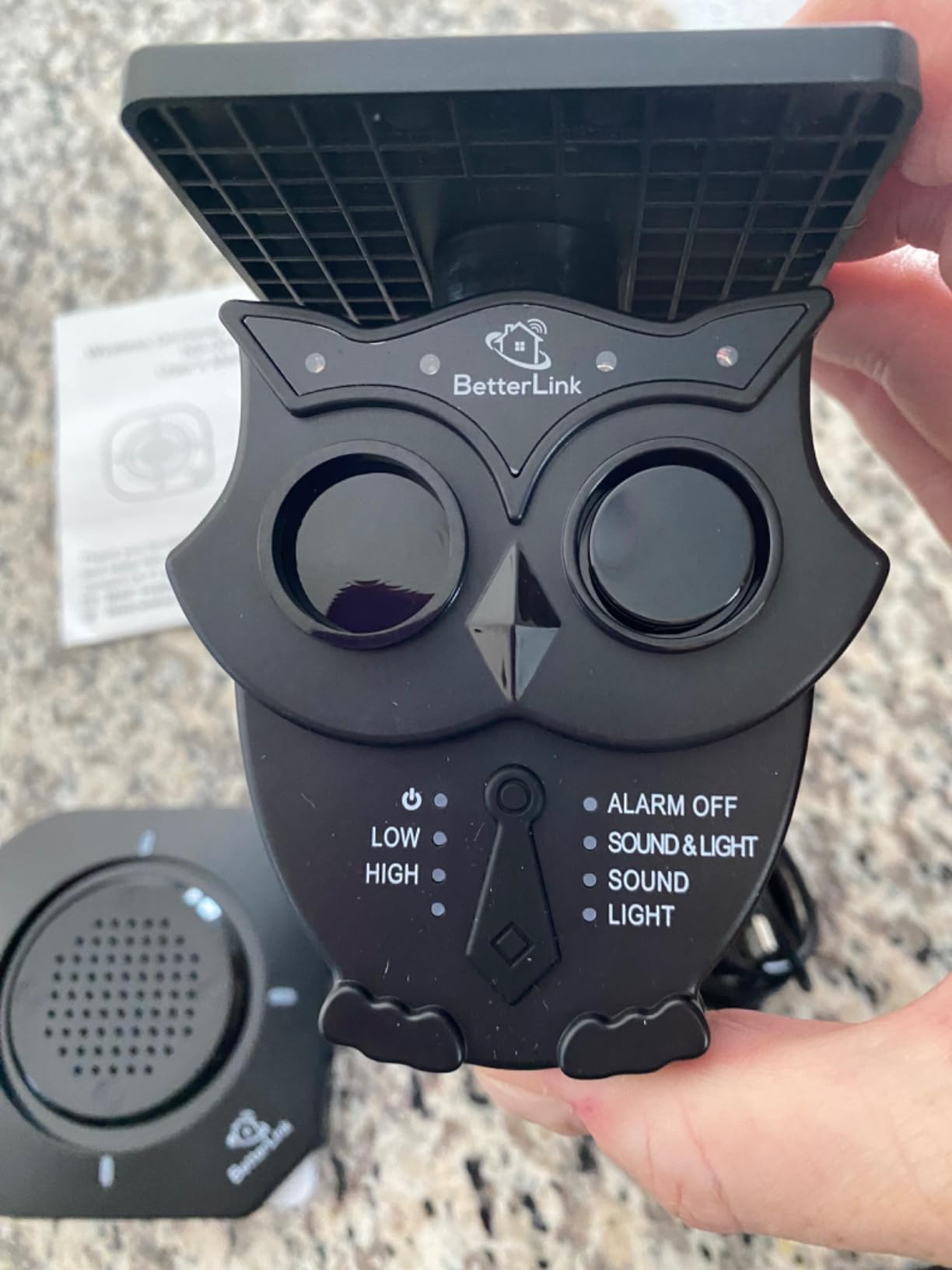
The loud option is genuinely loud. The sensor itself can fire a 120 dB sound and light alert, which is startling if you are standing at the bottom of the drive, and there is a silent light mode that is useful at night. A single receiver handles up to 16 motion sensors, so expansion is not the constraint here.
There is also a two year manufacturer warranty behind it, and owners report the company replaced a failed sensor and paid the postage. That is a small thing until you are the one standing in a field at the end of a quarter-mile drive wondering how you are going to get a replacement that day.
The design flaw is the solar panel placement. It is fixed to the rotating sensor head rather than sitting on a separate mount, so tilting the panel toward winter sun means aiming the entire unit and compromising the detection angle. Plan the mount angle for the average year rather than for July.
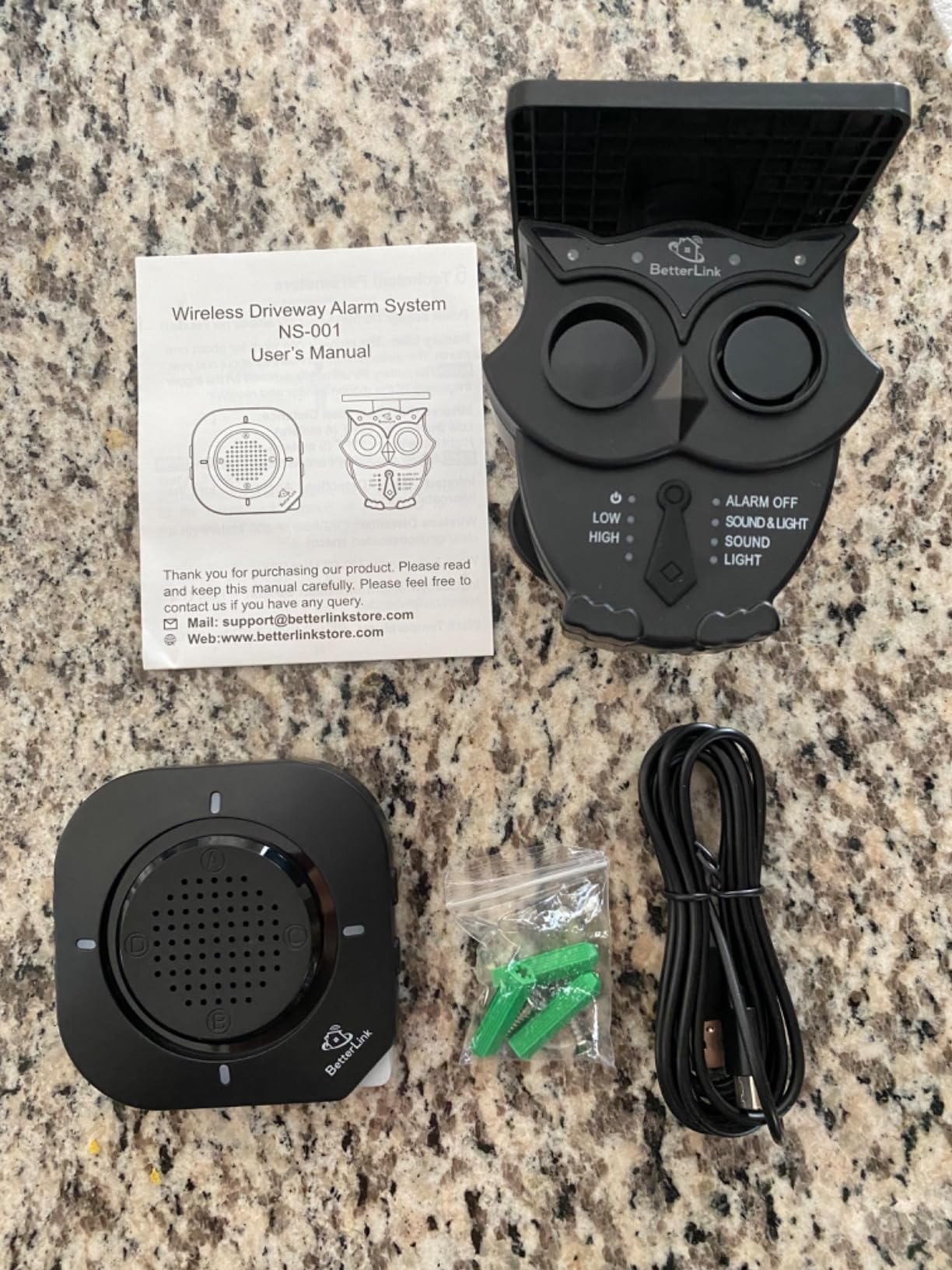
How it behaves at 400 to 700 ft
This is the most useful real-world data point in the whole roundup, because it comes with a stated range that is deliberately conservative. Owners report dependable alerts at 400 ft through dense forest, and 700 ft with an unobstructed line of sight. Treat those as your planning figures rather than the 2,640 ft open-area claim.
On that basis the kit comfortably covers a 700 ft drive, handles a 1,000 ft drive where the path is fairly clear, and starts to get marginal beyond that. Pair it with a second receiver rather than expecting the transmitter to stretch further.
Owners also report occasional missed detections in heavy rain, so if you are installing it in an open position on a coast or an exposed ridge, keep that in mind.
Where it will frustrate you
The fixed solar panel is the one that will bother a careful installer. Anyone who cares about seasonal charge wants to tilt the panel, and here tilting means re-aiming the detector.
A few examples reportedly stopped charging after about two years outdoors when water got in, so the long-term durability of the seal is the thing to watch on a permanently exposed mount. The receiver is rechargeable rather than running on mains power, which means periodic charging on your side as well.
We earn a commission, at no additional cost to you. CERTAIN CONTENT THAT APPEARS ON THIS SITE COMES FROM AMAZON. THIS CONTENT IS PROVIDED 'AS IS' AND IS SUBJECT TO CHANGE OR REMOVAL AT ANY TIME.
8. Bistee Microwave Plus IR Kit – Best for False-Alarm Control
Wireless Driveway Alarms with 58 Chimes,Drive Way Alarm Motion Sensor
- Range: 600 ft at 433.92 MHz
- Sensing: microwave plus IR
- Alert: 110 dB with 0 dB mute
- IP55 from -4F
Pros
- Microwave and IR must both trigger before the alert
- 58 chimes with 5 volume levels
- True 0 dB silent mode that still flashes
- IP55 housing rated -4F to 140F
- Battery life rated up to 3 years
Cons
- 600 ft is short for the longest drives
- Case screws strip easily when opened
- Battery compartment can corrode after two years
We earn a commission, at no additional cost to you. CERTAIN CONTENT THAT APPEARS ON THIS SITE COMES FROM AMAZON. THIS CONTENT IS PROVIDED 'AS IS' AND IS SUBJECT TO CHANGE OR REMOVAL AT ANY TIME.
This is the only kit in the roundup that does not rely on heat alone. It pairs 5.8 GHz Doppler radar with infrared and requires both to trigger before the alarm sounds, which is a genuine engineering answer to the false-alarm problem rather than a sensitivity dial.
What that buys you is rejection of the things that fool a plain PIR. A branch moving in wind moves the air but not much heat. Sunlight crossing the field changes the temperature contrast without the motion signature. An animal large enough to trip the radar still has to break the infrared before you hear anything.
The receiver is among the most feature-rich here. Fifty-eight chimes across five volume levels running from 0 dB up to 110 dB, a true silent mode at 0 dB that still flashes so you get a visual without the noise, and multi-zone operation where each area gets a distinct sound. It also retains its settings through a power loss, which saves a frustrating afternoon of reprogramming after an outage.
Range is 600 ft, which is short for the driveways this article covers. Think of it as a mid-run system, good for a suburban drive or the first few hundred feet of a longer one. If your drive is 1,000 ft, look elsewhere.
The 4.2 star average is the lowest here, and the reviews explain why. The case screws are tiny and strip easily when you open the unit to change batteries, the silicone weather plugs are not robust and spares are not supplied, and some buyers reported corrosion in the battery compartment after about two years that made the cells hard to remove. If you are the type to open the housing twice a year, that is a real annoyance.
The chime selection also gets criticism. The button combination for cycling tones is confusing enough that some buyers could not get through the list, which is a shame given there are 58 to cycle through.
How dual sensing changes nuisance alerts
The difference shows up most in weather and in vegetation. A PIR on its own will be triggered by a large animal crossing the cone, a headlight sweeping the field, or a shadow moving across a warm drive. Requiring radar and infrared to agree removes a large share of those, and owners who switch from a single-technology kit usually report the change within a day of switching back to the old unit.
The IP55 housing is rated from -4F to 140F, so cold and heat are both covered by the specification. There is one report of the sensor failing during heavy wind, which is a single data point rather than a pattern, but it is worth having a spare on hand if you are exposed.
Where it will frustrate you
The 600 ft limit is the headline issue. This is a false-alarm solution rather than a long-distance solution, and for a half-mile drive you are buying the wrong tool.
Build quality is the other issue. Stripped screws, non-robust seals and a battery compartment that can corrode after two years are all things that show up when you least want them, and the 4.2 average reflects it.
We earn a commission, at no additional cost to you. CERTAIN CONTENT THAT APPEARS ON THIS SITE COMES FROM AMAZON. THIS CONTENT IS PROVIDED 'AS IS' AND IS SUBJECT TO CHANGE OR REMOVAL AT ANY TIME.
9. Wuloo 1,760 ft Rechargeable Kit – Best for Flexible Power
Wireless Driveway Alarm 1800 Feet Long Range Motion Sensor Alert System Driveway Detector for Home with 1800mAh Rechargeable Battery (1&2-Brown)
- Range: 1760 ft tested in real conditions
- Motion: up to 30 ft adjustable
- Power: 1800 mAh rechargeable pack
Pros
- Range holds at 400 ft through trees and a house
- Receiver runs on AC adapter or 3 x AA
- Sensitivity adjustment cuts false alerts
- Compact receiver is louder than it looks
- Two year warranty and responsive support
Cons
- Soldered battery pack needs charging every 4 to 7 weeks
- Sensitivity dial needs the sensor removed
- Pairing was not factory done on some units
We earn a commission, at no additional cost to you. CERTAIN CONTENT THAT APPEARS ON THIS SITE COMES FROM AMAZON. THIS CONTENT IS PROVIDED 'AS IS' AND IS SUBJECT TO CHANGE OR REMOVAL AT ANY TIME.
This is the non-solar sibling of the third kit, and the differentiator is power flexibility. The receiver runs on an AC adapter or three AA batteries, so you can move it from the kitchen to the workshop without running a cable, and the sensor carries a 1,800 mAh rechargeable lithium polymer pack rather than replaceable cells.
Range is 1,760 ft, described as tested through trees, buildings, walls and vehicles, and owners confirm the link holds at 400 ft with trees and a house in the path. That is a realistic figure for a typical property and it is a sensible amount of reach for the money.
The receiver doubles as a clock and alarm, is compact enough to sit anywhere, and is louder than its size suggests. Additional sensors each get their own ring tone, expansion runs to eight sensors, and there is a two year warranty behind it.
The rechargeable pack is the piece to think hardest about. Because it is soldered into the sensor rather than being a replaceable cell, you are looking at a recharge every four to seven weeks rather than a battery swap twice a year. That is a trip to the sensor with a USB cable every month or so, and in bad weather that is an evening you will not enjoy.
The sensitivity adjustment is effective but awkward. You have to take the sensor off its mount and open the back panel to reach it, which is not something you want to do every time conditions change. Plan two or three settings for the year rather than tuning weekly.
Some examples also arrived without factory pairing, which adds setup steps the marketing does not mention. It is a five-minute job, not a disaster, but budget the time. And the receiver’s blue LED display is dim if you need to read it in daylight.
What the 1,760 ft link handles
Owners using this on long rural drives report 400 ft working reliably with trees and the house sitting in the signal path. Beyond that it becomes property-dependent, and on a straight open run you would expect considerably more.
For most driveways between 300 and 900 ft, this is the sweet spot. It covers the useful range without the maintenance profile of a solar unit, at the cost of a battery you cannot replace with a standard cell.
Where it will frustrate you
Monthly-ish recharging at the far end of the drive is the deal-breaker for a lot of people. If the walk to the sensor involves a muddy gravel track, that stops being a chore and becomes a reason to buy a different product.
It is also a plain PIR sensor, so deer and wind-blown branches in the cone will set it off. There is no app, so no phone notification when you are away from home.
We earn a commission, at no additional cost to you. CERTAIN CONTENT THAT APPEARS ON THIS SITE COMES FROM AMAZON. THIS CONTENT IS PROVIDED 'AS IS' AND IS SUBJECT TO CHANGE OR REMOVAL AT ANY TIME.
10. Driveway Informer 1000 ft Alarm – Best for Walls and Masonry
Driveway Informer Wireless Driveway Motion Alarm, Outdoor 1000′ Long Range
- Range: 1000 ft
- Power: 2 x AA per sensor
- Event counter on the base
- Made in the USA
Pros
- Signal passes through brick and metal roofs
- Reliable on long steep rural drives
- Loud alert with good volume control
- Event counter records triggers while away
- Multiple receivers each on their own tone
Cons
- Higher cost than any other kit in the group
- Very sensitive to wildlife and low morning sun
- Tiny screw heads make the housing hard to open
- Thin instructions on syncing two sets
We earn a commission, at no additional cost to you. CERTAIN CONTENT THAT APPEARS ON THIS SITE COMES FROM AMAZON. THIS CONTENT IS PROVIDED 'AS IS' AND IS SUBJECT TO CHANGE OR REMOVAL AT ANY TIME.
This one solves a specific problem that the cheaper kits solve badly. Owners report the signal passing through brick exteriors, interior brick walls, concrete siding and metal roofs, which matters enormously when the sensor is at the far end of the drive and the receiver has to end up on the far side of a substantial house.
Range is 1,000 ft, and reviewers on long, steep rural driveways report it reliable between 300 and 520 ft with the building in the path. The alert is loud with good volume control, audible throughout a multi-storey home, which is the right character for a system meant to warn you while you are still in bed.
It is also the only system here with an event counter on the base unit, which records how many times the sensor triggered while you were away. On a property where nobody is home during the day that turns a missed chime into actual information. The sensor is a discreet green PIR unit on a rotating bracket with screws, and multiple receivers can sit in separate buildings each with its own tone.
It is made in the USA by a manufacturer with more than 20 years in the category, and it comes with a one year warranty and a no-hassle return policy.
It carries the highest outlay in this roundup, and you should know that the spend buys range through buildings and a build that has been in the category for two decades, not smart features. There is no app and no cloud.
The sensitivity is the trade-off. Owners report it picking up birds, deer, coyotes and dogs, and that low morning sun can trigger it. If you mount it facing east at sunrise you will get told about it. Aim it along the drive rather than across it and the problem reduces considerably.
Orientation matters more here than on most kits. The sensor has to be mounted with the longer dimension vertical and the antenna pointing up, or it will not work correctly, and that instruction is easy to miss. The housing also opens with very small screw heads, which is fiddly, and newer units no longer include the event counter while the counter resets if power is lost.
How the signal gets through a house
Most of the range advantage here is penetration rather than distance. When the receiver sits behind a brick wall, a concrete floor or a metal roof, the effective path is the wall and everything in it. Reviewers on masonry properties report this unit holding the link where cheaper kits drop it, which is why the 1,000 ft figure feels more conservative than it sounds.
Place the receiver centrally rather than in the room nearest the sensor. On a two-storey house the middle of the ground floor tends to give better penetration to the basement or the upstairs than a unit tucked into a corner near the driveway-facing wall.
Where it will frustrate you
Two AA batteries per sensor means regular replacements, and buyers who moved to lithium cells for the longer intervals tend not to go back. Plan for a swap every few months in summer and more often in winter.
Instructions are thin on syncing two sets together and changing ring tones, which is exactly the task you will want when you add the shop receiver. Budget time to work it out, and check the mounting orientation before you seal the housing back up.
We earn a commission, at no additional cost to you. CERTAIN CONTENT THAT APPEARS ON THIS SITE COMES FROM AMAZON. THIS CONTENT IS PROVIDED 'AS IS' AND IS SUBJECT TO CHANGE OR REMOVAL AT ANY TIME.
How to Match a Driveway Alarm to Your Driveway Length
Measure first, then buy. Walk the drive from the point where the sensor would sit to the wall of the house where the receiver will go, and write the number down. This is the figure every range claim on the box should be judged against, and it is the one that appears nowhere in the marketing.
Then add 30 percent headroom. Manufacturer ranges are open-condition figures, which means clear line of sight and clean air, and your drive has a bend in it, a rise, a barn or a stand of trees. If your measured drive is 1,000 ft, look for a system rated at 1,300 ft or more.
As a rule of thumb from what owners report on real installs, dependable range in obstructed conditions lands at roughly 40 to 50 percent of the stated figure. A 2,600 ft kit will often deliver 1,000 to 1,300 ft through trees and buildings, which is still the longest reach available in this category apart from the one-mile system.
Measure to the nearest wall rather than to the property line. A receiver 20 ft inside the house picks up a stronger signal than one mounted on an exterior wall, and that 20 ft is free performance you do not have to pay for.
How to Choose a Driveway Alarm for a Long Driveway
Pick the detection technology before the range. A passive infrared sensor reacts to heat movement, so a deer, a dog or a large raccoon triggers it exactly the way a person does. A buried magnetic probe only reacts to a vehicle carrying a magnet, so it ignores people on foot and every animal. An infrared break beam trips when something interrupts the beam across the drive. A rubber hose laid across or buried under the surface reacts to weight.
Choose PIR when you want people and vehicles and can tolerate wildlife alerts. Choose a probe when the goal is vehicle theft deterrence on a rural acreage and you are tired of the neighbour’s dog setting it off. Choose a beam when the drive is a clear corridor with vegetation you can control. Choose a hose when the drive is short, paved and you want zero electronics in the ground.
Decide on power next. Battery units are the simplest and least costly but need swapping, and users describe battery consumption in cold months as considerably worse than in summer. Solar units remove the maintenance entirely but depend on panel orientation, and a panel that faces away from the sun becomes a battery unit with extra steps. Rechargeable packs sit in between, needing a cable run every few weeks.
Look at the operating temperature range, not the IP rating alone. An IP65 housing tells you about water ingress and says nothing about a sensor at minus twenty degrees. The kits here are rated from minus 4F up through plus 140F, and two carry explicit low-temperature figures of minus 15C and minus 30 degrees Fahrenheit, which matters if your drive is exposed all winter.
Plan for wildlife before you buy rather than after the first 4am alert. A wide detection cone, sensitivity reduction, adjustable lens caps that mask all but a thin slice, dual sensing that requires two technologies to agree, and physical aimability all reduce the problem. What does not reduce it is anything. If your drive runs through heavy deer country, set the detection to the minimum that still catches a vehicle, aim it along the drive rather than across it, and trim the vegetation inside the cone.
Check how many receivers one sensor can drive. Most systems here allow unlimited receivers per sensor, which is how you cover a house, a shop and a barn from one transmitter. If you have two separate driveways, confirm the receiver supports multiple sensors with distinct tones, otherwise you lose the ability to tell which entrance was used.
Be realistic about smart home integration. Every unit in this roundup is a standalone chime system with no app, no push notifications and no cloud. If you need to know about an arrival while you are away, you are buying a different product category, typically a cellular camera with solar power, which will run well past the reach of any alarm here.
Finally, think about whether the noise is welcome. A 110 dB alert in a house with young children or a light sleeper is a genuine quality-of-life problem. The kits with a true 0 dB silent mode that still flashes are the ones to consider, and placing the receiver in a spot where it can be heard but not slept through is a sensible middle ground.
Frequently Asked Questions
What is the longest range driveway alarm?
Among the systems in this roundup, the Dakota Alert DCMA-4K Plus has the longest stated range at 1 mile, which is roughly double the half-mile systems. Real-world reception depends heavily on obstructions. Owners report dependable figures of roughly 1,000 to 1,500 ft when trees, buildings or terrain sit in the signal path, and around 1,000 to 1,200 ft for the best-performing half-mile kits under the same conditions.
How far will a driveway alarm work?
Expect a manufacturer figure quoted in open conditions, which assumes clear line of sight and clean air. As a practical guide, budget about 40 to 50 percent of the stated range once trees, buildings, a rise in the ground or a side wall enter the path. Measure your drive end to end, add 30 percent headroom, and treat a 2,600 ft kit as a realistic 1,000 to 1,300 ft alarm on an obstructed property.
Are driveway alarms worth it?
On a long driveway, yes, because the intruder is already on your property for several minutes before a front door sensor would react. The alarm gives you time to reach a camera, switch on outdoor lights or call police while the vehicle is still at the bottom of the drive. The strongest case is on rural acreage with a gate, a shop or a barn, where an early warning genuinely changes the outcome.
What security system do burglars hate?
No single system deters on its own, but layered detection does more than any one device. A driveway alarm gives you advance notice rather than a record after the fact, and it pairs well with outdoor lighting that switches on at the entrance and visible cameras at the house. What matters to someone approaching an unseen property is light, noise and the certainty that their approach has been noticed, and that is what early detection delivers.
How do I stop a driveway alarm from detecting deer and animals?
Set the sensitivity to the lowest level that still reliably catches a vehicle, and aim the sensor along the drive rather than across it so the detection cone avoids the treeline. Kits with adjustable lens caps let you mask all but a thin slice of the field, and dual-sensing units that require microwave and infrared to agree before alarming reject most wildlife. Trimming vegetation inside the cone stops wind-blown branch alerts, and burying a magnetic probe instead of using a motion sensor removes the problem entirely.
Do driveway alarms work in the winter and snow?
Yes, provided the kit is rated for the temperatures you actually face. Look for an explicit low-temperature figure rather than relying on the IP waterproof rating, which says nothing about cold. The units here are rated from minus 4F up to plus 140F, with two models rated to minus 15C and minus 30 degrees Fahrenheit. Solar units need a south-facing panel with a clear view of the sky to recharge through successive cloudy days.
The Verdict on the Best Driveway Alarms for Long Driveways
The HTZSAFE half mile kit wins this roundup because it pairs the longest reach in the practical tier with a frequency-hopping link that holds up in cluttered wireless environments, 35 to 50 ft of adjustable detection, and expansion to 32 sensors and unlimited receivers, all with the heaviest review count we found. It is the pick I would put on a 600 to 1,200 ft drive with obstructions in the way.
Go further out than that and the Dakota Alert DCMA-4K Plus is the right answer, because its 1 mile range and 110 dB alert absorb the terrain that defeats everything else on this list. If wildlife is the thing driving you nuts, the TECKNET kit with adjustable lens caps is the best hardware answer, and the Bistee dual-sensing unit is the one that solves it at the circuit level. For the best balance of rating, weatherproofing and half-mile range, the Betterlink solar kit is hard to argue with at 4.5 stars.
Whatever you choose, measure the drive before you buy, add 30 percent headroom, and set the sensitivity to the lowest level that still catches a vehicle. That last step does more for your experience with these alarms than any spec on the box.