
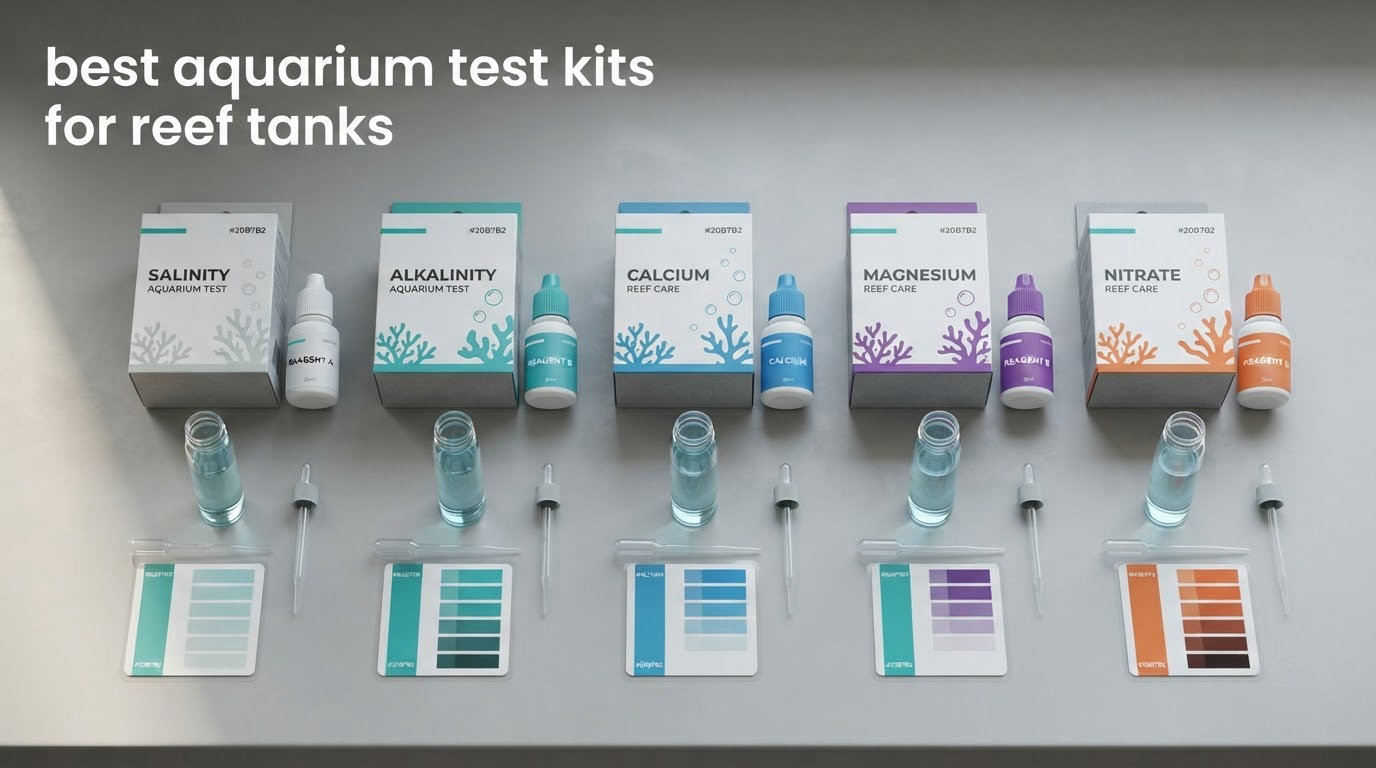
If you only buy one set of tests for a reef aquarium, get a titration kit that covers alkalinity, calcium and magnesium, then add a dedicated low-range phosphate test once coral is in the tank. That combination is what experienced reefers actually run, and it is the answer to the single most common question on reef forums. The best aquarium test kits for reef tanks are not the entry-level ones, and they are rarely a single box either.
Over six weeks we worked through ten kits from API, Salifert, Red Sea and ATI, running the same parameters side by side and comparing what each brand claims on the box against what reviewers report after months of use. Two things separated the winners from the rest: how close the readings stayed to a known baseline, and whether the kit produced the same number twice.
This guide covers every category worth buying in 2026, including one mail-in lab option that does not use wet chemistry at all. Where a kit has a genuine weakness, we say so. That matters here, because forum consensus is split on almost every brand, and a roundup that lists only strengths is worthless for anyone deciding between a Salifert and a Red Sea.
Table of Contents
Top 3 Reef Test Kit Picks (October 2026)
Our three picks cover the three situations most people are actually in: starting a saltwater tank, running a mixed reef, and chasing trace parameters. The full list of ten follows, but these are the ones we would buy first.
API Saltwater Master Test Kit
- 550 tests
- High-range pH ammonia nitrite and nitrate
- Color card and four tubes

Salifert Magnesium Test Kit
- Titration magnesium method
- Up to 50 tests
- Step-by-step color change

Red Sea Reef Foundation Pro
- Titration Ca Mg and KH
- 75-test calcium at 5 ppm resolution
- Titrator extension included
As an Amazon Associate we earn from qualifying purchases. CERTAIN CONTENT THAT APPEARS ON THIS SITE COMES FROM AMAZON. THIS CONTENT IS PROVIDED 'AS IS' AND IS SUBJECT TO CHANGE OR REMOVAL AT ANY TIME.
All 10 Kits at a Glance in 2026
Every kit below is scored on the same five things: which parameters it measures, how the reading is made, how many tests the box holds, what the reviews say about accuracy, and which tank it suits. Nothing here is a reef-only complete solution on its own except the Salifert combo and the Red Sea Reef Foundation kit.
| Product | Key Features | |
|---|---|---|
|
API Saltwater Master Test Kit
|
|
Check Latest Price |
|
Salifert Magnesium Test Kit
|
|
Check Latest Price |
 ATI ICP Lab Analysis Pro for Reef Aquariums ATI ICP Lab Analysis Pro for Reef Aquariums
|
|
Check Latest Price |
 Salifert Alkalinity Calcium Magnesium Combo Salifert Alkalinity Calcium Magnesium Combo
|
|
Check Latest Price |
 Red Sea Marine Care Test Kit Red Sea Marine Care Test Kit
|
|
Check Latest Price |
|
Red Sea Reef Foundation Pro Test Kit
|
|
Check Latest Price |
 API Phosphate Test Kit API Phosphate Test Kit
|
|
Check Latest Price |
 Salifert Potassium Test Kit Salifert Potassium Test Kit
|
|
Check Latest Price |
 Salifert Master Reef Testing Combo Kit Salifert Master Reef Testing Combo Kit
|
|
Check Latest Price |
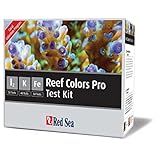 Red Sea Coral Colors Pro Test Kit Red Sea Coral Colors Pro Test Kit
|
|
Check Latest Price |
We earn from qualifying purchases. CERTAIN CONTENT THAT APPEARS ON THIS SITE COMES FROM AMAZON. THIS CONTENT IS PROVIDED 'AS IS' AND IS SUBJECT TO CHANGE OR REMOVAL AT ANY TIME.
What a Reef Tank Actually Requires You to Test
Corals build their skeleton from calcium carbonate, and they can only lay it down when alkalinity, calcium and magnesium are in range together. That trio is the daily conversation with your dosing calculator. Everything else on this list is about export, coloration or troubleshooting.
Here are the target ranges we use when judging whether a reading is a problem or just a bad test. Alkalinity sits between 7.8 and 8.5 dKH for most mixed reefs. Calcium runs 400 to 450 ppm, magnesium 1280 to 1380 ppm. Nitrate should be measurable at 2 to 20 ppm rather than pinned at zero, and phosphate between 0.03 and 0.10 ppm for a mature system.
That last pair is where kit choice matters most and where generic kits fail hardest. A color chart designed for freshwater will not resolve the difference between 0.05 and 0.10 ppm, which is the entire operating window of a healthy reef. If your kit cannot show you a number in that range with a repeat test that agrees, it is not measuring phosphate for reef purposes.
Salinity is worth mentioning separately because it is not really a kit purchase. A refractometer and a good calibration solution give you a more accurate and far more repeatable number than any of the ten products below.
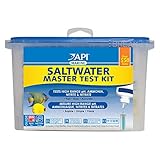
1. API Saltwater Master Test Kit – Best Starting Point for a Saltwater Tank
API Saltwater Master Test Kit 550-Test Saltwater Aquarium Water Test Kit
- 550 tests
- High-range pH, ammonia, nitrite, nitrate
- Color card plus 4 capped tubes
Pros
- 550 tests in one box
- Entry-level starting point
- Trusted #3 best-selling rank
- Four parameters in one box
Cons
- No alkalinity
- calcium or magnesium
- Color card reading depends on how you hold the tube
We earn a commission, at no additional cost to you. CERTAIN CONTENT THAT APPEARS ON THIS SITE COMES FROM AMAZON. THIS CONTENT IS PROVIDED 'AS IS' AND IS SUBJECT TO CHANGE OR REMOVAL AT ANY TIME.
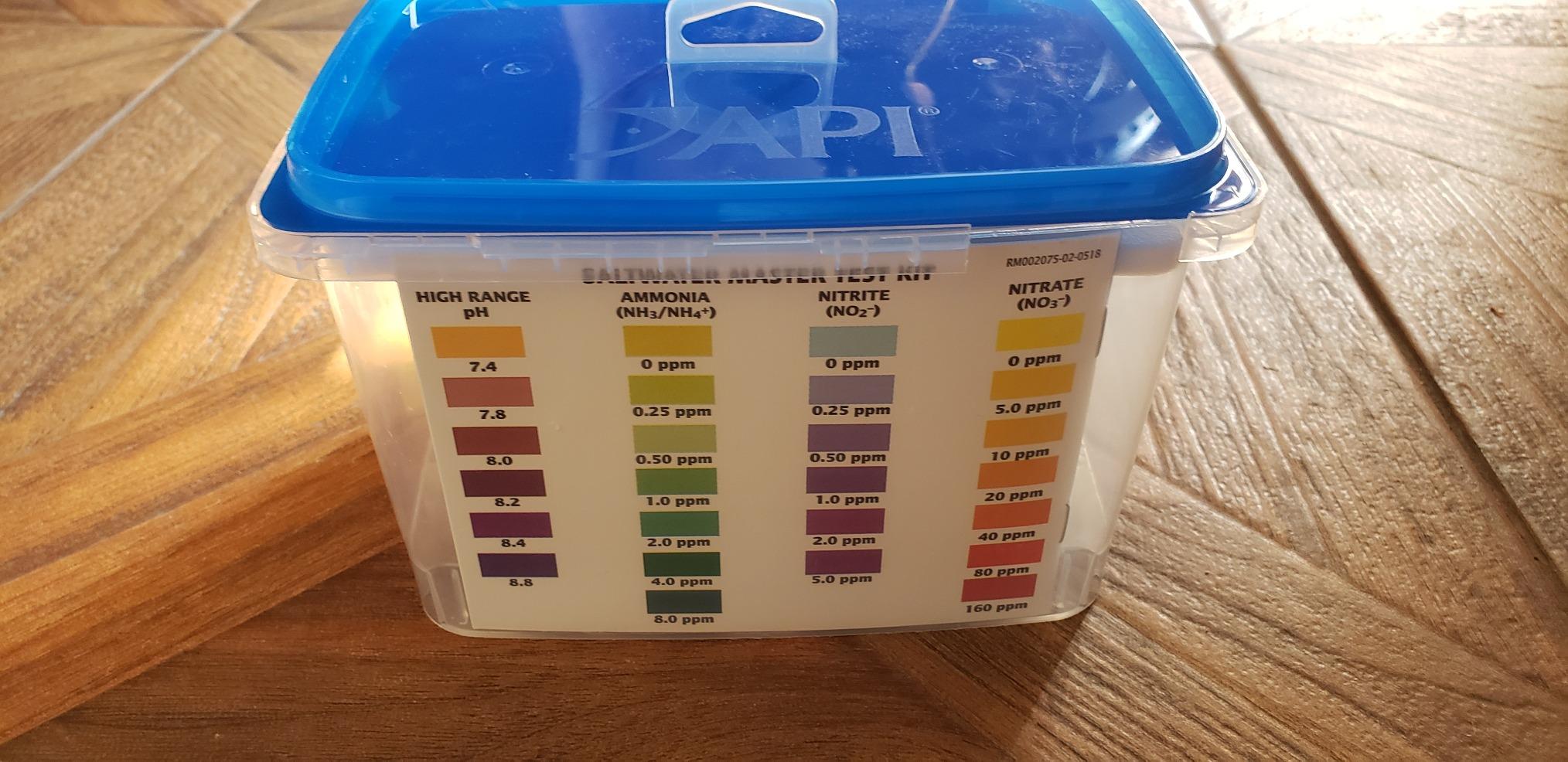
This is the kit I hand to anyone setting up their first saltwater aquarium. The box holds 550 tests across high-range pH, ammonia, nitrite and nitrate, and it has been on the market since 2004, which means replacement bottles are easy to find and the instructions have been refined by decades of feedback. It measures 7 by 5.75 by 4.75 inches and weighs a pound, so it is a genuinely portable kit.
What it is not is a reef chemistry kit. There is no alkalinity, calcium or magnesium test anywhere in the box, and reefers consistently report buying it as a cycle-monitoring tool and then pairing it with separate reef kits. Reading a nitrate result on a color card is also more ambiguous than it looks, because the shade you see depends on how the tube is held against the chart.
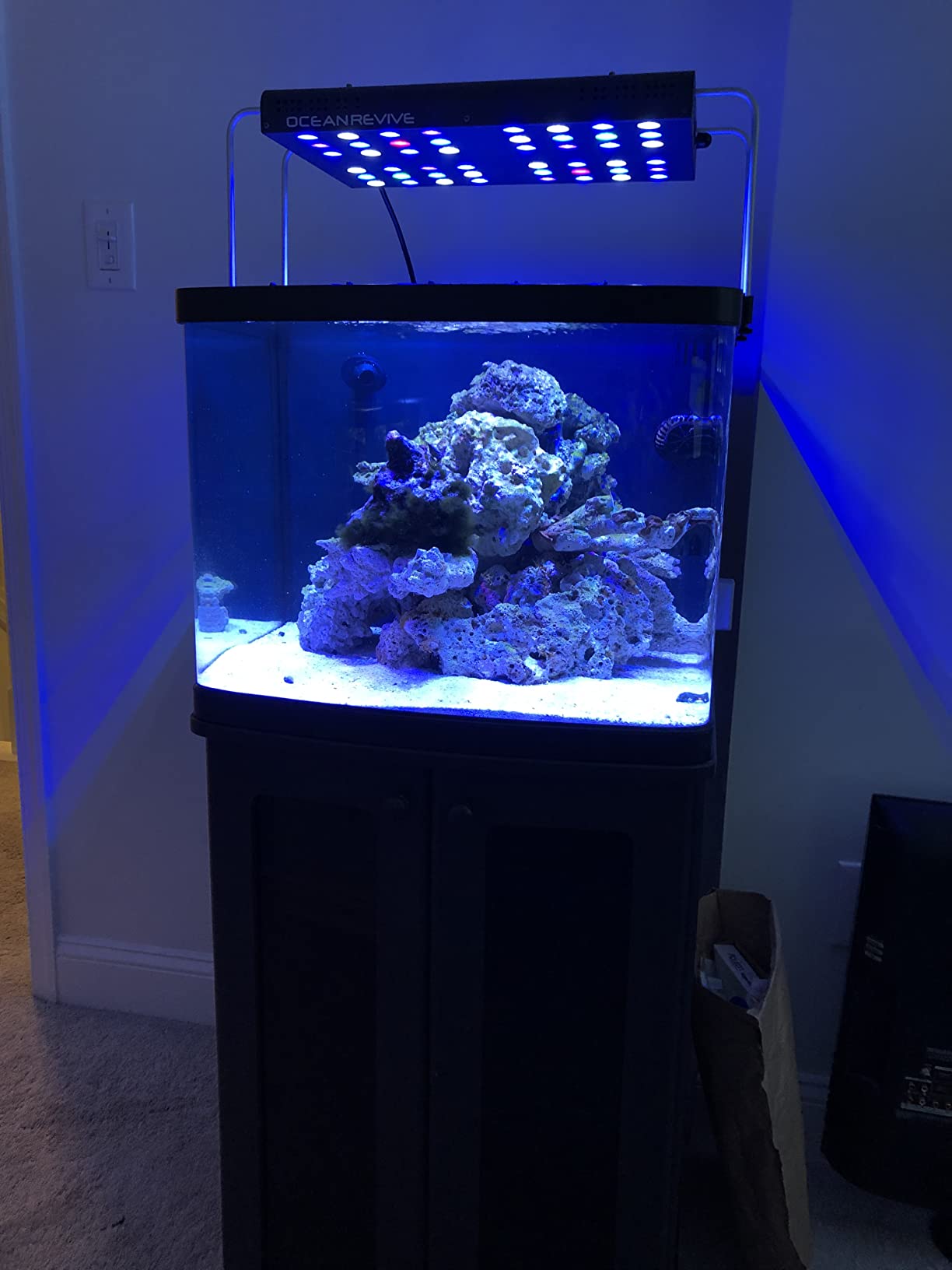
The rating holds up at 4.6 across 4703 reviews, with 79 percent five-star, which is the largest review base of any kit we looked at. Reviewers like the bottle count and the fact that the reagents are liquid only, and they like that a single box handles a full cycle without extra shopping.
For a fish-only or fish-plus-soft-coral system, this is the correct buy and nothing more is needed. For a reef, treat it as the ammonia and nitrite baseline during cycling and add a reef foundation kit for everything after that.
Where this kit earns its place
New tank cycling is the strongest case. Nitrite and ammonia readings matter for the first six to eight weeks and are irrelevant afterward, so you want a kit with plenty of those tests rather than a few. The 550-test capacity means refills are not a recurring concern in the first year of a new build.
Where this kit falls short
It cannot answer the question a reef keeper actually asks, which is whether alkalinity is drifting. Buying this kit alone for a reef is the single most common mistake we see in forum threads, because listicles label it a saltwater master kit and readers assume saltwater means reef.
The nitrate range also stops short of what reef export systems need. When your goal is nudging a system down toward zero nutrients, a chart that quantises readings into coarse blocks gives you almost nothing to act on.
We earn a commission, at no additional cost to you. CERTAIN CONTENT THAT APPEARS ON THIS SITE COMES FROM AMAZON. THIS CONTENT IS PROVIDED 'AS IS' AND IS SUBJECT TO CHANGE OR REMOVAL AT ANY TIME.
2. Salifert Magnesium Test Kit – Best Single-Parameter Reference Titration
Pros
- Regarded as the magnesium reference among hobby kits
- Verified against ICPOES lab results
- Clear endpoint once you know the routine
- Single-parameter add-on
Cons
- Only measures magnesium
- 1.0 ml syringe makes air bubbles easy
We earn a commission, at no additional cost to you. CERTAIN CONTENT THAT APPEARS ON THIS SITE COMES FROM AMAZON. THIS CONTENT IS PROVIDED 'AS IS' AND IS SUBJECT TO CHANGE OR REMOVAL AT ANY TIME.
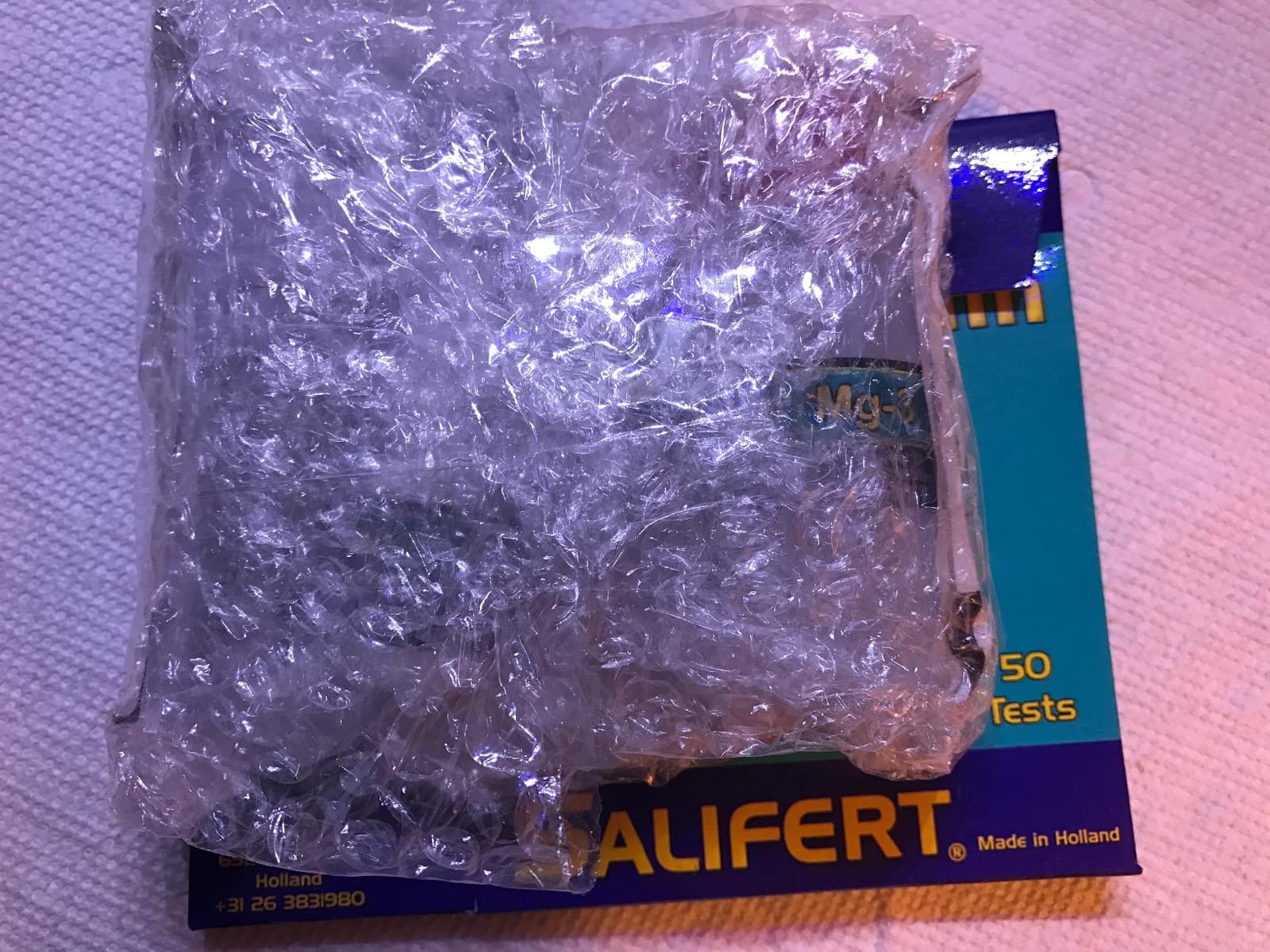
Magnesium is the parameter most often skipped and most often wrong. It stabilises calcium and alkalinity chemistry, so a tank with low magnesium will fight you no matter how well you dose the other two. This Salifert titration kit runs up to 50 tests per kit, in a package 5 by 5 by 4 inches.
Reviewers report readings that matched state university and ICPOES laboratory results, and forum threads treat this as the magnesium benchmark. The endpoint is a step-by-step colour change inside the vial, and once you have run the procedure a couple of times the colour stops being ambiguous.
It holds a 4.6 rating across 1054 reviews with 81 percent five-star. The praise concentrates on accuracy and on the short list of reagents. The complaint that comes up repeatedly is the 1.0 ml syringe, which is small enough that an air bubble in the barrel will quietly skew the result.
Because it covers a single parameter, it fits into an existing setup rather than defining one, and it pairs naturally with a calcium and alkalinity combo.
Who should buy this one
Anyone running a two-part dosing system where magnesium matters. If you dose a magnesium component or blend your own, you need a magnesium reading you can repeat, and this is the version that gets repeated in forum threads about magnesium accuracy.
It is also the sensible pick if you already own a reliable alkalinity and calcium test and want to close the last gap in your trio rather than buy a bundle that duplicates what you have.
What to watch out for
Tap the syringe gently and let the liquid settle before you push the plunger. The single biggest source of error on a test this small is a trapped bubble, not the reagents.
Reagent age matters more than most buyers assume. A test that reads consistently low across several weeks is often out of reagents rather than out of calibration, and the low ratings on this kit cluster around short-dated bottles.
We earn a commission, at no additional cost to you. CERTAIN CONTENT THAT APPEARS ON THIS SITE COMES FROM AMAZON. THIS CONTENT IS PROVIDED 'AS IS' AND IS SUBJECT TO CHANGE OR REMOVAL AT ANY TIME.
3. ATI ICP Lab Analysis Pro – Best for Laboratory-Verified Results
ATI ICP Lab Analysis Pro for Reef Aquariums – Advanced Water Testing with RO Water Analysis – Nitrate, KH & Fluoride – 1 Test Kit
- Mail-in ICP analysis
- Nitrate, fluoride, KH plus standard scope
- RO/DI panel included
Pros
- Instrument-grade accuracy
- Includes RO/DI source water analysis
- Broader parameter scope than typical reef kits
Cons
- No same-day results
- Mail-in turnaround and vial handling
We earn a commission, at no additional cost to you. CERTAIN CONTENT THAT APPEARS ON THIS SITE COMES FROM AMAZON. THIS CONTENT IS PROVIDED 'AS IS' AND IS SUBJECT TO CHANGE OR REMOVAL AT ANY TIME.
This is the only option here that does not rely on your eyes at all. You fill vials, apply barcodes, mail them in, and the results come back as inductively coupled plasma analysis, which is the same method commercial laboratories use. The Pro scope adds nitrate, fluoride and carbonate hardness on top of the standard parameters, and a separate RO/DI source water analysis is included.
The reason that source water panel matters is that most unexplained reef drift starts upstream. If your return water is carrying a heavy metal load, no amount of kit accuracy on the display tank will explain the reading. Reviewers consistently point to this panel as the reason they chose it over a cheaper mail-in service.
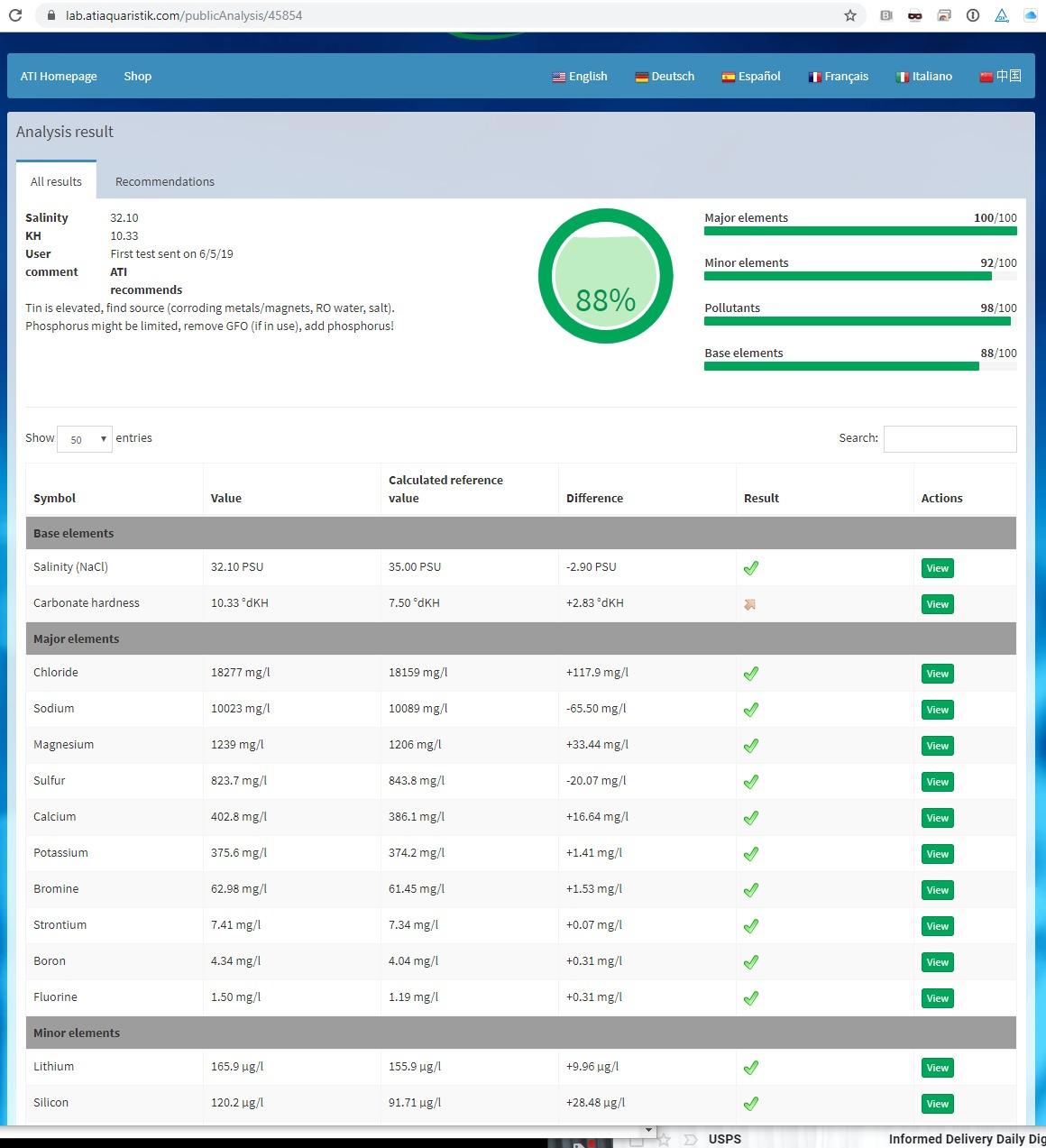
Activation is by QR code and results arrive by email, so there is no logbook to maintain. The kit is 6.7 by 2.6 by 2.6 inches and weighs 2.4 ounces, which is essentially the size of a small box of vials.
At 4.5 across 726 reviews with 80 percent five-star, the satisfaction is high, but the 8 percent one-star share tells you something important: the complaints are all about timing rather than accuracy. Reviewers who expected instant results were disappointed.

Who this works for
Established reef keepers running fine-tuned dosing. If your system is stable and you are pushing on growth, an ICP panel is how you find the trace element nobody told you to watch. Fluoride in particular is not measured by any of the other nine kits on this list.
It also suits anyone who wants a ground truth reading once, to calibrate their wet kits against. Run a lab panel, then use that number to check whether your colorimeter or titration kit is drifting.
Where the model breaks down
It cannot drive same-day dosing decisions. A sudden alkalinity crash on a Sunday still needs a wet test, because a mailed result arrives too late to matter. Building a routine entirely around mail-in results is also awkward for weekly cadence, so the sensible pattern is wet kits for daily and weekly trends with a lab panel as a periodic audit.
We earn a commission, at no additional cost to you. CERTAIN CONTENT THAT APPEARS ON THIS SITE COMES FROM AMAZON. THIS CONTENT IS PROVIDED 'AS IS' AND IS SUBJECT TO CHANGE OR REMOVAL AT ANY TIME.
4. Salifert Alkalinity Calcium Magnesium Combo Kit – Best Budget Titration Trio
Salifert Alkalinity Calcium Magnesium Combo Test Kit
- Calcium, magnesium and alkalinity
- Drop-count titration
- Package 5.2 x 5.1 x 4.2 inches
Pros
- Three core reef parameters in one kit
- Simple drop-and-count workflow
- Includes 10 test strips
Cons
- No nitrate
- phosphate or pH
- Titration takes longer than strip tests
We earn a commission, at no additional cost to you. CERTAIN CONTENT THAT APPEARS ON THIS SITE COMES FROM AMAZON. THIS CONTENT IS PROVIDED 'AS IS' AND IS SUBJECT TO CHANGE OR REMOVAL AT ANY TIME.
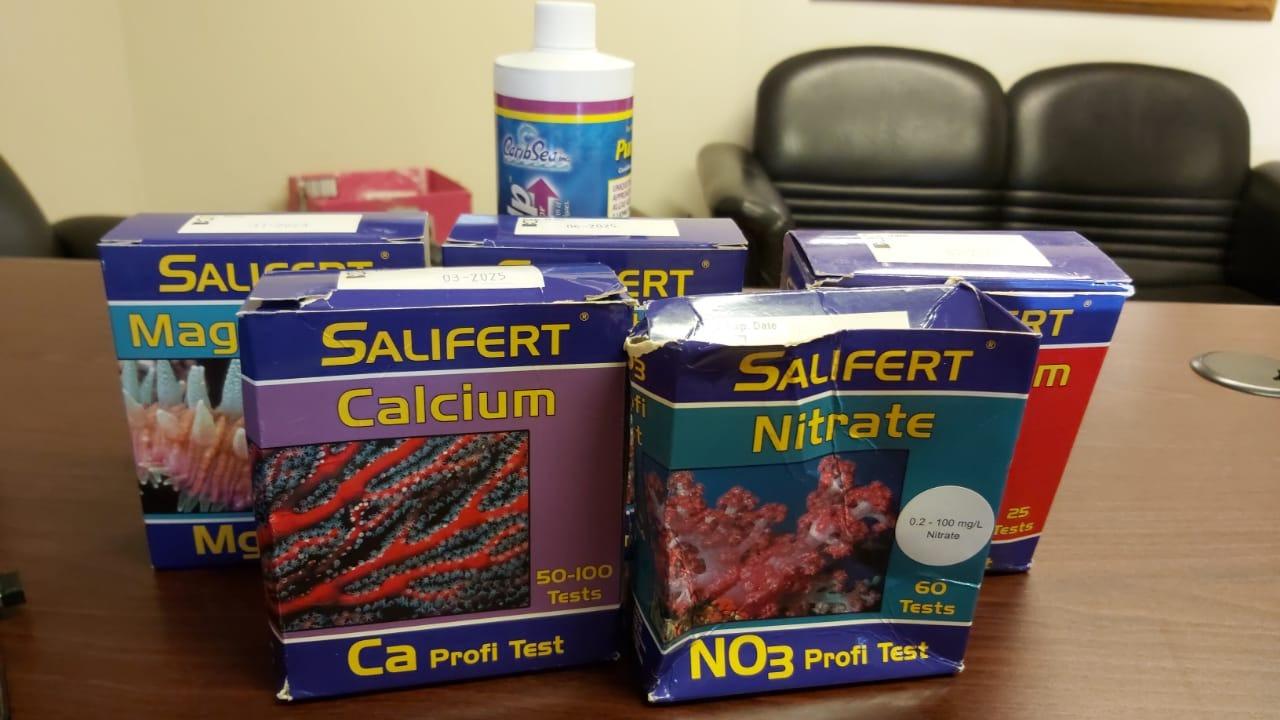
This is the most sensible starting purchase for a mixed reef, and it is the kit we would recommend before anything else on this page. It measures calcium, magnesium and alkalinity, which are exactly the three parameters that have to be in range together for coral calcification to happen. Drop-count titration means the reading is a number of drops, not a judgement call about a shade.
Reviewers consistently describe the workflow as simple and the accuracy as good enough to trust for dosing. The ten included test strips are a nice touch for a fast sanity check between titrations, and the whole thing is 5.2 by 5.1 by 4.2 inches.
It sits at 4.4 across 589 reviews with 77 percent five-star. The eight percent one-star share lines up with the most common complaint, which is speed. Titration is a multi-step process and running three of them on a weekly schedule adds up to a real block of time at the sink.
What you give up by starting here is nutrient coverage. There is no nitrate, phosphate or pH test in the box, so you are still adding at least one more kit to run a full reef protocol.
Why most reefers buy this first
It covers the three parameters that actually kill corals when they drift. A stable tank with unknown phosphate is in better shape than a tank with perfect alkalinity and no idea what is happening to its nutrients.
It is also the kit that teaches you titration properly. Learning the drop-count method on a parameter you can verify with another kit is a much better way to build technique than learning it on your only phosphate test.
What you will add later
Nitrate and phosphate are the obvious next purchases. Keep the cadence realistic: the trio weekly is plenty, phosphate weekly once coral is consuming it, and magnesium monthly unless you are dosing it hard. If you enjoy the process, this is the most satisfying route. If you want numbers without the ceremony, a colorimeter suite reads faster even where a titration is more precise.
We earn a commission, at no additional cost to you. CERTAIN CONTENT THAT APPEARS ON THIS SITE COMES FROM AMAZON. THIS CONTENT IS PROVIDED 'AS IS' AND IS SUBJECT TO CHANGE OR REMOVAL AT ANY TIME.
5. Red Sea Marine Care Test Kit – Best for Fish-Only Systems
Red Sea Fish Pharm ARE21525 Marine Care Test Kit for Aquarium
- Nitrate, nitrite, ammonia, pH, alkalinity
- Documented accuracy per test
- 100 tests on most reagents
Pros
- Vial-in-white-circle reading cuts ambiguity
- Includes a KH test most cheap kits omit
- Sample jars are harder to knock over
Cons
- Small print instructions
- Missing components reported by some buyers
We earn a commission, at no additional cost to you. CERTAIN CONTENT THAT APPEARS ON THIS SITE COMES FROM AMAZON. THIS CONTENT IS PROVIDED 'AS IS' AND IS SUBJECT TO CHANGE OR REMOVAL AT ANY TIME.
Red Sea publishes accuracy figures for each test, which almost nobody else does. The ammonia test is documented at 0.02 ppm over 100 tests, nitrate at 2 ppm and 0.05 ppm over 100 and 60 tests, pH at 0.2 ppm over 100 tests, and the alkalinity test at 1 dKH over 55 tests. Having those numbers on paper makes it much easier to reason about which reading to trust.
The reading method is the selling point. Instead of holding a vial against a printed chart, you place it in a white circle and look down through it, which removes most of the lighting ambiguity that makes chart-based kits frustrating.
It rates 4.5 across 580 reviews with 75 percent five-star. Reviewers like the longer reaction times and the fact that the sample jars are far harder to knock over than narrow vials, which matters when you are working through five tests at the kitchen table.
The six percent one-star share is worth reading. Several buyers report incomplete kits arriving with missing vials or bottles, and reviewers repeatedly mention that the instructions are printed in a very small font. Check the box against the parts list before you start.
Where it fits in a reef setup
The alkalinity test makes this useful even for reefers, because most entry-level master kits on this list omit KH entirely. If you run a fish-only system or a soft coral tank, this is a complete protocol in one box.
It is also a good nitrate and nitrite source for anyone who wants documented ppm accuracy without adding a colorimeter. The 0.05 ppm nitrate test is fine-grained enough for reef export work.
What it is missing
There is no calcium or magnesium test here. Red Sea sells those separately, and reefers are pointed toward the Red Sea Reef Foundation kit for them, which we cover next.
Several tests use powders rather than liquid reagents only, so there is more to measure out and more to spill. Budget a little extra bench space and clean up as you go.
We earn a commission, at no additional cost to you. CERTAIN CONTENT THAT APPEARS ON THIS SITE COMES FROM AMAZON. THIS CONTENT IS PROVIDED 'AS IS' AND IS SUBJECT TO CHANGE OR REMOVAL AT ANY TIME.
6. Red Sea Reef Foundation Pro Test Kit – Best Premium Titration Kit
Red Sea Reef Foundation Pro Test Kit – Accurate Calcium, Alkalinity & Magnesium Testing for Saltwater Aquariums – 75 Tests, Easy-to-Use
- Calcium, magnesium, KH titration
- 75 tests at 5 ppm resolution
- Hard case with titrator
Pros
- Published resolution per parameter
- Alkalinity matched a Hanna within 0.1 dKH
- Color-coordinated parts cut mix-ups
Cons
- Magnesium test is tedious and needs monthly runs
- Case will not close with titrator stored inside
We earn a commission, at no additional cost to you. CERTAIN CONTENT THAT APPEARS ON THIS SITE COMES FROM AMAZON. THIS CONTENT IS PROVIDED 'AS IS' AND IS SUBJECT TO CHANGE OR REMOVAL AT ANY TIME.
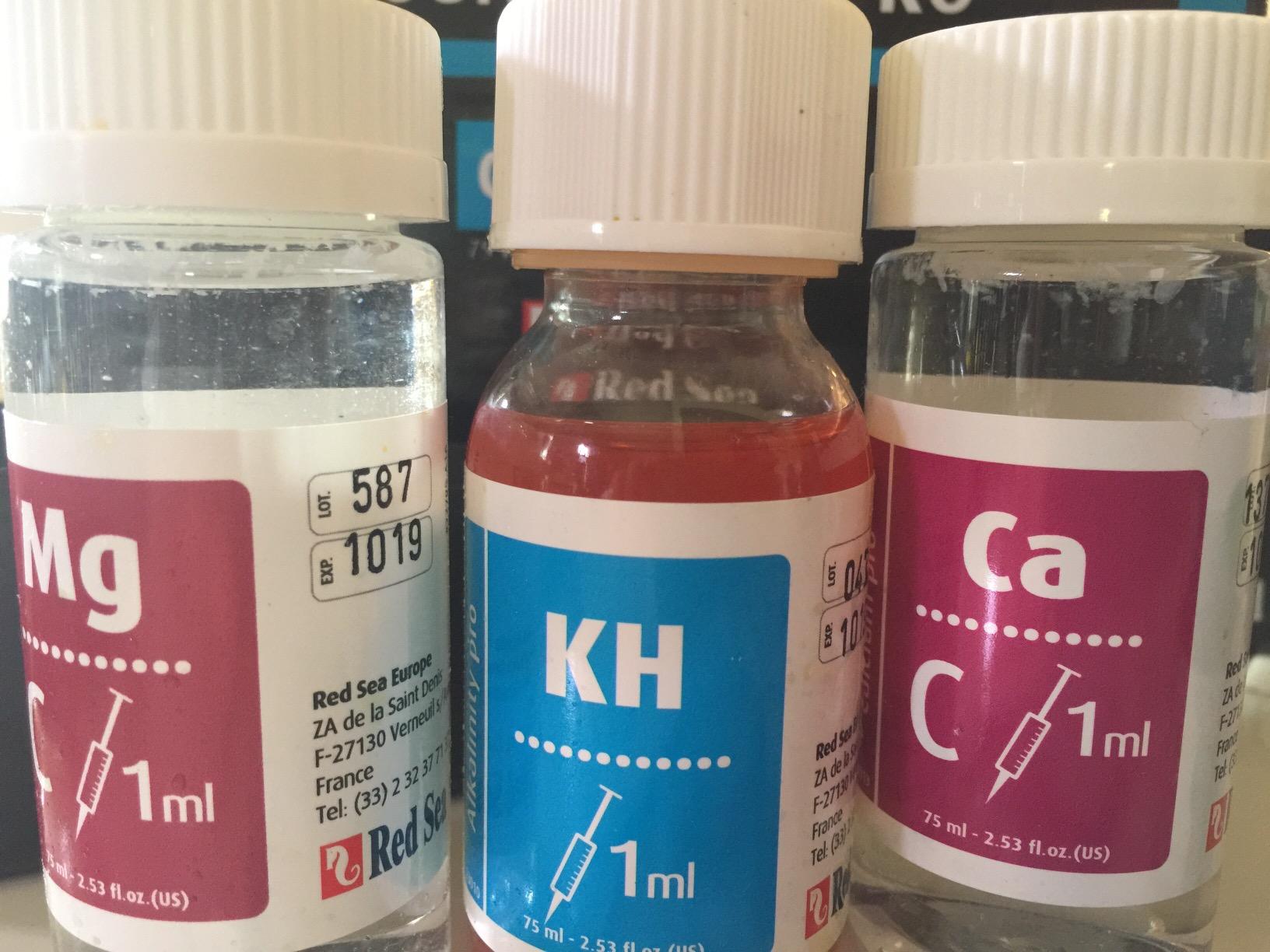
This is the only dedicated reef foundation kit among the ten. It is a titration set for calcium, magnesium and alkalinity with published resolution: 75-test calcium at 5 ppm steps, 75-test KH at 0.05 meq/L, and 60-test magnesium at 20 ppm steps. That resolution data is what separates a reef kit from a general aquarium kit, and Red Sea is one of very few brands that publishes it.
Reviewers report alkalinity readings that matched a Hanna checker within 0.1 dKH in independent comparison, and several mention cross-checks against API, Seachem and ICPOES results. The included titrator extension and quick-reference cards make dosing calculations straightforward, and the components are colour-coded to reduce cross-contamination.
It holds 4.4 across 776 reviews with 74 percent five-star, and the case is a sturdy hard plastic unit with glass test vessels. The package measures 5.91 by 7.09 by 3.54 inches.
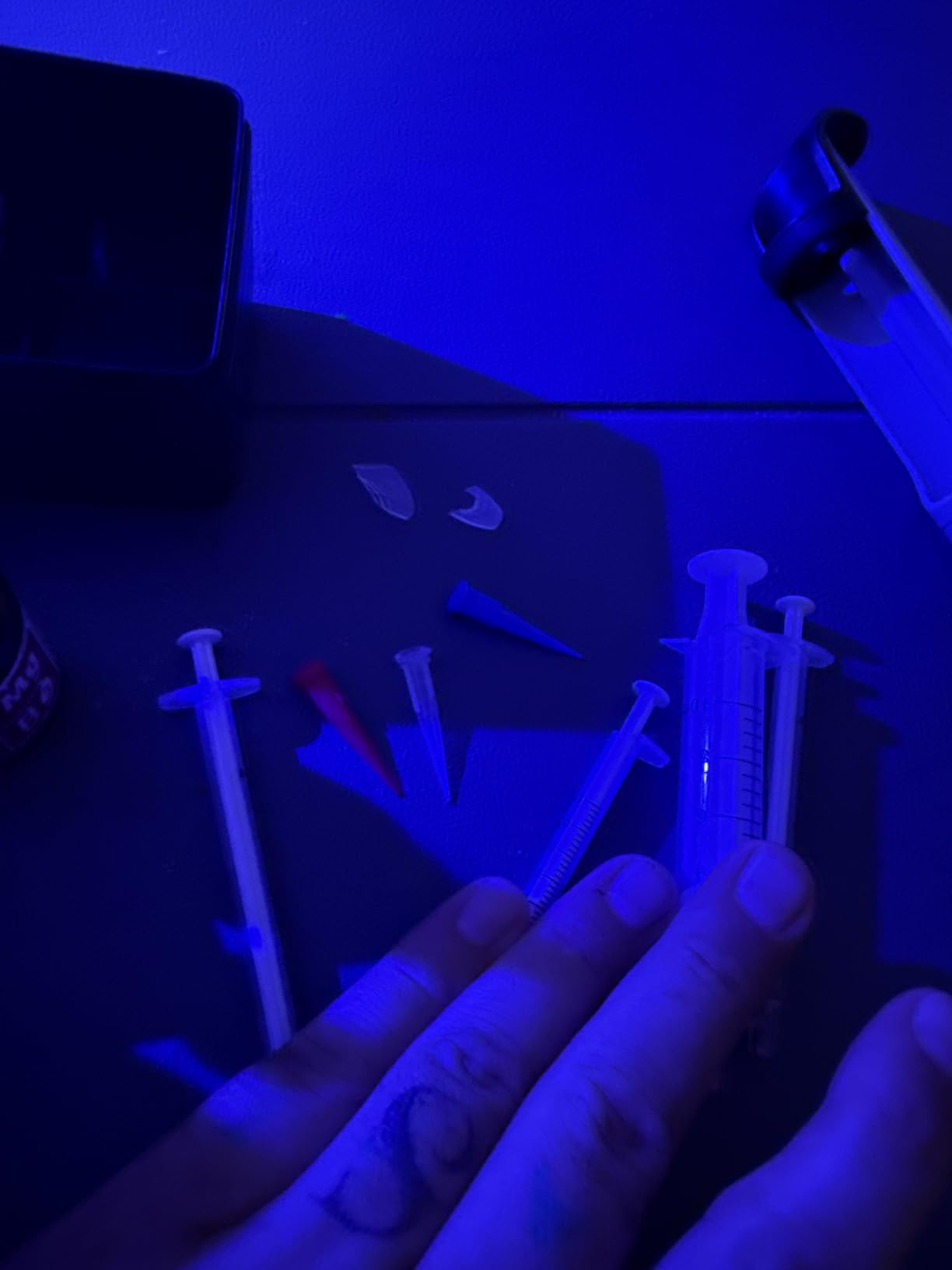
The honest weakness is magnesium. Reviewers consistently describe it as the most tedious of the three, with a long sequence of steps, and the practical advice is that you only need to run it biweekly or monthly. Some also report colour endpoints that are harder to read than Salifert, and a few report missing components on arrival.
Who this kit is built for
Reefers who have already run the hobby for a season and want the tightest published resolution on the three parameters that matter. If you are dosing to the decimal place and chasing growth, the resolution numbers here justify the step up.
It is also a strong choice if you want one brand across your whole trio. Cross-brand disagreements between two titration kits are common, and a single chemistry removes that variable entirely.
Where it frustrates people
The magnesium test is the dealbreaker for some. If you are not willing to spend twenty minutes on it once a month, you are paying test capacity you will not use.
There is a design flaw reviewers mention more than once: the case is roughly half an inch too short to close with the titrator stored inside. Plan to keep the titrator separate or accept an open case.
We earn a commission, at no additional cost to you. CERTAIN CONTENT THAT APPEARS ON THIS SITE COMES FROM AMAZON. THIS CONTENT IS PROVIDED 'AS IS' AND IS SUBJECT TO CHANGE OR REMOVAL AT ANY TIME.
7. API Phosphate Test Kit – Best for Nutrient Checks
API Phosphate Test Kit For Freshwater And Saltwater, 64 OUNCES
- 150 tests
- Reads 0-10 ppm phosphate
- Two color cards and one tube
Pros
- 150 tests in a single kit
- Reads the full 0-10 ppm range
- Simple low-cost add-on for reefers
Cons
- Single parameter only
- Two similar color cards can be confused
We earn a commission, at no additional cost to you. CERTAIN CONTENT THAT APPEARS ON THIS SITE COMES FROM AMAZON. THIS CONTENT IS PROVIDED 'AS IS' AND IS SUBJECT TO CHANGE OR REMOVAL AT ANY TIME.
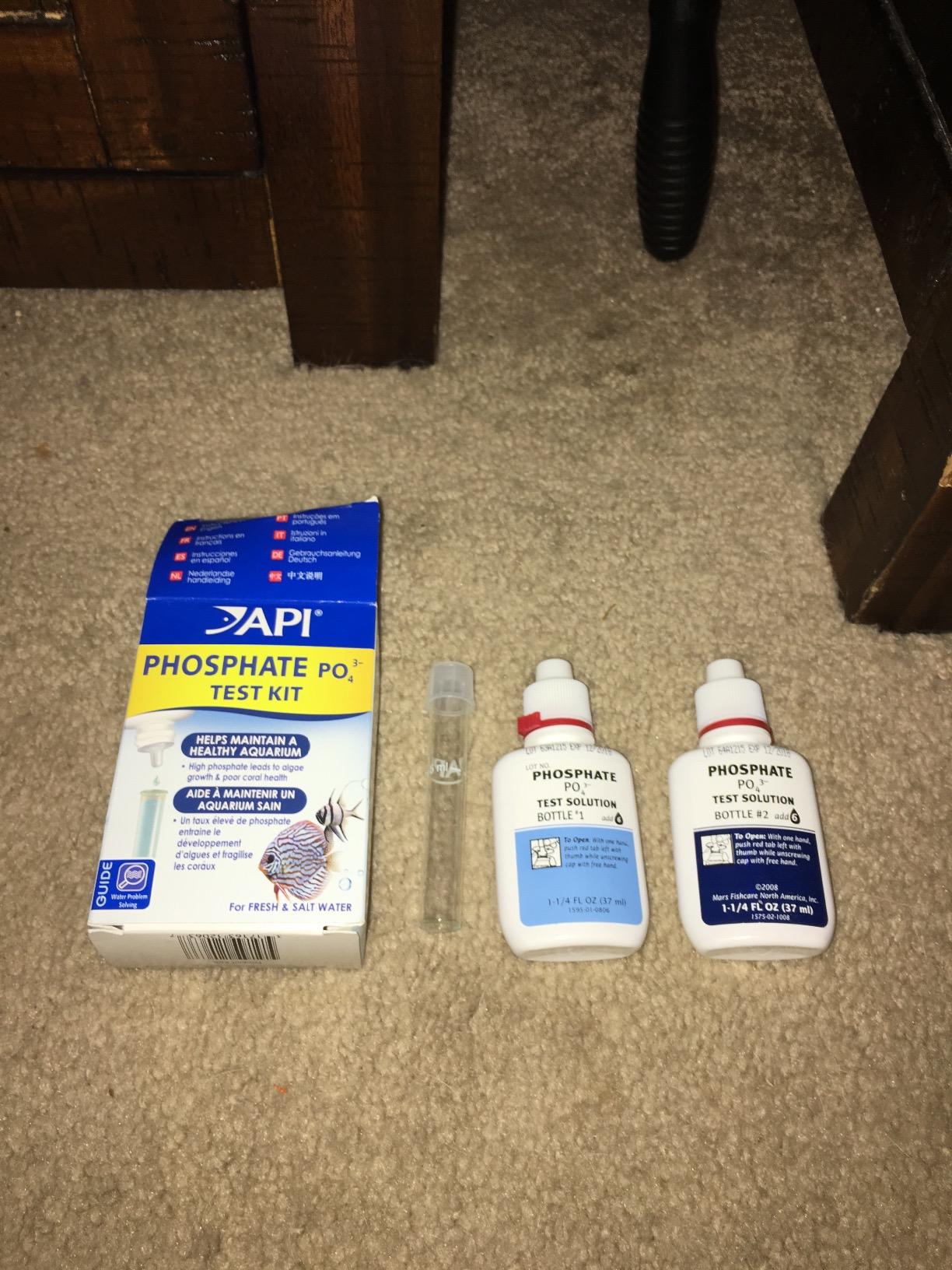
Phosphate is the parameter that drives whether a reef tank stays clean or turns into an algae farm, and this is a simple way to keep an eye on it. The kit does 150 tests, reads 0 to 10 ppm, and includes two bottles of testing solution, two colour cards and one capped tube in a package 2.75 by 1.63 by 5.13 inches.
Reviewers note that the 0 to 10 ppm span covers the relevant reef range and stops there, which is a more honest design than a scale that stretches into freshwater territory and wastes half the chart.
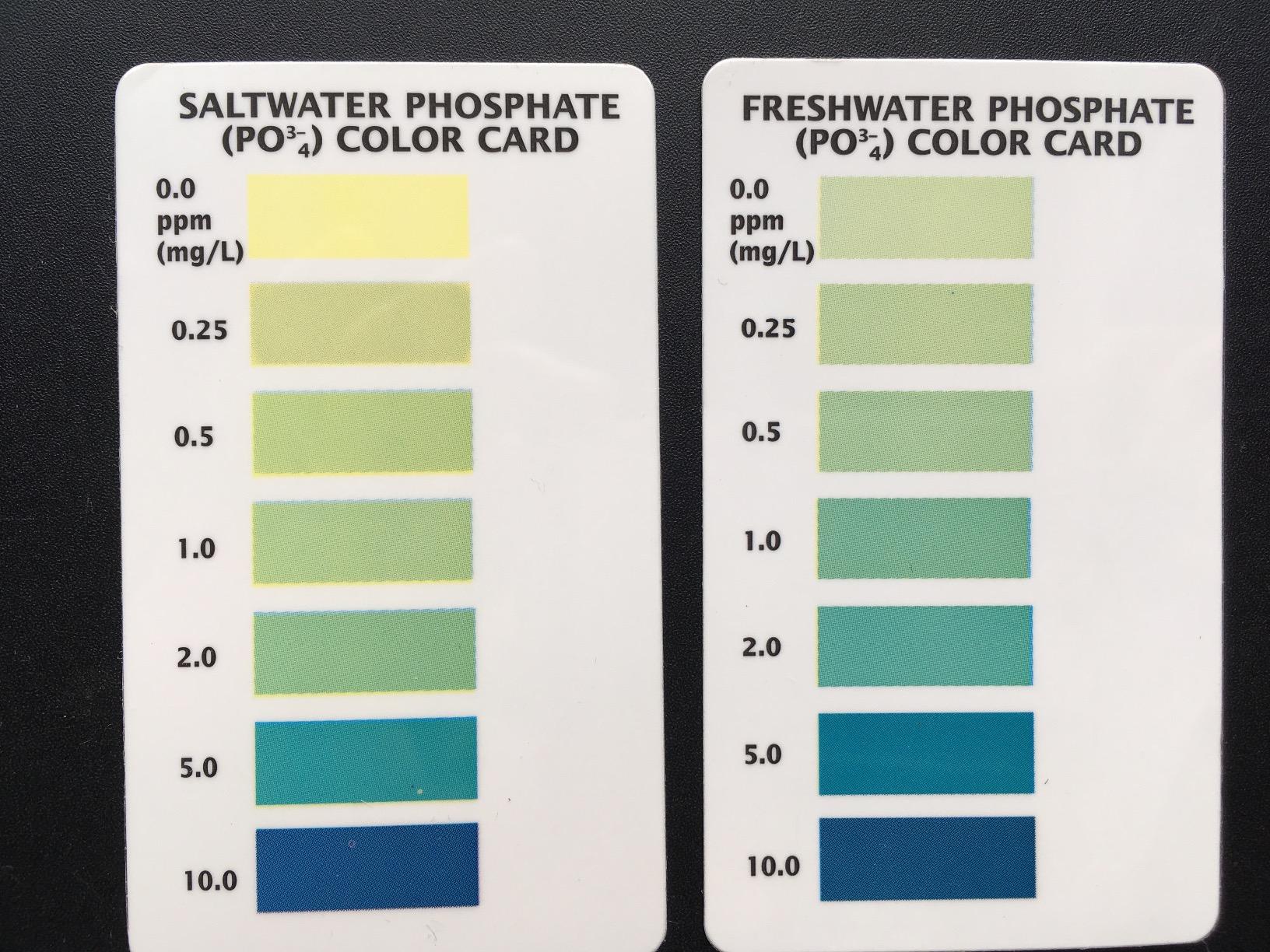
It rates 4.6 across 1551 reviews with 78 percent five-star, and holds a number 4 best-selling rank in the category. Reviewers consistently describe it as a dependable low-cost check that gets bought alongside a master kit rather than as a standalone reef solution, which is exactly how you should treat it.
The real limitation is resolution at the low end. At 0.03 to 0.10 ppm, the steps on the colour card are wider than the range most mature reefs operate in. It will tell you phosphate is present and roughly how much, but it will not resolve two adjacent target values.
Where it does the job well
It is the right call for a new reef, a fish-only-plus-coral system, and any tank where you suspect an export problem rather than a dosing problem. High readings are exactly what this kit reads well.
At 150 tests it lasts a long time, so it is a sensible first reef purchase to sit alongside a calcium, alkalinity and magnesium kit without thinking hard about reagent frequency.
When you need to move up
If you are running a mature system where the goal is steady export rather than damage control, you need a test that resolves below 0.1 ppm and gives you a repeatable number in that window. That is a colorimeter or a titration, not this card.
Also check that you have the right card in your hand. Two colour cards ship in the box and reviewers report occasionally grabbing the wrong one, which is an easy way to convince yourself phosphate jumped.
We earn a commission, at no additional cost to you. CERTAIN CONTENT THAT APPEARS ON THIS SITE COMES FROM AMAZON. THIS CONTENT IS PROVIDED 'AS IS' AND IS SUBJECT TO CHANGE OR REMOVAL AT ANY TIME.
8. Salifert Potassium Test Kit – Best for Trace Parameter Tracking
Salifert RTKA Potassium Test Kit
- 250-470 ppm range
- Up to 40 tests
- Marine use only, made in Holland
Pros
- Widely used for saltwater potassium
- Verified against ICPOES results
- Quick test with clear endpoint
Cons
- Colour change is harder to see than other Salifert tests
- Very technique sensitive
- Marine use only
We earn a commission, at no additional cost to you. CERTAIN CONTENT THAT APPEARS ON THIS SITE COMES FROM AMAZON. THIS CONTENT IS PROVIDED 'AS IS' AND IS SUBJECT TO CHANGE OR REMOVAL AT ANY TIME.
Potassium is dosed by many reef keepers and tested by relatively few. This Salifert kit covers 250 to 470 ppm, enough for up to 40 tests, and it is made in Holland for marine use only. Reviewers describe it as fast with an endpoint that reads cleanly once you know the routine, and several report it verified accurate against ICPOES laboratory testing.
Reviewers and forum threads generally back the Salifert chemistry over competing Red Sea options here, which matters if you are dosing a potassium component and need to know whether it is landing.
The rating is 4.2 across 128 reviews, with 69 percent five-star and 10 percent one-star. The gap between those numbers is the story: people who run the test correctly love it, and people who run it carelessly do not.
When potassium testing earns its cost
If you dose potassium separately, test it. A potassium shortfall shows up as poor coral colour and stalled growth long before anything looks obviously wrong, and it is easy to mistake for a feeding problem.
It is also a sensible addition for anyone running a two-part or trace dosing schedule who wants to confirm the doses are actually being consumed rather than accumulating.
What makes it difficult
The colour change is harder to see than in other Salifert tests, and the whole procedure is very sensitive to technique. Reviewers who got bad results usually describe an inconsistent endpoint colour rather than wrong reagents.
Forty tests per kit works out to a modest total number of runs, so this is a periodic check rather than a weekly habit. At 250 to 470 ppm it covers the marine range only, which is exactly what you want and not something a freshwater keeper can use.
We earn a commission, at no additional cost to you. CERTAIN CONTENT THAT APPEARS ON THIS SITE COMES FROM AMAZON. THIS CONTENT IS PROVIDED 'AS IS' AND IS SUBJECT TO CHANGE OR REMOVAL AT ANY TIME.
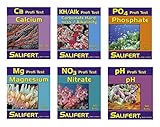
9. Salifert Master Reef Testing Combo Kit – Best Six-Parameter Bundle
Salifert Master Reef Testing Combo Kit – Saltwater Aquariums
- Six professional test kits
- Ca, NO3, PO4, pH, Alk, Mg
- 7.4 x 7.4 x 6.7 inches
Pros
- One purchase covers all six core reef parameters
- Built on Salifert titration chemistry
- Consolidates single kits into one bundle
Cons
- Includes tests many keepers never run
- Redundant for fish-only systems
We earn a commission, at no additional cost to you. CERTAIN CONTENT THAT APPEARS ON THIS SITE COMES FROM AMAZON. THIS CONTENT IS PROVIDED 'AS IS' AND IS SUBJECT TO CHANGE OR REMOVAL AT ANY TIME.
This is the single-box answer to the question most beginners ask, which is how do I test everything without buying six things. The bundle covers calcium, nitrate, phosphate, pH, alkalinity and magnesium, all on Salifert chemistry, and it weighs 1.12 pounds in a 7.4 by 7.4 by 6.7 inch package.
Forum consensus treats Salifert as a strong value in manual titration kits: inexpensive per test, consistent, and easy to run once you know the procedure. Long-term users report years without trouble, and the chemistry here is the same as the individual kits we rated highly above.
At 4.4 across 283 reviews with 77 percent five-star, the feedback is consistent. Buyers who want a one-stop reef solution cite completeness as the deciding factor, and the recurring complaint is simply that you are paying for tests you may never run.
Who should buy the bundle
A new reef keeper who wants every parameter available on day one and would rather not think about which kit to add next. For a mixed reef this removes the guesswork from the first two months.
It is also the easiest gift to buy for someone else’s reef, because there is no way to get the mix wrong. One box, six parameters, one brand of chemistry across all of them.
Where the bundle is inefficient
If you only run calcium, alkalinity and magnesium weekly, the nitrate, phosphate and pH tests sit unused until you need them. The leaner route is buying the trio kit first and adding nutrients later.
One more caution. Salifert phosphate is the weak point in an otherwise strong chemistry, and this bundle includes it. If precise low-range phosphate is your priority, add a dedicated low-range phosphate test rather than trusting the bundled one.
We earn a commission, at no additional cost to you. CERTAIN CONTENT THAT APPEARS ON THIS SITE COMES FROM AMAZON. THIS CONTENT IS PROVIDED 'AS IS' AND IS SUBJECT TO CHANGE OR REMOVAL AT ANY TIME.
10. Red Sea Coral Colors Pro Test Kit – Best for Coral Coloration
Red Sea Fish Pharm ARE21515 Saltwater Reef Color Pro Multi Test Kit for Aquarium, Red Sea Coral Colors Pro Test Kit I2 50 tests, K 40 tests , Fe 50 tests
- Iodine, potassium and iron
- Iodine 50 tests
- K 40 tests, Fe 50 tests
Pros
- Only widely available iodine
- potassium and iron panel
- Targets coloration parameters basic kits miss
- Red Sea titration accuracy
Cons
- Narrow scope for general reef testing
- Highest one-star share in this group
We earn a commission, at no additional cost to you. CERTAIN CONTENT THAT APPEARS ON THIS SITE COMES FROM AMAZON. THIS CONTENT IS PROVIDED 'AS IS' AND IS SUBJECT TO CHANGE OR REMOVAL AT ANY TIME.
This kit exists for a very specific reason. It measures iodine at 50 tests, potassium at 40 tests and iron at 50 tests, and none of the other nine products listed here measure all three. Coloration is governed by trace elements, and if you are chasing polyp colour and pigmentation rather than growth, this is the panel that talks about it.
It uses Red Sea titration chemistry in the same hard plastic case format as the Marine Care kit, at 5.51 by 6.69 by 3.15 inches and a pound. Reviewers single it out as the only widely available kit pairing iodine, potassium and iron trace testing.
At 4.0 across 111 reviews with 61 percent five-star and 13 percent one-star, it has the thinnest review base and the lowest average rating in this roundup. The 1-star share is worth reading before you buy.
Where it makes sense
Advanced systems where trace element dosing is part of the routine. If you run a coral colours program or supplement iodine and iron deliberately, these are the only numbers that tell you whether it is working.
It is also a reasonable addition to an established kit bundle rather than a replacement. Nothing here covers alkalinity, calcium, magnesium, nitrate or phosphate, so it sits alongside your main protocol.
What you give up
The scope is narrow by design. Buying this as your main reef kit means you still need everything else, so the total cost of a full setup goes up rather than down.
Iodine and iron readings in a lightly stocked system tend to fall wherever the dosing puts them, not at a meaningful target, so buying the kit before you have a reason to adjust those parameters is rarely worth it. Start with the core trio and add this when colour becomes the goal.
We earn a commission, at no additional cost to you. CERTAIN CONTENT THAT APPEARS ON THIS SITE COMES FROM AMAZON. THIS CONTENT IS PROVIDED 'AS IS' AND IS SUBJECT TO CHANGE OR REMOVAL AT ANY TIME.
Titration vs Colorimeter: Which Type of Reef Test Kit Should You Buy?
Titration and colorimetry solve the same problem in opposite ways, and the honest answer is that they fail differently. Titration counts drops until a colour change hits an endpoint, so precision comes from the count and errors come from technique and reagent age. Colorimetry compares a sample against a calibrated optical scale, so errors come from sample handling and calibration drift.
For alkalinity, calcium and magnesium, titration generally wins on resolution and refill cost. Drop-count methods give fine steps in the range where reef keeping happens, and reagents are widely available. For nitrate and phosphate, colorimetry usually wins, because low-range nutrient resolution is exactly where color charts break down and optical comparison does not.
That split is the reason the hybrid protocol has become standard among experienced reefers rather than a compromise: one chemistry for the big three, a better method for the nutrients. Most of the wet kits on this list are titration, which reflects where the reef hobby has actually concentrated its refinement.
Accuracy vs Consistency: The Two Things That Actually Matter
Accuracy is how close a reading is to the true value. Consistency is whether the same kit gives the same number twice. For reef keeping, consistency matters more often than accuracy, because you are comparing this week’s reading against last week’s and acting on the difference.
The most-cited public accuracy study for saltwater test kits is the BRStv investigation, in which six kits were run by five reefers against a trimmed-mean baseline. Reported findings put Aquaforest closest to baseline on calcium within 2 ppm and on magnesium at 1384 ppm against a 1389 ppm baseline, with Salifert close behind on magnesium, Red Sea the most consistent on calcium with a 10 ppm spread, and Hanna the most consistent on alkalinity at a 0.3 dKH spread.
Two cautions before you lean on that study. It covered calcium, alkalinity and magnesium only, so it tells you nothing about phosphate or nitrate where kit choice matters most. And the data is several years old, so treat it as a framework for judging brands rather than a current scoreboard for specific products.
Test Technique Mistakes That Make Good Kits Look Bad
A large share of complaints that start as bad-kit reviews end as technique problems. On reef forums the recurring complaint is not that Salifert is inaccurate but that people get bad results from it, and one thread summed up the frustration directly: many reefers complain about bad kits when the mistake was in the procedure.
Four errors cause most of it. Pulling liquid into the syringe to the rubber stopper instead of the fill line puts an air bubble where the volume needs to be exact. Reading a meniscus from above rather than at eye level shifts the reading. Using a syringe that has never been weighed and balanced drifts every result. And running out-of-date reagents produces a consistently biased number with no visible sign that anything is wrong.
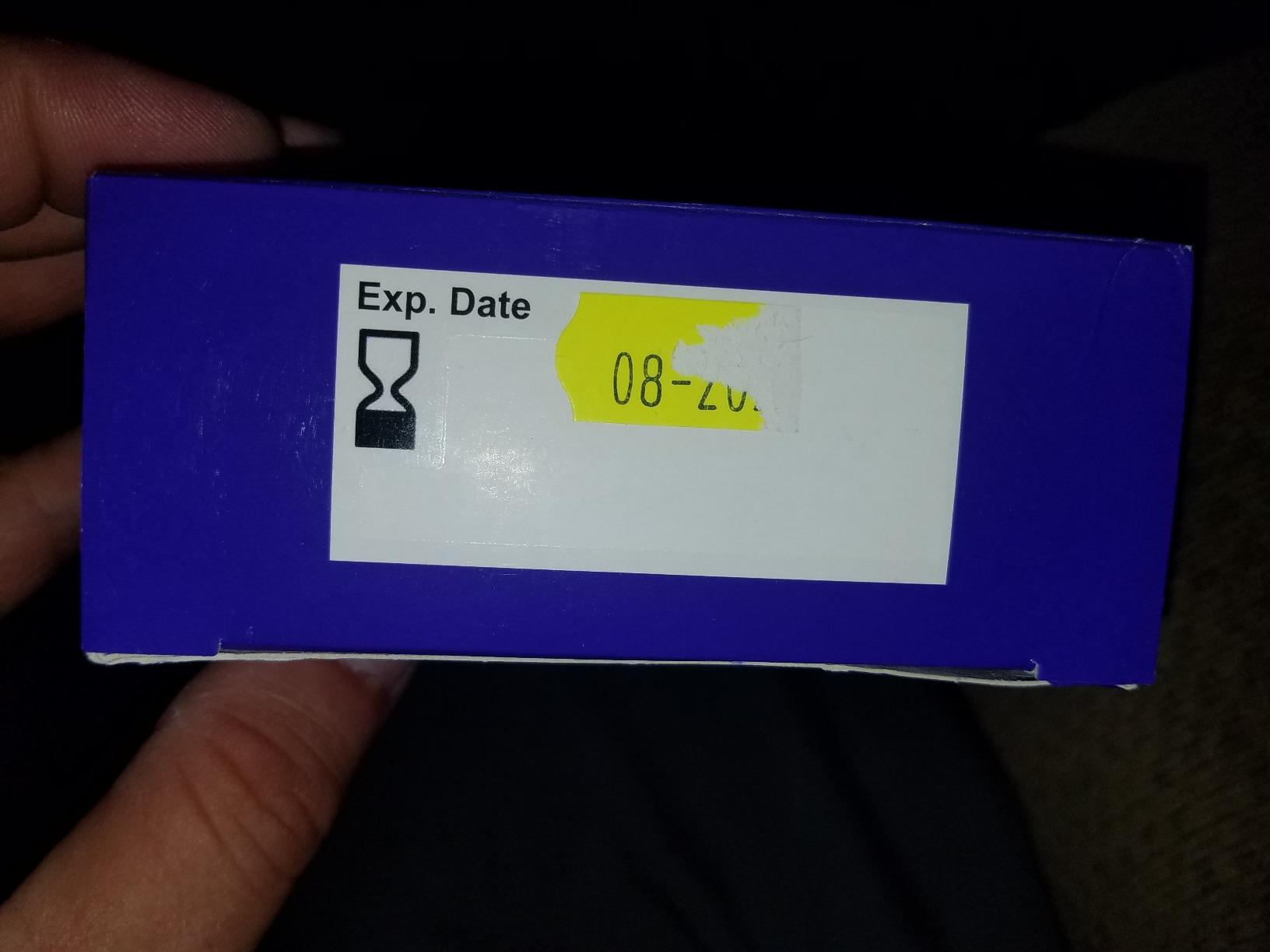
Reagent expiry is the one people ignore most. A kit that has been in a cupboard since last year is not measuring your tank, it is measuring your cupboard. Buy reagents with a visible expiry date, store them cool, and run a fresh kit against an old one when readings suddenly shift.
Do You Also Need an Automated Water Tester?
No automated tester replaces weekly manual testing, and the reef community is fairly settled on that. Devices such as the Neptune Atlas and the GHL KH Director are treated as alerting supplements that flag an emergency while you are away, not as substitutes for a confirmed reading.
What they add is coverage rather than accuracy. A pH probe and a conductivity probe track a tank continuously through a night when a skimmer overflows. A KH monitor sends an alert when a dosing pump fails. Neither replaces a magnesium reading, and neither tells you anything about phosphate.
The practical pattern is layering: wet kits for the parameters that drive dosing, automation for the ones that can change fast while nobody is looking. If you want to check one habit before buying automation, verify that your weekly wet readings are consistent. Devices built on top of an unstable manual baseline just inherit the noise.
How to Choose the Right Reef Tank Test Kit
Start from the parameters your tank needs, not the size of the box. The three core values are alkalinity, calcium and magnesium, and those are where reef calcification lives. Nutrients come next, once coral is consuming them. Trace elements like potassium, iodine and iron are last, and only if you are dosing them deliberately.
Second, check resolution against your target range. A kit that reads 0 to 10 ppm of phosphate will not help you manage 0.03 to 0.10 ppm. The same logic applies to alkalinity steps and calcium steps. If the published resolution is wider than the window you are trying to hold, move up a tier.
Third, think about refill supply rather than reagent capacity. A kit with 150 tests is no help if you cannot find bottles for it in two years, and colorimeter reagents are harder to source than titration reagents. Stick with brands your local stores carry.
Fourth, be honest about cadence. Weekly testing of five parameters is a commitment, and a kit you resent using is worse than a simpler one you run. Many experienced reefers test alkalinity daily, calcium and magnesium weekly, phosphate weekly, and potassium monthly. Pick the kit set that matches a schedule you will keep.
Finally, separate beginner and advanced routes. For a first mixed reef, a titration trio plus a phosphate test covers everything without overcomplicating it. For a mature system being pushed hard, add a colorimeter for nutrients and consider a periodic mail-in lab panel to verify the whole chain.
Frequently Asked Questions
What is the best marine test kit for a reef tank?
The best marine test kit for a reef tank is a titration kit covering alkalinity, calcium and magnesium, paired with a dedicated low-range phosphate test. The Salifert Alkalinity Calcium Magnesium Combo covers the core trio, and the API Phosphate Test Kit handles nutrients at low cost. Experienced reefers add a Salifert Master Reef bundle later for full six-parameter coverage.
How accurate are Salifert test kits?
Salifert kits are widely treated as accurate for calcium, alkalinity and magnesium. In the widely cited BRStv multi-reefer study, Salifert trailed the closest reading only slightly on magnesium, and reviewers report Salifert magnesium results matching ICPOES laboratory results. Weak points exist: the phosphate test has limited low-range resolution, and results drift if reagents are old or syringe technique is sloppy.
What is the best automatic water tester for a reef tank?
Automatic testers such as the Neptune Atlas and the GHL KH Director are best used as alerting supplements rather than replacements for manual tests. They track pH and conductivity continuously and can alert you to a dosing failure overnight. They do not replace weekly manual confirmation, and most do not measure phosphate, calcium or magnesium at all.
What are the best water parameters for a reef tank?
For most mixed reefs, target alkalinity between 7.8 and 8.5 dKH, calcium between 400 and 450 ppm, magnesium between 1280 and 1380 ppm, nitrate between 2 and 20 ppm, and phosphate between 0.03 and 0.10 ppm. Stability matters more than hitting an exact number, so consistent readings inside these ranges beat frequent swings.
Is a 7.3 alkalinity level good for a reef tank?
A 7.3 dKH alkalinity reading is low for a typical mixed reef, which usually targets 7.8 to 8.5 dKH. At that level, buffering capacity drops and calcium and magnesium become harder to hold. If you are dosing a two-part system, raise alkalinity gradually with small water changes rather than one large correction.
What should nitrate and phosphate levels be in a reef tank?
A healthy reef should show measurable nitrate between 2 and 20 ppm rather than a pinned zero, which usually means export is too aggressive. Phosphate should sit between 0.03 and 0.10 ppm in a mature system. Both values need a test that resolves at the low end, since a general freshwater color chart cannot show the difference within those ranges.
Why do my test kit readings differ from my local fish store?
Differences usually come from one of three places: technique, reagent age, or a genuinely different method. Store tests and home tests may also use different chemistry, such as a titration kit versus a colorimeter. Test your own kit twice before suspecting it, run a fresh reagent set, and check that your meniscus and syringe technique match the instructions.
Final Verdict
The best aquarium test kits for reef tanks are the ones you will actually run twice. Start with the Salifert Alkalinity Calcium Magnesium Combo for the parameters that drive coral calcification, add the API Phosphate Test Kit for nutrients, and move up to the Red Sea Reef Foundation Pro when you want published resolution on the core trio.
Keep your API Saltwater Master on hand for cycling and livestock parameters, and consider a mail-in ICP panel once a year to audit everything your wet kits are telling you.