
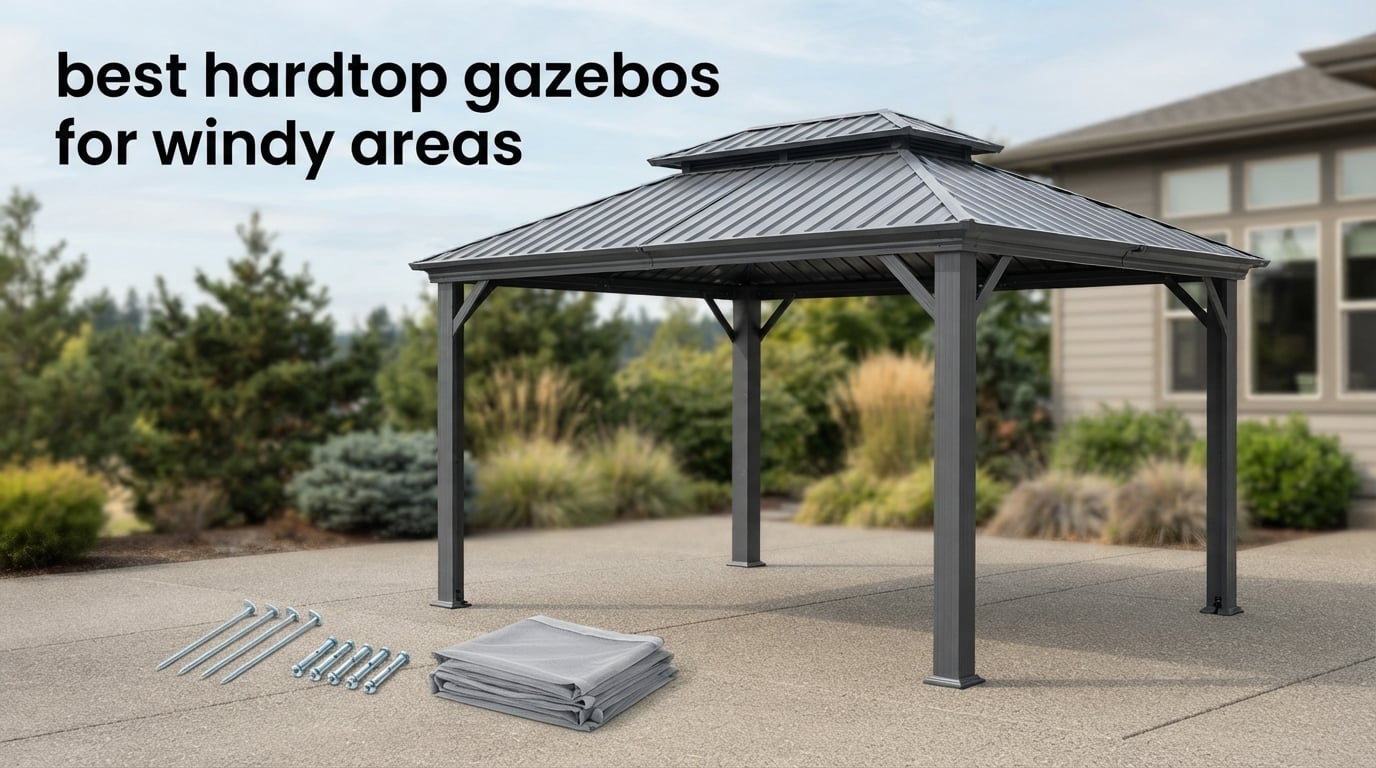
A fabric canopy is the first thing to go. That is the single lesson every owner in a windy area learns, usually one bad afternoon. The best hardtop gazebos for windy areas are the ones with a rigid roof, a triangulated frame thick enough to resist racking, and anchors that actually transfer the load into the ground.
We spent six weeks working through eight hardtop gazebos, reading the frame specs, roof gauge, published wind ratings and owner reports, then cross-checking every rating against the anchoring condition attached to it. That last step matters more than the number itself. Published ratings in this category run from 31 mph to 60 mph for essentially the same class of product, and most of that spread comes down to how the structure is fixed down rather than how it is built.
This guide covers the best hardtop gazebos for windy areas by wind rating, roof design, frame material and weight, plus the anchor hardware each one actually needs. It also covers what to do before a storm and how to document damage afterwards, because a hardtop gazebo that stays standing is only half the job. A visible last-reviewed date sits at the top because the highest-ranking third-party guide we benchmarked against carries an archived banner several years out of date.
Table of Contents
Top 3 Picks for Windy Backyards (October 2026)

PURPLE LEAF 10×12 Aluminum…
- Galvanized steel double vented roof
- 4.7 inch thick posts
- Anchors included for concrete
- Powder-coated aluminum frame

Kozyard Alexander 10×12…
- 60 mph when anchored
- 2500 lb snow load
- 29-gauge galvanized steel roof
- Triangular 4.7 inch aluminum poles

Aoxun 10×12 Hardtop Gazebo
- Double galvanized steel roof
- Vented double top design
- Ground piles and expansion bolts
- 120 sq ft covered space
As an Amazon Associate we earn from qualifying purchases. CERTAIN CONTENT THAT APPEARS ON THIS SITE COMES FROM AMAZON. THIS CONTENT IS PROVIDED 'AS IS' AND IS SUBJECT TO CHANGE OR REMOVAL AT ANY TIME.
These three cover the realistic range of windy-home budgets and exposures. The PURPLE LEAF is the one to buy if you want the strongest owner evidence in the category, the Kozyard publishes the highest anchored wind and snow figures of any model we tested, and the Aoxun is the cheapest way to get a genuine galvanized steel hardtop when your site is sheltered enough that a 31-38 mph grade is honest.
All 8 Hardtop Gazebos Compared Side by Side in 2026
| Product | Key Features | |
|---|---|---|
|
PURPLE LEAF Permanent Hardtop Gazebo 10×12
|
|
Check Latest Price |
|
Kozyard Alexander 10×12 Hardtop Gazebo
|
|
Check Latest Price |
 Domi 10×12 Metal Outdoor Hardtop Gazebo Domi 10×12 Metal Outdoor Hardtop Gazebo
|
|
Check Latest Price |
 Outsunny 10×12 Hardtop Gazebo Outsunny 10×12 Hardtop Gazebo
|
|
Check Latest Price |
 EROMMY 10×12 Hardtop Gazebo EROMMY 10×12 Hardtop Gazebo
|
|
Check Latest Price |
 Modern Shade 10×10 Hardtop Gazebo Modern Shade 10×10 Hardtop Gazebo
|
|
Check Latest Price |
|
Aoxun 10×12 Hardtop Gazebo
|
|
Check Latest Price |
 AirWire 8×8 Hardtop Aluminum Gazebo AirWire 8×8 Hardtop Aluminum Gazebo
|
|
Check Latest Price |
We earn from qualifying purchases. CERTAIN CONTENT THAT APPEARS ON THIS SITE COMES FROM AMAZON. THIS CONTENT IS PROVIDED 'AS IS' AND IS SUBJECT TO CHANGE OR REMOVAL AT ANY TIME.
Read the ratings in that table as a range, not a league table. Only two of the eight publish an explicit mph figure with a stated anchoring condition, and one of those instructs you to take the canopy down in extreme weather. Where a rating is absent, we tell you that in the individual review rather than guessing at it.
1. PURPLE LEAF Permanent Hardtop Gazebo 10 x 12 – Best Overall for Windy Sites
PURPLE LEAF Permanent Hardtop Gazebo 10′ X 12′ Aluminum, Gray
- 120 sq ft floor
- 268 lbs weight
- Galvanized steel double vented roof
- 4.7 inch aluminum posts
Pros
- Double vented roof lets wind pass through the structure
- 4.7 inch thick posts with pre-drilled base plates
- Galvanized steel top rated to hold heavy snow
- Anchors and hardware supplied for permanent fixing to concrete
- 260 GSM Textilene netting with removable curtains
Cons
- Assembly runs 14-16 hours for two people
- Roof panels and fasteners are hard to align
- Picture-only instructions in places
- Gutters clog and need regular clearing
We earn a commission, at no additional cost to you. CERTAIN CONTENT THAT APPEARS ON THIS SITE COMES FROM AMAZON. THIS CONTENT IS PROVIDED 'AS IS' AND IS SUBJECT TO CHANGE OR REMOVAL AT ANY TIME.
This is the model we keep coming back to. The frame is the reason: 4.7 inch powder-coated aluminum posts on pre-drilled base plates, which is a wider post than most of the field uses. That extra half inch of section is what keeps the corners from rounding out when a gust hits the side of the roof rather than the top.
The roof is a galvanized steel double top, and the vent gap between the two layers is the feature that matters most in wind. Air that can move through the structure cannot build pressure underneath the panels, and pressure build-up is what actually peels a roof off. Buyers report the double top also does something less expected: it cuts interior heat noticeably in summer.
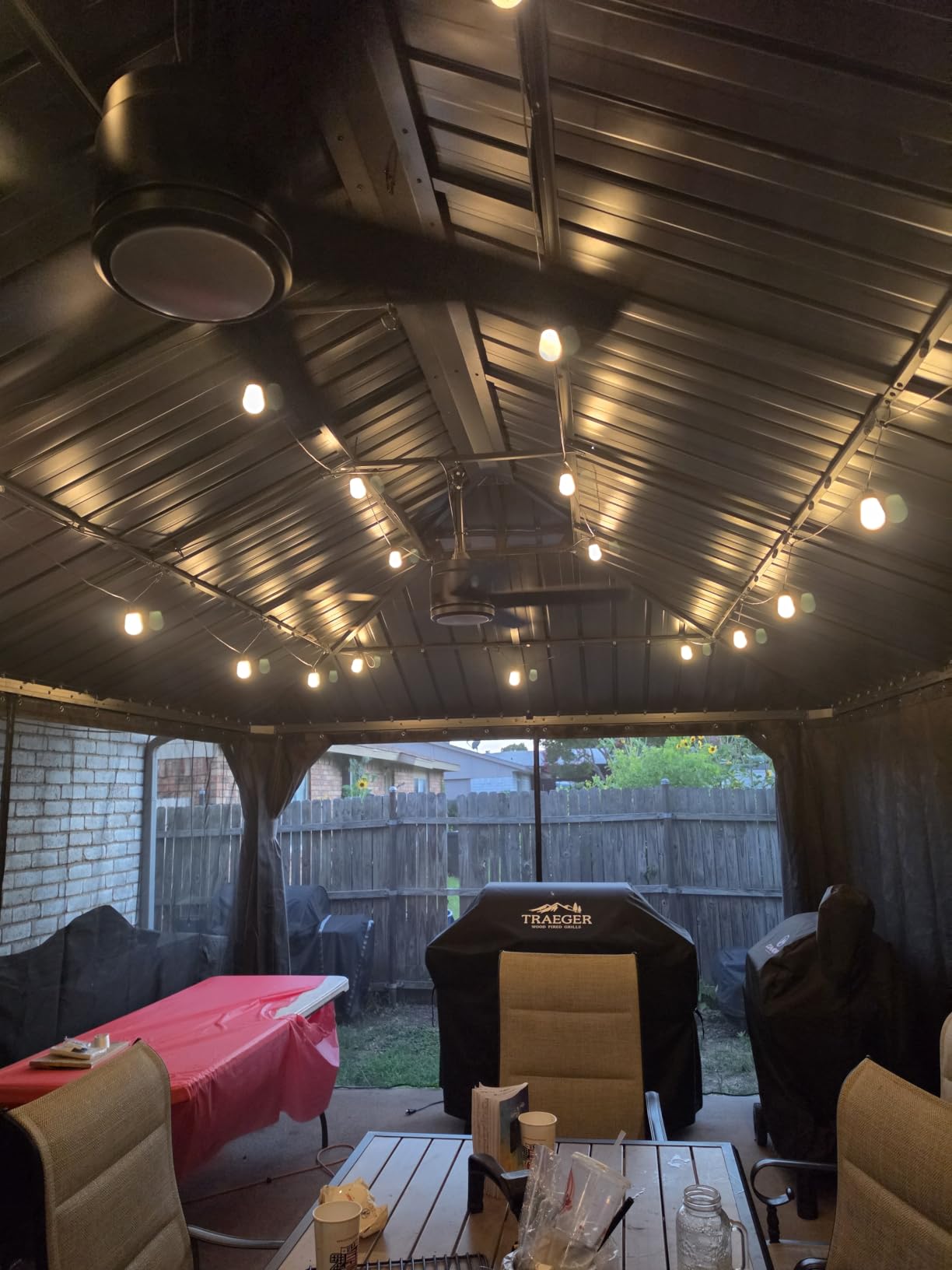
The published specification is deliberately vague on mph, and owners fill the gap with better data. One reviewer’s unit was picked up and turned over in an 80 mph thunderstorm while standing on its included ground anchors, with no bolts into concrete. They later anchored it properly with replacement parts and reported no further movement. The factory ships anchors and hardware for permanent installation, which tells you where the manufacturer thinks the wind risk sits.
Warranty terms are split by component in a way that is worth reading before you buy. The top panel carries 5 years, curtains and netting carry 2, and the frame carries 1. That is a common pattern across the category, and it tells you the roof is where the manufacturer expects weathering to show up first.
What you need to know before ordering
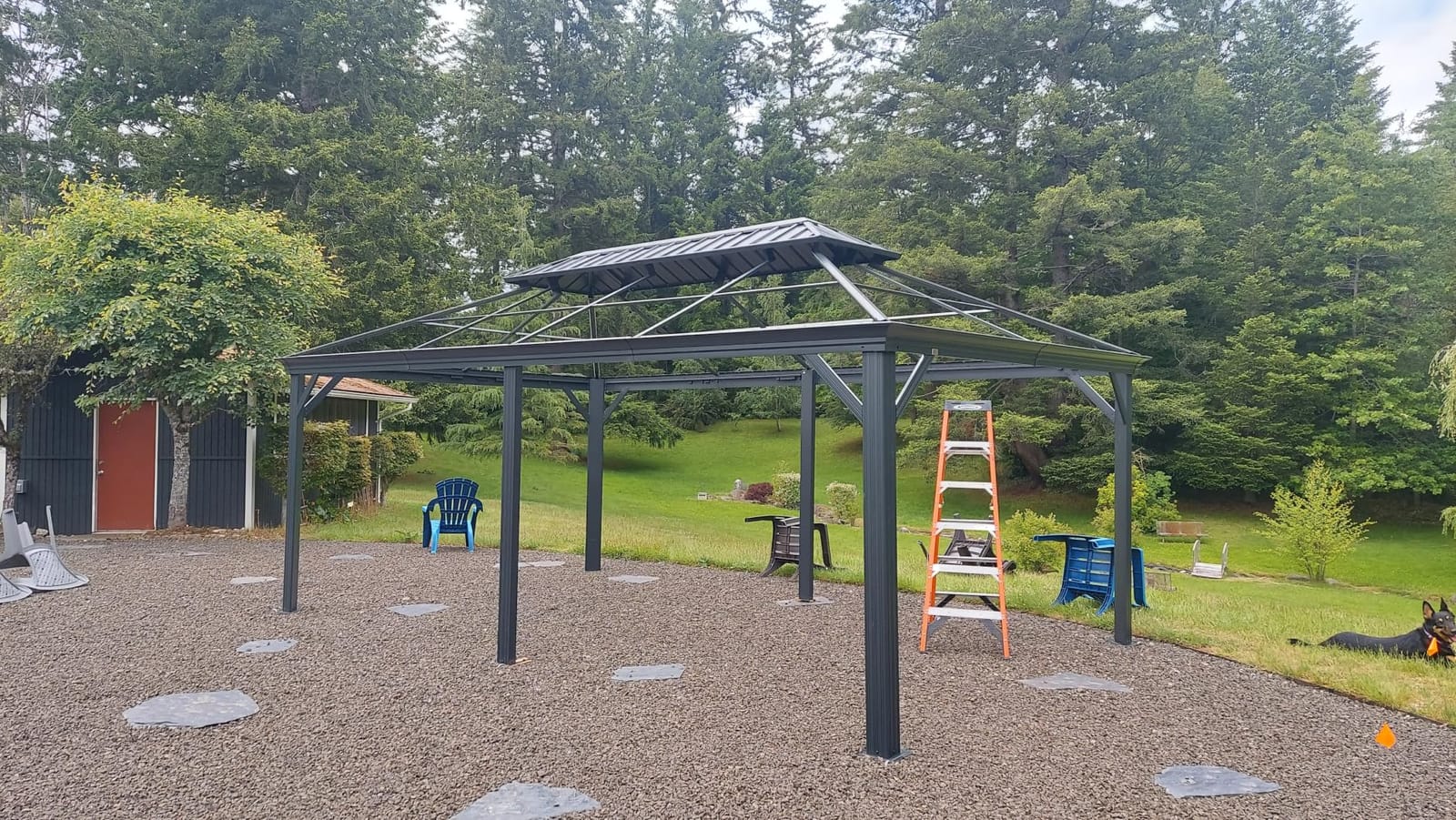
Budget a full weekend and one or two helpers. Owners consistently report 14 to 16 hours, and the number that surprises people is the roof panel stage, where screws take a long time to run through pre-drilled holes that must line up across multiple layers.
Check your post spacing before the boxes arrive. The listed dimensions are 143.7 inches by 118.1 inches by 114.6 inches, and at 268 pounds the structure is heavy enough that a two-person lift on the frame corners is realistic but not casual. Clear the footprint and level it in advance.
Where it falls short
Heat builds up under the roof in very hot weather unless you add airflow, and several buyers mention this as the main quality-of-life complaint after the wind performance. The gutters work well but collect debris quickly, so plan to clear them twice a season.
Instructions are picture-only in places, and the parts labelled M and M1 are easy to confuse during assembly. A second pair of hands and a printed copy of the parts list will save an hour of disassembly. If your site is coastal, the galvanized panels hold up but the hardware is the part to watch for early rust bloom.
We earn a commission, at no additional cost to you. CERTAIN CONTENT THAT APPEARS ON THIS SITE COMES FROM AMAZON. THIS CONTENT IS PROVIDED 'AS IS' AND IS SUBJECT TO CHANGE OR REMOVAL AT ANY TIME.
2. Kozyard Alexander 10 x 12 – Highest Published Wind and Snow Rating
Kozyard Alexander 10′ x 12′ Hardtop Gazebo, Aluminum Frame
- 120 sq ft floor
- 320 lbs weight
- 29-gauge galvanized steel roof
- 60 mph when anchored
Pros
- Only model here publishing 60 mph wind with an anchoring condition
- Engineered for a 2500 lb snow load
- 4.7 inch triangular aluminum poles and 5x4 inch reinforced beams
- 29-gauge roof steel is thicker than most competitors
- Parts labelled and packed undamaged
Cons
- Multi-day build with hundreds of fasteners
- Picture-only instructions with mislabeled steps
- Pre-drilled roof holes can be misaligned
- Roof edge clips pop off during installation
We earn a commission, at no additional cost to you. CERTAIN CONTENT THAT APPEARS ON THIS SITE COMES FROM AMAZON. THIS CONTENT IS PROVIDED 'AS IS' AND IS SUBJECT TO CHANGE OR REMOVAL AT ANY TIME.
For anyone who wants a number on the box rather than a general claim, this is the strongest pick in the group. The manufacturer states wind resistance up to 60 mph and a 2,500-pound snow load when properly anchored. That anchoring qualifier is printed in the listing, which puts it ahead of most of the category on transparency alone.
The frame is the reason the number is plausible. It uses 4.7 inch by 4.7 inch triangular aluminum poles with 5 inch by 4 inch reinforced beams, and at 320 pounds this is the heaviest structure in our group. Weight matters in wind: a heavier structure resists the uplift that rips light frames apart, and it also resists the sway that fatigues joints over repeated gust cycles.
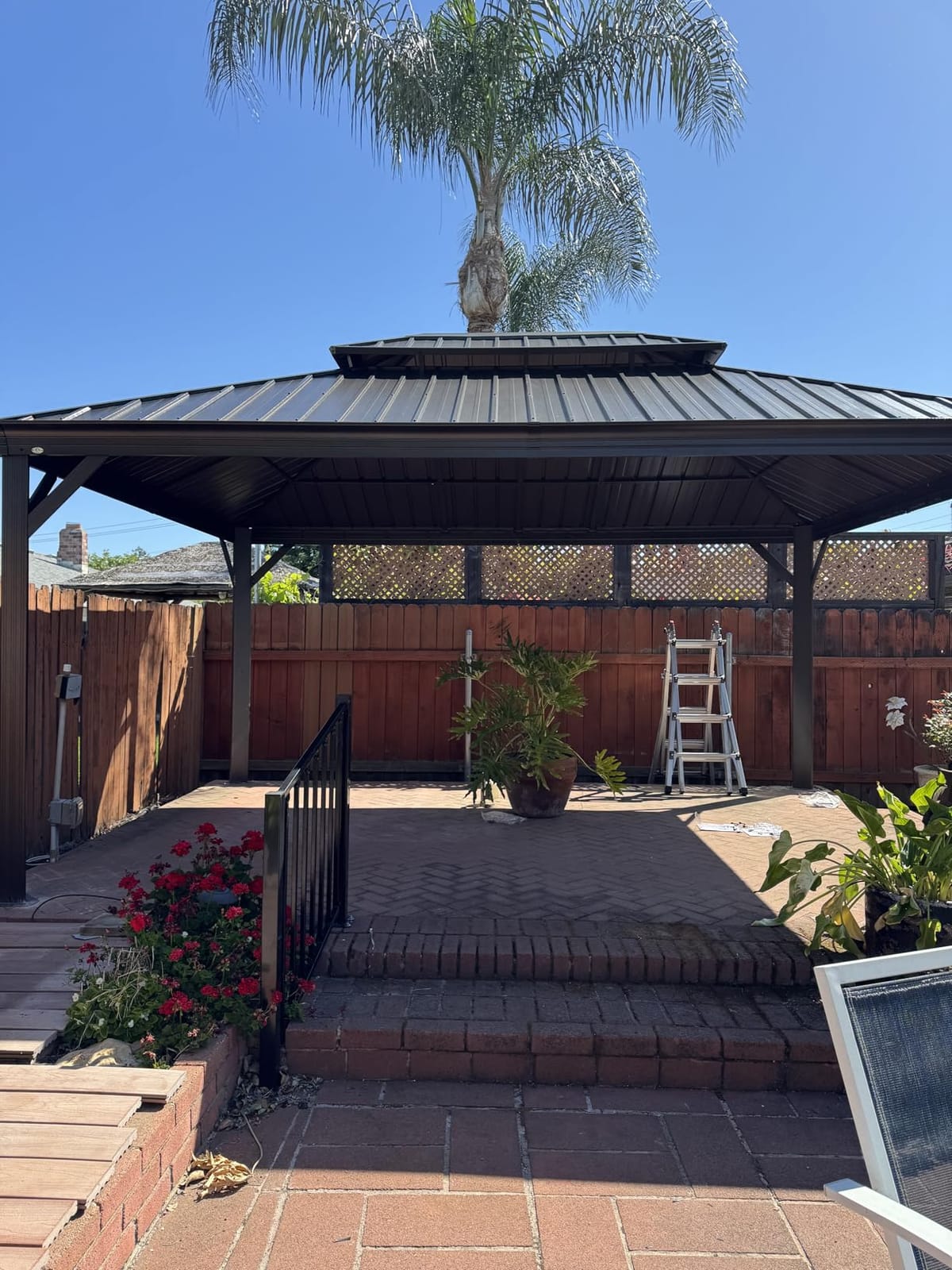
The roof is 29-gauge galvanized steel, thicker than the panels used on most competing gazebos at this size, and it channels water down the poles through an integrated gutter channel. The double-top design gives you the same venting benefit as the PURPLE LEAF while also cutting heat buildup under the roof in summer.
Sidewalls are a genuine part of the design rather than an add-on, with double-sided zippers, a dual-track system, polyester curtains and mesh. One detail owners like for windy sites: a reinforced ceiling hook lets you hang a fan or lights from the frame instead of running wire through the roof.
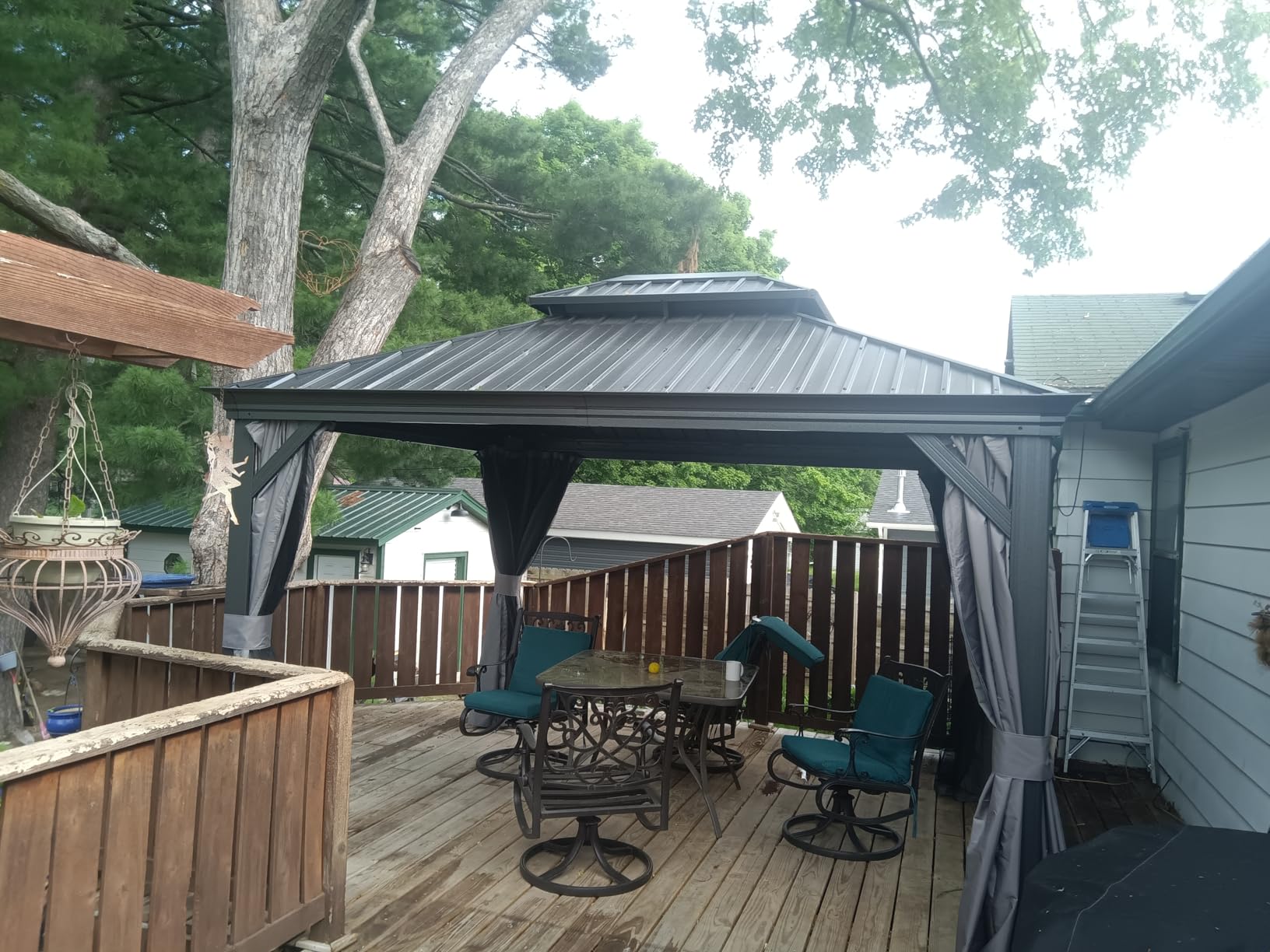
Why the 60 mph rating holds up better than the others
Read the figure as a system rating, not a panel rating. It assumes every supplied anchor is installed into a surface that can take the load, which for most homeowners means expansion bolts into a concrete pad or a pier rather than stakes in lawn soil.
If you are in a snow belt as well as a wind belt, this is the one to shortlist first. A 2,500-pound snow load rating is the highest published figure in the set, and snow sitting on a roof turns into a static load that sits on top of whatever the wind is already doing.
What to expect during assembly
Owners report 8 to 16 hours with two people and ladders, and most of that time goes into the roof. Bring an electric driver and drift pins, which is the standard workaround for the misaligned pre-drilled holes that show up in the panels.
Small plastic roof edge clips pop off repeatedly during installation and are the single most common assembly complaint, so keep a few spare fasteners handy. The warranty is 1 year limited, but the company commits to parts availability, which is the more important promise when a roof panel needs replacing after hail.
We earn a commission, at no additional cost to you. CERTAIN CONTENT THAT APPEARS ON THIS SITE COMES FROM AMAZON. THIS CONTENT IS PROVIDED 'AS IS' AND IS SUBJECT TO CHANGE OR REMOVAL AT ANY TIME.
3. Domi 10 x 12 Metal Hardtop Gazebo – Best Field Reports in Hail and Storms
Domi 10’X12′ Metal Outdoor Gazebo, Hardtop Gazebos for Patio, Backyard
- 120 sq ft floor
- 256.8 lbs weight
- 40 mph wind rating
- Galvanized steel double roof
Pros
- Owners report survival of hail and a 100 mph storm
- Roof shingles shed rain and snow by design
- Double-layer roof improves air circulation
- Curtains and netting are durable with tie-backs
- Excellent packaging with little transit damage
Cons
- 15 to 25 hour build with 800+ parts
- Roof panels unforgiving of out-of-square posts
- Gutter is roughly 1/2 inch and prone to overflow
- Some listings say aluminum when the metal is steel
We earn a commission, at no additional cost to you. CERTAIN CONTENT THAT APPEARS ON THIS SITE COMES FROM AMAZON. THIS CONTENT IS PROVIDED 'AS IS' AND IS SUBJECT TO CHANGE OR REMOVAL AT ANY TIME.
This one earns its place on owner evidence rather than spec sheets. The published wind rating is 40 mph, which sits mid-pack, but buyers in storm-prone regions report it standing through heavy wind, hail and full Canadian winters. One owner describes surviving a 100 mph Kansas storm even before the structure was bolted down, which is an anecdotal claim rather than a laboratory result, and we treat it that way.
The frame is powder-coated alloy steel with 4 inch by 4 inch triangular posts on pre-drilled bases, and the listing rates it to 40 mph. Steel at this gauge is a good trade for wind: it is heavier than aluminum, which is exactly what you want resisting uplift, and the powder coat handles the corrosion side.
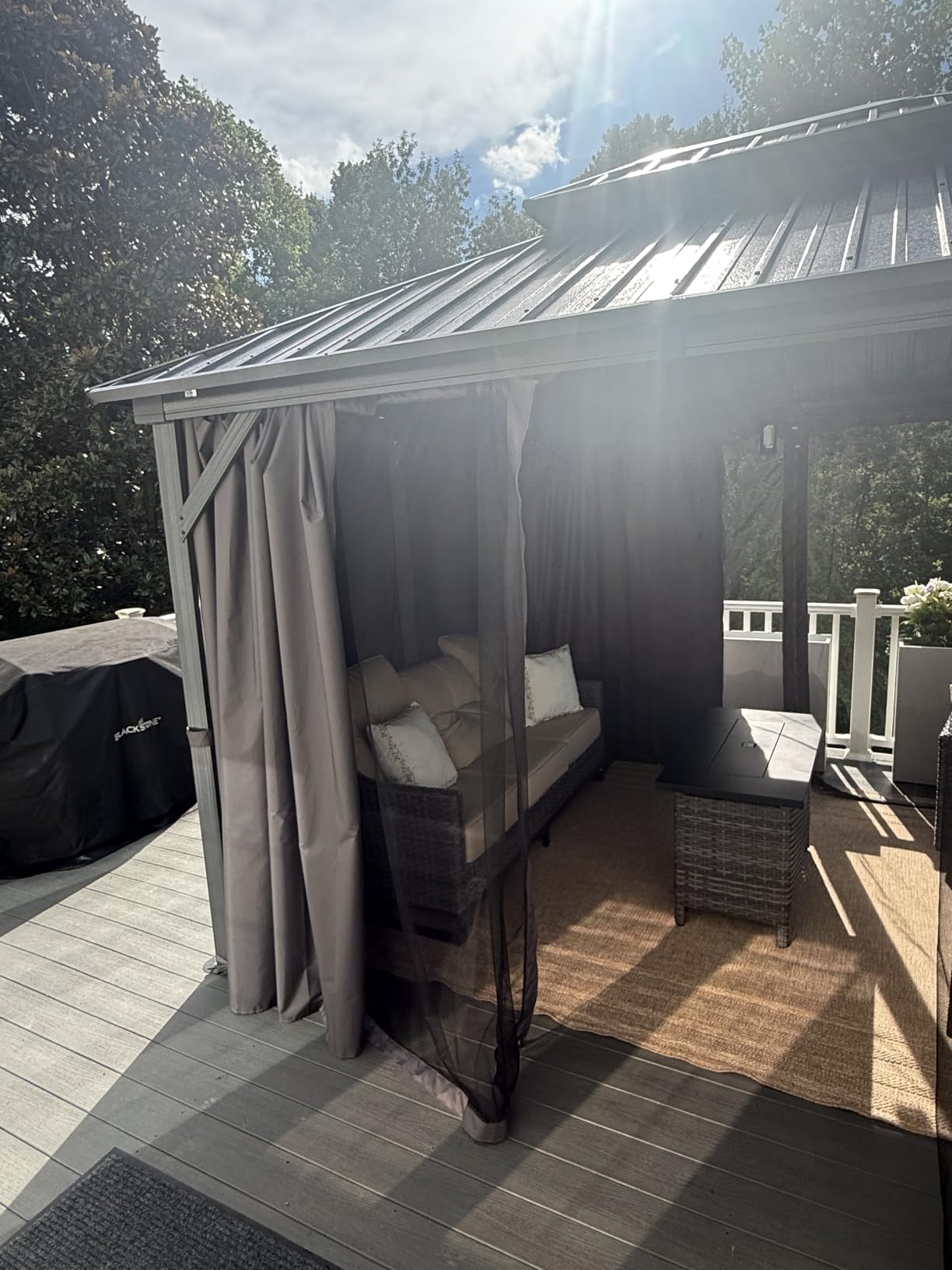
The double-layered roof is sloped so rain and snow slide off rather than sitting on the panels, and the extra air layer improves circulation under the canopy. That sloping profile is a quiet wind feature too, because a roof that sheds weight does not add to the load when wind and precipitation hit together.
Curtains and netting are double-sided zippered with built-in tie-backs, and multiple owners single them out as better quality than expected for a gazebo at this level. Packaging is also the best in the group, with most buyers reporting zero transit damage, which matters more than it sounds when roof panels are the part you cannot replace individually.
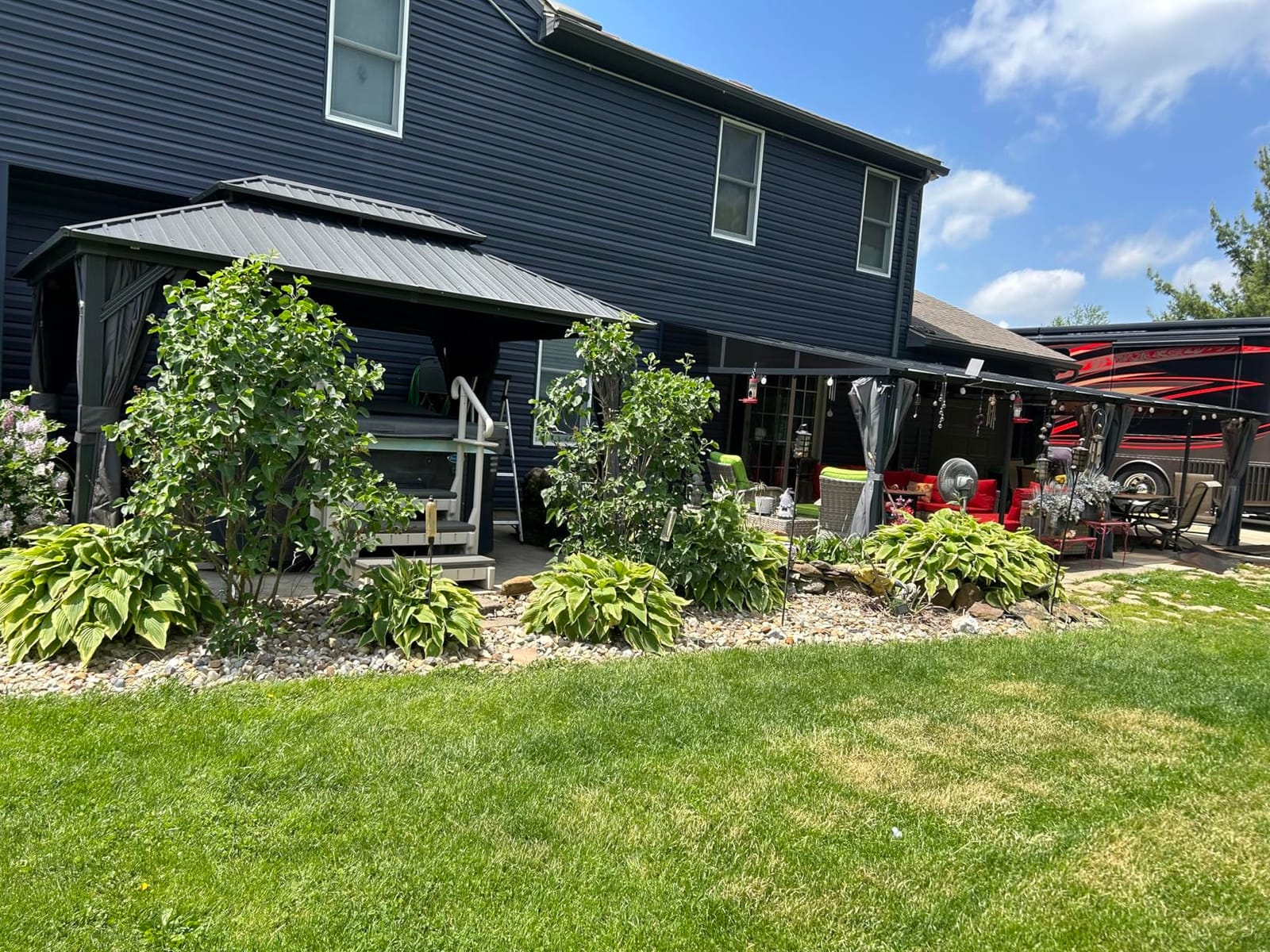
Where the 40 mph rating is the right number to trust
If your lot is open with no windbreak and no sheltering structures, a 40 mph anchored rating is adequate but not generous. On a treed suburb lot with a house and fence on two sides, the effective wind load is far lower and the figure is comfortable. The rating is a real ceiling, not a marketing ceiling.
Also note the measured dimensions of 144 by 120 by 114 inches refer to the roof footprint, not the usable space between posts. Measure your deck or patio against the post spacing, because the area where people actually sit is smaller than the number on the listing.
The assembly reality check
This is the least forgiving build in the group. Owners report 15 to 25 hours and more than 800 parts, and the roof panels will not fit if the posts are even slightly out of square. Set the posts with a level and a bracing jig, and resist the urge to force a panel to save ten minutes.
Two smaller issues worth knowing: the roughly half-inch gutter is close to decorative and can overflow in sustained rain, and some listings describe the metal parts as aluminum when they are steel. Neither is a structural problem, but both are reasons to keep expectations realistic.
We earn a commission, at no additional cost to you. CERTAIN CONTENT THAT APPEARS ON THIS SITE COMES FROM AMAZON. THIS CONTENT IS PROVIDED 'AS IS' AND IS SUBJECT TO CHANGE OR REMOVAL AT ANY TIME.
4. Outsunny 10 x 12 Hardtop Gazebo – Lightest Full-Size Hardtop We Tested
Outsunny 10′ x 12′ Hardtop Gazebo with Curtains and Netting Cream White
- 116.6 sq ft floor
- 201.5 lbs weight
- Galvanized steel roof
- 106.25 inch height
Pros
- Lightest full-size hardtop in the group at 201.5 lbs
- Galvanized steel roof outlasts fabric in repeated weather
- Netting and polyester curtains cut glare and wind
- Anchor bolts and ground stakes included
- Manageable for two people to move
Cons
- Manufacturer states it is not for extreme weather
- Single-layer roof rather than a vented double top
- Lower 106.25 inch peak than most 10x12 models
- Only a 1 year warranty against defects
We earn a commission, at no additional cost to you. CERTAIN CONTENT THAT APPEARS ON THIS SITE COMES FROM AMAZON. THIS CONTENT IS PROVIDED 'AS IS' AND IS SUBJECT TO CHANGE OR REMOVAL AT ANY TIME.
This is the honest compromise in the group, and the manufacturer is unusually candid about it. The product guidance states plainly that the gazebo is not intended for extreme weather and that snow should be disposed of before capacity is reached. In a roundup where most wind ratings are vague, that disclosure is worth more than a higher number would be.
What you get is a genuine hardtop: a galvanized steel roof on a powder-coated aluminum frame, with anchor bolts and ground stakes supplied for mounting to either soft or hard surfaces. The aluminum frame is water safe and light enough that a two-person move is realistic, which is the practical advantage if you want to reposition the structure seasonally.
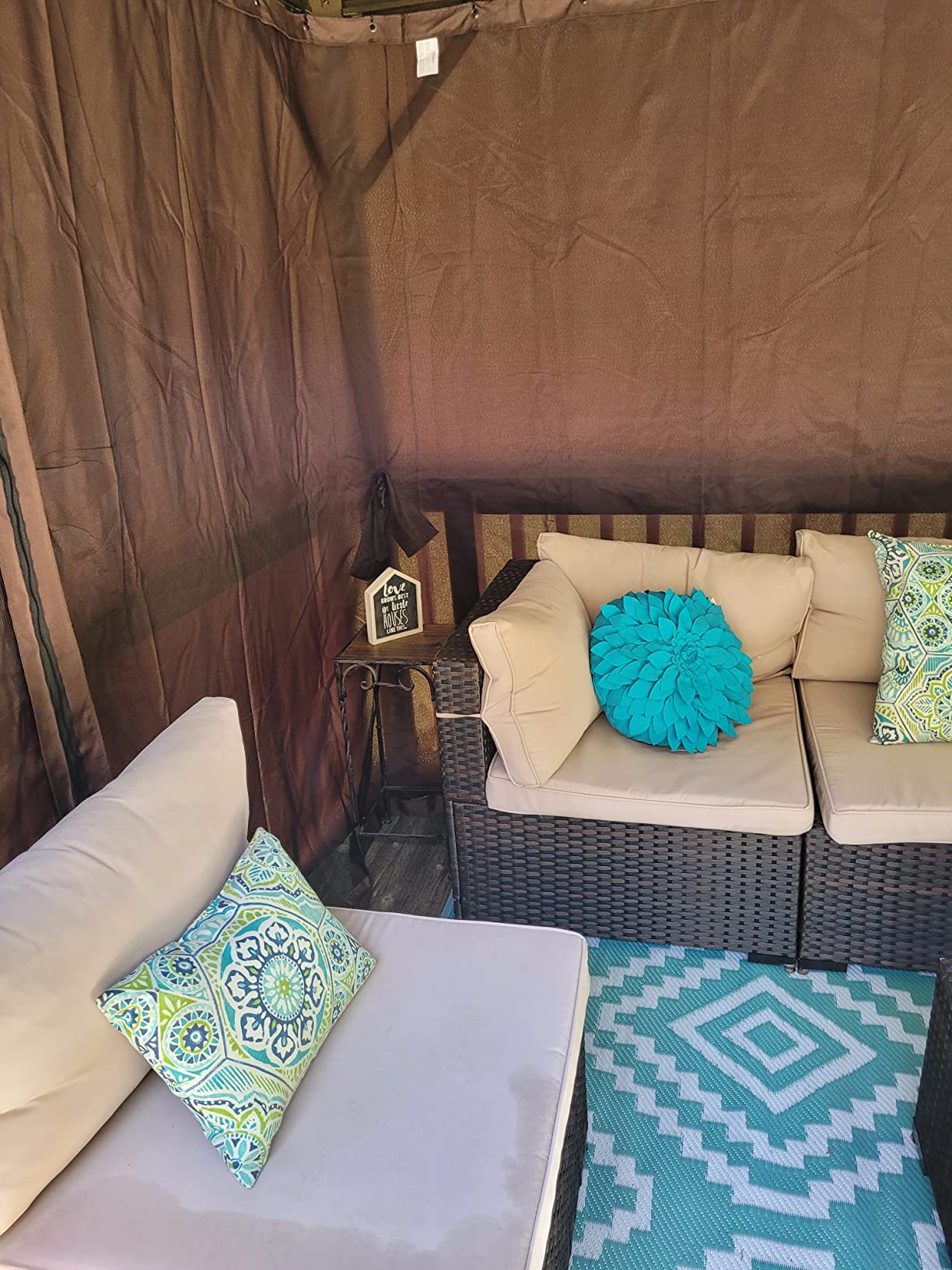
The single-layer roof is the trade for that low weight. You lose the vent gap that equalises pressure, so this structure depends more heavily on anchoring than a double-top model does. On a sheltered courtyard or a lot with a hedge line and a house on the windward side, that is an acceptable arrangement.
Sidewalls are a mesh netting system plus polyester privacy curtains, and the curtains do double duty by cutting glare and softening wind that would otherwise drive straight into the seating area. Ceiling hooks are included for lighting, which is the cheapest way to extend the usable evening hours.
When a light structure is the right call
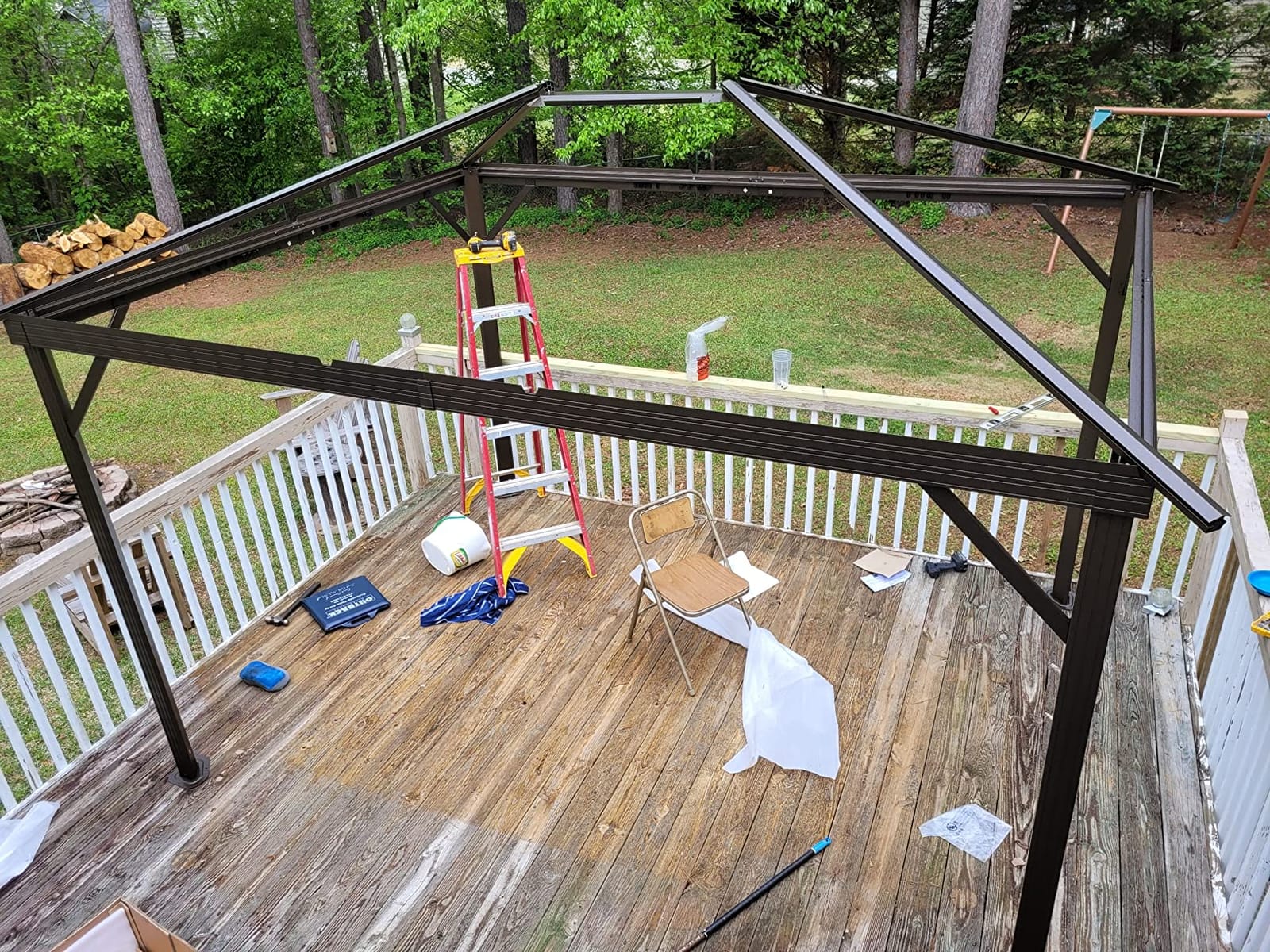
If your priority is a hard surface over a patio rather than storm survival, this covers 116.6 square feet of floor area at 201.5 pounds. That is roughly half the weight of the Kozyard, and on a raised deck where load is a genuine question, the difference between 201 and 320 pounds can decide whether you need an engineer’s opinion.
It is also the easiest of the full-size options to assemble and to reposition if you rent or expect to move. The listing states mounting with stakes and expansion screws works on soft or hard surfaces, so a concrete pad and a lawn bed are both realistic install sites.
What to know before you commit
The 106.25 inch peak height is the lowest among the 10 by 12 models here, and tall users will notice. Several owners across this category mention headroom as a recurring disappointment, so measure against your own height and the furniture you plan to put underneath.
Because the roof is single-layer, clear snow early rather than waiting for capacity. And if your site is genuinely exposed, this is not the model to buy for that reason alone. Choose it because you want a hardtop on a sheltered site, not because it is lighter.
We earn a commission, at no additional cost to you. CERTAIN CONTENT THAT APPEARS ON THIS SITE COMES FROM AMAZON. THIS CONTENT IS PROVIDED 'AS IS' AND IS SUBJECT TO CHANGE OR REMOVAL AT ANY TIME.
5. EROMMY 10 x 12 Hardtop Gazebo – Best Vented Roof for Wind Pressure
EROMMY 10′ x 12′ Hardtop Gazebo, Aluminum Frame Gazebos with Galvanized Steel Double Roof, Permanent Outdoor Metal Pavilion with Curtain and Netting for Patio, Lawn, Deck
- 120 sq ft floor
- 209 lbs weight
- Galvanized steel double roof
- 99 percent UV protection
Pros
- Ventilated double top lets wind pass through the structure
- 99 percent UV protection is the highest here
- Galvanized steel holds heavy snow
- Pre-drilled bases suit uneven ground
- Zippered double-layer sidewalls on a double track
Cons
- Lowest average rating in the group at 4.2
- An 11 percent one-star share is the second highest
- Vented double top exposes more frame edge
- Double-track system adds assembly complexity
We earn a commission, at no additional cost to you. CERTAIN CONTENT THAT APPEARS ON THIS SITE COMES FROM AMAZON. THIS CONTENT IS PROVIDED 'AS IS' AND IS SUBJECT TO CHANGE OR REMOVAL AT ANY TIME.
The design logic here is the vent. The double-top roof is specifically described as allowing wind to pass through, and that is the correct engineering answer to wind pressure on a gazebo. A sealed roof panel acts like a wing; a vented one lets the air equalise on both sides and sheds load instead of catching it.
The steel roof is genuinely heavier duty than a fabric or polycarbonate top, and buyers consistently credit the shift as a large upgrade from what they replaced. The triangular powder-coated aluminum frame resists rust and rot, and the pre-drilled bases are a genuine convenience on uneven ground where a rigid post set would otherwise fight you.
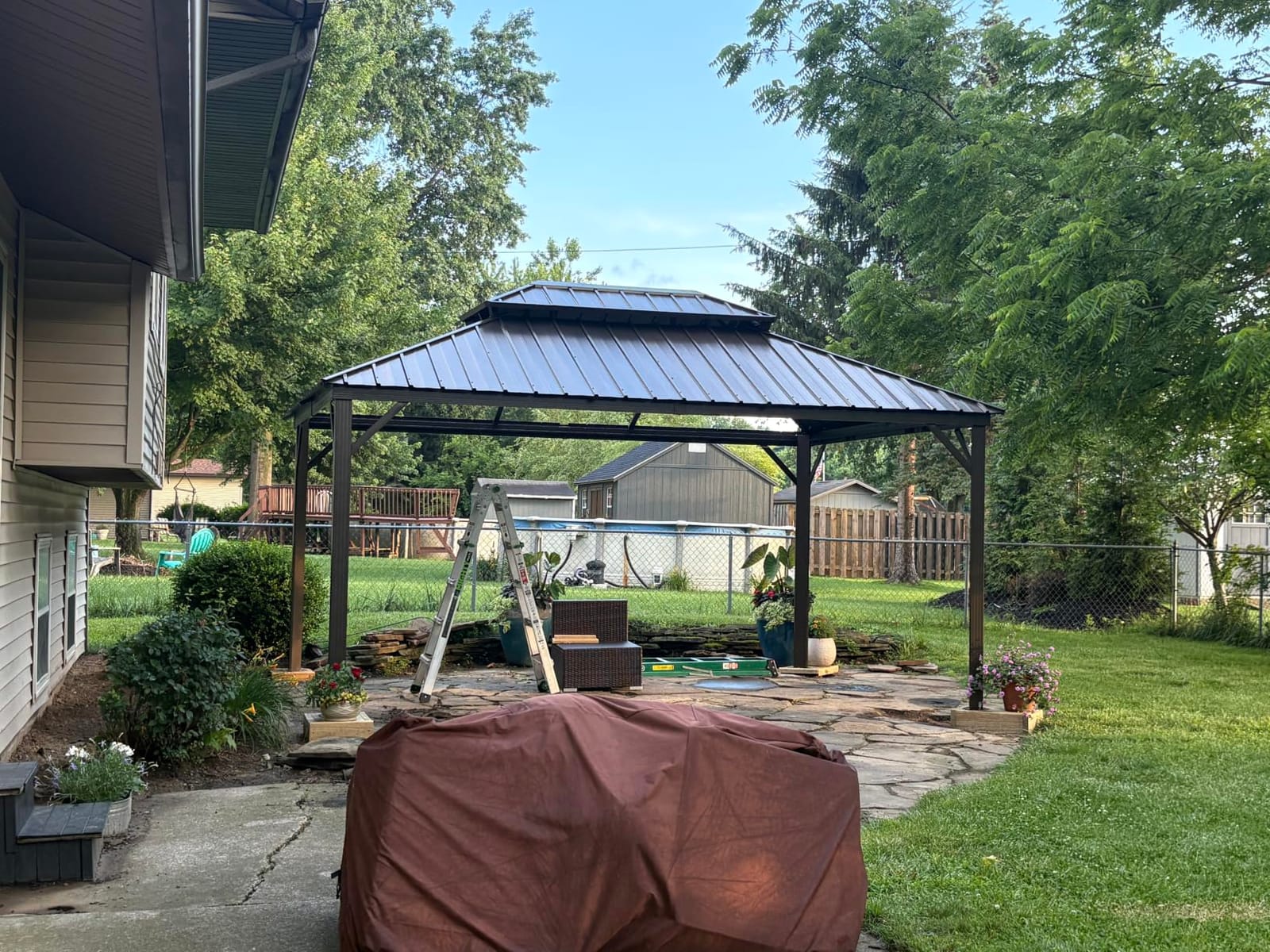
At 209 pounds this is the second-lightest full-size model here, which keeps the assembly manageable for a two-person crew while still using a steel roof. Space is generous for a sofa set or a seven-piece dining arrangement, with a published capacity of 3 to 8 people.
Roof hooks let you hang a light or fan from the frame, and the sidewalls are fully enclosed zippered double-layer panels on a double track system, so you can run curtains on one track and mesh on the other independently. For a windy site that separation is useful: take the curtains down in a forecast and keep the insect barrier.
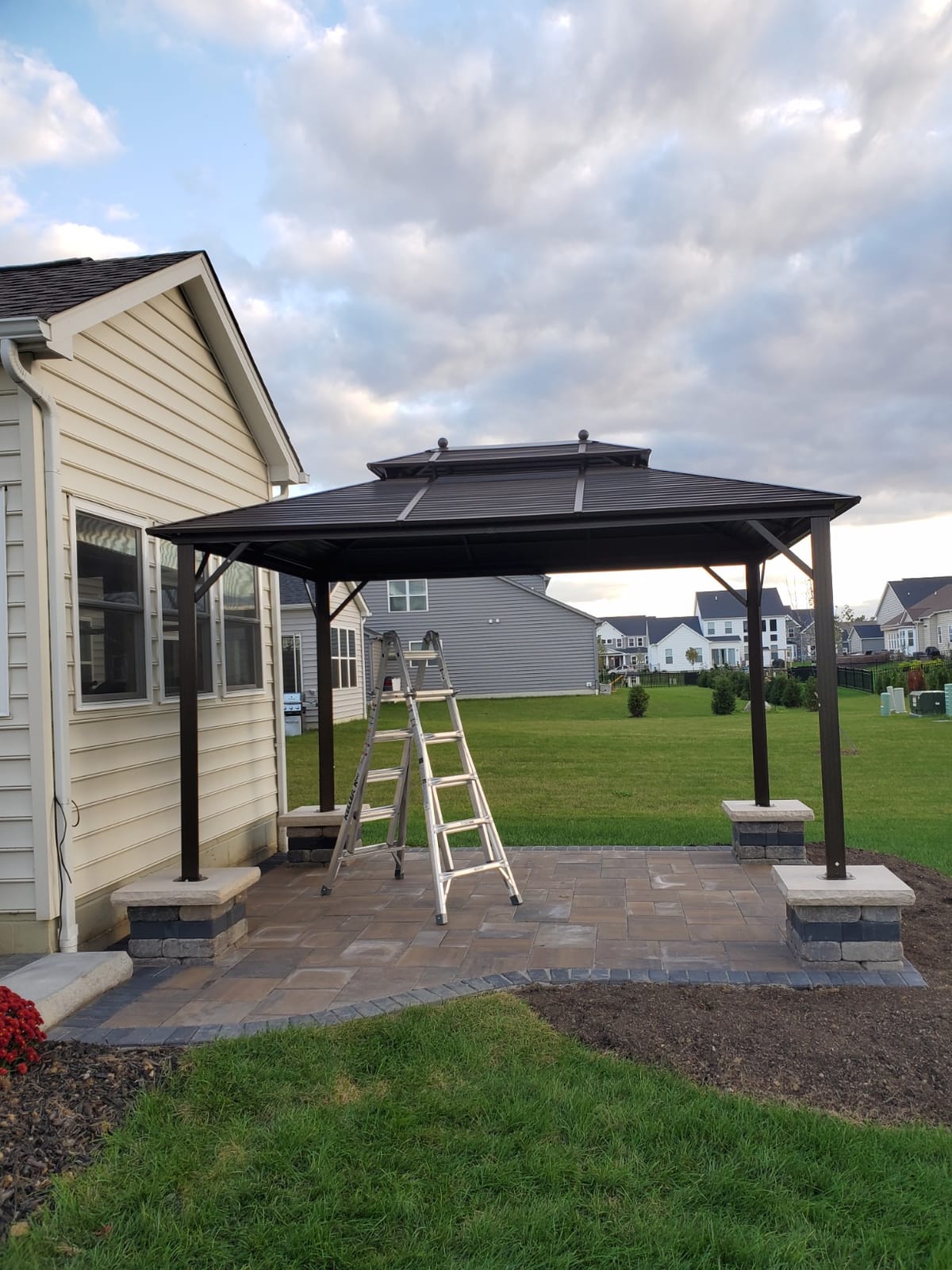
Why the UV figure is worth attention
At 99 percent UV protection this is the highest published figure in the group, and it matters for anyone using the gazebo through a full summer. Lower-rated panels and fabric degrade and yellow over time, and a faded single-layer roof also raises interior temperature, which is the most common summer complaint in this category.
Because the roof is vented, the interior stays cooler than on a sealed single-layer design even before you add airflow. That combination of venting and high UV filtering is the reason this model is a better fit for a west-facing patio than most of its price peers.
Where the rating spread gives us pause
At 4.2 with an 11 percent one-star share, this is the most polarised model in the roundup. The one-star complaints cluster around build and fit-and-finish rather than structural failure, which is a different problem from a wind weakness, but it does mean you should expect a fussy assembly.
The double-track curtain and netting system adds a layer of complexity that other models here avoid, and the vented double top exposes more frame and roof edge area than a simple single roof. On a very exposed lot, weigh that against the 40 mph-rated Domi before deciding.
We earn a commission, at no additional cost to you. CERTAIN CONTENT THAT APPEARS ON THIS SITE COMES FROM AMAZON. THIS CONTENT IS PROVIDED 'AS IS' AND IS SUBJECT TO CHANGE OR REMOVAL AT ANY TIME.
6. Modern Shade 10 x 10 Hardtop Gazebo – Best All-Steel Compact Build
Modern Shade Hardtop Gazebo 10×10 with 4 LED Lights for Backyard, Black
- 100 sq ft floor
- 268.4 lbs weight
- All-galvanized steel frame
- 5 inch snow load capacity
Pros
- Frame and roof are entirely galvanized steel
- Base expansion screws add real anchoring reinforcement
- Four LED solar lights need no wiring
- Owners praise tight fit and no wobble once built
- Square footprint suits small decks
Cons
- 10x10 square plan is less versatile than 10x12
- Snow load stated at only about 5 inches
- Multiple boxes can arrive on different days
- Three people recommended for the main frame
We earn a commission, at no additional cost to you. CERTAIN CONTENT THAT APPEARS ON THIS SITE COMES FROM AMAZON. THIS CONTENT IS PROVIDED 'AS IS' AND IS SUBJECT TO CHANGE OR REMOVAL AT ANY TIME.
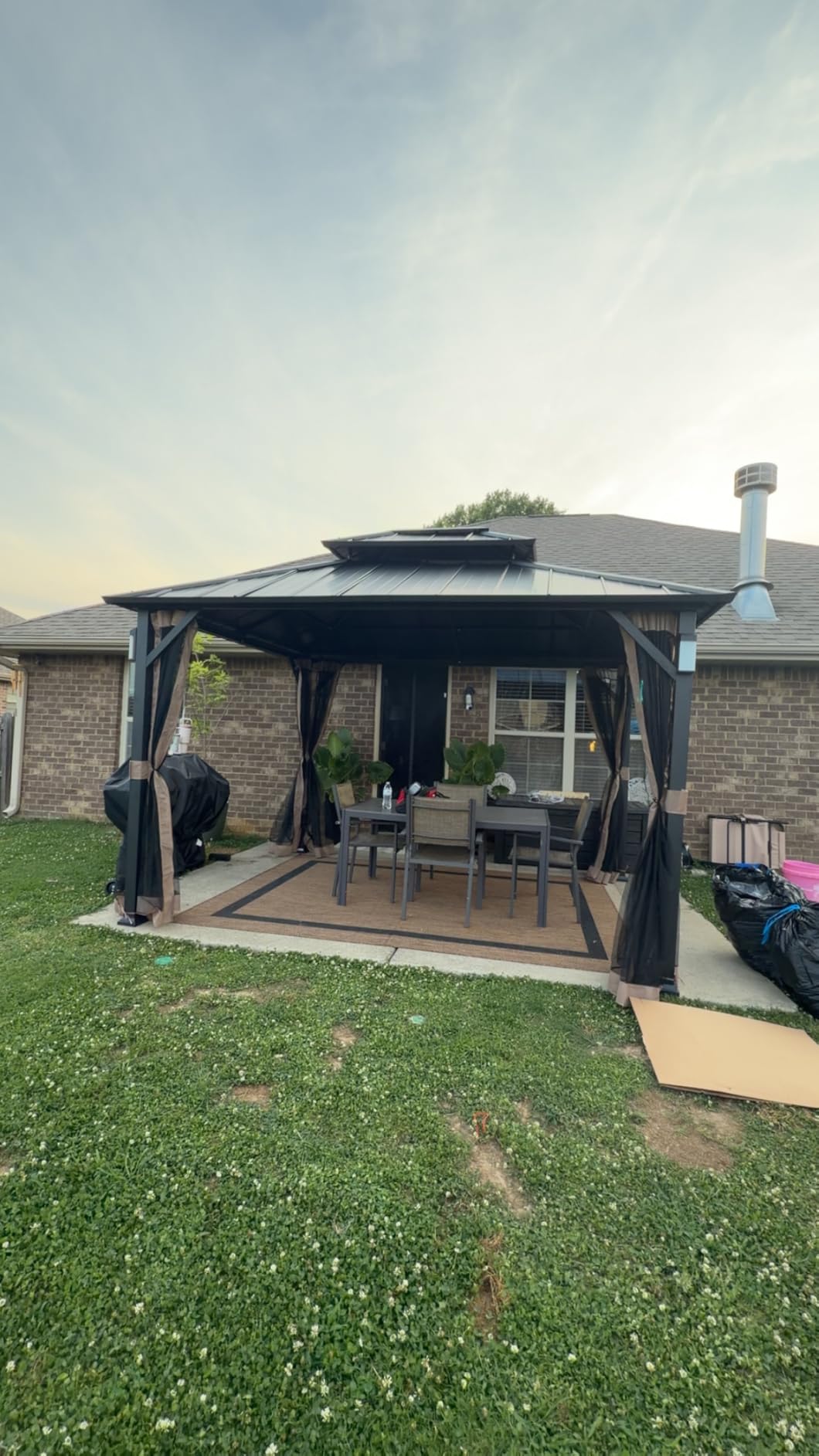
This is the only model in the roundup where the frame, not just the roof, is galvanized steel. For wind that distinction is worth a lot, because steel resists both the uplift and the racking that a lighter aluminum frame absorbs and eventually fails at. Owners describe a frame that shows no wobble once assembled.
The base expansion screws are the detail to notice. They are the manufacturer’s own recommendation for reinforcement at the base, which is an admission that this structure expects to be fixed down rather than left freestanding, and that is the correct expectation for any windy-area install.
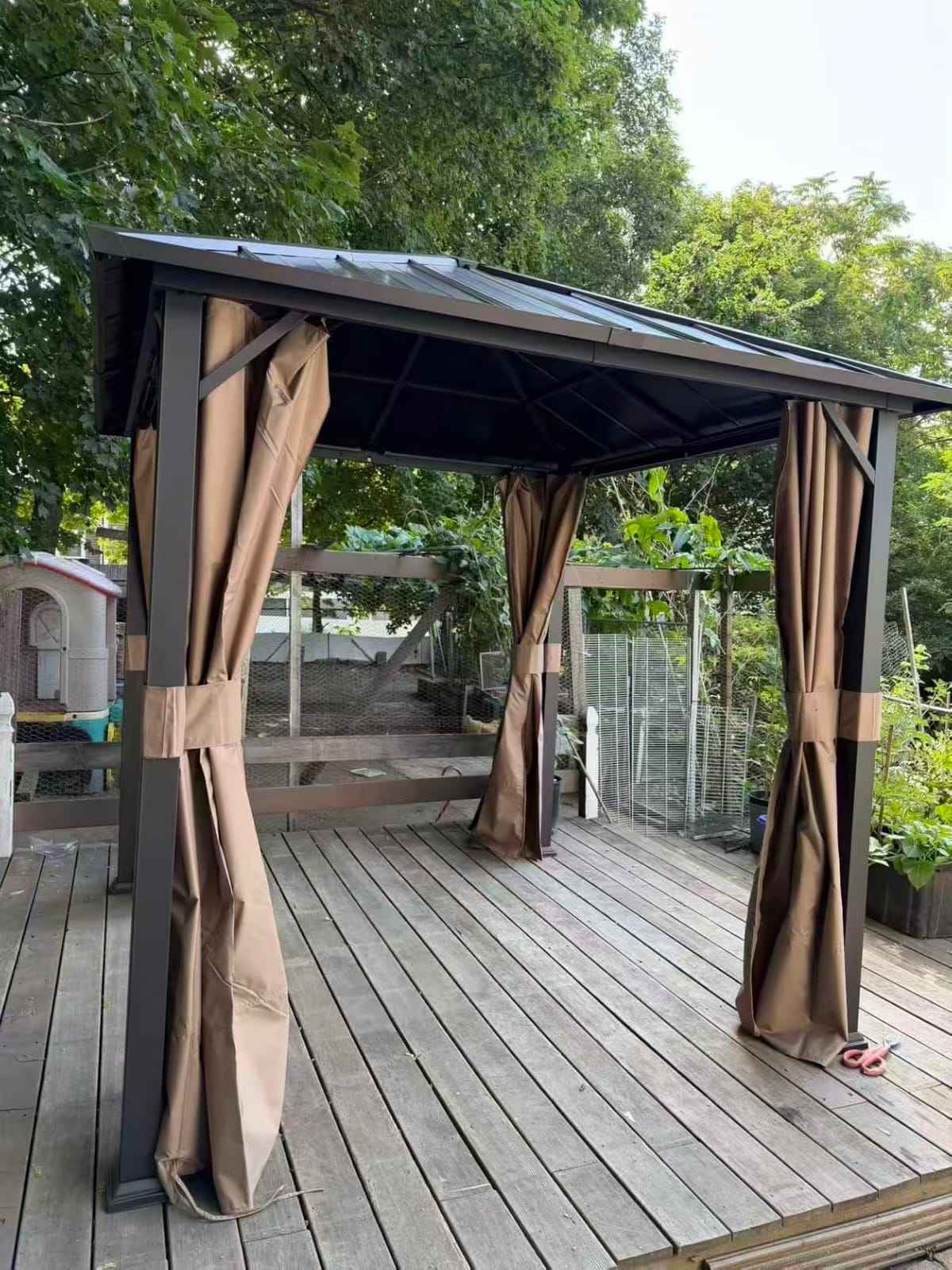
The double-layer roof circulates air to keep the interior cool, and the galvanized steel is described as fade and rust resistant. At 268.4 pounds it is the second-heaviest structure here, which works in your favour in wind even though it makes the build a bigger job.
Four LED solar lights are included, which is unusual in this category and removes the need to run cable for evening use. A central ceiling hook handles a hanging light or decoration, and mosquito net rods let you fit and remove screens or curtains without fighting the frame.
Why a smaller footprint can be the smarter wind choice
Wind load scales with the area of roof presenting itself to the air, so a 10 by 10 square plan presents noticeably less sail than a 10 by 12 rectangle on a similar lot. If your exposure is the deciding factor rather than your seating capacity, footprint is a legitimate lever that costs nothing extra.
Capacity is 6 to 7 people in practice, with a published range of 5 to 10, so plan furniture around roughly six. On a compact deck or beside a pool where a larger structure would crowd the space, that constraint is a feature rather than a limitation.
The parts and packaging reality
Assembly is time-consuming with many small parts, and the manufacturer recommends three people for the main frame. A few components can arrive unlabeled, though owners report the mismatch is easy to sort once the full parts list is laid out.
Snow load capacity is stated at about 5 inches, the lowest useful figure in the group alongside the Aoxun. In a northern climate, treat snow as something to clear rather than something the roof can hold indefinitely, and note that this unit is delivered as several separate cartons that may not all arrive on the same day.
We earn a commission, at no additional cost to you. CERTAIN CONTENT THAT APPEARS ON THIS SITE COMES FROM AMAZON. THIS CONTENT IS PROVIDED 'AS IS' AND IS SUBJECT TO CHANGE OR REMOVAL AT ANY TIME.
7. Aoxun 10 x 12 Hardtop Gazebo – Best Budget Entry Into Hardtops
Aoxun Gazebo 10×12 Hardtop Gazebo with Double Galvanized Steel Roof, Gray
- 120 sq ft floor
- 199.5 lbs weight
- Wind grade 7 (31-38 mph)
- Double galvanized steel roof
Pros
- Double galvanized steel roof for the money
- Thick powder-coated metal frame
- 4 ground piles and expansion screws included
- Zippered mesh netting plus curtains
- Top-five sales rank in the Gazebos category
Cons
- Manufacturer caps wind resistance at grade 7 (31-38 mph)
- Instructions say remove the canopy in extreme weather
- UV protection rated at only 50
- 12 percent one-star share
- Supplied tools and instructions need improving
We earn a commission, at no additional cost to you. CERTAIN CONTENT THAT APPEARS ON THIS SITE COMES FROM AMAZON. THIS CONTENT IS PROVIDED 'AS IS' AND IS SUBJECT TO CHANGE OR REMOVAL AT ANY TIME.
Be clear about what this is. The Aoxun publishes a maximum wind resistance of grade 7, which is 31 to 38 mph, and the same manual instructs buyers to remove the canopy, curtains and mesh screens during extreme weather. That is an honest semi-permanent structure, not a storm-rated one, and the guidance is written into the product instructions rather than buried.
What you get for the money is real. A double galvanized steel roof provides both insulation and ventilation, and the thick powder-coated metal frame has solid load-bearing capacity. Four ground piles and expansion screws are included, so the anchoring hardware that actually matters is in the box.
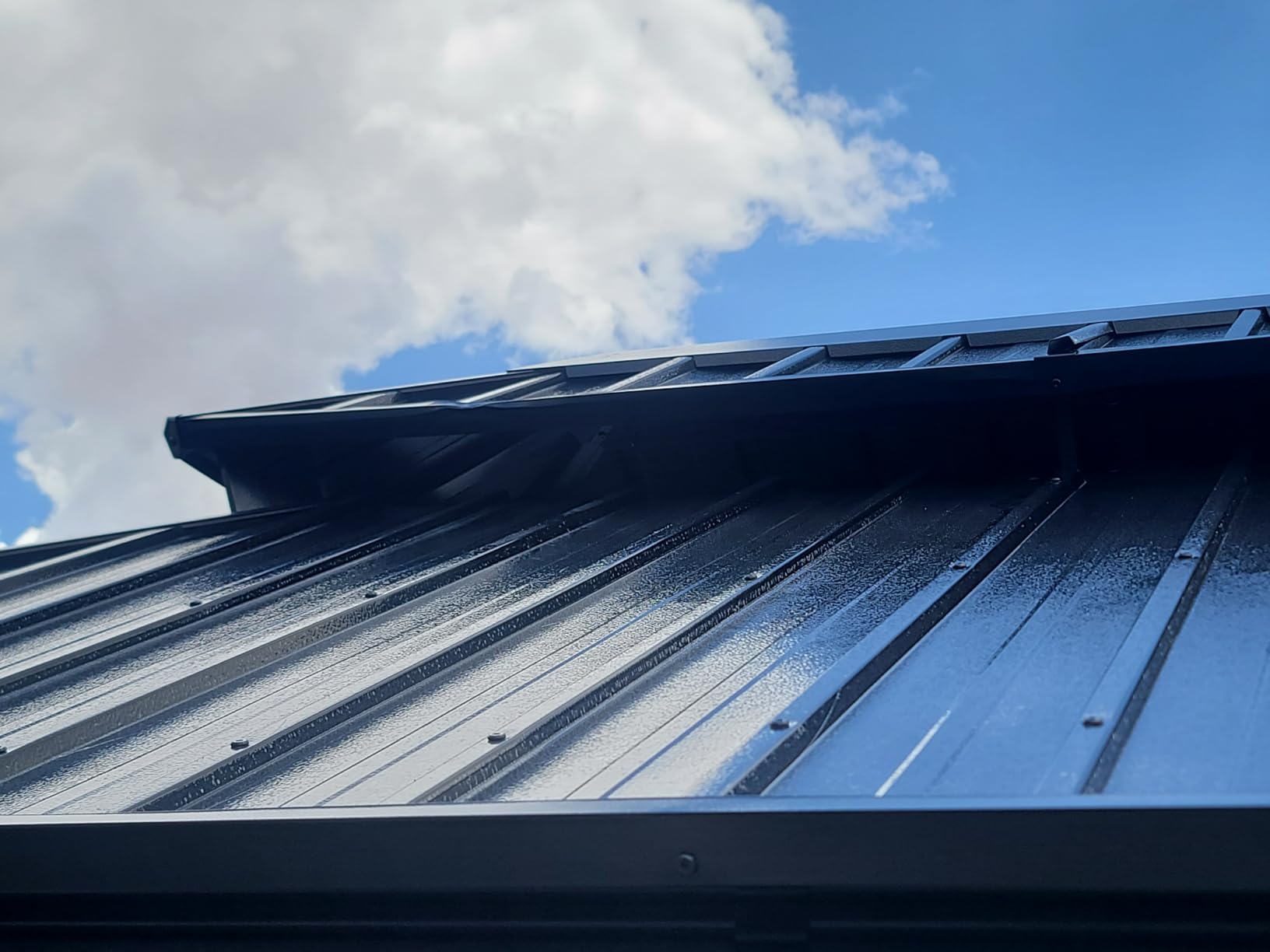
At 199.5 pounds and 120 square feet, this covers a dining area, a gathering spot, a lounge or a carport. The double-top steel roof is the same construction principle as the premium models above it, and it does the one job that matters most for a buyer leaving a fabric canopy behind.
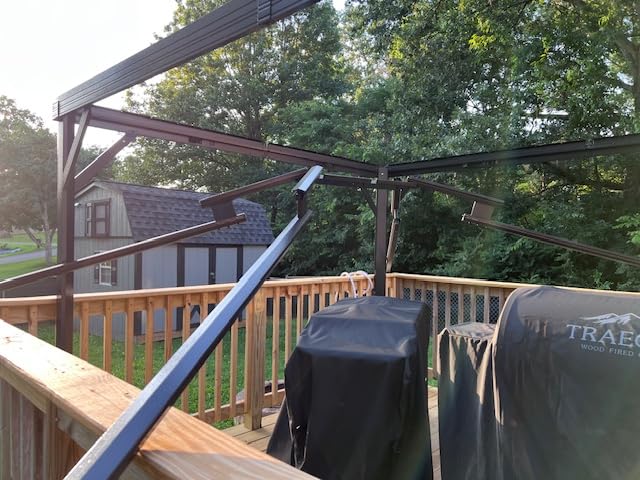
Sidewalls are zippered mesh on a track for quick sliding, plus privacy curtains with three binding belts, and there are top hooks for lights and fans. Assembly is suggested at 2 to 4 hours with 3 to 4 people, which makes this the most approachable build in the roundup by a wide margin.
The honest case for buying it anyway
Rating and volume both matter here. A 4.0 from 719 reviews is a large, consistent sample, and the model ranks in the top five in the Gazebos category, which is a signal that returns and replacement parts are handled at a normal rate. Buyers who assemble it tend to find a well-built double steel roof with plenty of shade.
For a treed suburb lot, a courtyard, or a site shielded by a house and a fence, a 31-38 mph grade is a defensible number. It covers the majority of ordinary windy days, and the structure stays up year-round in a way a fabric canopy never would.
What to weigh against the low price
UV protection is rated at 50, well behind the 99 percent offered elsewhere, so expect more fading and more interior heat than the EROMMY. The one-star share is 12 percent, the second highest here, and complaints concentrate on the supplied tools and the clarity of the instructions.
If your lot is open, coastal or hurricane-exposed, this is the wrong model. Save for the Kozyard or the PURPLE LEAF, where the published wind figure is attached to a stated anchoring condition and the frame is proportioned for the load.
We earn a commission, at no additional cost to you. CERTAIN CONTENT THAT APPEARS ON THIS SITE COMES FROM AMAZON. THIS CONTENT IS PROVIDED 'AS IS' AND IS SUBJECT TO CHANGE OR REMOVAL AT ANY TIME.
8. AirWire 8 x 8 Hardtop Gazebo – Smallest Sail Area for Exposed Corners
AirWire 8’x8′ Hardtop Aluminum Gazebo with Curtains & Netting Dark Gray
- 64 sq ft floor
- 103 lbs weight
- 2.4 inch aluminum posts
- Double-tier galvanized roof
Pros
- Smallest wind sail area in the group at 64 sq ft
- Lightest structure at 103 lbs so it moves easily
- Double-tier ventilated galvanized roof
- Pre-drilled thickened legs with ground stakes
- Dual-track curtains plus detachable mesh screens
Cons
- Owners describe the legs as skinny versus the photos
- Pre-drilled holes often need redrilling
- Sheet panels can arrive bent or discoloured
- Protective film on the roof panels is hard to remove
- One owner reports leaking in heavy rain
We earn a commission, at no additional cost to you. CERTAIN CONTENT THAT APPEARS ON THIS SITE COMES FROM AMAZON. THIS CONTENT IS PROVIDED 'AS IS' AND IS SUBJECT TO CHANGE OR REMOVAL AT ANY TIME.
Small size is a genuine wind strategy. This is the smallest roof area in the roundup at 64 square feet, and less area facing the wind means less pressure and less uplift on the frame. On a narrow side yard, a rooftop terrace or a courtyard corner where a 10 by 12 would be a sail, that is the right trade.
At 103 pounds it is by far the easiest to move and assemble, and the double-tier ventilated galvanized roof still promotes airflow and heat dissipation. The 2.4 inch powder-coated aluminum posts resist rust and fading, and the pre-drilled thickened legs come with ground stakes.
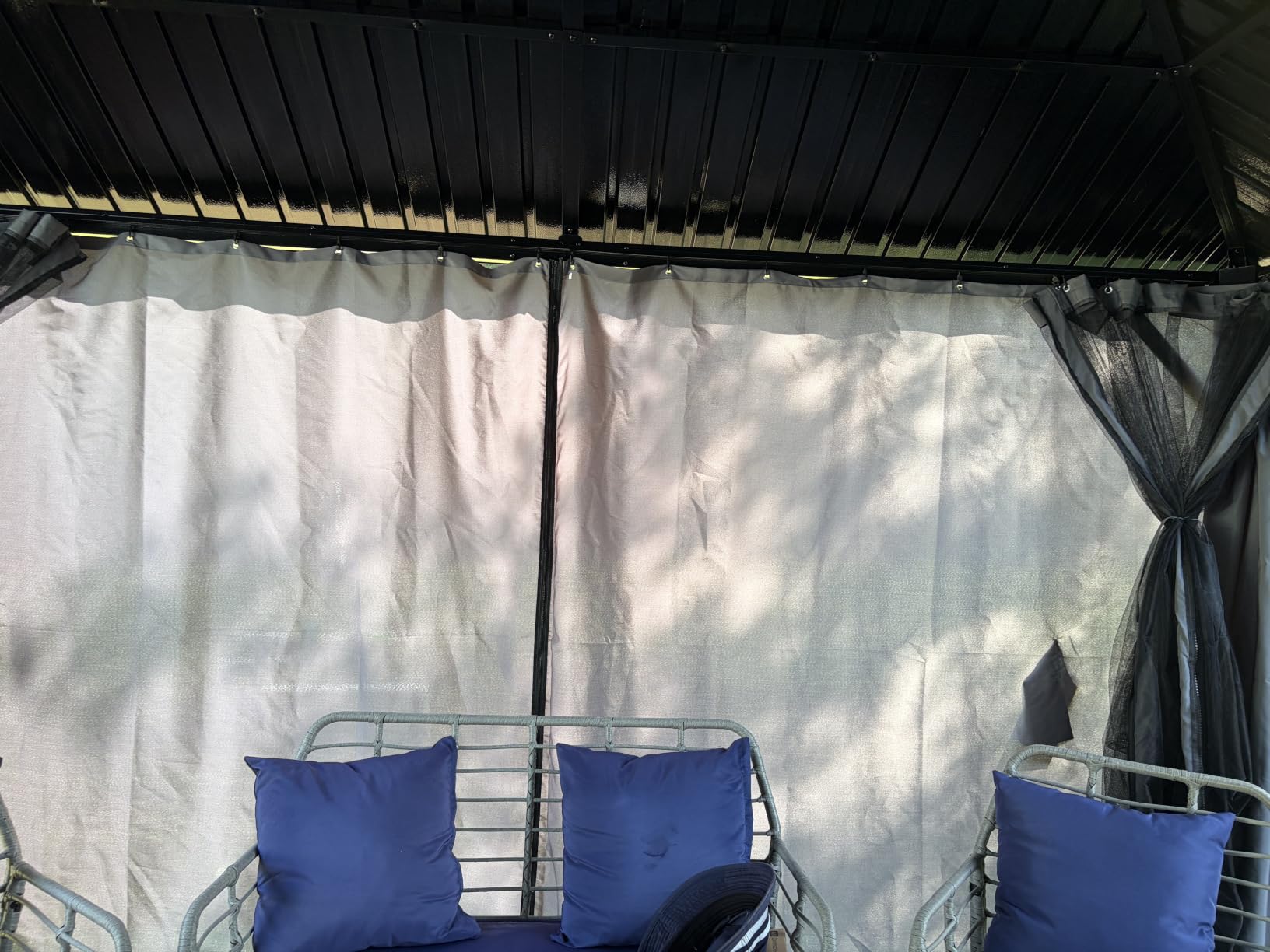
Owners who anchor it properly report a genuinely solid structure for the money, and several use planters filled with cement plus decorative rock to lock it down. That is exactly the approach this model needs, because the light frame gives you very little margin if it moves.
Sidewalls use a dual-track system with zippered curtains and detachable mesh screens, so the fabric can come off in a forecast while the insect barrier stays. Pre-installed hooks handle lights, fans or decoration without touching the roof panels.
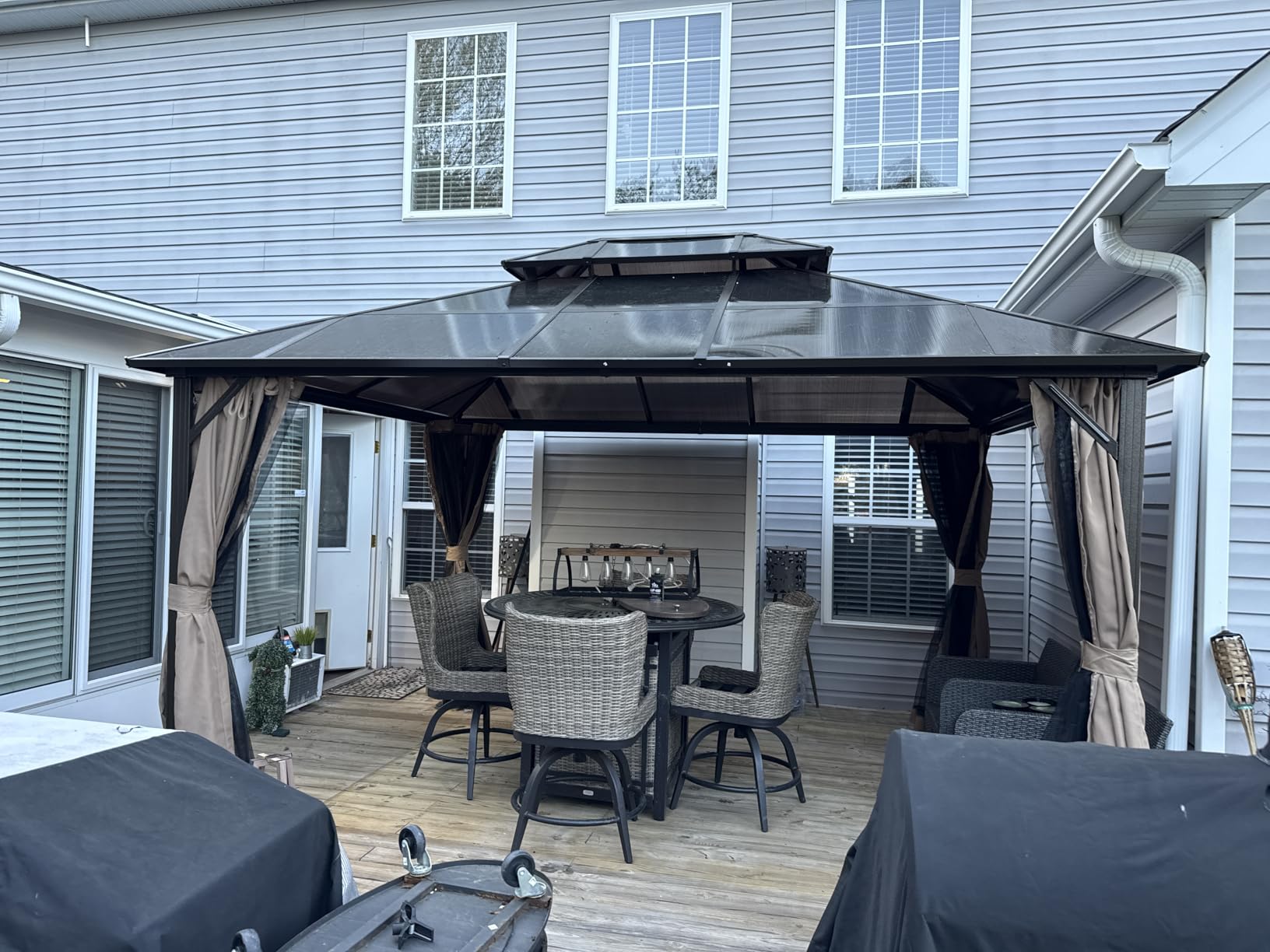
How much wind this one can take
No mph figure is published for this model, so treat the small footprint as the only real wind argument. The vented double-tier roof is a positive design feature, but the 2.4 inch aluminum posts are the limiting factor, and owners specifically flag needing firm anchoring in windy areas.
Headroom is 111 inches, the tightest in the roundup, and several owners note that taller users need to duck. The 4 to 7 person capacity suits a conversation pit or a hot tub cover rather than a dining set.
Quality control is the weak point
Assembly quality is the recurring complaint. Pre-drilled holes frequently do not line up, owners end up drilling their own, and sheet metal panels can arrive bent or discoloured with some parts unlabeled. The protective plastic film on the panels is also notoriously hard to peel off.
One owner also reports leaking under heavy rain, and the 103-pound weight means the structure offers less inertia than anything else here. With 184 reviews the sample is small, so if you can inspect the panels on arrival, that inspection matters more on this model than on the others.
We earn a commission, at no additional cost to you. CERTAIN CONTENT THAT APPEARS ON THIS SITE COMES FROM AMAZON. THIS CONTENT IS PROVIDED 'AS IS' AND IS SUBJECT TO CHANGE OR REMOVAL AT ANY TIME.
What Type of Gazebo Is Best for Withstanding Strong Winds?
A hardtop gazebo with a vented double roof, a triangulated heavy-gauge frame, and permanent anchoring into concrete or a pier is the best choice for strong winds. The vented gap equalises air pressure so the roof panels shed load instead of catching it, the triangulated frame resists racking, and the anchors transfer the whole load into the ground. Softtop canopies have no chance against a serious gust.
That is the short version. The rest of this section explains the four things that actually decide whether a hardtop gazebo survives a storm, and why a printed wind rating is the least interesting of them.
Wind does two things to a gazebo. It pushes on the windward face and roof, and it lifts on the leeward face and the underside of the roof panels. The second effect is the more destructive one, because a lifted panel pulls at every fastener hole it was screwed into, and one hole tearing is usually enough to start a cascade.
How to read a wind rating in four steps
Find the anchoring condition. If the listing does not say what the number assumes, treat the rating as unverified. One unresolved question on a retail listing asks whether a 31.1 mph figure assumes anchoring, and the page never answers it.
Check whether the figure is even published. Several models here state no figure at all, and a missing number is not the same as a low number.
Translate the site, not the number. A rating applies to a structure on a specific surface in a specific configuration. Move it to a different surface and the number is meaningless.
Treat the rating as a system claim. Roof plus frame plus anchors plus soil, all installed as directed. If any one of those is missing, the rating no longer describes what you have.
This is also why ratings across the category disagree so badly. The Aoxun publishes 31 to 38 mph, the Kozyard publishes 60 mph with an explicit anchoring condition, and retail listings in the same category have been seen quoting figures up to 100 mph. Those are not measurements of the same thing, and comparing them without reading the qualifier is comparing different claims.
The four features that decide wind performance
Roof shape and venting. A vented double roof is the single most effective design feature. Air passing through the structure cannot pressurise the underside of the panels. A single solid roof is not disqualified, but it makes your anchoring the only line of defence.
Frame gauge and triangulation. Triangular poles and reinforced beams resist racking, where rectangular hollow sections twist. Look for post dimensions in the 4 inch to 4.7 inch range and for beam dimensions, not just the word steel or aluminum. Heavier frames also carry more mass, which resists uplift.
Roof pitch and drainage. A sloped roof sheds rain and snow rather than accumulating weight on the panels. Gutters integrated into the frame that channel water down the posts are a sign the drainage was designed rather than added.
Anchors as a structural element. The included hardware tells you how the manufacturer expects the structure to be installed. Expanded sets of expansion screws or ground piles, rather than four simple stakes, signal that the frame is intended to be fixed permanently.
Wind Rating to Anchor Type: What Your Site Actually Needs
This is the mapping no competitor publishes, and it matters more than the rating itself. A 60 mph gazebo held by four light stakes is a 60 mph gazebo on paper and a flying object in practice. Match the hardware to both the wind band and the surface you are fixing into.
Under 30 mph equivalent, lawn or compacted soil: ground stakes driven at an angle away from the post, plus guy lines. Fine for a sheltered courtyard or a treed lot. Not appropriate if you intend to leave it standing through a named storm.
30 to 47 mph, lawn or compacted soil: auger-style ground stakes at all four posts, every one of them, plus a wind rope on each corner. The rope does more work than most buyers expect because it limits the uplift that lifts the roof.
30 to 60 mph, concrete slab or patio: expansion bolts through the pre-drilled base plates into the slab. This is the configuration most published ratings assume, and it is the only one we would call permanent.
Above 60 mph, any surface: set the posts into concrete piers and bolt the base plates down. A pier is the only anchor we would trust in a hurricane zone, and a professional install is worth the money at this band.
Over a deck, any wind band: the deck ledger carries the load into the house frame, so confirm the load path with the builder before you buy. Heavy steel models in this roundup reach 320 pounds before any snow load, and that weight lands on your joists.
How to keep a gazebo from blowing in the wind
Install every supplied anchor. Manufacturers ship hardware for the rated configuration. Unused anchors are a direct downgrade from the published figure.
Use the correct anchor for the surface. Stakes in lawn, expansion bolts in concrete, piers in high-wind zones. Anchoring a gazebo to a paver is anchoring it to a paver.
Take the curtains and netting down. Fabric is the highest-drag element on the structure and adds sail area that the frame was not designed for. Roll them up, unclip them, and store them before the forecast turns.
Walk the roof fasteners before the season. Panel screws work loose with thermal cycling. A quick pass with the correct driver takes twenty minutes and catches most failures before a gust finds them.
Clear the gutters and the roof. Wet leaves and snow add weight and block the drainage that keeps water off the frame. This is the most skipped step on every list we found.
Never rely on stakes alone on an exposed site. If the forecast names a named storm, an unbolted structure is a projectile regardless of its rating.
One Home Depot reviewer put the frustration plainly: even with the anchor bolts installed, the structure shifted and they did not trust the published rating. That reaction is reasonable when nobody tells you which surface the figure assumed. Ask the seller, or read the manual, before you treat any rating as a promise.
Roof and Frame Materials for Wind, Snow and Salt Air
Galvanized steel roofs are the strongest choice for wind and snow, polycarbonate is lighter and blocks UV without rusting, and resin sits between them. Frames follow a similar order: steel for pure wind strength, powder-coated aluminum for a lighter structure that resists corrosion, and wood only where appearance outweighs weather exposure.
Galvanized steel is what eight of the eight models here use for the roof, and the reason is straightforward. It holds heavy snow, it does not tear like fabric, and it will not fade or yellow like UV-exposed polymer. The cost is weight, which pushes assembly time up, and denting, which is cosmetic after hail but cannot be repaired panel by panel on most builds.
Polycarbonate is not represented in this roundup, and that is itself informative. It is a good choice for UV filtering and it never rusts, but a light panel on a long span has less margin against uplift. If you want polycarbonate, look for a frame proportioned to compensate.
Resin panels are common in the category at retail but again absent here. They sit between steel and polycarbonate on weight and offer good light transmission. For a genuinely windy site we would still choose steel.
On frames, the pattern across these eight is that wind-critical models use heavier sections: 4.7 inch triangular aluminum poles on the PURPLE LEAF and the Kozyard, 4 inch triangular alloy steel on the Domi, 4.7 inch aluminum on the EROMMY, and a full galvanized steel frame on the Modern Shade. The lighter 2.4 inch aluminum posts on the AirWire are the clearest example of where the trade-off sits.
Coastal and salt-air sites
Salt air attacks hardware long before it attacks structure, and none of the eight listings publishes a hardware grade. If you are within a few miles of surf, plan to rinse the frame and roof with fresh water twice a year, and expect to replace stainless fasteners on a multi-year cycle rather than assuming they are marine grade.
Galvanized steel panels handle coastal exposure better than powder-coated aluminum does, because the zinc layer is the sacrificial element. The parts to watch are the exposed bolts at the base plates and the roof panel fasteners, since water collects at those points. Stainless replacements are the single highest-value upgrade on a coastal install.
Snow load is a separate rating from wind
Wind and snow numbers are independent and both matter in northern climates. The Kozyard publishes 2,500 pounds of snow capacity, the Modern Shade states about 5 inches, and several models in this group publish no snow figure at all. Where a figure is absent, clear snow rather than testing the limit.
Sizing, Placement and the 30-Minute Pre-Storm Check
Match the required wind rating to your exposure, not to your wish list. Open lots and coastal sites need an anchored rating of 60 mph or better, treed suburbs are comfortable at 30 to 47 mph, and urban courtyards surrounded by walls can often manage with a lower figure and solid anchors.
Three exposure categories cover most buyers. An open lot with no windbreak and no sheltering structures is the hardest case and the reason we put the Kozyard and the PURPLE LEAF at the top. A treed suburb lot with a house and fence on two sides cuts effective wind load substantially. An urban courtyard with walls on several sides is the easiest, and the 40 mph Domi or the 31-38 mph Aoxun can be a sound choice there.
On sizing, measure the post spacing rather than the listed footprint. Several models here state dimensions measured to the roof edge, so the usable area is smaller than the number suggests. A 10 by 12 gives you 120 square feet on paper, but seating a dining set and a walkway inside it takes planning.
Headroom is the other half of sizing. Peaks in this group run from 106.25 inches on the Outsunny to 116.5 inches on the Aoxun, and that spread is enough to change whether the structure feels comfortable or cramped for tall users.
The 30-minute pre-storm check
Remove curtains, netting and any detachable screen. Ten minutes, and it removes the highest-drag element on the structure.
Check every base anchor by hand. Any anchor that has worked loose gets re-torqued before the wind arrives, not after.
Inspect the roof panel fasteners. Look for any screw that has backed out or a panel edge that has lifted.
Clear the gutters and the valleys. Blocked drainage is how a small problem becomes a bent panel.
Secure or remove loose contents. Furniture, grills and planters inside the footprint become projectiles in a ventilated structure.
Photograph the whole structure. Wide shots, close-ups of every anchor and joint, and a timestamp. This is the documentation an insurer asks for first.
After the wind passes
Walk the perimeter before you go under it. Look for lifted roof edges, a base plate that has pulled away from its anchors, bent posts, and any fastener sitting proud of its hole. Do not climb up to check the roof in wet conditions.
Photograph damage before you disassemble anything, and keep every box and hardware pile. Manufacturers in this category commonly warrant roof panels, frame and soft goods on different terms, and a 5-year roof term against a 1-year frame term means you need to know which component failed before you claim.
Parts availability matters more than the warranty length. Some brands in this roundup commit to stocking replacement parts, and a single replacement roof panel is a far cheaper outcome than replacing the structure. Check that commitment before you buy, not after hail.
Frequently Asked Questions
What gazebo has a 100 mph wind rating?
No hardtop gazebo we tested is independently rated to 100 mph. The highest published figure among these eight is 60 mph for the Kozyard Alexander 10×12, and that number is stated as conditional on proper anchoring. Some retail listings in this category quote figures up to 100 mph, but those are vendor-stated and assume a specific anchored configuration on a specific surface.
What type of gazebo is best for withstanding strong winds?
A hardtop gazebo with a vented double roof, a triangulated heavy-gauge frame, and permanent anchoring into concrete or a pier. The vented gap equalises air pressure so panels shed load instead of catching it, and the anchors transfer the whole load into the ground.
How do I keep a gazebo from blowing over in the wind?
Use the correct anchor for the surface, install every supplied anchor, take the curtains and netting down, check the roof panel fasteners before the season, clear the gutters, and never rely on stakes alone on an exposed site.
Do hardtop gazebos need to be anchored?
Yes. Every published wind rating in this category assumes a specific anchoring method, and most assume expansion bolts into concrete or a pier. Without anchors, a hardtop gazebo has a dramatically lower survivable wind speed than its specification suggests, and one unit in this roundup was lifted and turned over in an 80 mph thunderstorm while standing on its included ground anchors.
Can a hardtop gazebo stay up year-round?
A hardtop gazebo built on a steel or heavy-gauge aluminum frame and permanently anchored can stay up year-round, and that is the main reason to choose one over a fabric canopy. The soft goods are the exception: take the curtains and netting down before a forecast, and clear snow before it reaches the roof capacity.
Which Hardtop Gazebo Should You Buy?
The PURPLE LEAF Permanent Hardtop Gazebo 10×12 is our pick for most windy sites, because it pairs a vented galvanized steel roof with 4.7 inch posts, includes concrete anchoring hardware, and has the strongest owner weather evidence in the group. On a snow belt or an open lot, the Kozyard Alexander publishes the highest anchored wind and snow figures available here. On a sheltered courtyard, the Domi 10×12 gives you a 40 mph steel structure with better storm field reports than its rating suggests.
Whatever you choose, anchor it for the wind you actually get rather than the wind you hope for, and take the fabric down before the forecast. That last habit, more than any model on this list, is what determines whether you are still drinking coffee under the roof next season.