
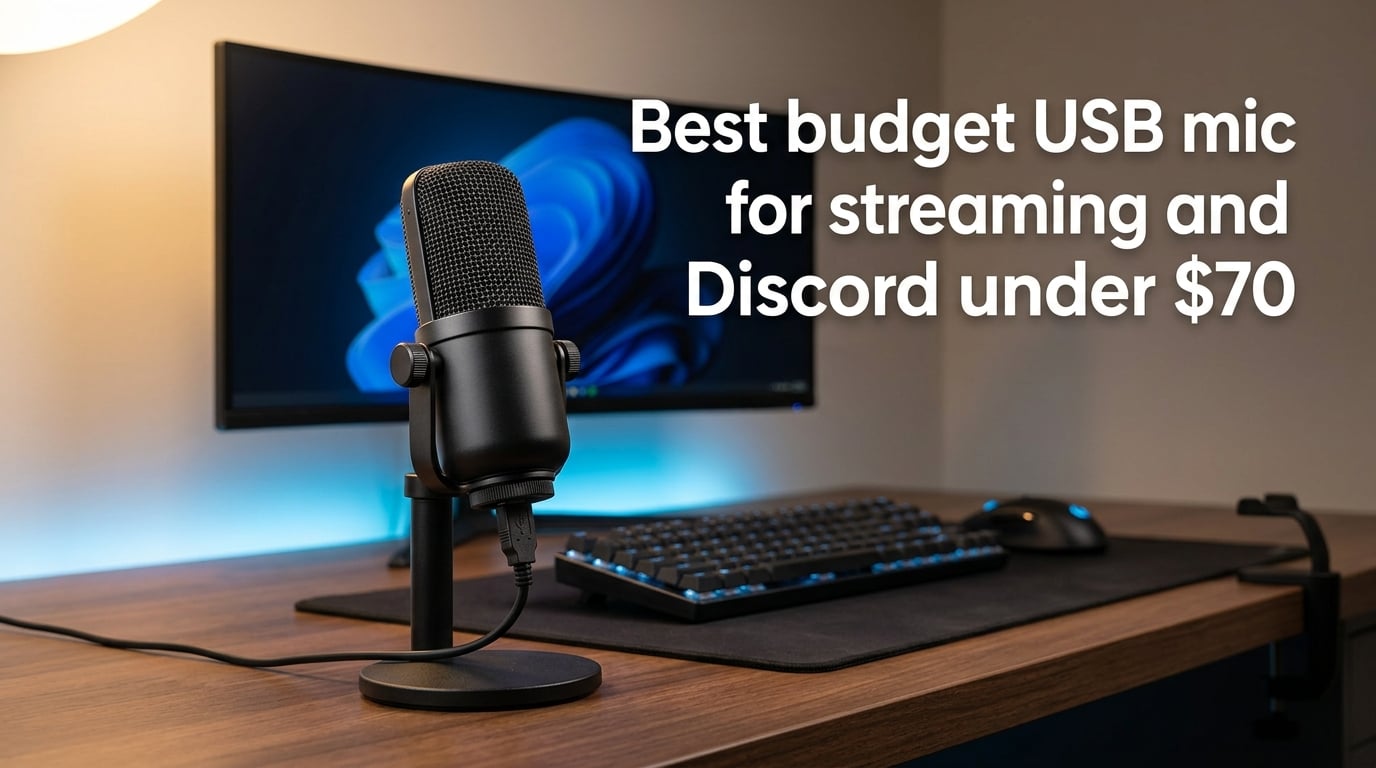
A dedicated USB microphone is one of the most impactful upgrades you can make for your Discord calls and streaming setup. Built-in headset mics and cheap clip-on options make you sound distant, buzzy, and riddled with keyboard noise. A good budget USB mic under $70 changes that overnight.
The good news? You don’t need to spend hundreds. In 2026, the sub-$70 market is packed with solid options from brands like HyperX, Logitech, Razer, and FIFINE. After analyzing Reddit threads, community feedback, and expert reviews, we put together this guide to help you find the best budget USB mic for streaming and Discord that fits your setup and budget.
Whether you’re a casual Discord chatter, a beginner Twitch streamer, or someone who just wants to stop hearing “you sound terrible” in team chat, this guide covers everything you need to know.
Table of Contents
What to Look for in a Budget USB Mic
Before you buy, understanding a few key specs will save you from disappointment. Not every cheap USB mic performs the same, and the differences matter more for Discord and streaming than you might think.
Polar Pattern (Cardioid Is King)
A mic’s polar pattern determines which directions it picks up sound from. For Discord and streaming, a cardioid pattern is what you want. It captures sound directly in front of the mic while rejecting noise from the sides and rear.
Most budget USB mics default to cardioid, which is perfect. Some offer switchable patterns (omnidirectional, bidirectional), but for gaming and streaming, you’ll stick with cardioid 99% of the time. If a mic only has one pattern and it’s cardioid, that’s not a limitation — it’s the right call.
Sample Rate and Bit Rate
Sample rate (measured in kHz) and bit rate (measured in bits) determine audio resolution. Here’s what matters for your use case:
- 48 kHz / 16-bit — The standard. More than enough for Discord voice chat and casual streaming.
- 48 kHz / 24-bit — A nice step up. Slightly better dynamic range, useful if you also record podcasts or voiceovers.
- 96 kHz / 24-bit — Overkill for Discord, but some budget mics include it. No harm, no real benefit for voice chat.
Bottom line: anything at 48 kHz or above is fine. Discord compresses your audio anyway, so the bottleneck is almost never your mic’s sample rate — it’s your positioning and gain settings.
Condenser vs Dynamic for Discord
This is where most buyers get confused, and it’s a gap that most guides gloss over. Here’s the simple version:
Condenser microphones are more sensitive. They pick up more detail in your voice, but they also pick up more background noise — keyboard clicks, PC fans, room echo. Most budget USB mics (FIFINE K669B, HyperX SoloCast 2, Razer Seiren Mini) are condensers.
Dynamic microphones are less sensitive by design. They reject more ambient noise and only capture what’s directly in front of them. The trade-off is you need to speak closer to the mic. The Samson Q2U is the standout budget dynamic option.
The Reddit consensus is clear: If you have a quiet room, go condenser — you’ll get richer, fuller voice quality. If your keyboard is loud, your room echoes, or your PC fans spin hard, a dynamic mic (or condenser + noise suppression software) is the smarter play. As one r/buildapc user put it: “I chose condenser because I’d rather use push-to-talk than not be able to lay back.”
Build Quality and Handy Features
Budget mics cut corners somewhere. Here’s what to check:
- Mute button — A physical tap-to-mute button is “very very appreciated” according to Reddit users. Software mute works, but fumbling for a hotkey mid-stream is annoying.
- Headphone jack — Zero-latency monitoring lets you hear yourself in real time. Helpful for avoiding the “am I clipping?” anxiety.
- Stand included — Most sub-$70 mics come with a desktop stand. Check if it’s sturdy or wobbly — cheap tripod stands pick up desk vibration.
- USB-C vs USB-A — USB-C is more future-proof, but both work fine. Some mics include a USB-C to USB-A adapter.
- Gain control — A physical gain knob on the body lets you adjust sensitivity without digging into Windows settings.
Top Budget USB Mics Under $70
Here are the eight mics we recommend for Discord and streaming, each tested against the criteria above. Every one of these sits comfortably under $70 at standard retail pricing.
| Mic | Type | Sample Rate | Mute Button | Best For |
|---|---|---|---|---|
| HyperX SoloCast 2 | Condenser | 48 kHz / 24-bit | Tap-to-mute | Best overall for Discord + streaming |
| Logitech Yeti Orb | Condenser | 48 kHz / 24-bit | Tap-to-mute | Plug-and-play simplicity |
| Amazon Basics USB Condenser | Condenser | 48 kHz / 16-bit | No | Rock-bottom budget |
| FIFINE K669B | Condenser | 48 kHz / 16-bit | No | Best value under $30 |
| Razer Seiren Mini | Condenser | 48 kHz / 16-bit | No | Compact setups |
| MAONO AU-A04 | Condenser | 48 kHz / 16-bit | No | Full kit buyers |
| TONOR TC-777 | Condenser | 48 kHz / 16-bit | No | Beginners on a tight budget |
| Samson Q2U | Dynamic | 48 kHz / 16-bit | No | Noisy environments |
Our Top Recommendations in Detail
Each of these mics has been evaluated based on audio quality, build, features, and real-world feedback from Discord and streaming communities. Here’s what makes each one worth considering.
HyperX SoloCast 2
The HyperX SoloCast 2 is our top pick for most people. It delivers clear, warm vocals with a cardioid condenser capsule, includes a tap-to-mute button with LED indicator, and connects via USB-C. At 48 kHz / 24-bit, the audio specs are solid for the price.
What makes it stand out is the combination of audio quality and thoughtful design. The built-in shock mount reduces desk vibration, and the adjustable desktop stand lets you position it properly without needing extra gear. HyperX’s NGENUITY software adds optional EQ tweaks if you want them, but the mic sounds great out of the box.
Pros: Excellent vocal clarity, tap-to-mute with LED, USB-C, built-in shock mount, sturdy stand.
Cons: No headphone jack for zero-latency monitoring, no physical gain knob on the body.
Logitech Yeti Orb
Logitech’s Yeti Orb is designed for plug-and-play simplicity. It uses a cardioid condenser capsule tuned specifically for voice, and it runs through Logitech’s G HUB software for optional Blue VO!CE effects — real-time EQ, noise reduction, and voice filters that work directly in Discord.
The build quality feels premium for the price, with a weighted base that stays put on your desk. The tap-to-mute button is responsive, and the LED ring shows mic status at a glance. For anyone who wants a “set it and forget it” experience, the Yeti Orb delivers.
Pros: Blue VO!CE software support, solid weighted base, clean voice tuning, plug-and-play with G HUB.
Cons: Slightly more expensive than other options in this range, no headphone monitoring jack.
Amazon Basics USB Condenser Microphone
This is PC Gamer’s best budget pick, and for good reason. The Amazon Basics USB Condenser punches well above its weight with surprisingly clear audio that rivals mics costing twice as much. It’s a no-frills cardioid condenser with a simple desktop stand.
There’s no mute button, no headphone jack, and no software. But if all you need is a mic that makes you sound good in Discord and doesn’t break the bank, this is hard to beat. The price-to-performance ratio is genuinely impressive.
Pros: Outstanding value, surprisingly good audio quality, lightweight and portable.
Cons: No mute button, no headphone monitoring, basic tripod stand can wobble.
FIFINE K669B
The FIFINE K669B is a Reddit favorite, and it’s easy to see why. It consistently shows up in budget mic recommendation threads across r/buildapc, r/microphone, and r/Twitch. The cardioid condenser captures clean voice audio, and the metal body feels more durable than its price suggests.
One r/buildapc thread summed it up well: “FIFINE K669 and MAONO AU-PM461TR are the names that keep coming up.” It connects via USB-A, has a simple tripod stand, and works without drivers on Windows, Mac, and PS4/PS5.
Pros: Extremely affordable, solid metal build, consistently recommended by Reddit users, plug-and-play.
Cons: No mute button, no headphone jack, tripod stand picks up desk vibration, USB-A only.
Razer Seiren Mini
The Razer Seiren Mini is the most compact option on this list. At roughly 6 inches tall with a built-in desktop stand, it’s perfect for small desks or minimalist setups. Despite its size, the supercardioid condenser capsule delivers focused, clear voice pickup.
Razer’s Synapse software adds some customization options, though the mic works perfectly without it. The Seiren Mini is available in multiple colors (black, white, pink, quartz) if aesthetics matter to you. Audio quality is solid for Discord and casual streaming.
Pros: Ultra-compact design, supercardioid pattern rejects side noise well, multiple color options, Razer Synapse support.
Cons: No mute button, no headphone jack, no gain control, supercardioid requires precise positioning.
MAONO AU-A04
The MAONO AU-A04 is the best option if you want a complete kit. It typically ships with a pop filter, shock mount, and adjustable boom arm — accessories that cost as much as the mic itself if bought separately. For under $50, the value proposition is strong.
Reddit users in r/buildapc and r/microphone frequently recommend MAONO kits as the best way to get a full setup without spending a fortune. The audio quality is clean and detailed, though the included boom arm is basic and may need upgrading eventually.
Pros: Full accessory kit included (pop filter, shock mount, boom arm), great value, clear audio.
Cons: Included boom arm is basic quality, no mute button, no headphone monitoring.
TONOR TC-777
The TONOR TC-777 is another Reddit-endorsed budget pick that delivers solid performance for its price. It’s a straightforward cardioid condenser with a tripod stand and pop filter included. Audio quality is clean enough for Discord, gaming chat, and beginner streaming.
It’s not going to blow anyone away, but it consistently performs above its price point. If you’re starting out and don’t want to overthink your first mic purchase, the TC-777 is a safe bet that many users have happily used for years.
Pros: Very affordable, pop filter included, decent audio quality for the price, wide compatibility.
Cons: No mute button, basic tripod stand, no headphone jack, limited to 16-bit.
Samson Q2U
The Samson Q2U is the wildcard pick and the only dynamic mic on this list. If you have a noisy room — loud keyboard, PC fans, roommates, street noise — this is the mic to get. Dynamic mics naturally reject more ambient sound, and the Q2U excels at capturing only your voice.
What makes the Q2U special is its dual connectivity: USB and XLR. You can start with USB and later upgrade to an audio interface via XLR without buying a new mic. It’s frequently recommended across Reddit microphone communities as the best “grow with you” option under $70.
Pros: Excellent background noise rejection, USB and XLR dual connectivity, durable build, grows with your setup.
Cons: Requires you to speak closer to the mic, no included pop filter, no mute button, slightly warmer/darker tone than condensers.
How to Set Up and Tune Your Budget USB Mic for Discord and Streaming
Buying the right mic is only half the equation. Proper setup and tuning make the difference between “sounds okay” and “sounds great.” Here’s a step-by-step guide tailored for Discord and streaming.
Step 1: Position Your Mic Correctly
Placement is everything with budget mics. Position your mic 6-8 inches from your mouth, slightly off-axis (angled slightly to the side, not pointed directly at your lips). This reduces plosives — those harsh “P” and “B” pops — without needing a pop filter.
If you’re using a desktop stand, place it on a folded towel or mouse pad to absorb desk vibration. For boom arm users, position the mic above your mouth pointing slightly down. Never place the mic directly behind your keyboard — that’s the fastest way to make every keystroke audible in Discord.
Step 2: Adjust Gain and Discord Settings
Start with your mic’s gain at around 50-70%. In Windows, right-click the speaker icon, go to Sound Settings, select your mic, and set the input volume to 80-90%. Then open Discord and go to User Settings > Voice and Video.
Set your input device to your USB mic (not “Default”). Enable push-to-talk if you have any background noise — it’s the single biggest improvement you can make for Discord quality. Alternatively, use Discord’s built-in noise suppression (Krisp) or set the input sensitivity slider so your mic only activates when you speak.
Step 3: Configure OBS for Streaming
In OBS Studio, add an Audio Input Capture source and select your USB mic. Right-click it, go to Filters, and add these in order:
- Noise Suppression — Use RNNoise (built into OBS) for effective, free background noise removal.
- Noise Gate — Set open threshold around -30 dB and close threshold around -40 dB. This silences the mic when you’re not speaking.
- Compressor — Ratio 3:1, threshold -18 dB. This evens out your volume so quiet and loud moments stay consistent.
This three-filter chain transforms even cheap mics into broadcast-quality voice. It takes two minutes to set up and makes a massive difference.
Step 4: Add Free Noise Suppression Software
If you want noise suppression system-wide (not just in OBS), these free tools work exceptionally well with budget mics:
- NVIDIA Broadcast — If you have an NVIDIA GPU, this is the gold standard. It uses AI to remove background noise in real time for any app, including Discord.
- Krisp — Works with any hardware. The free tier gives you 60 minutes per week of noise cancellation. Integrates directly with Discord.
- Voicemeeter — A free virtual audio mixer that lets you add noise gates, EQ, and compression system-wide. Steeper learning curve but extremely powerful.
As one r/buildapc user noted: “Software processing (Voicemeeter, NVIDIA Broadcast) recommended to lift cheap mics.” This is the real secret — the right software makes a $30 mic sound like a $100 mic.
Free Noise Suppression Tools That Make Cheap Mics Sound Great
If there’s one takeaway from this guide, it’s this: software noise suppression is a game-changer for budget USB mics. Here’s a quick comparison of the best free options:
NVIDIA Broadcast requires an NVIDIA RTX GPU but delivers the cleanest results. It removes keyboard noise, fan hum, and room echo in real time with almost no latency impact. Discord, OBS, and every other app benefits automatically.
Krisp works on any hardware — Mac, Windows, even integrated GPUs. The free tier limits you to 60 minutes weekly, but for most Discord users that’s plenty. The paid plan is unlimited and still costs less than a new mic.
OBS RNNoise is built into OBS Studio and completely free with no limits. It only works within OBS, so for Discord you’d still need one of the above options. But for streaming, adding RNNoise as a filter is the easiest free upgrade you can make.
One important note from Reddit: “USB mics and noise cancellation is a fairytale — accept some bleed and use software.” No budget mic perfectly isolates your voice. These tools bridge the gap between what the hardware can do and what you actually need.
Boom Arm vs Desk Stand: Do You Need One?
Most budget USB mics come with a desktop stand, and for many users, that’s perfectly fine. But a boom arm offers real advantages if you’re willing to invest an extra $15-30.
A boom arm positions the mic closer to your mouth without taking up desk space. This means you can lower your gain, which reduces background noise pickup. It also eliminates desk vibration transfer — a common problem with tripod stands that sit directly on your desk surface.
That said, some Reddit users actively prefer desk stands. One r/microphone user noted: “Boom arm would get in the way of my second monitor.” If you have a small desk or multi-monitor setup, a compact desk stand might be the more practical choice.
Our advice: start with the included stand. If you find yourself constantly repositioning the mic or hearing desk bumps, upgrade to a boom arm later. Most budget mics have standard 5/8-inch threading that fits universal boom arms.
Frequently Asked Questions
What is the best budget USB mic for Discord?
The HyperX SoloCast 2 is our top pick for Discord. It delivers clear cardioid audio, includes a tap-to-mute button, connects via USB-C, and works plug-and-play with no setup. For noisy rooms, the Samson Q2U dynamic mic rejects more background sound.
Is a condenser or dynamic mic better for Discord?
For quiet rooms, a condenser mic gives richer, more detailed voice quality. For noisy environments with keyboard clicks, fan noise, or room echo, a dynamic mic like the Samson Q2U rejects more ambient sound. Most budget USB mics are condensers, which work great when paired with noise suppression software.
Do I need a boom arm for a USB mic?
No, most budget USB mics include a desktop stand that works fine. A boom arm helps position the mic closer to your mouth and reduces desk vibration transfer, but it’s an optional upgrade. Start with the included stand and add a boom arm later if needed.
What sample rate should a budget USB mic have?
48 kHz at 16-bit or 24-bit is the standard and more than sufficient for Discord and streaming. Discord compresses audio anyway, so anything above 48 kHz provides no real-world benefit for voice chat. Focus on mic placement and gain settings instead.
Can I use a USB mic with Discord and OBS at the same time?
Yes, both Discord and OBS can use the same USB mic simultaneously. Set the mic as your input device in both applications. Discord handles voice chat while OBS captures the same audio for your stream. No splitter or special configuration needed.
How do I reduce keyboard noise on my USB mic?
Enable push-to-talk in Discord, position the mic off-axis from your keyboard, and use free noise suppression software like NVIDIA Broadcast or Krisp. In OBS, add the RNNoise noise suppression filter and a noise gate. Speaking closer to the mic at lower gain also helps reject keyboard sounds.
What is the best budget USB mic under $50?
The FIFINE K669B is the most recommended budget option under $30, with consistent praise from Reddit users. For around $30-40, the Amazon Basics USB Condenser and MAONO AU-A04 kit offer excellent value. The MAONO kit includes a pop filter and boom arm, making it the best value package.
Do I need NVIDIA Broadcast or Krisp with a budget USB mic?
It depends on your environment. In a quiet room with good mic positioning, you may not need extra noise suppression. But if you have keyboard noise, fan sounds, or room echo, NVIDIA Broadcast (free with NVIDIA GPUs) or Krisp (free tier available) will noticeably improve your audio quality in Discord and streaming.
Conclusion
Finding the best budget USB mic for streaming and Discord under $70 comes down to your environment and priorities. The HyperX SoloCast 2 is the all-around winner for most people — great audio, tap-to-mute, USB-C, and a solid stand. If your room is noisy, the Samson Q2U dynamic mic is the smarter choice. And if you want maximum value, the FIFINE K669B and MAONO AU-A04 kit prove you don’t need to spend much to sound good.
Pair whichever mic you choose with proper positioning, the right Discord settings, and free noise suppression software, and your Discord teammates and stream viewers will notice the difference immediately.